Which way is your house?

If you get lost in a new place, how do you know which way to go? Sailors, explorers and pilots use four magic words: north, south, east and west. And to find them, all they need to do is look at the sky.
East and west

Every morning the Sun rises on the same side of the sky. That side is called east.
In the afternoon the Sun sets on the opposite side. That side is called west.
In Bogotá, for example, the Sun rises behind the hills of Monserrate and Guadalupe. That is why they are called the cerros orientales, the eastern hills: they are in the east!
The Muisca, who lived in these lands hundreds of years ago, watched the Sun very carefully. In Sogamoso they built a Temple of the Sun for Sué, which was their name for the Sun. And the Moon, whom they called Chía, had her temple in the town that is called Chía today.
Find all four with your arms
- In the morning, go out to the schoolyard.
- Stretch your right arm toward where the Sun rose. That is east.
- Stretch your left arm toward the opposite side. That is west.
- Look straight ahead: that is north.
- Behind your back is south.
You are a human compass rose!
In the afternoon it works the other way around: your left arm points toward where the Sun sets (west) and your right arm points east. You still end up facing north.
The compass rose
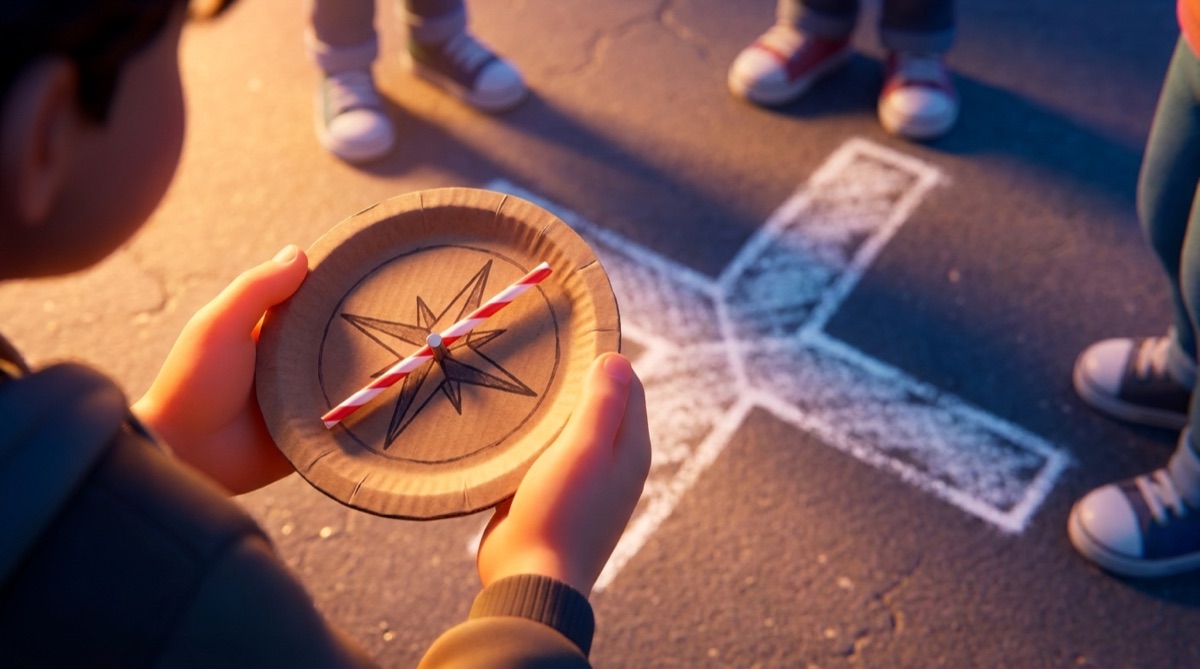
Sailors and explorers use a drawing shaped like a star. It is called a compass rose. It has four points, one for each cardinal direction:
| Point | Name | Letter |
|---|---|---|
| Top | North | N |
| Right | East | E |
| Bottom | South | S |
| Left | West | W |
On maps, north is almost always at the top. If you place the compass rose with the N pointing to the real north, the map is “set right” and you can follow it.
Quarter turns and half turns
Stand facing north.
- Turn a quarter turn to the right. Now you are facing east.
- Turn another quarter to the right. Now you are facing south.
- Two quarter turns make a half turn: your back is now toward where you started.
- Turn two more quarters. You are back to north! You made a full turn.
The right angle
Between north and east there is a quarter turn. That turn forms a right angle.
Look for right angles in the classroom:
- The corner of a notebook page.
- The corner of the door.
- The edge of the table with its leg.
Fold a sheet of paper twice, in half and then in half again. The corner left in the center is a right angle: your very own quarter-turn measurer!
Watch the Sun in the simulator

In Explorer mode, the landscape faces north: east is on the right.
- Press Morning. Which side is the Sun on?
- Press Afternoon. And now?
- Move the time slider: does the Sun cross the sky from right to left, or the other way around?
It’s daytime!
Activity: compass rose and orientation game
You need: a paper plate, a drinking straw or popsicle stick, a brass fastener (or a push pin with an eraser), markers and chalk.
Part 1: the compass rose
- Fold the plate in half and then in half again. Open it: the folds form a cross with four right angles.
- Write N at the top, E on the right, S at the bottom and W on the left.
- Attach the straw in the center with the fastener, so it can spin. This is your needle.
Part 2: the game in the schoolyard
- With the help of the morning Sun, find east together. Draw a big cross on the ground with chalk and mark N, E, S, W.
- Everyone stands in the center facing north.
- The teacher gives orders and everyone turns:
- “A quarter turn to the right.” Which way are you facing?
- “A half turn.” And now?
- “A quarter turn to the left.”
- Then, in pairs: one hides an object and gives clues. “From the tree, walk 5 steps south and then 3 steps east.”
Final question: in which cardinal direction is the school door? And your house?
Exercises
- It is morning and the Sun is on your left. Which way are you facing?
Show solution
South. In the morning the Sun is in the east; if east is on your left, west is on your right, north is behind you and you are facing south.
- You face east and make a half turn. Which way are you facing now?
Show solution
West, the opposite side. A half turn is two quarter turns: east → south → west.
- You face north. You make a quarter turn to the left. Which way are you facing?
Show solution
West. Turning left, the order is: north → west → south → east.
- Laura walks 4 steps north and then 4 steps south. Where does she end up?
Show solution
In the same spot where she started. North and south are opposite directions: 4 steps that way and 4 steps back.
- How many quarter turns do you need to make a full turn? And how many right angles does the cross of the compass rose have?
Show solution
Four quarter turns: ¼ + ¼ + ¼ + ¼ = 1. The cross has four right angles, one between each pair of cardinal directions.
✦ Mini-quiz
Remember
- The Sun rises in the east and sets in the west.
- With our right arm pointing east, we face north and south is behind us.
- The compass rose has N at the top, E on the right, S at the bottom and W on the left.
- Two quarter turns are a half turn; four quarters are a full turn.
- A quarter turn forms a right angle.
🍎 Teacher guide
- Time
- 2 sessions of 55 min (the second one in the morning, in the schoolyard)
- Colombian national standard (MEN)
- Mathematics, Grades 1 to 3 (MEN, 2006): 'I develop skills to relate direction, distance and position in space'; 'I recognize and apply translations and turns to a figure'; 'I represent the surrounding space to establish spatial relationships'. Natural Sciences, Grades 1 to 3: 'I record the movement of the Sun, the Moon and the stars in the sky over a period of time'; 'I observe my surroundings'.
- Evidence of learning
- The student finds east using the morning Sun and, with their arms, names the other three cardinal directions; builds their compass rose; performs and describes quarter turns and half turns to the right and to the left; follows an instruction such as '5 steps south and 3 east'.
Materials
- Paper plates, straws, brass fasteners and markers
- Chalk for the cross in the schoolyard
- Ribbon or wristband for the right hand
- Sheets of paper to fold the right angle
- Compass or phone with a compass app (optional, to check)
- Computer or tablet with the simulator (optional)
Suggested sequence
Session 1. In the classroom (55 min). Opening question: “how does a pilot know which way to go?” Building the compass rose (Part 1), the right angle with the folded sheet and the turning game inside the classroom with the wristband on the right hand. Simulator in Explorer mode: the Sun appears on the right (east) in the morning and on the left (west) in the afternoon.
Session 2. In the schoolyard, in the morning (55 min). Finding east with the Sun, drawing the cross and marking N, E, S, W; turning orders (Part 2) and treasure hunt with steps and cardinal directions. Closing: each pair says in which cardinal direction the school door lies. Individual mini-quiz.
For Grade 3. Add the intermediate points (northeast, southeast, southwest, northwest) as “eighth turns” and draw a map of the school with the compass rose.
Common mistakes
- The Sun rises on the east side, but not always at the exact same point. In Colombia the sunrise point shifts north or south of east, by at most about 23½° over the year. For this activity, "the side where it rises" is enough.
- Noon is no good for finding directions in Colombia. The noon Sun passes almost straight overhead, and its shadow sometimes points north and sometimes south depending on the date. Use sunrise or sunset.
- Teaching "north is up" as a truth about the world: it is only a map convention. In the schoolyard, north is in front of you when your right arm points east.
- Children of this age still mix up left and right. A ribbon or wristband on the right hand helps a lot during the game.
- If you check with a phone compass, remember it points to magnetic north: in Bogotá that is about 9° to the left (west) of true north. For this age the difference is small, but do not expect it to match the cross in the schoolyard exactly.