Simulators
Each simulator shows the mathematical model that governs it. Open it from one of its lessons to use it in context.
-
SecondaryHigher
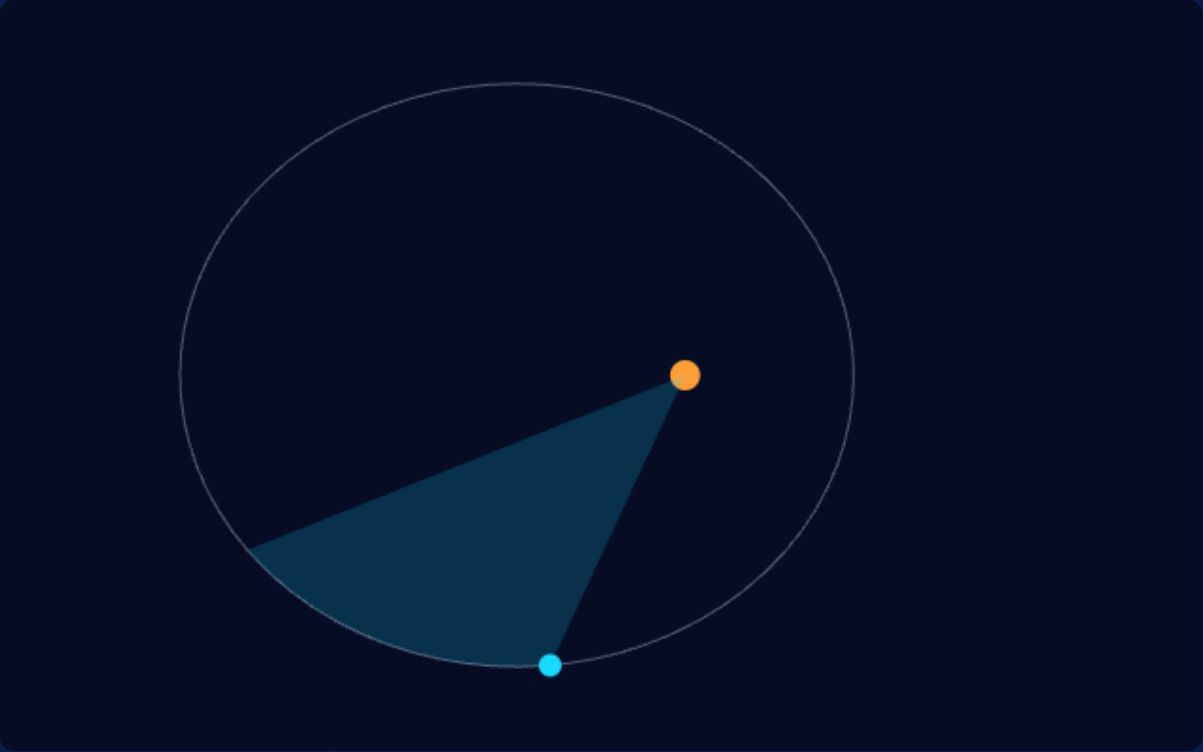
Keplerian orbit
A planet in an elliptical orbit: adjust a and e, watch the law of areas and the vis-viva equation.
Use it in: Velocity, acceleration and derivatives · Simulating an orbit with the Euler method · Kepler's three laws · Universal gravitation and satellites · Weighing the Sun and the planets · Kepler's equation and its numerical solution · Orbital elements and state ↔ elements conversion · Perturbation theory and the oblateness of the Earth · The two-body problem · Hohmann transfers and gravity assists · Tycho and Kepler, or how eight minutes of arc changed the universe · Why don't satellites fall?
-
ElementarySecondary
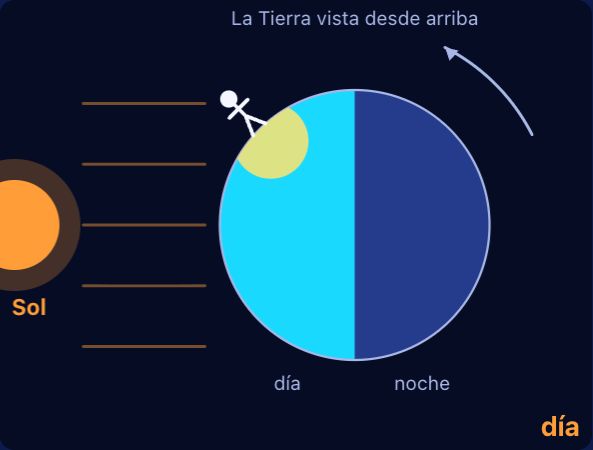
Day, night and the seasons
Explorer mode (the spinning Earth, day and night in Colombia, the shadow of a stick) and Scientist mode (orbit with the axis tilted 23.44°, hours of daylight through the year by latitude, altitude of the Sun at noon).
Use it in: The cardinal directions · The daytime sky · Watching the sky like scientists · The night sky · Day and night · Shadows and the sundial · Seasons and latitude · Length of the day and altitude of the Sun · “In summer we are closer to the Sun” · Why does Norway have days without night and nights without day?
-
ElementarySecondary
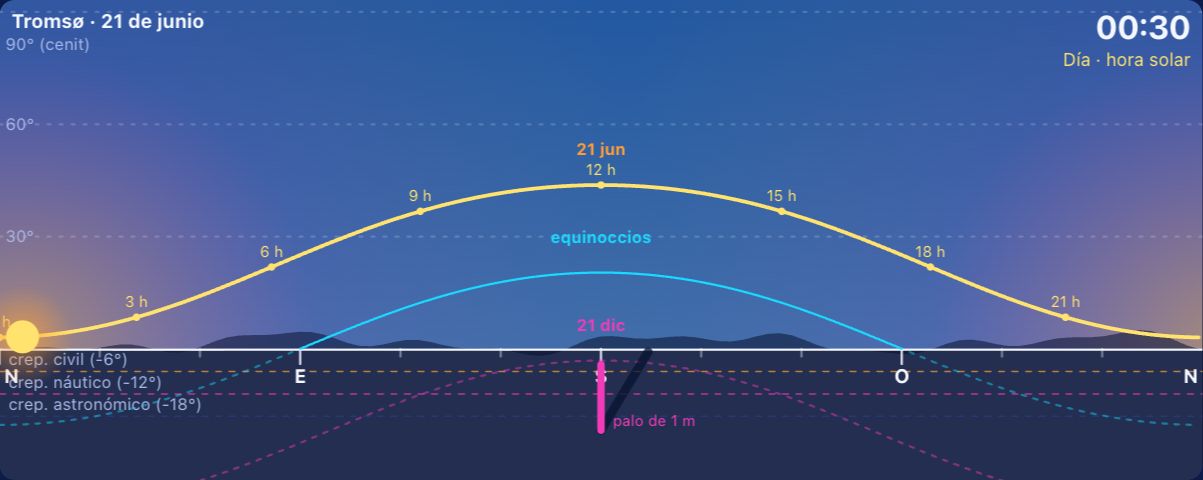
Seasons and the midnight sun: the Sun seen from Earth
360° panorama from the ground: the daily arc of the Sun (high in summer, low in winter, a full circle without setting under the midnight sun or without rising in the polar night), the color of the sky through civil, nautical and astronomical twilight, the shadow of a stick and solar time; a map of the year (days × hours) with the periods of midnight sun and polar night, and a globe with the tilted axis and the terminator. Presets from Bogotá to the poles (Tromsø, Longyearbyen, McMurdo…).
Use it in: Seasons and latitude · Length of the day and altitude of the Sun · “In summer we are closer to the Sun” · Why does Norway have days without night and nights without day?
-
ElementarySecondary
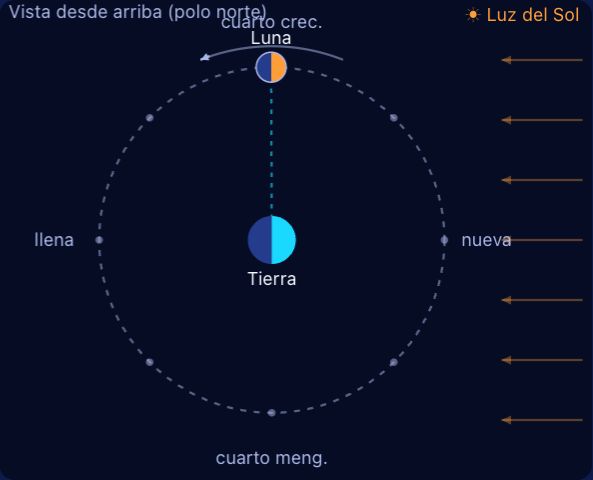
Phases of the Moon
Sun–Earth–Moon geometry seen from above and from Earth (northern or southern hemisphere); the real phase for any date, and the latitude of the Moon to understand eclipses.
Use it in: The phases of the Moon · The lunar calendar · Eclipses · Phases of the Moon and eclipses · Tides · Aristarchus: Earth–Moon–Sun distances · The sky in November 2026
-
ElementarySecondary
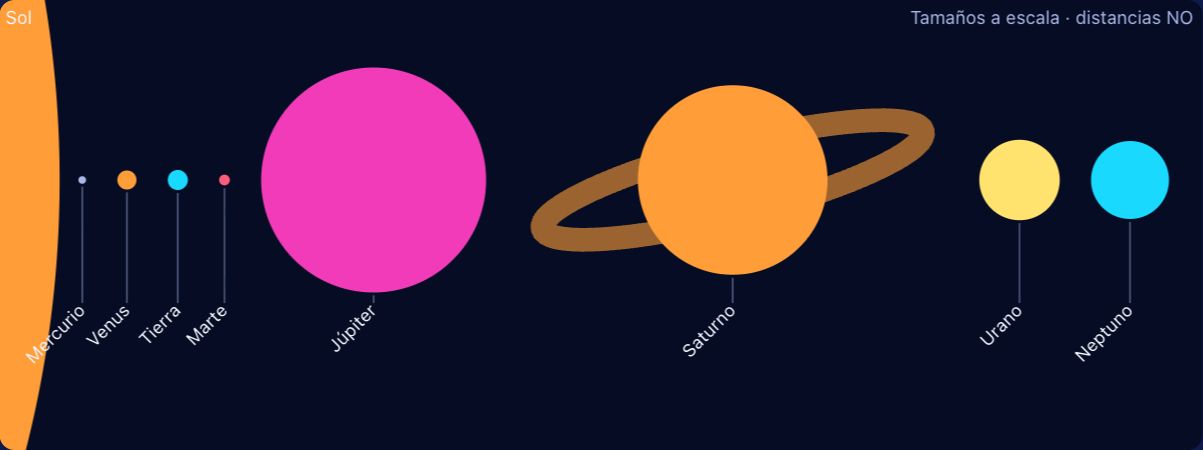
The Solar System to scale
Real sizes of the planets, distances with logarithmic zoom and a “light rocket” (×1, ×60, ×3600), a schoolyard model with everyday objects, and your weight and age on other worlds.
Use it in: Rocky planets and giant planets · The Solar System to scale · How much would you weigh on Mars? · Light takes time to arrive · Big numbers · Brightness and distance: the inverse-square law · The speed of light and the light-year · Scientific notation and distances in the universe · Astronomical unit, light-year and parsec
-
Secondary
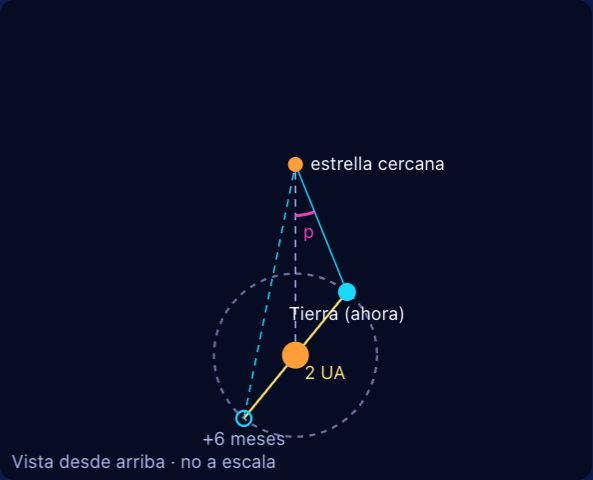
Stellar parallax
Top view of the Earth–Sun–star triangle and the telescope view: the nearby star traces its parallax ellipse against the fixed background; distance, ecliptic latitude, exaggeration and measurability with the naked eye, Hipparcos and Gaia.
Use it in: Stellar magnitudes and the first idea of a logarithm · Parallax and trigonometry
-
ElementarySecondary
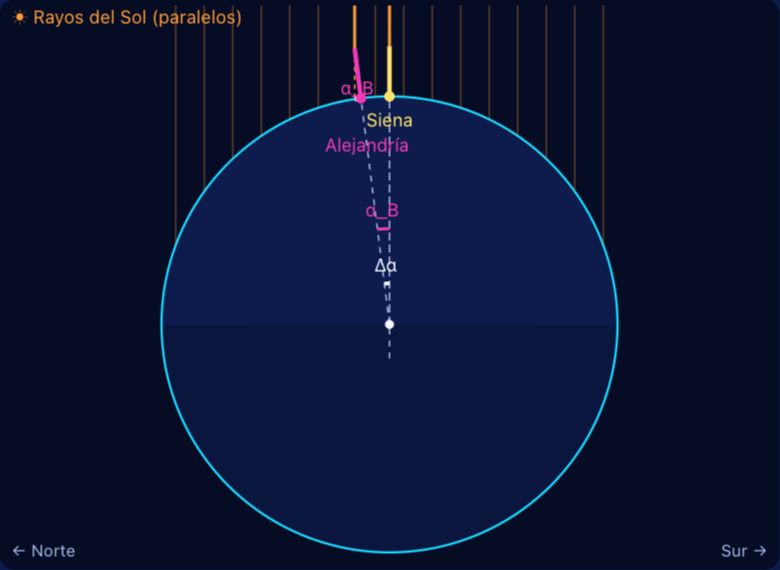
Eratosthenes measures the Earth
Parallel rays, two gnomons and alternate interior angles: the radius of the Earth from the shadows in two cities (Syene–Alexandria or Bogotá–Santa Marta), with stadia and percent error.
Use it in: Eratosthenes and the size of Earth · Eratosthenes measures the Earth · Angles, parallel lines and shadows · How Eratosthenes measured the Earth with a stick and a shadow
-
ElementarySecondaryHigher
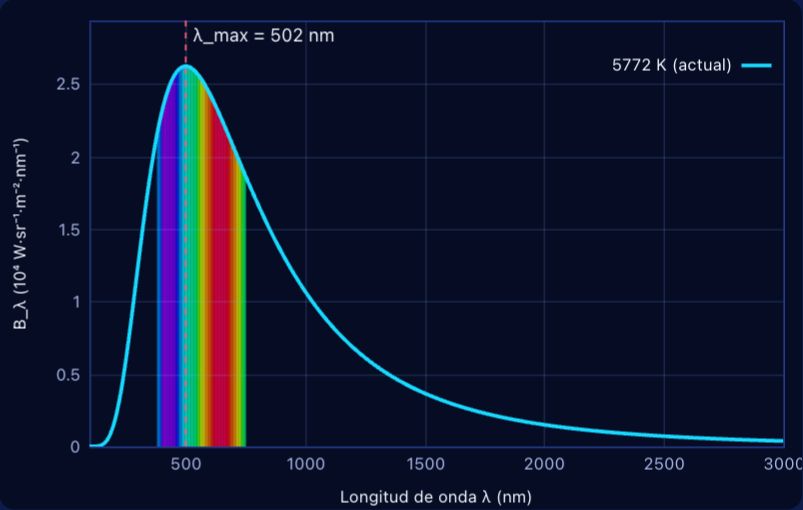
Blackbody spectrum
Planck curves, Wien’s law, sRGB color of stars, B−V index and luminosity L = 4πR²σT⁴.
Use it in: Stars and constellations · The lives of stars · The H–R diagram · The blackbody and the color of the stars · Spectra and the Doppler effect · Radiative and convective transport · Cosmic microwave background and primordial nucleosynthesis · Why are there no green stars?
-
SecondaryHigher
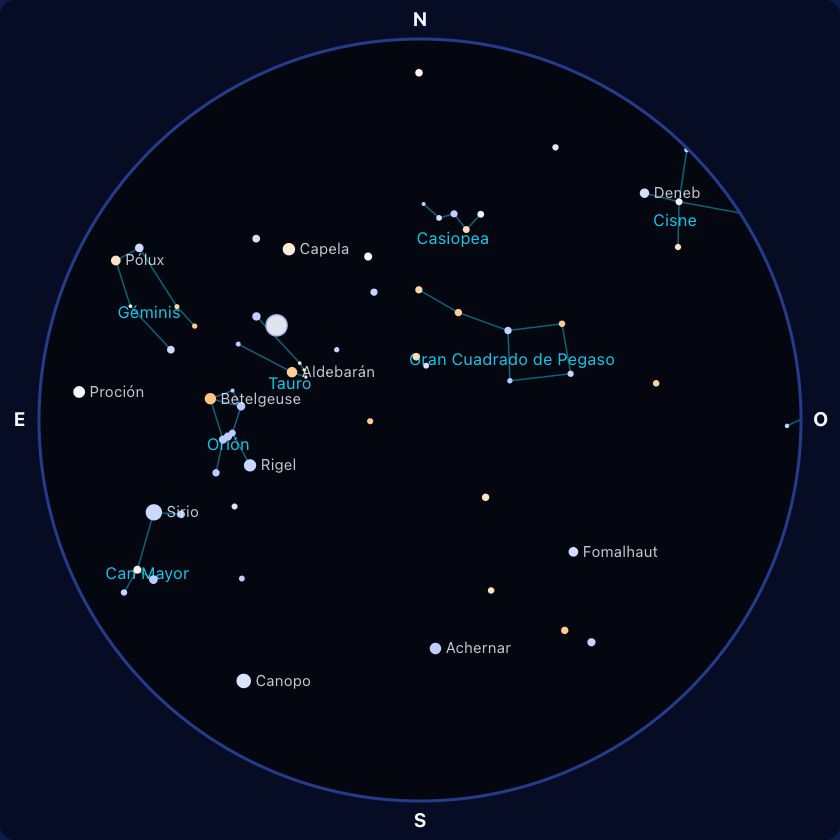
Interactive planisphere
The sky visible from any place and time: 140 bright stars with their color, constellations, Sun and Moon, in stereographic projection (zenith at the center, east on the left).
Use it in: Polaris and the Southern Cross · Celestial coordinates · Solar time and sidereal time · Spherical trigonometry and celestial coordinates · Precession, nutation, aberration and refraction · Time scales · The sky in November 2026
-
ElementarySecondaryHigher
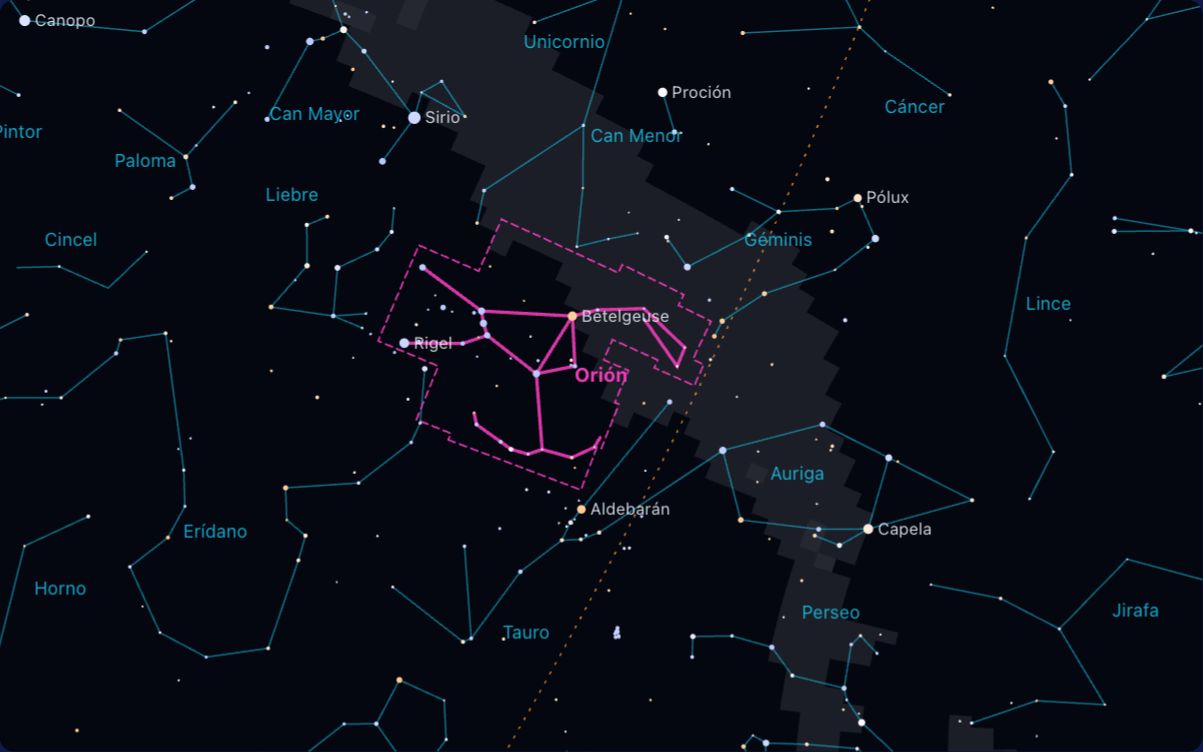
Planetarium: the 88 constellations
Dome of the sky from any place and time (drag to look around) or the full disk: ≈ 5000 stars down to V = 6 with their color, figures and IAU boundaries of the 88 constellations, ecliptic and zodiac signs, celestial equator, Milky Way, Sun and Moon. Search for a constellation to highlight it and learn when it rises, culminates and sets; animate one night or the whole year at the same time each night.
-
SecondaryHigher
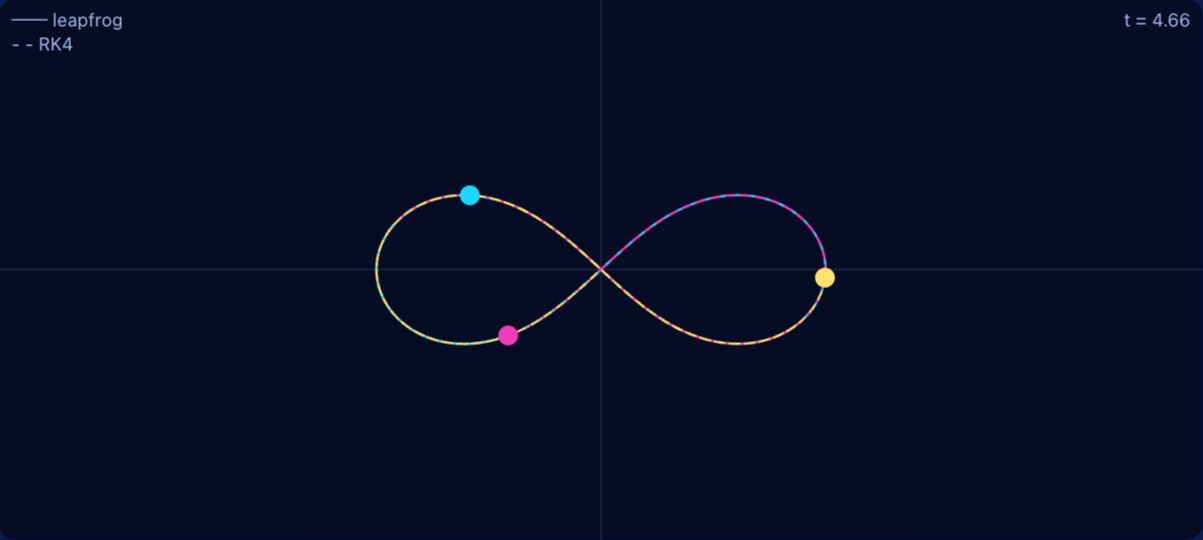
N bodies: integrators and chaos
RK4 versus symplectic leapfrog on an eccentric two-body orbit, the figure-eight and the Pythagorean problem; energy error on a log scale and divergence of neighboring trajectories (Lyapunov).
Use it in: Simulating an orbit with the Euler method · Collisionless Boltzmann equation, Jeans equations and the virial theorem · Symplectic integrators and chaos in the N-body problem · Large-scale N-body and the Barnes–Hut tree · Runge–Kutta and adaptive step size · Resonances and chaos
-
Higher
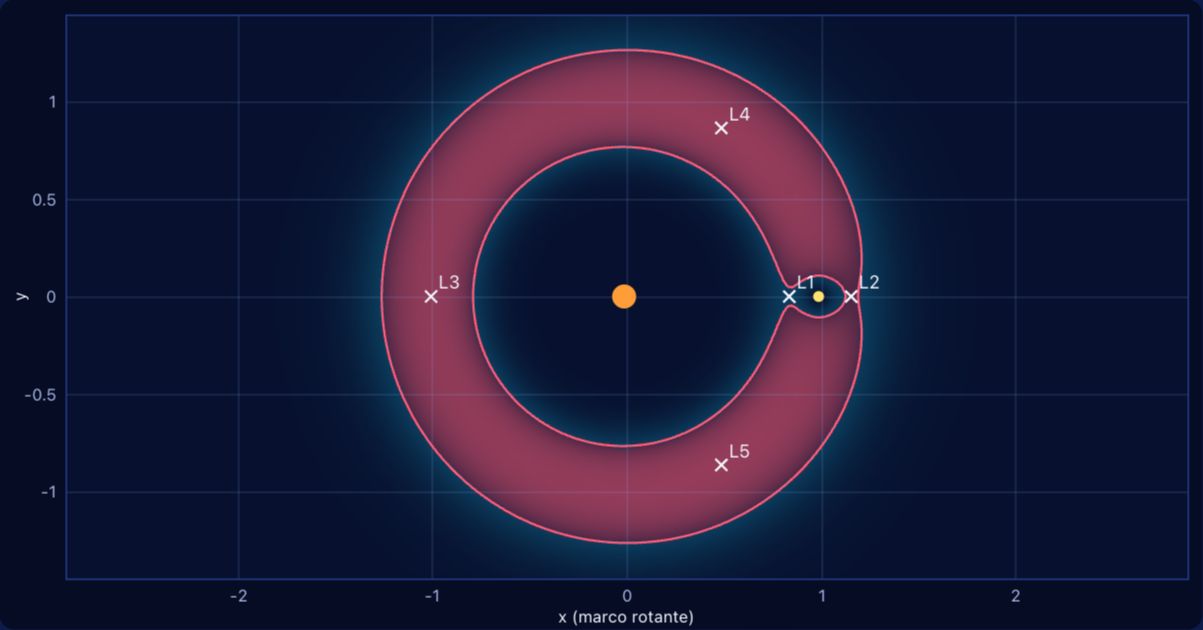
Lagrange points (restricted three-body problem)
Rotating frame of the circular restricted problem: zero-velocity curves, L1–L5, test particles with RK4 and Trojan orbits.
Use it in: The restricted three-body problem and the Lagrange points
-
Higher
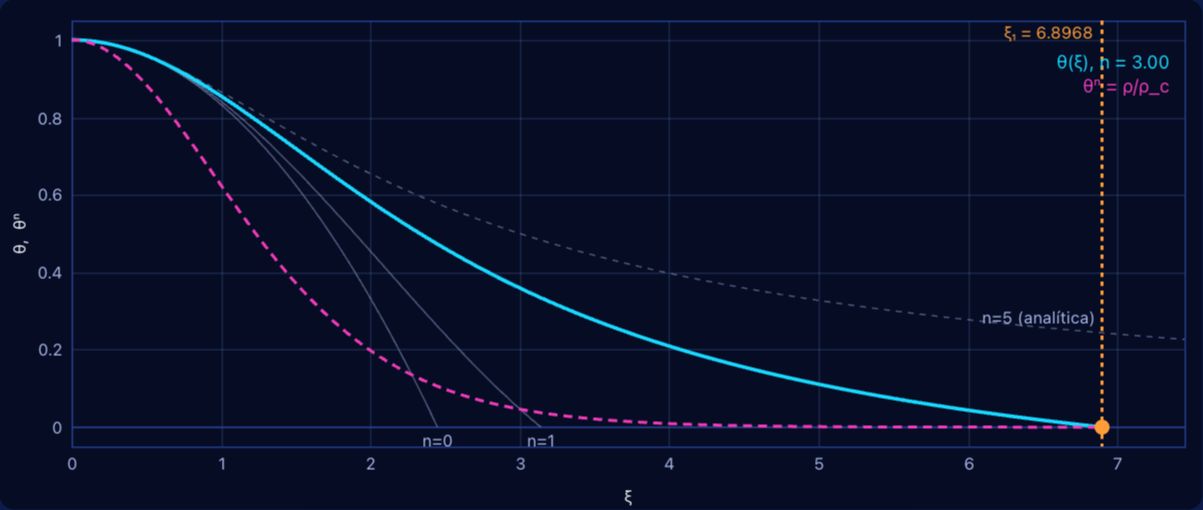
Stellar structure: Lane–Emden
Polytropes of index n: θ(ξ), density profile θⁿ, dimensionless radius ξ₁, concentration ρ_c/ρ̄ and the Sun modeled as a polytrope.
Use it in: The equations of stellar structure · Polytropes and the Lane–Emden equation · Radiative and convective transport · The Chandrasekhar limit
-
SecondaryHigher
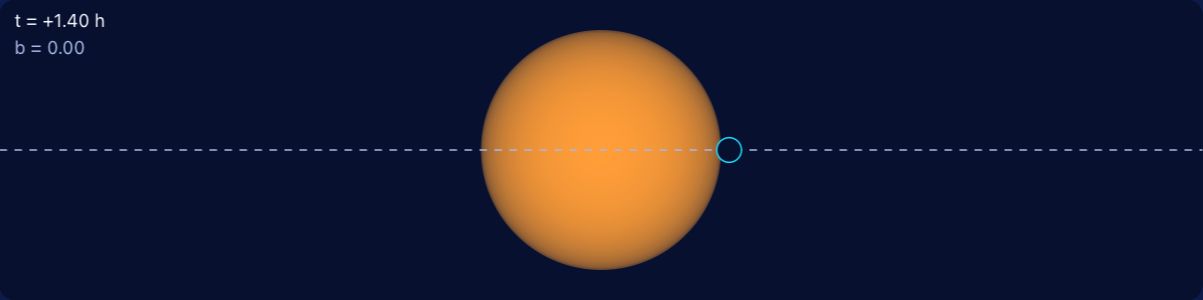
Light curve of a transit
A planet crossing a star with limb darkening and a real-time light curve with noisy synthetic data: depth, T₁₄, T₂₃, impact parameter, stellar density and S/N.
Use it in: Hunting exoplanets with transits · Transits and light curves · The radial-velocity method
-
Higher
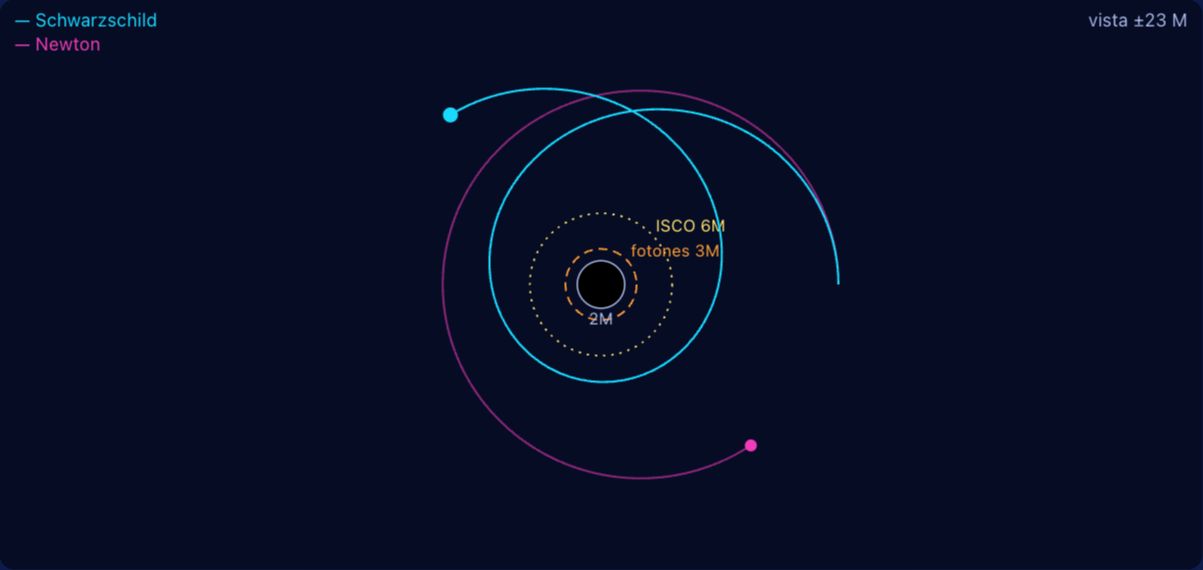
Orbits around a black hole
Schwarzschild geodesics: rosette periastron precession, ISCO, capture, and deflection and capture of light (b_c = 3√3 M).
Use it in: Schwarzschild geodesics: orbits and light around a black hole · Deflection of light and gravitational lenses · The precession of Mercury's perihelion
-
SecondaryHigher
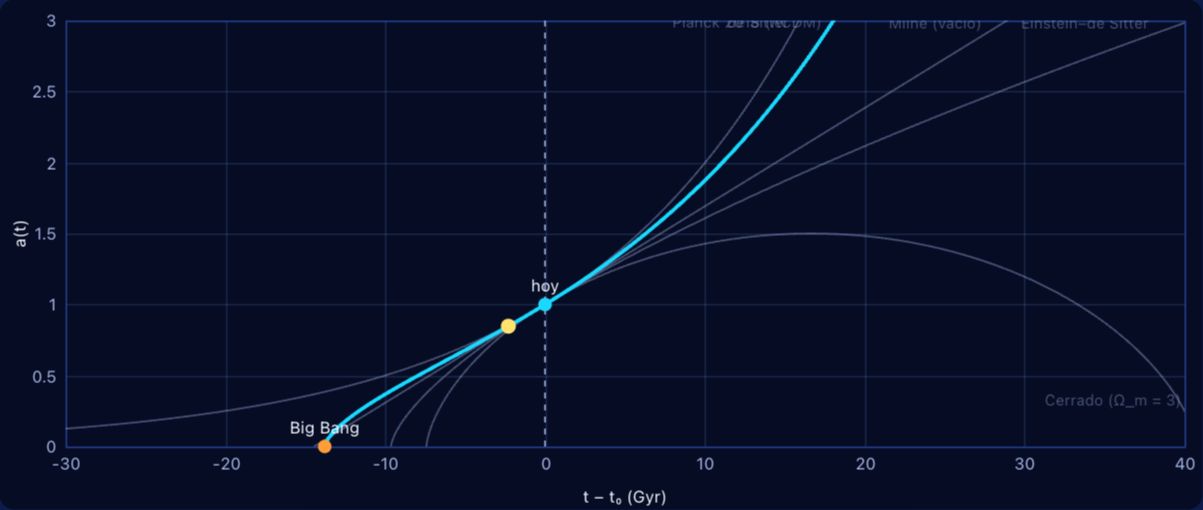
Expansion of the universe
a(t) for different Ω_m, Ω_Λ and H₀ (past and future): Big Bang, recollapse or bounce; interactive (Ω_m, Ω_Λ) plane; age, q₀ and curvature.
Use it in: The universe is expanding · The Friedmann equations · Cosmological distances · Cosmic inflation · Why is the sky dark at night?
-
SecondaryHigher
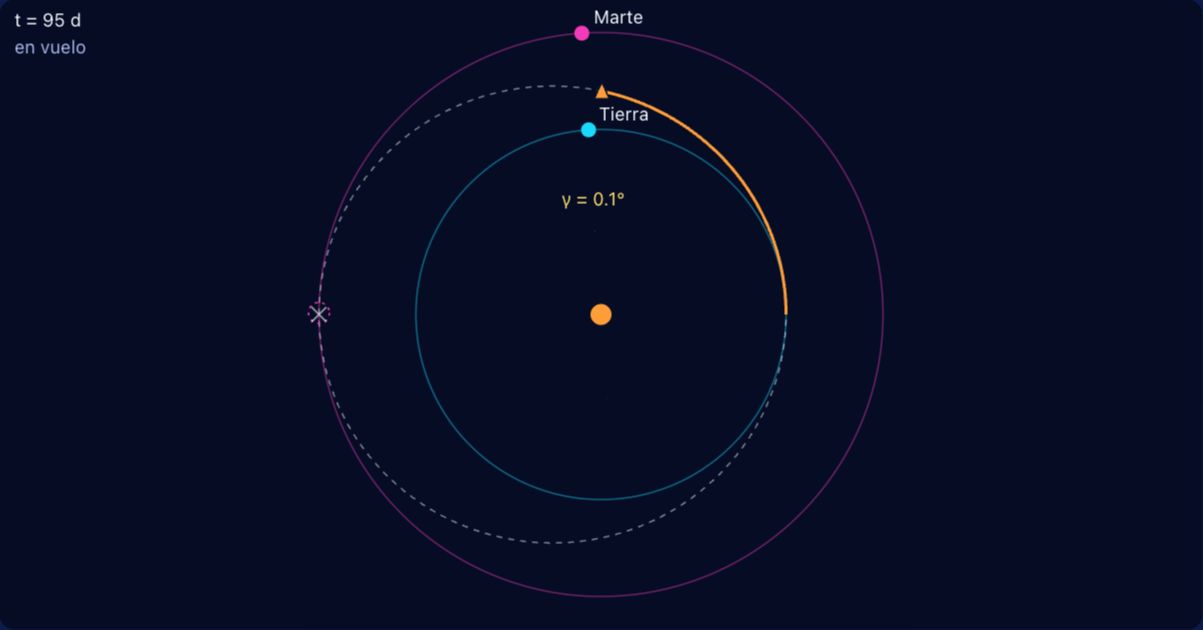
Mission to Mars: Hohmann transfer
Animated heliocentric view of a trip Earth → Venus, Mars, Jupiter… along the Hohmann ellipse: choose the departure phase angle and check whether the spacecraft meets the planet; Δv₁, Δv₂, time of flight, synodic period, C3 and Δv from LEO; university mode with bi-elliptic transfer and capture.
Use it in: Universal gravitation and satellites · Hohmann transfers and gravity assists
-
SecondaryHigher
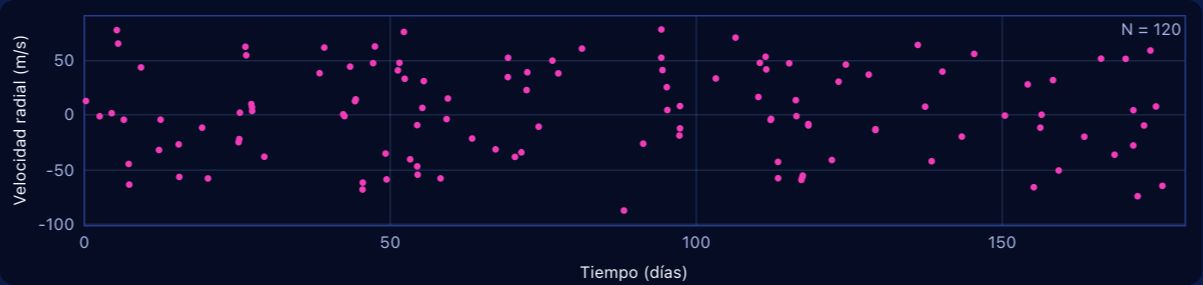
Periodogram: hunting periods in irregular data
A variable star (Cepheid, RR Lyrae) or an exoplanet by radial velocity with irregular observations (only at night, with gaps): Lomb–Scargle periodogram with the 1 % FAP line, daily aliases and spectral window, and the curve folded in phase with the detected period or the one you choose.
Use it in: Hunting exoplanets with transits · Lomb–Scargle periodograms
-
SecondaryHigher
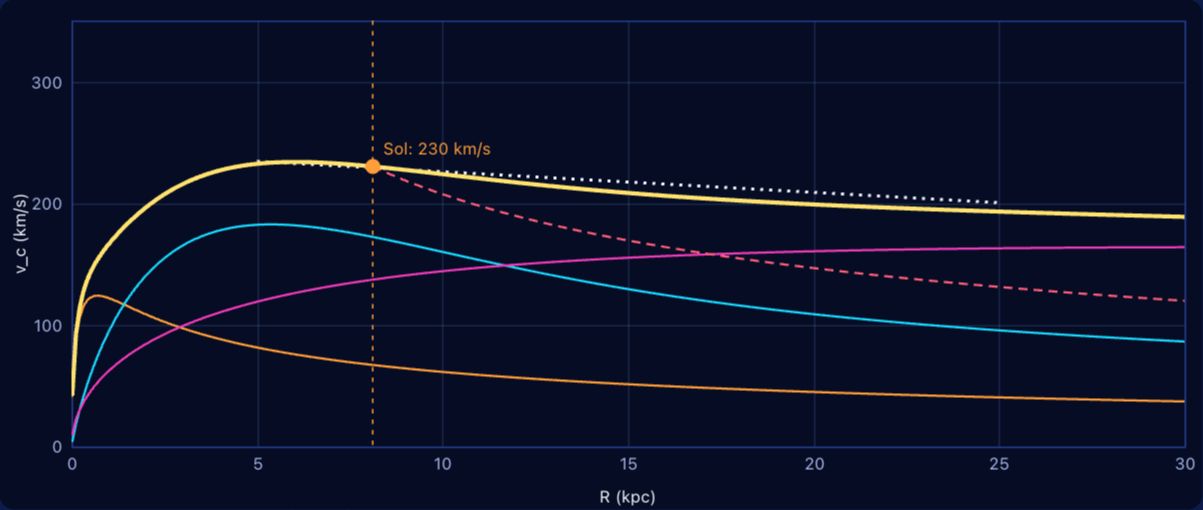
Galactic rotation curve
Circular velocity of the Milky Way by component (Hernquist bulge, exponential disk, NFW halo) versus the Keplerian fall-off and the fit of Eilers et al. (2019); dynamical mass inside the Sun’s orbit and top view with differential rotation.
Use it in: The Milky Way and other galaxies · Rotation curves and dark matter · Vera Rubin and the galaxies that spin too fast
-
ElementarySecondary
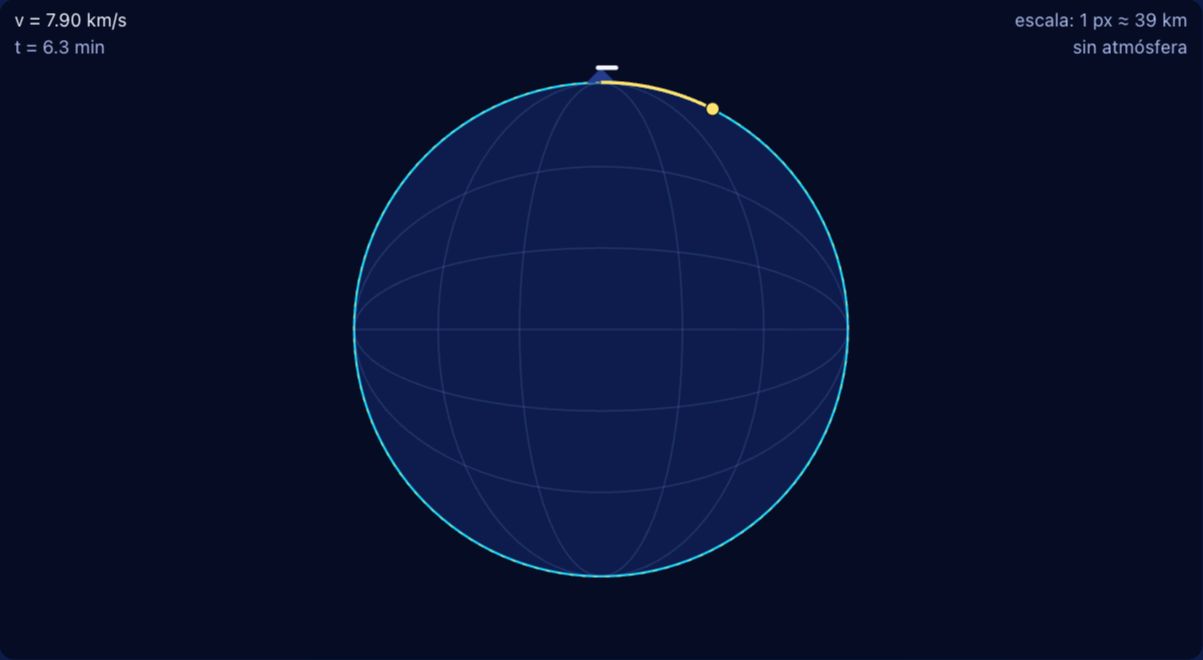
Newton’s cannonball
A cannon on a very tall mountain fires horizontally at the speed you choose: the ball falls (how many km away?), orbits (period, perigee and apogee) or escapes. Trajectories integrated with real Newtonian gravity, trails of the previous shots and the altitude of the Space Station (period ≈ 92 min).
Use it in: Universal gravitation and satellites · Why don't satellites fall?
-
SecondaryHigher
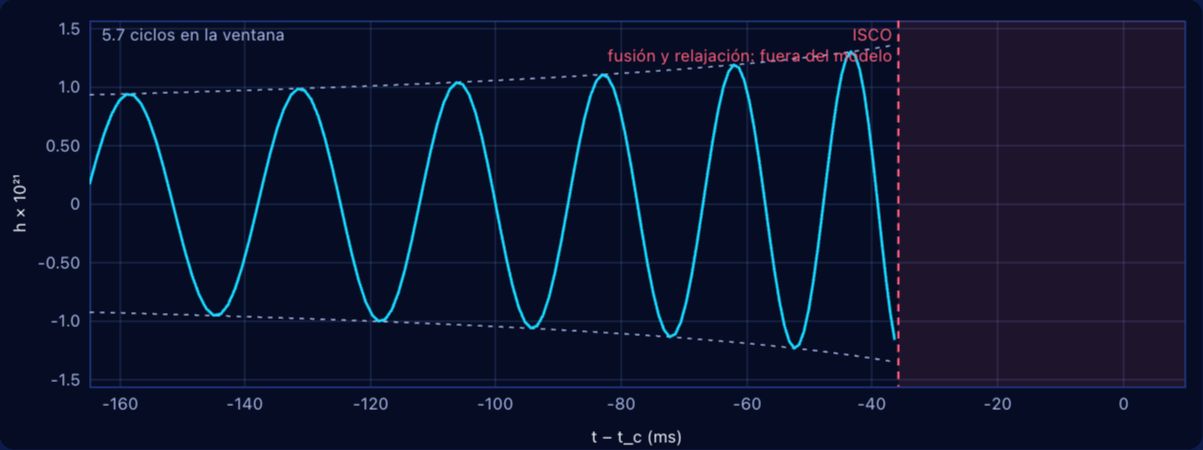
Gravitational-wave chirp
Inspiraling compact binary (GW150914, GW151226, GW170817 or custom): quasi-Newtonian waveform h(t) up to f_ISCO, frequency f(t), chirp mass, time to merger and amplitude; you can listen to the chirp.
Use it in: Gravitational waves: from the quadrupole to GW150914
-
SecondaryHigher
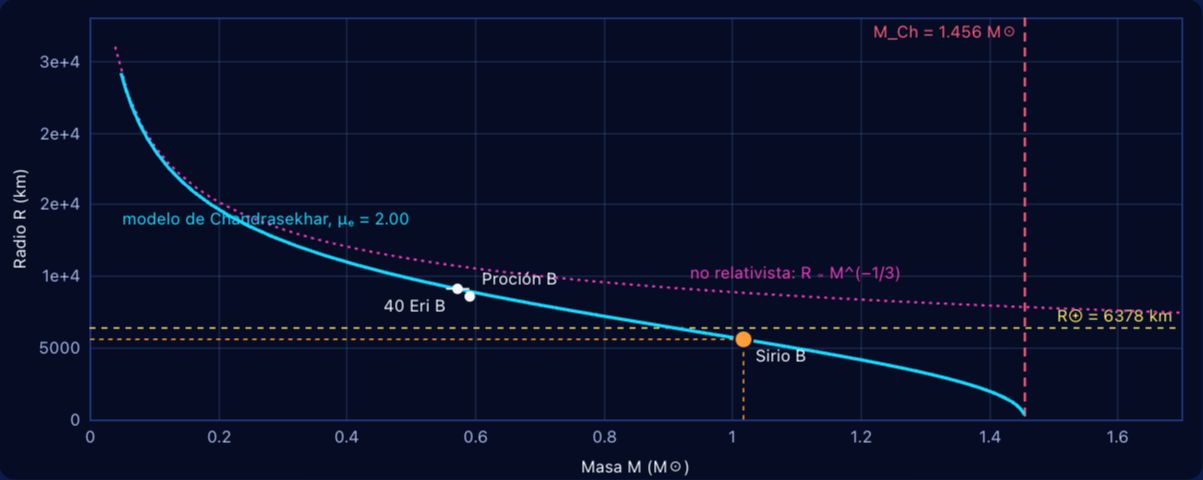
White dwarfs: mass, radius and the Chandrasekhar limit
Mass–radius curve of the Chandrasekhar model (degenerate electron gas with the exact equation of state) versus the non-relativistic branch R ∝ M^(−1/3) and the limit M_Ch = 5.83 μₑ⁻² M☉; choose the central density and the composition (C/O or Fe), look at the density profile and compare with Sirius B, Procyon B and 40 Eri B.
Use it in: The lives of stars · The Chandrasekhar limit
-
Higher
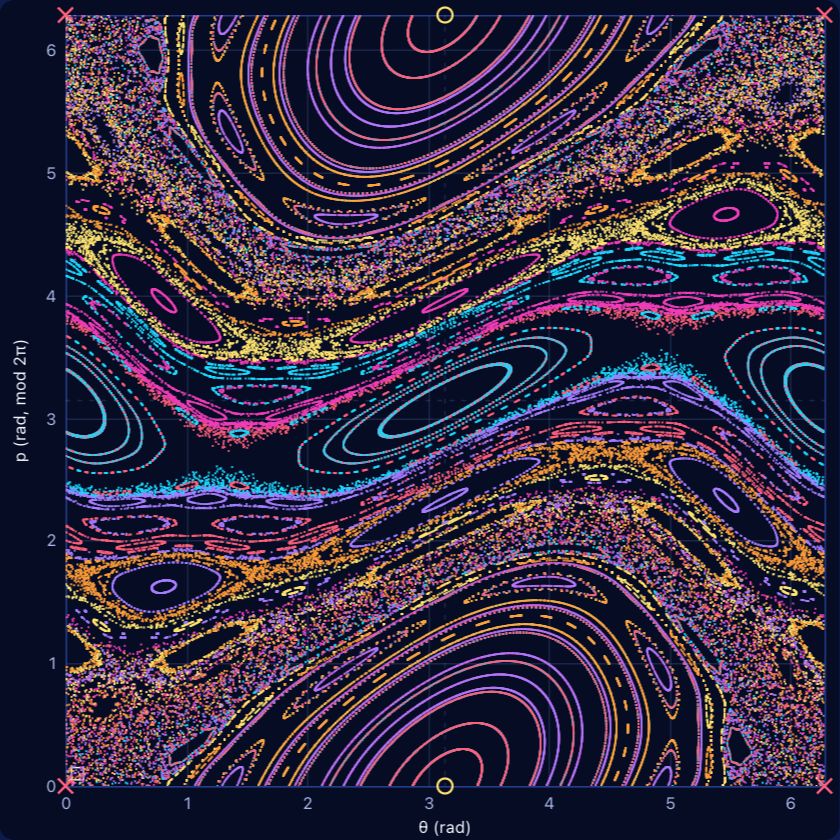
Chirikov standard map: Hamiltonian chaos
Phase portrait of the kicked rotor on the torus: click to launch orbits, fill the torus with a grid and vary K to see how the KAM tori break up (K_g = 0.9716, Greene 1979) and the resonances overlap (Chirikov criterion); diffusion panel ⟨(p − p₀)²⟩ versus n. Connection with mean-motion resonances and the Kirkwood gaps.
Use it in: Resonances and chaos