Teacher guides in PDF
All the portal's material to plan your astronomy classes, grade by grade, ready to print.
Each guide gathers, for one grade, what is already on the portal: the overview of the year, every lesson with its teacher guide (Colombian national standard, MEN, quoted verbatim), the activities, the exercises with solutions, the mini-quizzes with the correct answers and the grade's project sheet with its rubric. The online lessons add the interactive simulators.
- Select the guides you need and leave us your details.
- You receive an e-mail with one download link per guide.
- Download the PDF (the link is personal and valid for 30 days).
Request your guides
Want to bring the Astronomy Olympiad to your school? Select the “Olympiad: guide for schools” guide (letter to the principal, schedule, logistics, forms) or read it online.
One guide per grade
-
 Preschool · 5 years old
Preschool
“Why is there day and night?”
- 📘 3 lessons
- ✏️ 13 solved exercises
- ✦ 14 questions with answers
- 🧪 project with rubric
See the contents
- Unit 1: The daytime sky — The daytime sky
- Unit 2: The nighttime sky — The night sky
- Unit 3: The Earth spins — Day and night
- Mathematics (MEN): Counting to 20, Time sequences (before / after), Comparing sizes (big / small), Sorting by color and shape
- Project: Day and Night Mural (3 weeks)
- See the grade online →
-
 Grade 1 · 6 years old
Grade 1
“Which way does the Sun move during the day?”
- 📘 3 lessons
- ✏️ 15 solved exercises
- ✦ 15 questions with answers
- 🧪 project with rubric
See the contents
- Unit 1: Day and night — Day and night
- Unit 2: Shadows — Shadows and the sundial
- Unit 3: Watching the sky — Watching the sky like scientists
- Mathematics (MEN): Numbers to 100, Measuring with non-standard units (steps, strings), Tally tables, Patterns and sequences
- Project: The Stick's Shadow (4 weeks)
- See the grade online →
-
 Grade 2 · 7 years old
Grade 2
“Why does the Moon change shape?”
- 📘 4 lessons
- ✏️ 19 solved exercises
- ✦ 19 questions with answers
- 🧪 project with rubric
See the contents
- Unit 1: Finding our way with the Sun — The cardinal directions
- Unit 2: The sundial — Shadows and the sundial
- Unit 3: The Moon and its phases — The phases of the Moon; The lunar calendar
- Mathematics (MEN): Simple fractions (½, ¼), Quarter and half turns, Bar charts, Measuring time (days, weeks)
- Project: Moon Diary (5 weeks)
- See the grade online →
-
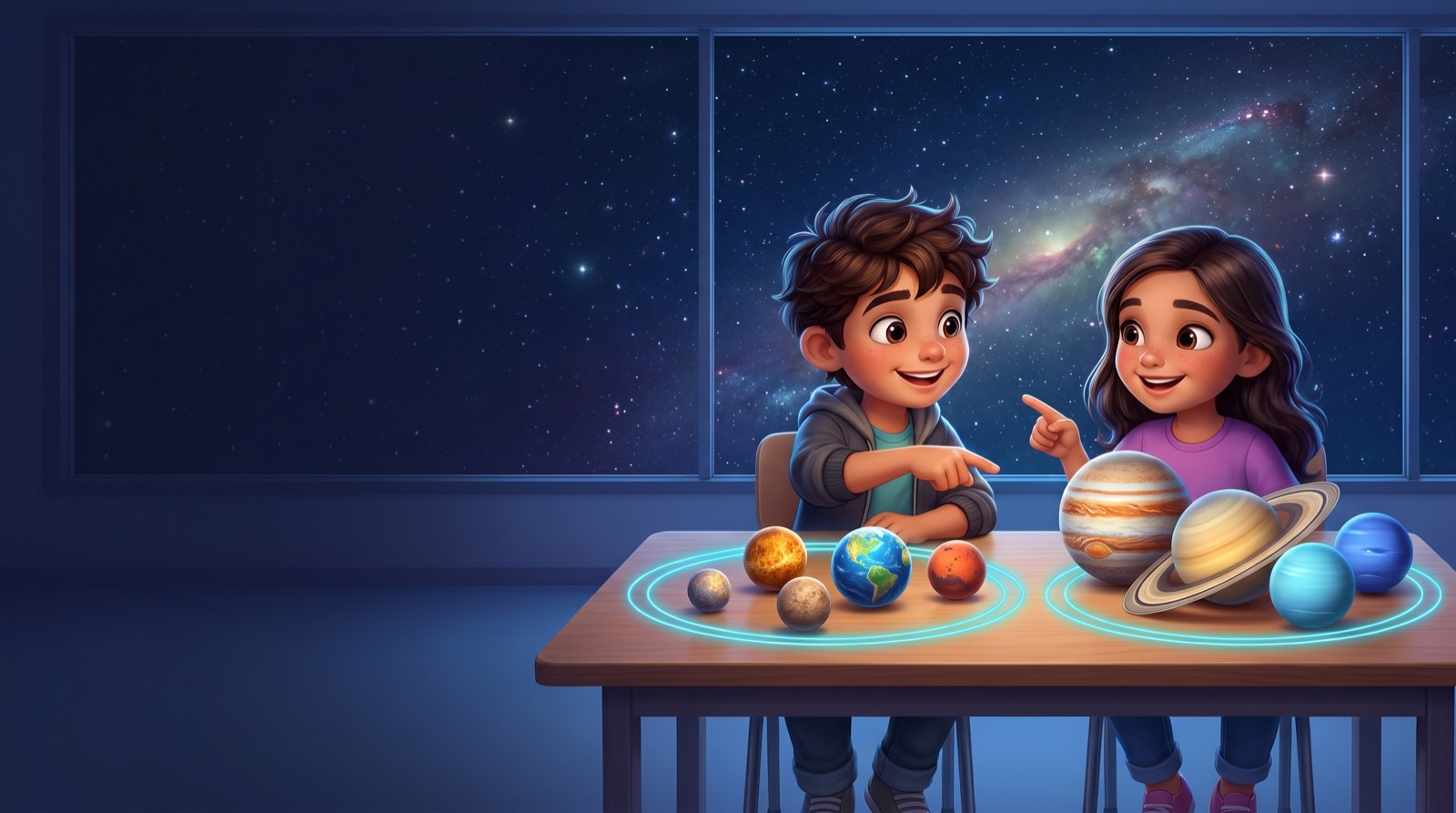 Grade 3 · 8 years old
Grade 3
“Are all the planets like Earth?”
- 📘 6 lessons
- ✏️ 29 solved exercises
- ✦ 30 questions with answers
- 🧪 project with rubric
See the contents
- Unit 1: The Moon, our neighbor — The phases of the Moon; Eclipses
- Unit 2: The planets — Rocky planets and giant planets
- Unit 3: Big numbers — Big numbers
- Mathematics (MEN): Numbers to 10 000 and place value, Ordering and comparing, Two-way tables, Classification
- Project: Planet Trading Cards (4 weeks)
- See the grade online →
-
 Grade 4 · 9 years old
Grade 4
“How big is the Solar System?”
- 📘 6 lessons
- ✏️ 30 solved exercises
- ✦ 32 questions with answers
- 🧪 project with rubric
See the contents
- Unit 1: The Solar System to scale — The Solar System to scale
- Unit 2: Mass and weight — How much would you weigh on Mars?
- Unit 3: Seasons and latitude — Seasons and latitude
- Mathematics (MEN): Proportionality (rule of three), Multiplication and division, Simple decimals, Scales and maps
- Project: The Solar System on the Sports Court (4 weeks)
- See the grade online →
-
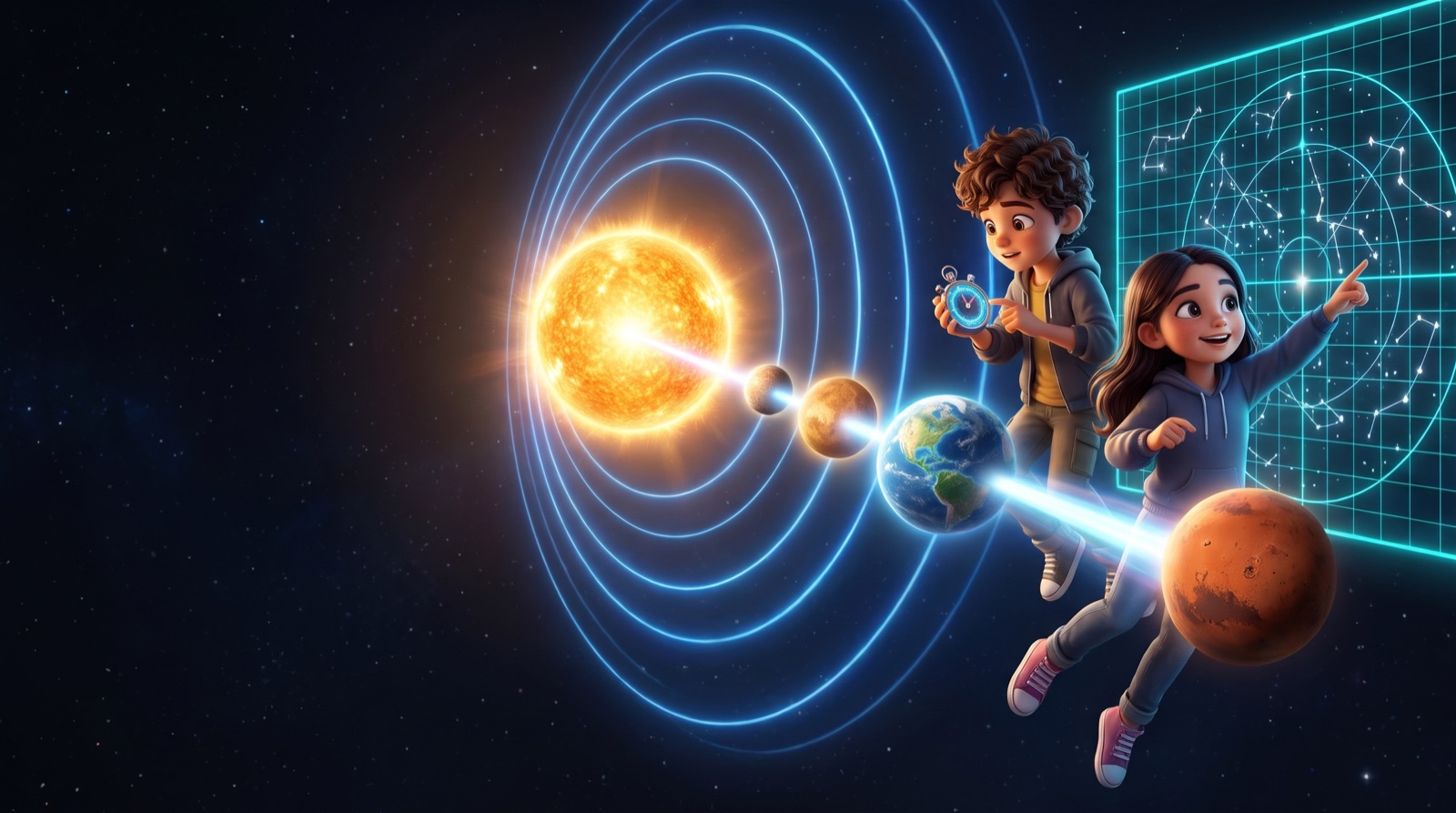 Grade 5 · 10 years old
Grade 5
“How long does light take to arrive from the stars?”
- 📘 5 lessons
- ✏️ 25 solved exercises
- ✦ 28 questions with answers
- 🧪 project with rubric
See the contents
- Unit 1: The speed of light — Light takes time to arrive
- Unit 2: Gravity on other worlds — How much would you weigh on Mars?
- Unit 3: Stars and constellations — Stars and constellations; Polaris and the Southern Cross
- Mathematics (MEN): Division with large numbers, Converting units of time, Cartesian plane (first quadrant), Simple decimals and percentages
- Project: Star Chart of the Colombian Sky (4 weeks)
- See the grade online →
-
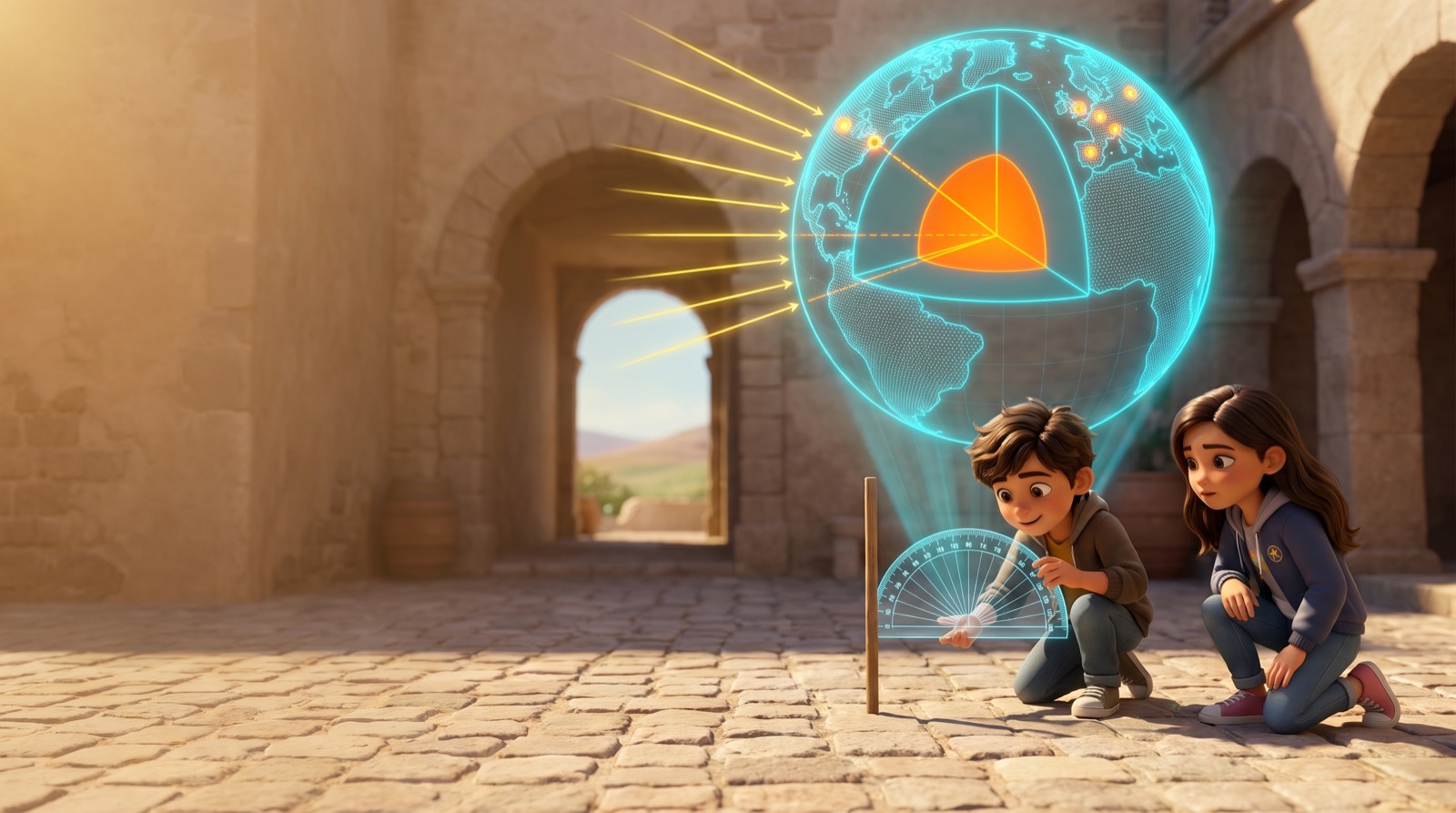 Grade 6 · 11 years old
Grade 6
“How can you measure the Earth without leaving it?”
- 📘 3 lessons
- ✏️ 27 solved exercises
- ✦ 16 questions with answers
- 🧪 project with rubric
See the contents
- Unit 1: Angles and parallel lines — Angles, parallel lines and shadows
- Unit 2: Eratosthenes — Eratosthenes measures the Earth
- Unit 3: Day, night and latitude — Length of the day and altitude of the Sun
- Mathematics (MEN): Angles and the protractor, Parallel lines and transversals, Direct proportionality, Circumference: C = 2πR
- Project: Measuring the Earth with Another School (6 weeks)
- See the grade online →
-
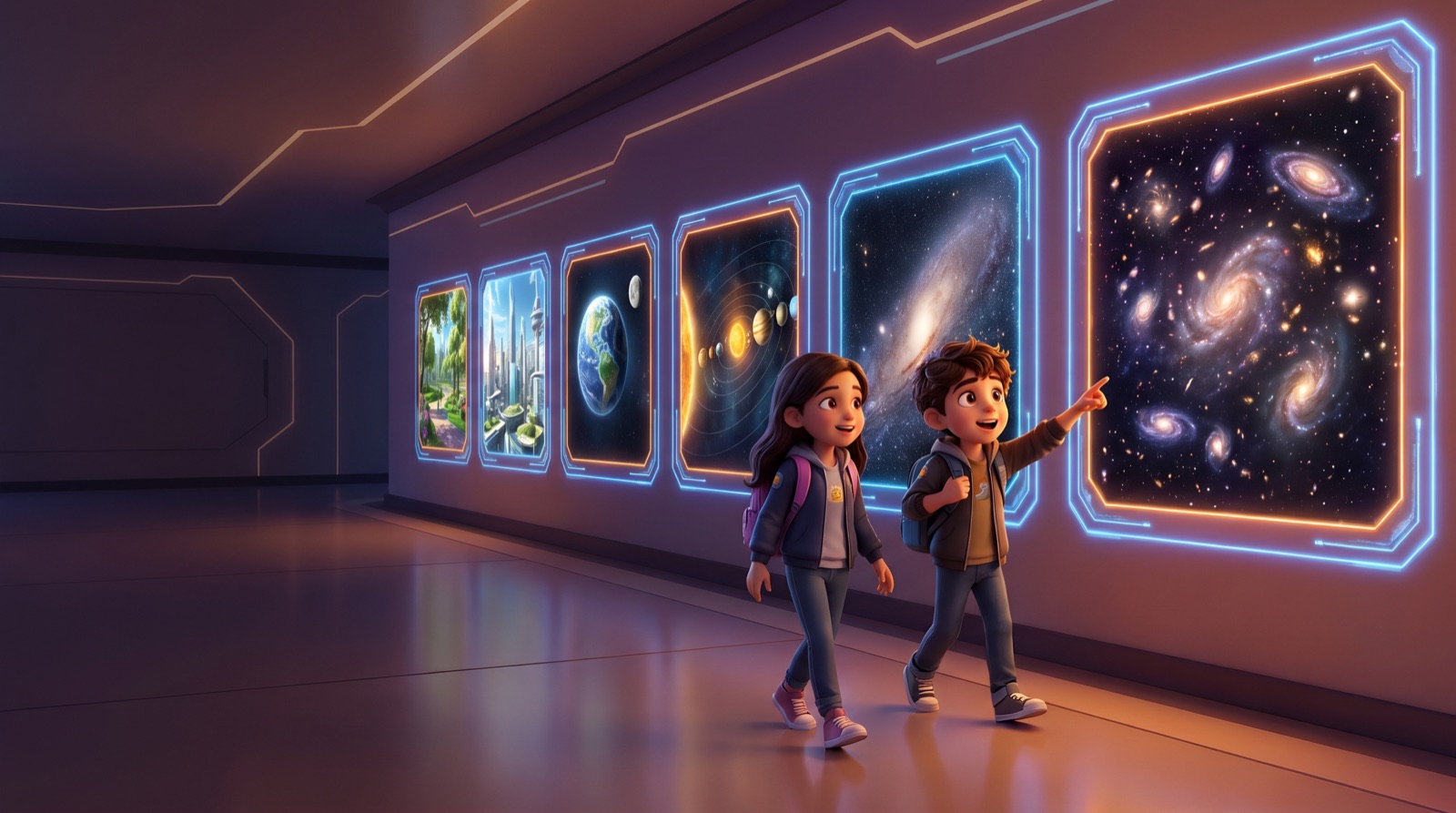 Grade 7 · 12 years old
Grade 7
“How do we write numbers as big as the universe?”
- 📘 3 lessons
- ✏️ 30 solved exercises
- ✦ 15 questions with answers
- 🧪 project with rubric
See the contents
- Unit 1: Powers of ten — Scientific notation and distances in the universe
- Unit 2: Astronomical units — Astronomical unit, light-year and parsec
- Unit 3: Eratosthenes with real data — Eratosthenes measures the Earth
- Mathematics (MEN): Powers and scientific notation, Integers and rational numbers, Unit conversion, Relative error and percentage
- Project: Powers-of-Ten Line in the Hallway (4 weeks)
- See the grade online →
-
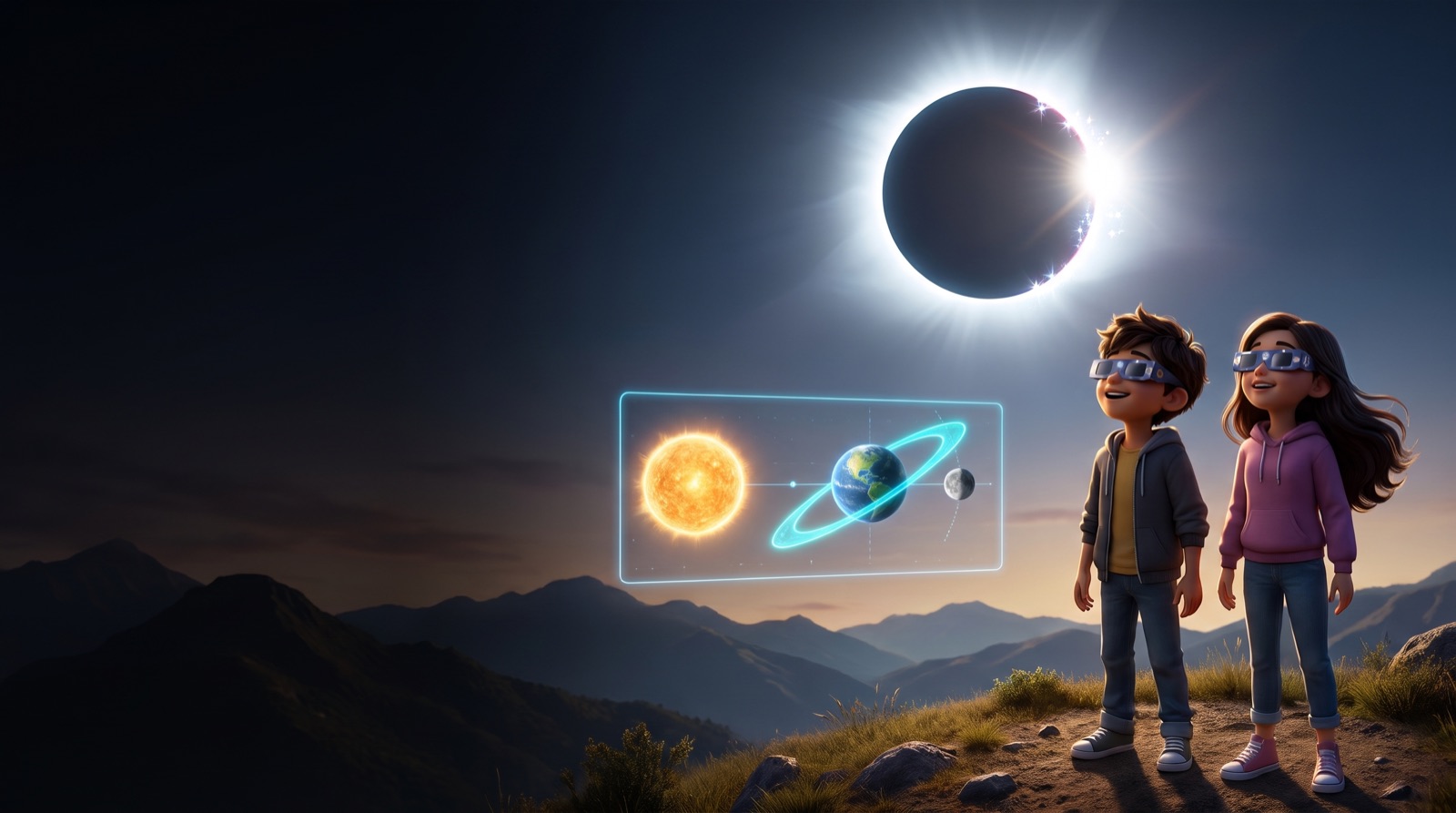 Grade 8 · 13 years old
Grade 8
“Why isn't there an eclipse every month?”
- 📘 4 lessons
- ✏️ 37 solved exercises
- ✦ 23 questions with answers
- 🧪 project with rubric
See the contents
- Unit 1: The speed of light — The speed of light and the light-year
- Unit 2: Phases and eclipses — Phases of the Moon and eclipses
- Unit 3: The celestial sphere — Celestial coordinates; Solar time and sidereal time
- Mathematics (MEN): Linear function and slope, First-degree equations, Geometry of the circle, Coordinate systems
- Project: Predicting and Verifying an Eclipse (5 weeks)
- See the grade online →
-
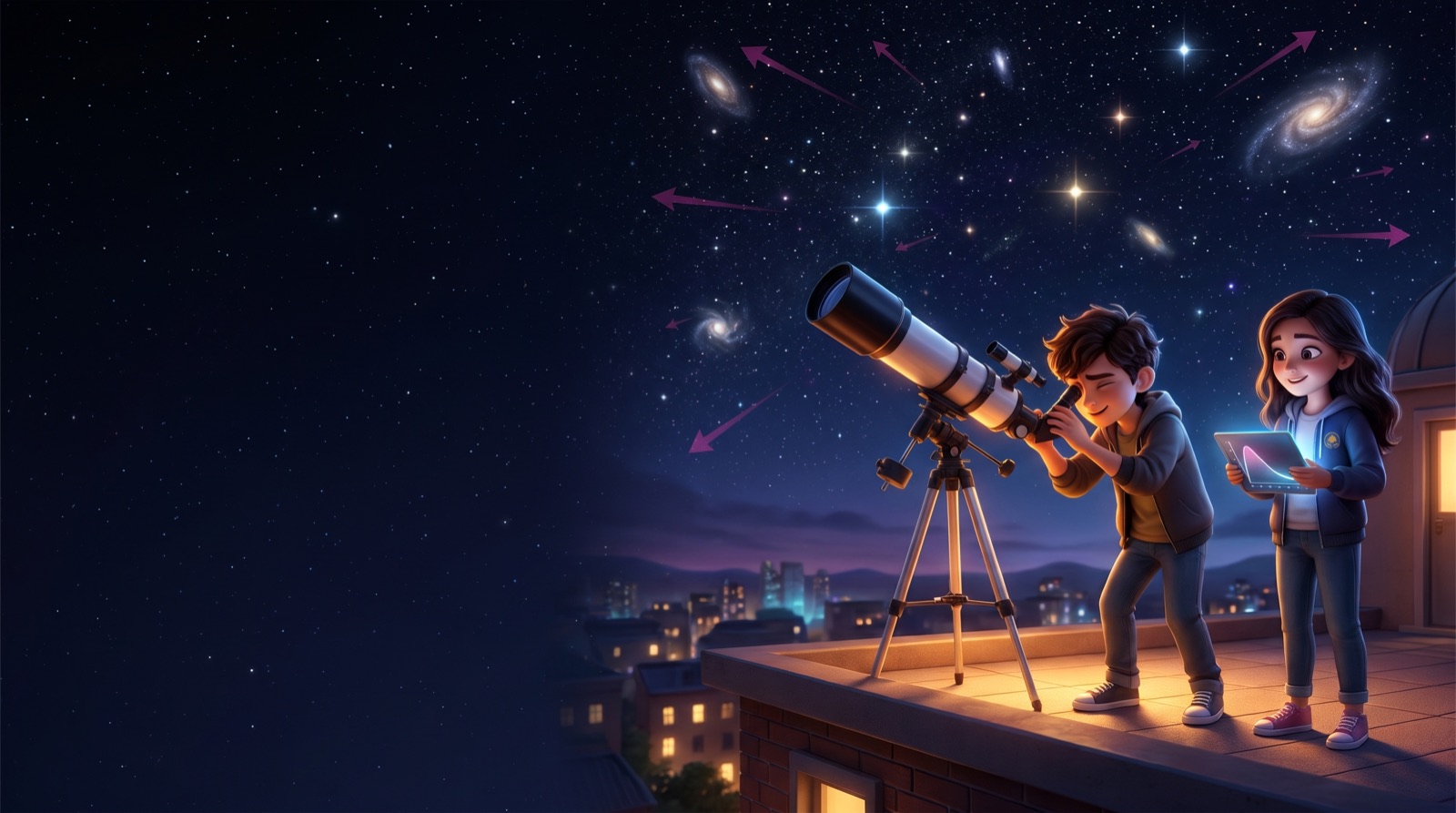 Grade 9 · 14 years old
Grade 9
“Why do distant stars look so faint?”
- 📘 8 lessons
- ✏️ 73 solved exercises
- ✦ 47 questions with answers
- 🧪 project with rubric
See the contents
- Unit 1: Brightness and distance — Brightness and distance: the inverse-square law
- Unit 2: Stellar magnitudes — Stellar magnitudes and the first idea of a logarithm
- Unit 3: The universe is expanding — The universe is expanding
- Mathematics (MEN): Power and exponential functions, Inverse proportionality, Linear regression, Introduction to the logarithm
- Project: The Age of the Universe with a Straight Line (4 weeks)
- See the grade online →
-
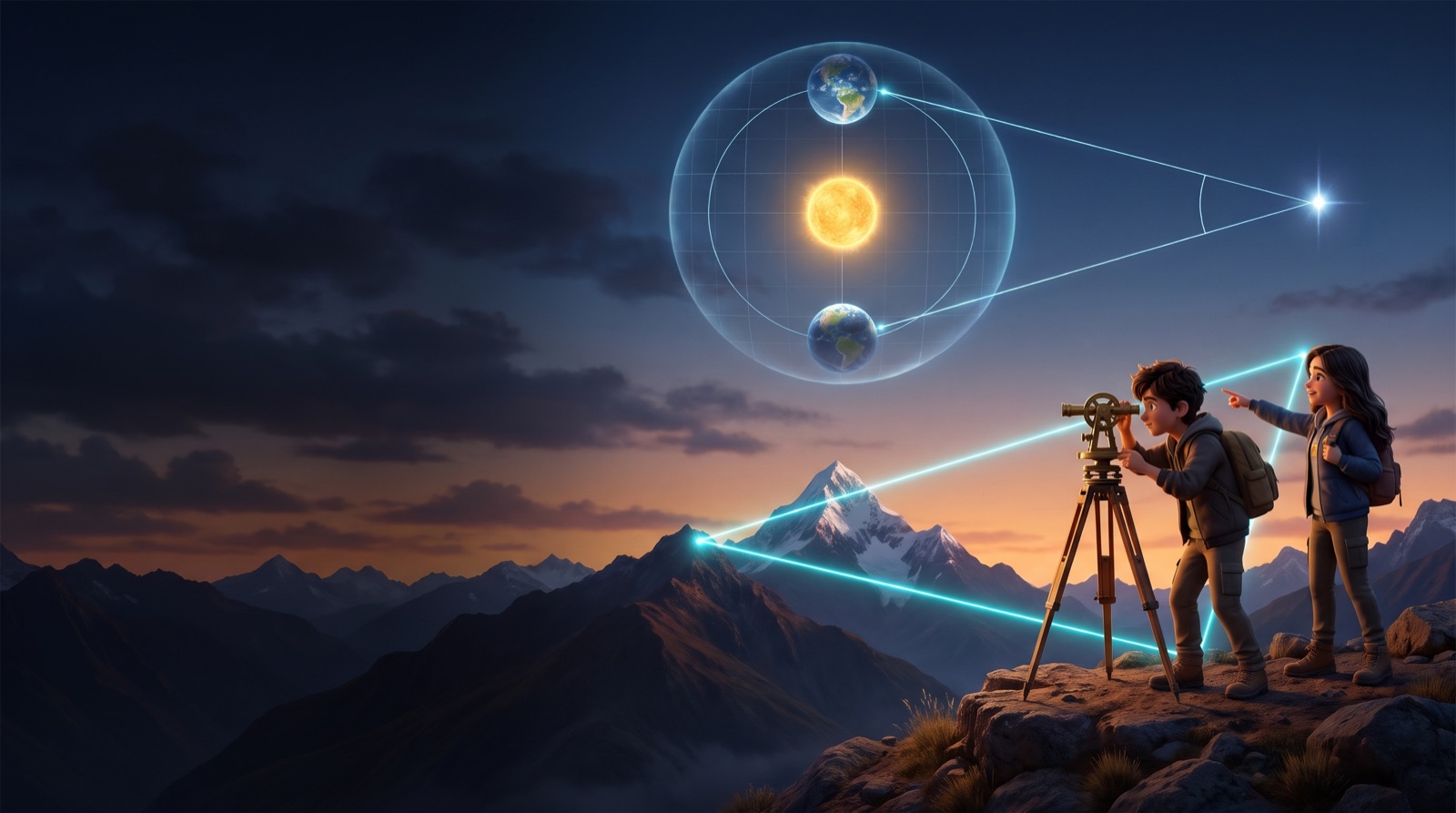 Grade 10 · 15 years old
Grade 10
“How do we measure the distance to the stars?”
- 📘 8 lessons
- ✏️ 70 solved exercises
- ✦ 45 questions with answers
- 🧪 project with rubric
See the contents
- Unit 1: Trigonometry and parallax — Parallax and trigonometry; Aristarchus: Earth–Moon–Sun distances
- Unit 2: Kepler's laws — Kepler's three laws; Weighing the Sun and the planets
- Unit 3: Gravitation — Universal gravitation and satellites; Tides
- Mathematics (MEN): Trigonometry, Conic sections, Powers and roots, Vectors in the plane
- Project: Triangulating a Hill: from a Baseline in the Playground to the Parallax of Proxima (4 weeks)
- See the grade online →
-
 Grade 11 · 16 years old
Grade 11
“How does a computer predict the motion of the planets?”
- 📘 5 lessons
- ✏️ 45 solved exercises
- ✦ 27 questions with answers
- 🧪 project with rubric
See the contents
- Unit 1: Calculus and motion — Velocity, acceleration and derivatives
- Unit 2: Simulating orbits — Simulating an orbit with the Euler method
- Unit 3: Starlight — The H–R diagram; The blackbody and the color of the stars
- Mathematics (MEN): Limits and derivatives, Exponential and logarithmic functions, Numerical methods, Modeling
- Project: The Earth's Orbit with Euler's Method (5 weeks)
- See the grade online →
Do you teach at a university? The higher-education lessons have their “Guide for the teacher” online: see the higher-education level. Questions or suggestions: use the support chat or write to soyleandrosilva@gmail.com. Personal data: privacy policy.