The 88 Constellations
The whole sky, with no gaps or overlaps, divided into 88 named regions: the figures we inherited from Mesopotamia and Greece, the ones 16th-century navigators drew in the southern sky, and the ones Lacaille invented with his scientific instruments.
Today a constellation is a region of the sky, not just a drawing. In 1922 the International Astronomical Union (IAU) adopted the official list of 88 constellations and their three-letter abbreviations, and in 1930 the Belgian astronomer Eugène Delporte published their boundaries: lines of constant right ascension and declination (for epoch 1875) that cover the whole celestial sphere. So every star, comet or nova lies in one constellation, and only one.
The lines that join the stars are not official: every atlas draws them its own way. And a named group of stars that is not a whole constellation is called an asterism: the Big Dipper (part of Ursa Major), Orion's Belt or the Summer Triangle (Vega, Deneb and Altair, from three different constellations).
Each page tells the constellation's history and mythology, shows its figure with its stars, gathers how other cultures see it (China, the Arab world, the Andean and Amazonian peoples, Polynesia…) and explains how to find it from Colombia. The stars and boundaries come from the Hipparcos and IAU catalogs (via d3-celestial, BSD-3).
Interactive planetarium
Locate any constellation from your city and your time, drag to look around, and animate a night or the whole year to see how the sky shifts by about 4 minutes every day.
The 88, one by one
88 constellations
-
Andromeda
Andromeda And
The chained princess of the Perseus myth. Home to the Andromeda Galaxy (M31), the most distant object visible to the naked eye.
722 °² Best in November
-
Antlia
the Air Pump Ant
Lacaille's vacuum pump: a faint southern constellation, with no legends, that honors the experimental physics of the 18th century.
239 °² Best in April
-
Apus
the Bird of Paradise Aps
The footless bird of the Dutch navigators, next to the south celestial pole. Faint, but with the star Paradys and two globular clusters.
206 °² Best in July
-
Aquarius
the Water Bearer Aqr
The water bearer of the zodiac, heir to the Babylonian god of the waters. It holds the nearest planetary nebula, the Helix, and the radiant of the Eta Aquariids.
980 °² Best in October
-
Aquila
the Eagle Aql
The eagle of Zeus, with Altair, one of the nearest and brightest stars, a vertex of the Summer Triangle and the hero of the legend of the cowherd and the weaver girl.
652 °² Best in August
-
Ara
the Altar Ara
The altar on which the gods swore to defeat the Titans. A small southern constellation on the Milky Way, with a very nearby globular cluster.
237 °² Best in July
-
Aries
the Ram Ari
The ram of the Golden Fleece. Small and unassuming, it gave its name to the vernal point, which precession has since shifted into Pisces.
441 °² Best in December
-
Auriga
the Charioteer Aur
The charioteer carrying a goat and her kids. Capella, its star, is the sixth brightest in the sky, and three Messier clusters adorn its pentagon.
657 °² Best in February
-
Boötes
the Herdsman Boo
The guardian of the Bear, with Arcturus, the brightest star in the northern celestial hemisphere and the namesake of the Polynesian canoe Hōkūleʻa.
907 °² Best in June
-
Caelum
the Chisel Cae
The engraver's burin, one of the smallest and faintest constellations, created by Lacaille in 1756 between Eridanus and Columba.
125 °² Best in January
-
Camelopardalis
the Giraffe Cam
A giraffe of faint stars that Plancius drew in 1612 in the gap between Ursa Major and Cassiopeia; home to Kemble's Cascade and the galaxy NGC 2403.
757 °² Best in February
-
Cancer
the Crab Cnc
The crab that bit Heracles: the faintest constellation of the zodiac, but with the Beehive (M44), one of the most beautiful naked-eye clusters.
506 °² Best in March
-
Canes Venatici
the Hunting Dogs CVn
Hevelius's two greyhounds beneath the tail of Ursa Major, with Cor Caroli and the Whirlpool Galaxy, the first spiral ever recognized.
465 °² Best in May
-
Canis Major
the Great Dog CMa
Orion's dog and its jewel, Sirius, the brightest star in the night sky, which set the Egyptian calendar and the “dog days” of the Greek summer.
380 °² Best in February
-
Canis Minor
the Lesser Dog CMi
Orion's little dog, reduced almost to a single star: Procyon, “the one before the dog”, a neighbor of the Sun and a vertex of the Winter Triangle.
183 °² Best in March
-
Capricornus
the Sea Goat Cap
The goat-fish of the Sumerians, turned by the Greeks into the god Pan. The smallest of the zodiac, and the place where Neptune was discovered in 1846.
414 °² Best in September
-
Carina
the Keel Car
The hull of the ship Argo, with Canopus, the second-brightest star in the sky, the Carina Nebula and the unstable Eta Carinae.
494 °² Best in March
-
Cassiopeia
Cassiopeia Cas
The vain queen, seated on her throne and circling the pole. Her W is unmistakable, and in it Tycho's supernova blazed in 1572.
598 °² Best in November
-
Centaurus
the Centaur Cen
The wise centaur Chiron, with Alpha Centauri, the star system nearest the Sun, and Omega Centauri, the largest globular cluster in the Milky Way.
1,060 °² Best in May
-
Cepheus
Cepheus Cep
The king of Ethiopia beside the north pole, with Delta Cephei, the star that gave Cepheids their name and the yardstick with which we measure the universe.
588 °² Best in October
-
Cetus
the Whale Cet
The sea monster that was going to devour Andromeda. Fourth largest constellation in the sky, home to Mira, the first variable star, and to Tau Ceti.
1,231 °² Best in November
-
Chamaeleon
the Chameleon Cha
The color-changing lizard, stalking the Fly next to the south pole. Small and faint, it hides a very nearby stellar nursery.
132 °² Best in April
-
Circinus
the Compasses Cir
Lacaille's Compasses: a tiny, faint constellation pressed against Alpha Centauri, which holds the active galaxy nearest the Milky Way.
93 °² Best in July
-
Columba
the Dove Col
Noah's Dove, drawn by Plancius in 1592 beneath Lepus, the Hare: a biblical figure with a runaway star and a distant globular cluster.
270 °² Best in February
-
Coma Berenices
Berenice's Hair Com
The hair of a queen of Egypt turned into a constellation by a court astronomer: a naked-eye star cluster and the window onto the Coma cluster of galaxies.
386 °² Best in May
-
Corona Australis
the Southern Crown CrA
Ptolemy's Southern Crown: an arc of faint stars below Sagittarius that hides one of the star factories nearest the Sun.
128 °² Best in August
-
Corona Borealis
the Northern Crown CrB
Ariadne's crown: a perfect semicircle of seven stars between Boötes and Hercules, home to two of the strangest variable stars in the sky.
179 °² Best in July
-
Corvus
the Crow Crv
Apollo's crow, a trapezoid of four stars next to Hydra, and the stage of the most famous galaxy collision in the sky: the Antennae.
184 °² Best in May
-
Crater
the Cup Crt
The cup of Apollo, resting on the back of Hydra: an ancient, faint constellation, but with a chalice shape that can be recognized under a dark sky.
282 °² Best in April
-
Crux
the Southern Cross Cru
The smallest constellation in the sky and the most famous of the southern hemisphere: four bright stars that point to the pole, the Coalsack and the Jewel Box.
68 °² Best in May
-
Cygnus
the Swan Cyg
The Swan flying along the Milky Way: the Northern Cross, Deneb, the first known black hole and the field of the Kepler mission.
804 °² Best in September
-
Delphinus
the Dolphin Del
The dolphin that saved the poet Arion: a small, sharp diamond next to Aquila, with two stars whose names are a joke in reverse.
189 °² Best in September
-
Dorado
the Dolphinfish Dor
The dolphinfish of the Dutch navigators, which drags behind it the Large Magellanic Cloud, the Tarantula Nebula and the site of the supernova of 1987.
179 °² Best in January
-
Draco
the Dragon Dra
The dragon that coils around the north pole: guardian of the golden apples, home of the ancient pole star Thuban and of the Cat's Eye Nebula.
1,083 °² Best in July
-
Equuleus
the Little Horse Equ
The Little Horse, attributed to Hipparchus: the second smallest constellation, just four faint stars next to the head of Pegasus.
72 °² Best in September
-
Eridanus
the River Eri
The celestial river that rises at the feet of Orion and ends at Achernar, with one of the most studied neighbors of the Sun and a gigantic cosmic void.
1,138 °² Best in December
-
Fornax
the Furnace For
Lacaille's chemical furnace: a constellation almost empty of stars that contains the Fornax galaxy cluster and the window of the Hubble Ultra Deep Field.
398 °² Best in December
-
Gemini
the Twins Gem
The twins Castor and Pollux, protectors of sailors: two bright stars of different colors, the cluster M35 and the radiant of the Geminids.
514 °² Best in February
-
Grus
the Crane Gru
The Crane of the Dutch navigators, formerly the tail of Piscis Austrinus: a clear figure with Alnair, two red giants and a quartet of galaxies.
366 °² Best in October
-
Hercules
Hercules Her
The kneeling hero, fifth constellation in size: the “Keystone”, the globular cluster M13 and the point toward which the Sun is traveling.
1,225 °² Best in July
-
Horologium
the Clock Hor
Lacaille's pendulum clock: a long, faint southern constellation with a globular cluster, a merging pair of galaxies and one of the first exoplanets.
249 °² Best in December
-
Hydra
the Water Snake Hya
The water snake, the largest of the 88: a hundred degrees of sky from the head next to Cancer to the tail in Libra, with the galaxy M83 and the Ghost of Jupiter.
1,303 °² Best in April
-
Hydrus
the Lesser Water Snake Hyi
The southern water snake of the Dutch navigators, between the two Magellanic Clouds, with the bright star nearest to the south pole and a system of seven planets.
243 °² Best in December
-
Indus
the Indian Ind
The Indian of the Dutch navigators, between Grus and Pavo: a discreet constellation with Epsilon Indi, one of the stars nearest to the Sun.
294 °² Best in September
-
Lacerta
the Lizard Lac
A discreet lizard wedged between Cygnus and Andromeda, invented by Hevelius in 1687; home of BL Lacertae, the prototype of the blazars.
200.7 °² Best in October
-
Leo
the Lion Leo
The Nemean Lion, a zodiacal constellation with the Sickle and the royal star Regulus; inherited from Babylonia and seen as a yellow dragon in China.
947 °² Best in April
-
Leo Minor
the Lesser Lion LMi
Hevelius's lion cub, between Ursa Major and Leo: a constellation with no alpha star thanks to an oversight of 1845, and home to the mysterious Hanny's Voorwerp.
232 °² Best in April
-
Lepus
the Hare Lep
The hare crouching beneath Orion's feet, eternally chased by Canis Major; home to the cluster M79 and Hind's Crimson Star.
290.3 °² Best in January
-
Libra
the Scales Lib
The scales, the only inanimate zodiacal constellation: it was the claws of the Scorpion for the Greeks and the “balance of heaven” for the Babylonians, who used it to measure the equinox.
538.1 °² Best in June
-
Lupus
the Wolf Lup
The beast impaled on the Centaur's spear, inherited from Babylonia as the “wild dog”; in 1006 it hosted the brightest supernova ever recorded.
333.7 °² Best in June
-
Lynx
the Lynx Lyn
A large empty strip between Ursa Major and Auriga that Hevelius filled in 1687 with a feline: “you need the eyes of a lynx to see it”. It holds the most distant globular in the sky.
545.4 °² Best in March
-
Lyra
the Lyre Lyr
The lyre of Orpheus, small but dominated by Vega, the fifth-brightest star in the sky; the Chinese Weaver Girl, the Arabic vulture and the Ring Nebula.
286.5 °² Best in August
-
Mensa
the Table Mountain Men
Cape Town's Table Mountain, carried to the sky by Lacaille with the Large Magellanic Cloud as its “tablecloth”; the faintest constellation of the 88.
153.5 °² Best in January
-
Microscopium
the Microscope Mic
A microscope of Lacaille's beneath the legs of Capricornus, with fifth-magnitude stars; it holds AU Microscopii, a young red dwarf with a dust disk and planets.
209.5 °² Best in September
-
Monoceros
the Unicorn Mon
The unicorn of Plancius (1612) between Orion and the two Dogs: modest stars against a Milky Way background with the Rosette Nebula and the triple star β Monocerotis.
481.6 °² Best in February
-
Musca
the Fly Mus
The fly of the Dutch navigators next to Crux, called “bee” for two centuries because of a mistake by Bayer; it borders the Coalsack.
138.4 °² Best in May
-
Norma
the Carpenter's Square Nor
Lacaille's architect's square and rule, in the heart of the Milky Way between Lupus and Ara; it lost its α and β stars when the boundaries were redrawn and looks toward the Great Attractor.
165.3 °² Best in July
-
Octans
the Octant Oct
Hadley's octant, a navigators' instrument that surrounds the south celestial pole; its star σ Octantis is the faint “southern pole star”. From near the equator it only partly peeks out.
291 °² Best in October
-
Ophiuchus
the Serpent Bearer Oph
Asclepius, the physician who raised the dead, holding the Serpent; the Sun crosses it in December, and it holds Barnard's Star and the last supernova seen in our Galaxy.
948.3 °² Best in July
-
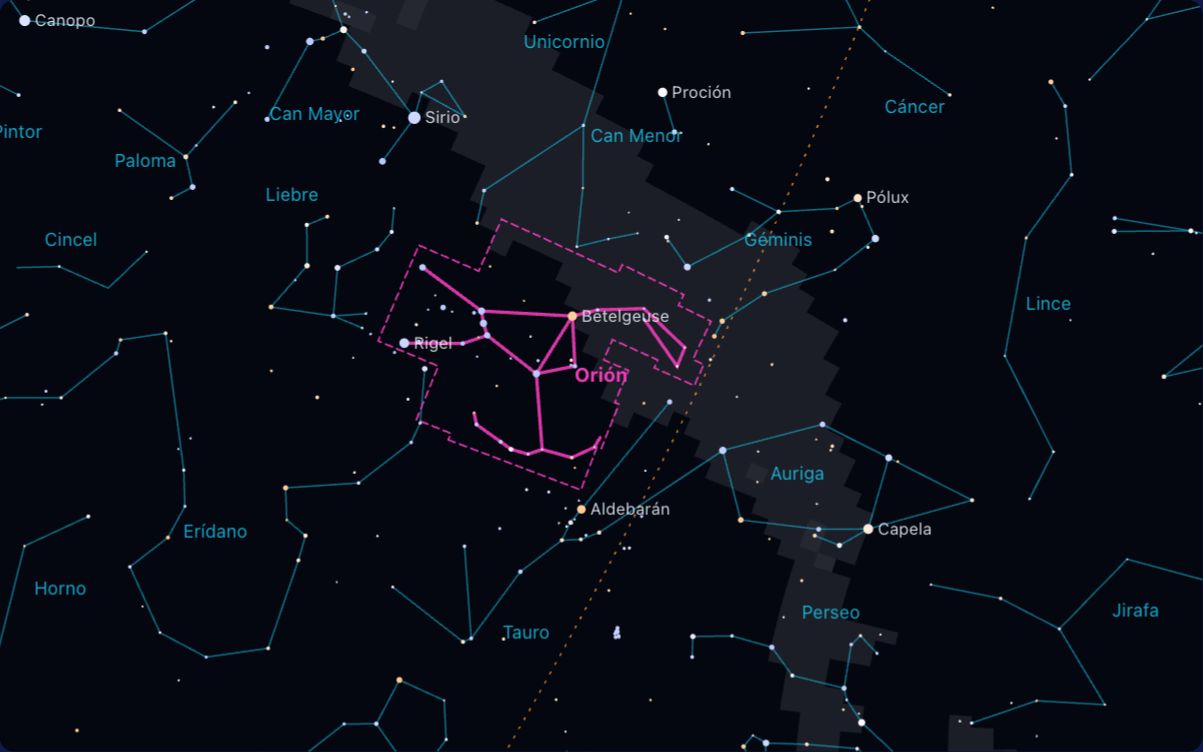
Orion
Orion, the Hunter Ori
The Hunter: the most recognizable constellation in the sky, crossed by the celestial equator and visible from the whole planet; Gilgamesh in Sumer, Shen in China, a canoe and a hearth in other skies.
594.1 °² Best in January
-
Pavo
the Peacock Pav
The green peafowl of Java, carried to the sky by the Dutch navigators and adorned with the hundred eyes of Argus; it hosts the globular NGC 6752 and the star Peacock.
377.7 °² Best in August
-
Pegasus
the Winged Horse Peg
The winged horse born from the blood of Medusa, with the Great Square as its body; the Babylonian “Field”, Kawelo's kite in Hawaii and 51 Pegasi, the first exoplanet.
1,120.8 °² Best in October
-
Perseus
Perseus Per
The hero who beheaded Medusa, with the demon's eye Algol blinking in his hand; the Double Cluster, the Perseids and the celestial boat of the Chinese.
615 °² Best in December
-
Phoenix
the Phoenix Phe
The bird reborn from its ashes, the largest of the twelve constellations of the Dutch navigators, next to the southern end of Eridanus; its star Ankaa bears the Arabic name of the phoenix.
469.3 °² Best in November
-
Pictor
the Painter's Easel Pic
Lacaille's painter's easel, next to Canopus; unremarkable to the naked eye but home to β Pictoris, the star with the first planetary disk ever photographed and a directly imaged planet.
246.7 °² Best in January
-
Pisces
the Fishes Psc
The two fishes tied by a cord that saved Aphrodite from the monster Typhon; a faint zodiacal constellation, but heir to Babylon and home of the vernal point.
889.4 °² Best in November
-
Piscis Austrinus
the Southern Fish PsA
The Southern Fish drinks the water poured by Aquarius; its mouth is Fomalhaut, the lone bright star of the October sky.
245.4 °² Best in October
-
Puppis
the Stern Pup
The stern of the ship Argo, the largest piece of the Argonauts' vessel that Lacaille took apart in 1756; crossed by the Milky Way and full of clusters.
673.4 °² Best in March
-
Pyxis
the Compass Pyx
Lacaille's mariner's compass, assembled from the stars that Ptolemy had placed in the mast of Argo; small, faint and home to a recurrent nova.
220.8 °² Best in March
-
Reticulum
the Reticle Ret
The eyepiece reticle with which Lacaille measured the southern sky: a tiny rhombus next to the Large Magellanic Cloud, home of the double star ζ Reticuli.
113.9 °² Best in January
-
Sagitta
the Arrow Sge
The arrow without an archer flying between Aquila and Cygnus: the third-smallest constellation in the sky, yet known since ancient Greece.
79.9 °² Best in August
-
Sagittarius
the Archer Sgr
The centaur archer who aims at the Scorpion and, with his “Teapot”, points to the center of the Milky Way: the richest region of the sky in nebulae and clusters.
867.4 °² Best in August
-
Scorpius
the Scorpion Sco
The scorpion that killed Orion, with the red heart of Antares and a curved tail that is one of the most faithful figures in the sky; in Hawaii it is the fishhook of Māui.
496.8 °² Best in July
-
Sculptor
the Sculptor Scl
Lacaille's sculptor's workshop: a constellation without bright stars that contains the south galactic pole and, for that reason, a clean window onto other galaxies.
474.8 °² Best in November
-
Scutum
the Shield Sct
The shield of King John III Sobieski, the only constellation with a political name that survives; small, but it contains the Wild Duck Cluster and the brightest star cloud in the Milky Way.
109.1 °² Best in August
-
Serpens
the Serpent Ser
The serpent held by Ophiuchus, the only constellation split in two: the Head (Caput) to the west and the Tail (Cauda) to the east, with the Eagle Nebula and the cluster M5.
636.9 °² Best in July
-
Sextans
the Sextant Sex
The sextant with which Hevelius measured the sky with the naked eye, placed on the celestial equator between Leo and Hydra; faint, but with the Spindle Galaxy.
313.5 °² Best in April
-
Taurus
the Bull Tau
The bull charging at Orion, with the red eye of Aldebaran, the Hyades and the Pleiades: one of the groups of stars with the most names in every culture of the world.
797.2 °² Best in January
-
Telescopium
the Telescope Tel
Lacaille's aerial telescope, trimmed by 19th-century astronomers down to a modest rectangle south of Sagittarius and Corona Australis.
251.5 °² Best in August
-
Triangulum
the Triangle Tri
The small triangle that the Greeks called Deltoton after the letter delta and the Nile delta; it hides the galaxy M33, the third largest in the Local Group.
131.8 °² Best in December
-
Triangulum Australe
the Southern Triangle TrA
The southern triangle, the smallest of the Dutch navigators' constellations but with brighter stars than its northern sister; next to Alpha and Beta Centauri.
110 °² Best in July
-
Tucana
the Toucan Tuc
The toucan of the Dutch navigators, with the Small Magellanic Cloud at its tail and 47 Tucanae, the second most spectacular globular cluster in the sky.
294.6 °² Best in November
-
Ursa Major
the Great Bear UMa
The Great Bear, third-largest constellation in the sky, whose seven stars of the Big Dipper have been a wagon, a plough, a bier, a ladle and a bear for peoples across the northern hemisphere.
1,279.7 °² Best in April
-
Ursa Minor
the Lesser Bear UMi
Ursa Minor, the Little Bear, with Polaris at the tip of its tail: the axis of the northern sky from the Phoenicians to today, which from the tropics grazes the horizon.
255.9 °² Best in June
-
Vela
the Sails Vel
The sails of the ship Argo, with the brightest Wolf-Rayet star in the sky, the False Cross and the remains of a supernova that exploded eleven thousand years ago.
499.6 °² Best in March
-
Virgo
the Maiden Vir
The maiden with the ear of wheat, Spica; second constellation by size, it contains the September equinox and the great Virgo Cluster of galaxies.
1,294.4 °² Best in May
-
Volans
the Flying Fish Vol
The flying fish that leaps beside the hull of Argo fleeing from Dorado: a small constellation of the Dutch navigators, with no myth but with curious galaxies.
141.4 °² Best in March
-
Vulpecula
the Fox Vul
Hevelius's fox, which carried a goose in its mouth; faint but rich: the Dumbbell Nebula, the Coathanger asterism and the first pulsar ever discovered.
268.2 °² Best in September
No constellation matches. Try another word or clear the filters.