Look up
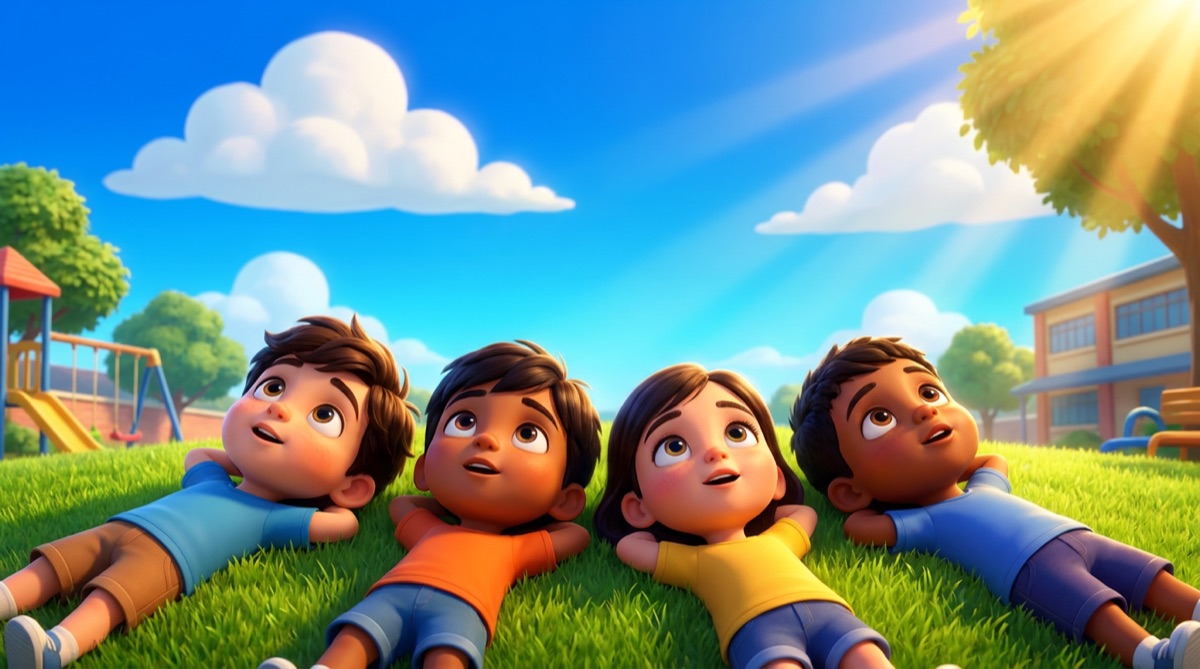
Go out to the schoolyard in the morning. Look up.
What do you see? The Sun. The clouds. The blue sky.
Today we are going to get to know the daytime sky.
The Sun gives us light and warmth
The Sun is a star. It is a giant ball of fire. It is very, very far away. That is why it looks small.
The Sun gives us light. With its light we see the trees, the houses and our friends.
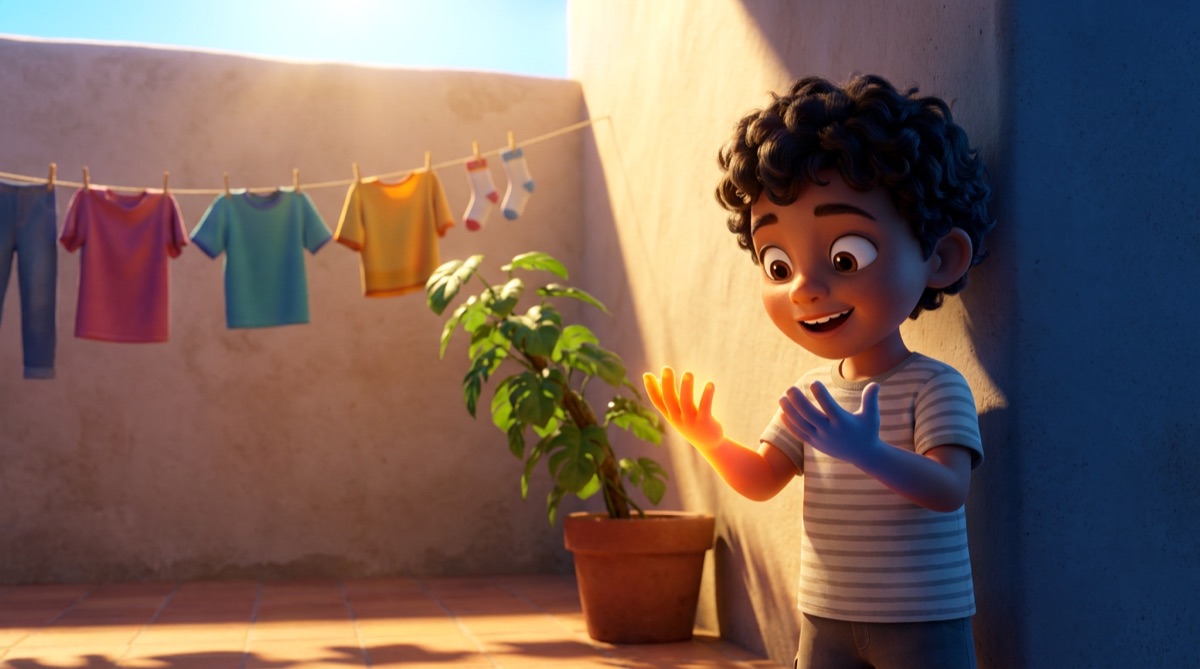
The Sun gives us warmth. That is why the day is warm and clothes dry in the yard.
Plants also need sunlight to grow.
Careful! Never look straight at the Sun. Its light is so strong that it hurts your eyes. Look at the clouds, the trees or the ground, but not the Sun.
Feel the warmth
- Put one hand in the sun and the other in the shade.
- Wait a little while. Count to 10.
- Which hand is warmer?
Now put one stone in the sun and another stone in the shade. After a while, touch them. Which one is warmer? Why?
The clouds and the color of the sky

What color is the sky?
When there are no clouds, the daytime sky is blue. Sunlight has all the colors mixed together. The air scatters the blue color the most. That is why we see it everywhere.
In the afternoon, when the Sun is low, the sky turns orange and red. That is because its light crosses much more air before it reaches us.
When there are lots of clouds, the sky looks gray or white.
What are clouds?
Clouds are made of very tiny water droplets. They are so tiny that they float in the air. Sometimes, very high up, they are made of ice.
Clouds come in many shapes. Look:
| Shape | What does it look like? | Where is it? |
|---|---|---|
| Cotton cloud | Cotton balls | Halfway up |
| Feather cloud | Feathers or horse tails | Very high |
| Sheet cloud | A sheet covering the whole sky | Low down |
Big, dark cotton clouds bring rain.
Count and sort
Go out to the schoolyard with your teacher. Lie down on the grass or on a mat.
- How many clouds do you see? Count them with your finger: 1, 2, 3…
- Which is the biggest cloud? Which is the smallest?
- Are they cotton, feather or sheet clouds?
- What color are they: white or gray?
Play with the simulator
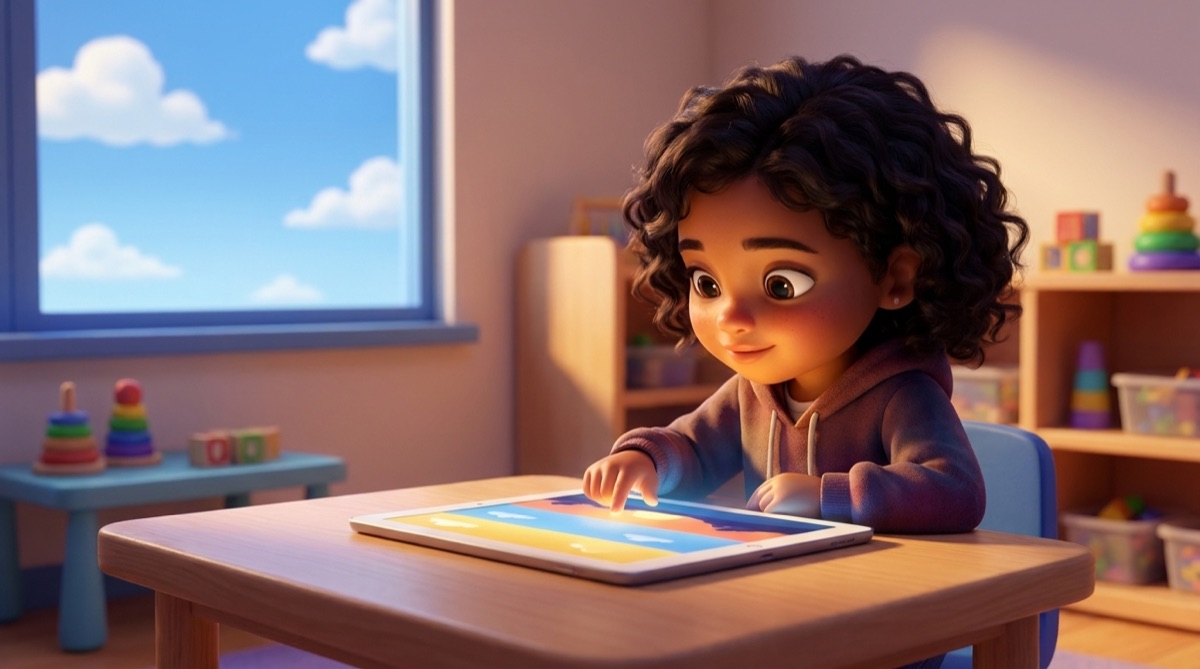
Use Explorer mode. Look at the landscape on the right.
- Press Morning. What color is the sky?
- Press Noon. Where is the Sun: high or low?
- Press Afternoon. Did the color of the sky change?
- Press Night. What happened to the Sun?
It’s daytime!
Activity: cloud hunters
You need: a sheet of blue poster board, cotton, glue, a small mirror and a sunny window.
Part 1: the hidden rainbow
- Put the mirror in a glass of water, near the window, where the Sun shines.
- Move the mirror slowly until a little patch of colors appears on the wall.
- What colors do you see? Sunlight has all those colors hidden inside!
Part 2: my cotton sky
- Look at the real sky through the window or in the schoolyard.
- Count the clouds. How many are there?
- On the blue poster board, glue one cotton ball for each cloud you counted.
- Make feather clouds by stretching the cotton, and sheet clouds by flattening it.
- If the sky is gray, paint the cotton with a little bit of gray!
Final question: how many clouds did you glue? Were there more cotton clouds or feather clouds?
Exercises
- Name two things the Sun gives us.
Show solution
Light and warmth. With light we see, and with warmth we stay warm and plants grow.
- Juan drew 5 cotton clouds and 3 feather clouds. How many clouds did he draw in all? Count on your fingers.
Show solution
5 and 3 make 8 clouds. Count: 1, 2, 3, 4, 5… 6, 7, 8.
- What color is the sky at noon if there are no clouds? And when the Sun is setting?
Show solution
At noon it is blue. When the Sun sets it turns orange or red.
- Ana says: “I’m going to look straight at the Sun to see how big it is.” Is that okay? What would you tell her?
Show solution
It is not okay. Looking straight at the Sun hurts your eyes. I would tell her to look at the clouds or the ground, but never at the Sun.
✦ Mini-quiz
Remember
- The Sun is a star that gives us light and warmth.
- We never look straight at the Sun.
- The daytime sky is blue; at sunset it turns orange.
- Clouds are water droplets and come in cotton, feather or sheet shapes.
🍎 Teacher guide
- Time
- 2 moments of 25 min (one in the schoolyard, one in the classroom)
- Colombian national standard (MEN)
- Preschool DBA (MEN, 2016): DBA 7 'Expresses and represents what they observe, feel, think and imagine, through play, music, drawing and body expression'; DBA 12 'Establishes relationships between the causes and consequences of events that happen to them or around them' (evidence: 'Observes and makes graphic, sound or audiovisual records to explain what happens'); DBA 15 'Compares, orders and classifies objects and identifies patterns according to different criteria'. Looking ahead to Natural Sciences, Grades 1 to 3 (MEN, 2006): 'I identify and compare sources of light, heat and sound and their effect on different living beings'.
- Evidence of learning
- The child points to the Sun as a source of light and warmth without looking straight at it, compares sun and shade with their hands, counts and sorts the clouds they see (up to 20) and represents them on their poster board.
Materials
- Mats or grass to lie down and watch the sky
- Two stones of the same size
- Blue poster board, cotton, glue and a gray marker
- Small mirror and glass of water
- Computer or tablet with the simulator (optional)
Suggested sequence
Moment 1. In the schoolyard (25 min). Safety rule (do not look at the Sun). Lying down, the children count clouds with their finger and name them by shape; then the hand-in-the-sun-and-shade test and the two-stone test. Close with a circle: “what does the Sun give us?”
Moment 2. In the classroom (25 min). The rainbow with the mirror; blue poster board with as many cotton balls as clouds they counted. Conversation with the simulator (Explorer mode): color of the sky in the morning, at noon, in the afternoon and at night. Mini-quiz out loud, in groups.
Note for Colombia. We are near the equator: the day lasts almost 12 hours all year round (in Bogotá, between 11 h 51 min and 12 h 23 min), the noon Sun passes very high and is very hot. It is best to do moment 1 before 10 a.m. and with a hat.
Local note. In London the day lasts 16 h 38 min on June 21 and 7 h 49 min on December 21, and the noon Sun is very hot. It is best to do moment 1 in the early morning hours and with a hat.
Common mistakes
- Believing the Sun is "tiny" because that is how it looks. Compare with a ball moving away across the schoolyard: the farther away, the smaller it looks.
- Thinking clouds are made of cotton or smoke. Show the steam from a pot or the mist on a cold window: they are water droplets.
- Looking at the Sun "just for a second" to check. Set the rule before going out and repeat it: we look at the sky, never at the Sun.
- Believing the sky is blue "because the sea is up there". With the mirror and the water you can see that sunlight carries all the colors.