When the Sun goes down
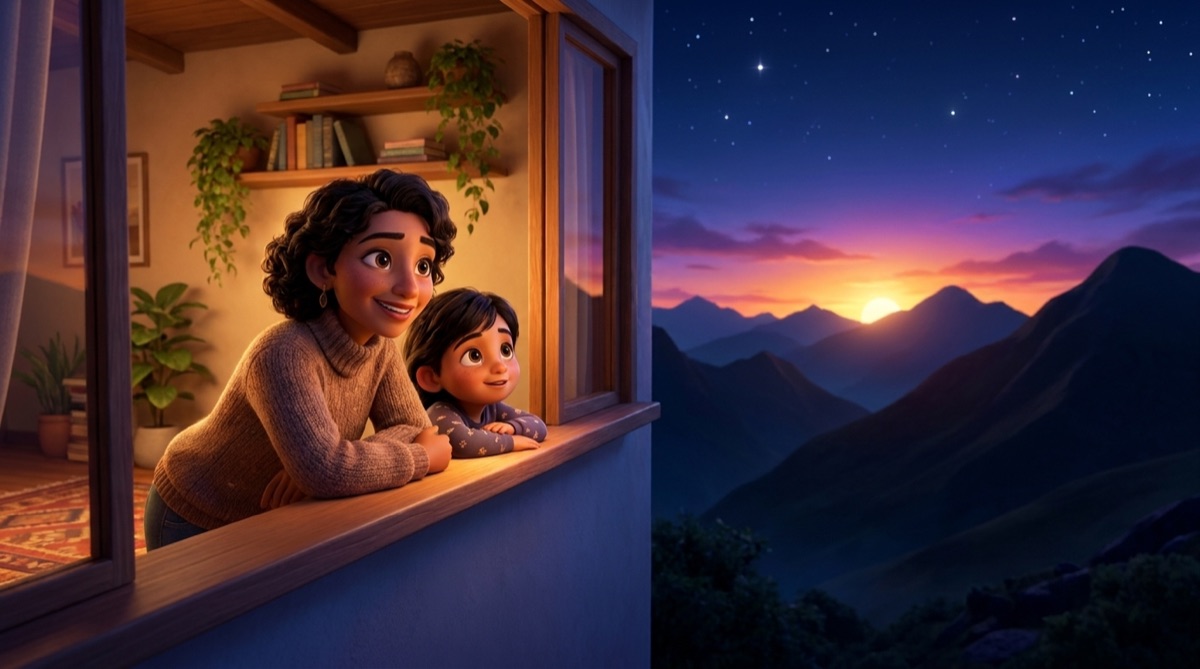
In the afternoon the Sun goes down and down. It sets. The sky turns dark.
But the night sky is not empty. Look out the window with your family. What do you see?
The Moon and the stars
The Moon
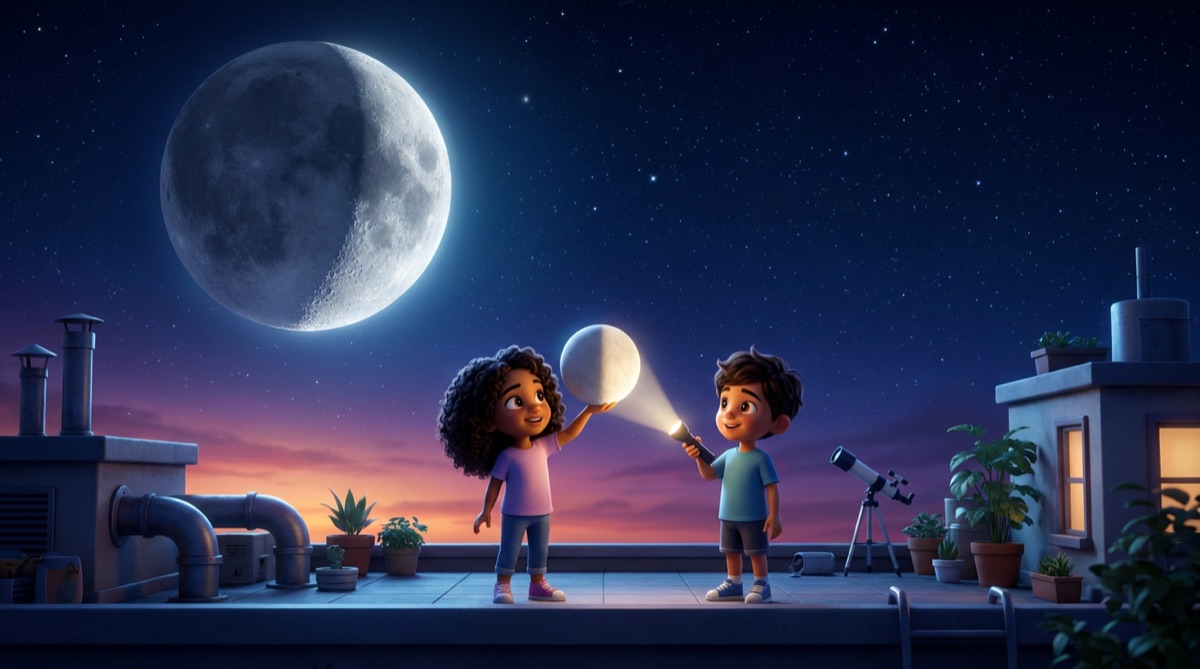
The Moon is a big ball of rock. It goes around the Earth. It is very far away, but it is the closest thing we have in the sky.
The Moon has no light of its own. It is like a white ball in a dark room: it shines because the Sun lights it up.
The Moon changes shape. Some nights it is round like a plate. Other nights it is a thin sliver. And sometimes you cannot see it at all. It takes almost a month to become round again.
Did you know the Moon also comes out during the day? Look for it in the afternoon, when the sky is still blue.
The stars
The stars are tiny dots of light. Every star is a sun very, very far away! Because they are so far, they look tiny.
The stars are in the daytime sky too. But sunlight is so strong that it does not let us see them. They only appear when the sky is dark.
In the city there are many lights and we see few stars. In the countryside, far from the lights, you can see lots and lots: thousands!
Old names
The peoples of Colombia have been watching the sky for a very long time.
- The Muisca, who lived where Bogotá and Boyacá are today, called the Sun Sué and the Moon Chía. They said they were husband and wife.
- The Wayuu, in La Guajira, call the Sun Ka’i and the Moon Kashi.
What do they call the Sun and the Moon in your family?
What do we do at night?
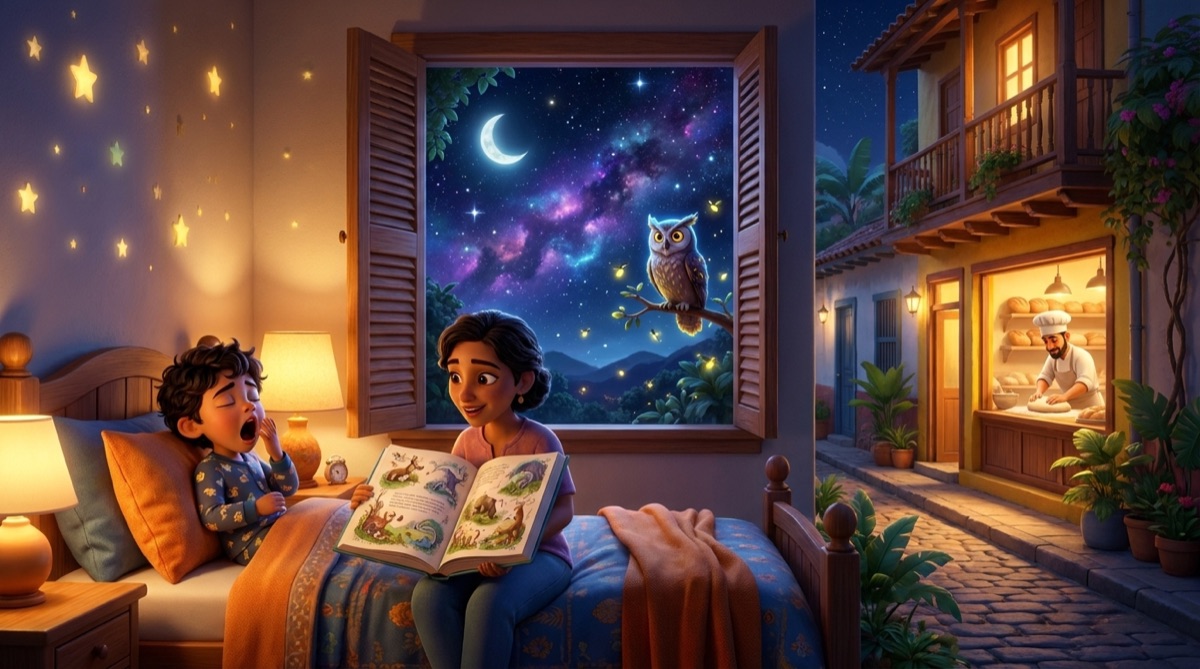
At night it is cold and dark. People go back home. We have dinner. We brush our teeth. We put on our pajamas. We sleep.
But not everyone sleeps.
- Some people work at night: bakers, nurses, security guards.
- Some animals wake up at night: the owl, the bat, the firefly, the cricket.
- Other animals sleep: the hen, the hummingbird, the dog.
Put your night in order
Think about what you do every night. Draw each thing on a card:
| Card | What do I do? |
|---|---|
| 1 | Have dinner |
| 2 | Brush my teeth |
| 3 | Put on my pajamas |
| 4 | Listen to a story |
| 5 | Sleep |
Now put the cards in a row. What comes first? What comes after? What comes last?
“Before sleeping I listen to a story. After dinner I brush my teeth.”
Play with the simulator
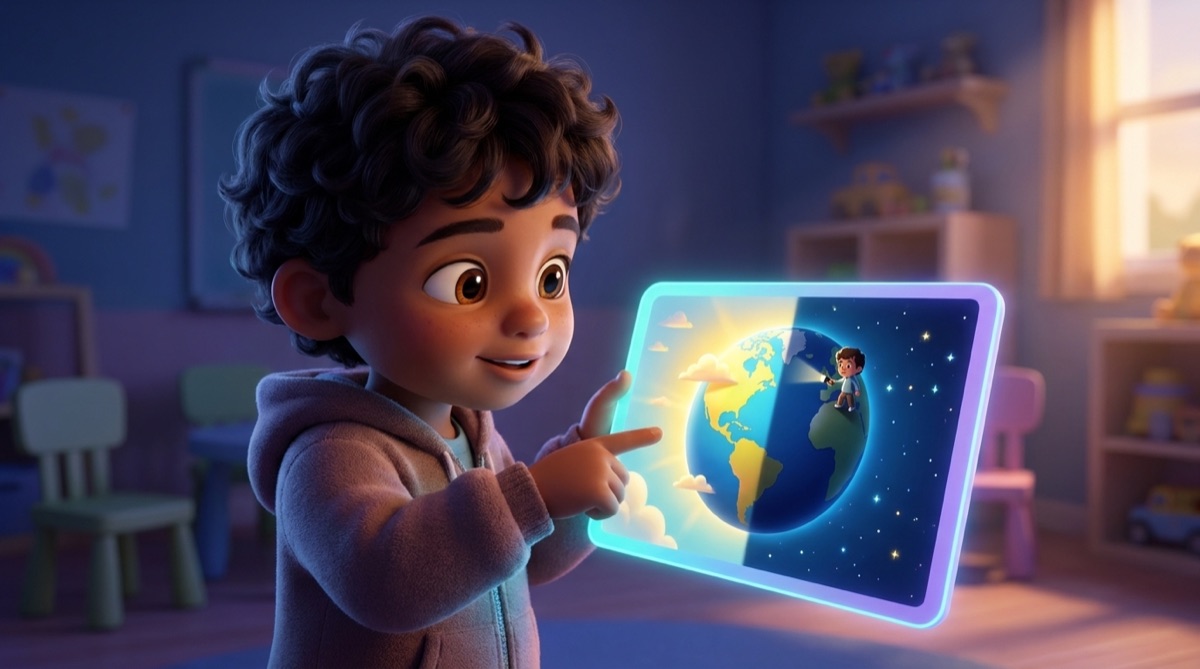
Use Explorer mode.
- Press Night. What color is the sky? Do you see stars?
- Look at the little figure on the left. Is it on the dark side?
- Press ▶ Spin and wait. Does the day come back?
It’s daytime!
Activity: the sky in a box
You need: a shoebox, black paper, an awl (the teacher uses it), a flashlight and tape.
- Line the inside of the box with the black paper.
- The teacher pokes little holes in the lid with the awl. Each little hole is a star.
- Ask for one big, round hole: that will be the Moon.
- Close the box. Put the flashlight on top of the lid and turn off the classroom light.
- Look in through one side of the box. It is your night sky!
- Count the stars in your sky with your finger. How many are there?
Final question: does your sky have more stars or more moons? Why does the Moon in the box shine if it is only a hole?
My first Moon diary
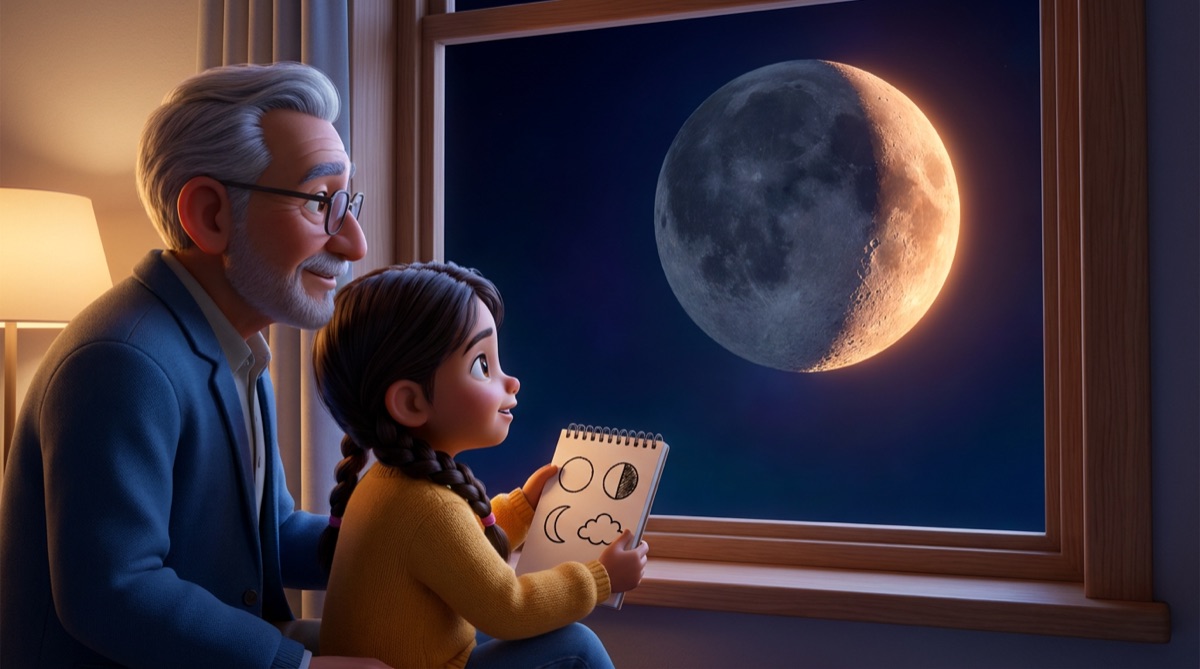
For 5 nights, look at the Moon with an adult and draw its shape.
| Night | Drawing of the Moon | Round, half or sliver? |
|---|---|---|
| 1 | ||
| 2 | ||
| 3 | ||
| 4 | ||
| 5 |
If it is cloudy, draw a cloud. That is observing too!
Exercises
- Name two things you can see in the night sky and one you can see during the day.
Show solution
At night: the Moon and the stars. During the day: the Sun (and the clouds too). The Moon can sometimes be seen during the day as well.
- Does the Moon have light of its own, like a light bulb?
Show solution
No. The Moon shines because the Sun lights it up, like a white ball with a flashlight.
- Sofía’s sky-in-a-box has 12 stars. Pedro’s has 9. Who has more stars? How many stars are there between the two of them?
Show solution
Sofía has more (12 is more than 9). Between the two they have 12 and 9, that is, 21 stars. Count on from 12: 13, 14, 15, 16, 17, 18, 19, 20, 21.
- Put in order: sleep, have dinner, put on my pajamas.
Show solution
First have dinner, then put on my pajamas and last sleep.
✦ Mini-quiz
Remember
- At night we see the Moon and the stars.
- The Moon has no light of its own: the Sun lights it up.
- The stars are suns very far away. You can see more of them in the countryside than in the city.
- At night most of us sleep, but some people and animals are awake.
- To go out and watch the night sky, always with an adult.
🍎 Teacher guide
- Time
- 2 moments of 25 min + a 5-night Moon diary at home
- Colombian national standard (MEN)
- Preschool DBA (MEN, 2016): DBA 7 'Expresses and represents what they observe, feel, think and imagine, through play, music, drawing and body expression'; DBA 14 'Builds notions of space, time and measurement through everyday experiences' (evidence: 'Recognizes the before, the now and the after of an event'); DBA 16 'Determines the number of objects that make up a collection, by establishing correspondence relationships and actions of joining and separating'. Looking ahead to Natural Sciences, Grades 1 to 3 (MEN, 2006): 'I record the movement of the Sun, the Moon and the stars in the sky over a period of time'.
- Evidence of learning
- The child names the Moon and the stars, explains with the ball and the flashlight that the Moon has no light of its own, counts the stars in their box (up to 20) and puts three cards of their nighttime routine in order with 'before' and 'after'.
Materials
- Shoeboxes, black paper, awl (teacher use only) and flashlights
- White ball and flashlight for the Moon model
- Cards to draw the nighttime routine
- Photocopy of the 5-night Moon diary
- Computer or tablet with the simulator (optional)
Suggested sequence
Moment 1. Look and compare (25 min). Conversation with drawings: “What is in the sky during the day? And at night?” Ball-and-flashlight model for the Moon. With the simulator in Explorer mode, go from Afternoon to Night and name what changes (color of the sky, stars, shadow of the stick). Muisca and Wayuu names for the Sun and the Moon; each child tells what they call them at home.
Moment 2. The sky in a box and the routine (25 min). Building the sky-in-a-box (the teacher pokes the holes; the children count them and compare: “who has more?”). Nighttime routine cards and the “before / after” game. The 5-night Moon diary is handed out to do with the family. Mini-quiz out loud.
Safety. Insist that nighttime observation is always done with an adult and from home or the yard, never in the street.
Common mistakes
- Believing the Moon has light of its own. Shine a flashlight on a white ball in the darkened classroom: it shines only on the side facing the flashlight.
- Believing the stars "switch off" during the day. Turn on a flashlight with the classroom light on and then off: the flashlight was on the whole time, but you only notice it in the dark.
- Thinking the Moon only comes out at night. Look for it in the afternoon sky at first quarter (the phases simulator tells you the date).
- Mixing up "first" and "after". Use the cards in a row and ask the child to walk along the row while telling the story of their night.