Scientists write things down

A scientist looks at the sky. Just like you. But they do something more: they write down what they see.
They write down the day. They write down the time. They draw. And the next day, they do it again.
After many days they compare their notes. And they discover things that nobody can see in a single day.
Today you are going to be a sky scientist.
Sky diary
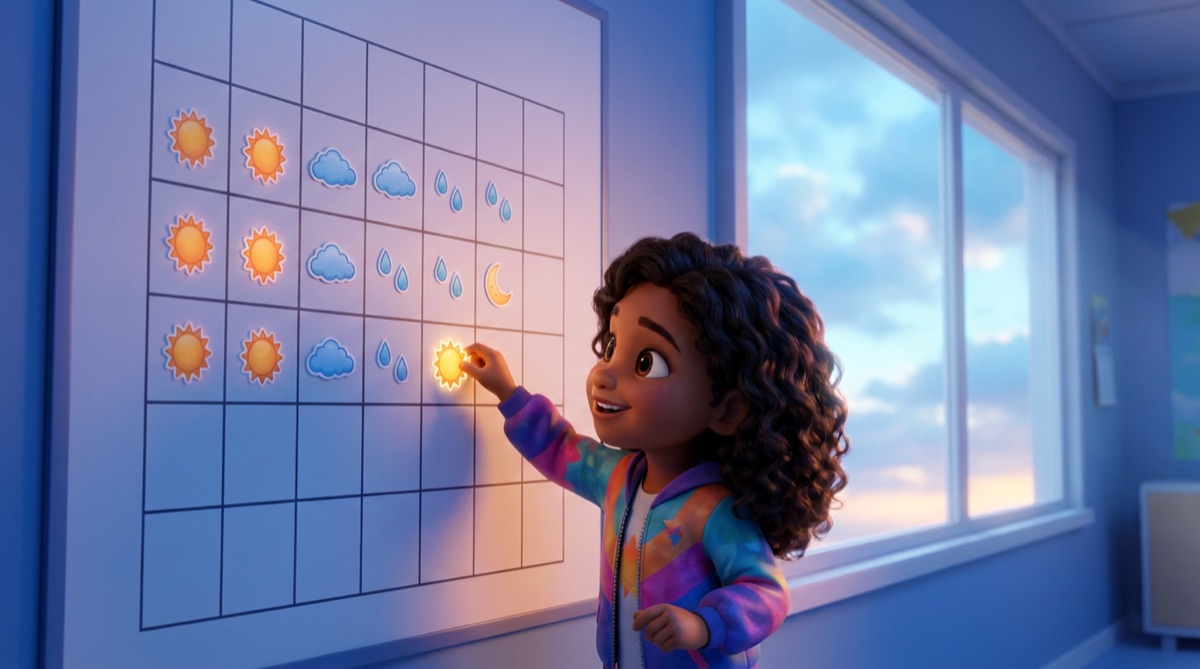
What do we write down?
Every day, at the same time, look at the sky from the same place. Write down five things:
| What do I look at? | What do I write down? |
|---|---|
| The Sun | Can you see it? Is it high or low? Which side is it on? |
| The clouds | Are there few, many or none? Cotton, feather or sheet clouds? |
| The sky | Blue, gray or white? |
| The Moon | Can you see it during the day? What shape is it? |
| The weather | Is it sunny, cloudy or raining? |
My ten-day diary
Copy this table into your notebook. Use these symbols: ☀ sun · ☁ clouds · 🌧 rain · ☾ Moon.
| Day | Date | Time | Sun | Clouds | Sky | Moon | Weather |
|---|---|---|---|---|---|---|---|
| 1 | |||||||
| 2 | |||||||
| 3 | |||||||
| 4 | |||||||
| 5 | |||||||
| 6 | |||||||
| 7 | |||||||
| 8 | |||||||
| 9 | |||||||
| 10 |
Scientist’s rules:
- I write down what I see, not what I imagine.
- If I could not look, I leave the box empty. I do not make it up.
- I never look straight at the Sun.
The tally table
When the ten days are over, count how many days there were of each kind of weather. Make one tally mark for each day. When you get to 5, cross the four marks with a fifth mark across them.
This is how Valentina’s diary turned out in Bogotá:
| Weather | Tally marks | Total |
|---|---|---|
| ☀ Sunny | |||| | | 6 |
| ☁ Cloudy | ||| | 3 |
| 🌧 Rain | | | 1 |
- How many days did Valentina write down in all? 6 + 3 + 1 = 10. They are all there!
- Were there more sunny days or rainy days? Sunny: 6 is more than 1.
- How many more sunny days than cloudy days? 6 − 3 = 3 more days.
The pictograph
A pictograph is a table with pictures. Each picture stands for one day.
| Weather | Days |
|---|---|
| ☀ Sunny | ☀ ☀ ☀ ☀ ☀ ☀ |
| ☁ Cloudy | ☁ ☁ ☁ |
| 🌧 Rain | 🌧 |
Just by looking at the longest row you know which kind of weather there was most of.
Drawing what I see

The fixed-point trick
If you draw the Sun on an empty page, you cannot tell whether it moved. That is why scientists draw something that does not move: a tree, a pole, the roof of the house next door.
- Always stand in the same spot in the schoolyard. Mark the spot with chalk or a stone.
- First draw the fixed point: the tree or the building.
- Then draw the Sun, the clouds or the Moon where you see them compared to the fixed point.
- Write the time on the drawing.
Morning and afternoon
Make two drawings on the same day: one at 8 a.m. and another at 3 p.m.. Compare them.
- Is the Sun on the same side of the tree?
- Is it higher or lower?
Do this for several days. You will see a pattern: the Sun always rises on the same side and always sets on the opposite side. In Colombia it rises at about 6 a.m. and sets at about 6 p.m., all year round.The time of sunrise and sunset changes with the seasons of the year. Write down in your diary what time it rises and what time it sets.
A pattern that repeats
A pattern is something that repeats the same way. Look: day, night, day, night, day, night… What comes next? Day!
The sky is full of patterns. Your diary helps you discover them.
Play with the simulator

Use Explorer mode. The landscape has a stick and its shadow.
- Press Morning. Which side is the Sun on? Draw it in your notebook.
- Before pressing Afternoon, guess: which side will it be on?
- Press Afternoon. Were you right?
- Move the time slider slowly and watch how the Sun crosses the sky. Does it look like your drawings?
It’s daytime!
Activity: my window to the sky
You need: a piece of cardboard, scissors (with help), a piece of string, your notebook and colored pencils.
- Cut a square window out of the cardboard, like a picture frame.
- Hang the frame with the string in a fixed spot in the schoolyard or at a classroom window, facing where you can see the sky.
- Every day, at the same time, look at the sky through the frame without moving the frame or changing your spot.
- Draw in your notebook exactly what you see inside the frame: clouds, Sun (without looking straight at it), Moon, birds, airplanes.
- After 5 days, put the drawings in a row.
Final question: what changed from one day to the next? What stayed the same? Did you ever see the Moon during the day?
Exercises
- This is Santiago’s diary in Medellín: ☀ ☀ ☁ 🌧 ☀ ☁ ☁ ☀ 🌧 ☀. Make the tally table. How many days of each kind of weather were there?
Show solution
| Weather | Tally marks | Total |
|---|---|---|
| ☀ Sunny | |||| | 5 |
| ☁ Cloudy | ||| | 3 |
| 🌧 Rain | || | 2 |
5 + 3 + 2 = 10 days. It matches the 10 symbols!
- In Santiago’s diary, how many more sunny days than rainy days were there?
Show solution
5 sunny days and 2 rainy days: 5 − 2 = 3 more sunny days.
- Camila drew the Sun at 8 a.m. to the right of the tree. At 3 p.m., will she draw it on the same side? Why?
Show solution
No. In the afternoon the Sun will be on the other side of the tree, on the left. The Sun crosses the sky during the day: it rises on one side and sets on the opposite side.
- Continue the pattern: sun, night, sun, night, sun, ___, ___.
Show solution
Night, sun. The pattern repeats in twos: sun and night, sun and night.
- One day Daniel could not look at the sky. What should he do with that box in the diary: make it up, leave it empty or copy his neighbor’s?
Show solution
Leave it empty. A scientist only writes down what they really saw. An empty box is honest; a made-up one spoils the whole diary.
✦ Mini-quiz
Remember
- Scientists write down what they see: date, time, drawing. And they do not make things up.
- We look at the sky at the same time and from the same spot, with a fixed point to compare.
- A tally table with marks in 5s and a pictograph tell us which kind of weather there was most of.
- The Sun always rises on the same side and sets on the opposite side: it is a pattern.
- We never look straight at the Sun.
🍎 Teacher guide
- Time
- 2 sessions of 55 min + a 10-day diary in 5-min moments
- Colombian national standard (MEN)
- Natural Sciences, Grades 1 to 3 (MEN, 2006): 'I record my observations in an organized and rigorous way (without alterations), using drawings, words and numbers'; 'I record the movement of the Sun, the Moon and the stars in the sky over a period of time'; 'I communicate in different ways the process of inquiry and the results obtained'. Mathematics, Grades 1 to 3: 'I classify and organize data according to qualities and attributes and present them in tables'; 'I represent data about my surroundings using concrete objects, pictographs and bar charts'; 'I recognize and describe regularities and patterns in different contexts (numerical, geometric, musical, among others)'.
- Evidence of learning
- The student completes at least 8 of the 10 days of the diary without making up boxes, builds the tally table and the pictograph of their diary, answers how many more days there were of one kind of weather than another, and explains with two drawings (morning and afternoon) that the Sun changes sides with respect to the fixed point.
Materials
- Photocopy of the 10-day diary
- Cardboard, scissors and string for the window-to-the-sky frame
- Chalk or a stone to mark the observation spot
- Notebook and colored pencils
- Computer or tablet with the simulator (optional)
Suggested sequence
Session 1. Being a sky scientist (55 min). Opening: the MEN activity “Watching the sky” (Altablero 30) is presented as a class challenge. The fixed time and spot are agreed on, the spot is marked and the cardboard frame is built. First guided observation and first record with the symbols. Simulator in Explorer mode: each child predicts where the Sun will be in the afternoon and checks it at the end of the school day.
Ten days of diary (5 min a day). The record is made at the start of the school day or of recess, always at the same time; a “scientist of the day” reminds everyone of the rules. One day, halfway through, make the double drawing at 8 and at 3.
Session 2. Counting and telling what we saw (55 min). Tally table with marks in 5s (first with beans), pictograph and comparison questions (exercises 1 and 2). Sharing in groups with posters, as the MEN suggests: “what changed? what repeated?” Individual mini-quiz.
To go further. The same diary, extended to a month, is the Grade 1 project (measuring the shadow three times a day) and prepares the Grade 2 Moon diary.
Common mistakes
- Drawing what "should" be there (a smiling Sun at the top) instead of what was observed. Insist on the frame and the fixed point, and praise drawings with gray clouds or no Sun.
- Making up the days that were not observed in order to "finish". Celebrate the empty box as a sign of scientific honesty.
- Counting the tally marks one by one even though they are grouped. Practice first with beans in piles of 5.
- Believing the Sun rises on a different side each day. The multi-day diary and the simulator show that it is always the same side (this prepares the Grade 2 lesson on cardinal directions).
- Looking at the Sun to "draw it properly". Firm rule: you draw where it is, glancing sideways or using its shadow, never looking straight at it.