A night at the farm

Mariana lives in Bogotá. One clear night she goes out onto the balcony and counts the stars she can see: twelve.
On vacation she goes to her grandmother’s farm, in Huila, near the Tatacoa Desert. She looks up and is left speechless. There are stars everywhere. There is even a white band crossing the sky.
Mariana tries to count them. At a hundred she loses track. It is impossible to count them one by one!
How do astronomers do it? Today we are going to learn: they do not count all of them, they count a sample.
Counting a sample
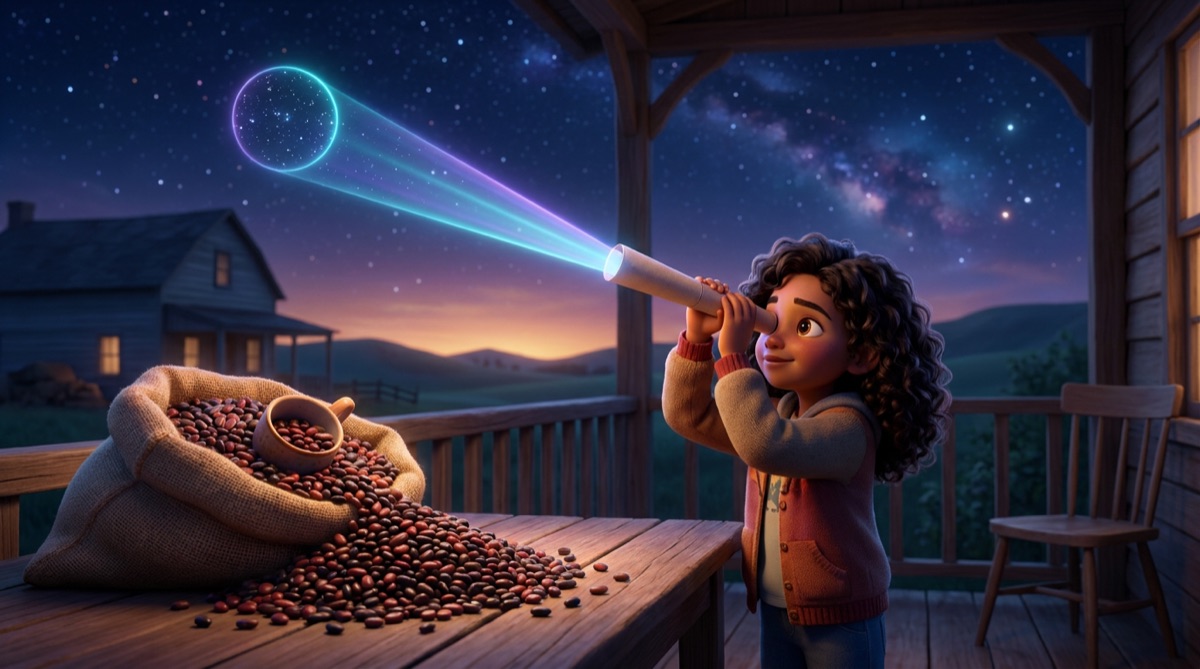
Imagine you want to know how many beans there are in a huge sack. You do not count them all. You fill one cup, count the beans in the cup and then multiply by the number of cups that fit in the sack.
With the stars we do the same thing. The “cup” will be a paper tube. We look at the sky through the tube and count only the stars that fit in that little round patch.
We do that ten times, pointing at ten different parts of the sky. Then we work out the average and multiply.
The average

The average is “what you would get if all the counts were the same”. It is calculated like this: we add all the counts and divide by how many counts we made.
Mariana pointed her tube ten times in Bogotá and wrote down:
| Count | 1 | 2 | 3 | 4 | 5 | 6 | 7 | 8 | 9 | 10 |
|---|---|---|---|---|---|---|---|---|---|---|
| Stars in the tube | 0 | 1 | 0 | 0 | 1 | 0 | 0 | 0 | 1 | 0 |
Sum: 0 + 1 + 0 + 0 + 1 + 0 + 0 + 0 + 1 + 0 = 3.
Average: 3 ÷ 10 = 0.3 stars per tube. Less than one!
At the farm she wrote down:
| Count | 1 | 2 | 3 | 4 | 5 | 6 | 7 | 8 | 9 | 10 |
|---|---|---|---|---|---|---|---|---|---|---|
| Stars in the tube | 9 | 14 | 11 | 8 | 12 | 15 | 10 | 13 | 9 | 9 |
Sum: 9 + 14 + 11 + 8 + 12 + 15 + 10 + 13 + 9 + 9 = 110.
Average: 110 ÷ 10 = 11 stars per tube.
And how many in the whole sky?

A tube 20 cm long and 4 cm wide lets you see a small circle of the sky. Astronomers worked out with geometry that the whole sky above you, from the horizon to the top, holds about 200 windows of that tube.
So the total is the average times 200:
- In Bogotá: 0.3 × 200 = 60 stars, more or less.
- At the farm: 11 × 200 = 2 200 stars, more or less.
Thirty-six times more stars at the farm! (2 200 ÷ 60 ≈ 36.)
Notice the “more or less”. This is an estimate, not an exact count. If Mariana repeated the ten counts, she would get a similar number, but not the same one. For a question like “how many stars are there?”, a good estimate is enough.
How many stars can be seen, at most?

Astronomers do have the complete list. A famous catalog, the Bright Star Catalogue of Yale University, has 9 110 stars: all the ones a healthy eye can see on a perfect night, adding the northern sky and the southern sky.
But we never see them all at once. The Earth hides half of the sky: 9 110 ÷ 2 ≈ 4 500 above the horizon. And the ones near the horizon look so faint, because of the air, that they get lost.
That is why, in the darkest place in the world, with the tube you would count about 2 000 or 3 000. Mariana’s farm is a very good sky.
Light pollution
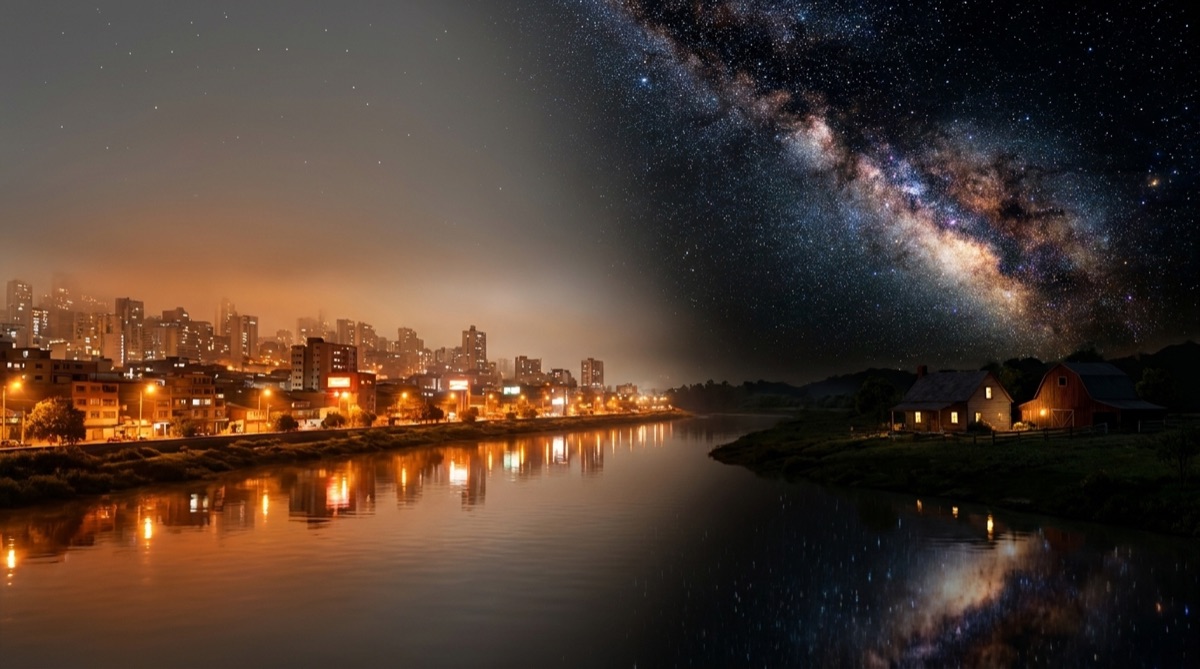
Why can you see 60 in Bogotá and 2 200 at the farm? The stars are the same.
The difference is the light of the city. Street lamps, signs and windows throw light upward. The air scatters it and the sky turns orange-gray instead of black. The faint stars disappear in that glow.
This is called light pollution: leftover artificial light that hides the sky from us.
Some scientists measured the Colombian sky with a special camera. They found that at the Bogotá Botanical Garden 99 % of the brightness of the night sky is artificial light. In the Tatacoa Desert it is 59 %: some light from the city of Neiva still reaches it, but the sky is still dark.
The sky of Bogotá shines about 40 times more than that of the Tatacoa. That is why the Milky Way, that white band Mariana saw, can be seen there and not in Bogotá.
The Bortle scale

In 2001, the astronomer John Bortle invented a scale from 1 to 9 to say how dark a sky is. It is like a grade: 1 is the best sky and 9 the worst.
| Class | What the sky is like | Can you see the Milky Way? |
|---|---|---|
| 1 | Perfect sky, far from everything (very few places in the world) | Yes, so bright it casts shadows |
| 3 | Open countryside, far from towns | Yes, with lots of detail |
| 5 | Outskirts of a small city | Only overhead, very pale |
| 7 | Neighborhood of a big city | Hardly at all, it looks like a cloud |
| 9 | Center of a big city | No; only a few stars can be seen |
Classes 2, 4, 6 and 8 fall in between. With your count you can give an approximate grade: fewer than 100 stars, classes 8 or 9; a few hundred, classes 5 to 7; more than 1 500, classes 1 to 4.
What grade would you give the sky at your house?
Activity: counting stars with a tube
You need: a sheet of paper, sticky tape, a ruler, a pencil, the counting table, a flashlight covered with red cellophane (so you are not dazzled) and an adult to go with you on a clear night with no Moon (look for the new moon on the calendar).
- Roll up the sheet to make a tube 20 cm long and 4 cm wide. Measure with the ruler and tape it. The size matters: with that tube, the sky has about 200 windows.
- Go out to a place where no lamp shines in your eyes. Wait 10 minutes without looking at screens or white lights: your eyes get used to the dark and start to see more stars.
- Point the tube at a part of the sky high up (not at the horizon). Look through the tube without moving it and count the stars you see. Write down the number.
- Repeat with nine other parts of the sky: toward the north, the south, the east, the west and overhead, high up and halfway up.
- Add the ten counts and divide by 10. That is your average.
- Multiply the average by 200. That is your sky.
- If you can, repeat the activity somewhere else: a town, a farm, the beach. Compare.
Question: how many stars did you estimate? What Bortle class would you give your sky? Which lights in your neighborhood could be switched off or pointed downward so you could see more?
To go further: the Globe at Night program receives counts from children and adults all over the world every month, on the nights around the new moon. With your teacher’s help you can send in yours and see the map of Colombia’s skies.
Exercises
- Pedro pointed his tube ten times in Medellín and wrote down: 2, 1, 3, 2, 2, 1, 4, 2, 1, 2. What is the average? How many stars does he estimate for the whole sky?
Show solution
Sum: 2 + 1 + 3 + 2 + 2 + 1 + 4 + 2 + 1 + 2 = 20. Average: 20 ÷ 10 = 2 stars per tube. Total: 2 × 200 = about 400 stars. That would be a class 6 or 7 sky on the Bortle scale.
- Mariana estimated 60 stars in Bogotá and 2 200 at the farm. How many more stars did she see at the farm? About how many times more?
Show solution
Difference: 2 200 − 60 = 2 140 more stars. Times: 2 200 ÷ 60 ≈ 36 times more. (If you work out 60 × 36 = 2 160, you will see it comes very close to 2 200.)
- If you make only one count and you get 0, can you say there are no stars in your sky? Why is it better to make ten counts?
Show solution
No. A single tube can land right on an empty patch of sky. With ten counts in different places, the full patches and the empty ones balance out and the average is closer to the truth. Mariana got several zeros in Bogotá, but also some ones (1), and that is why she estimated 60 and not 0.
- In the whole sky (north and south) there are about 9 110 stars visible to the naked eye. Why can you never see more than half of them at the same time?
Show solution
Because the Earth is under your feet and hides half of the sky. You only see the stars that are above the horizon: 9 110 ÷ 2 ≈ 4 555. And the ones almost on the horizon look very faint, so in practice there are fewer.
- A class 9 sky and a class 1 sky: which one is darker? Which of the two do you live in?
Show solution
The class 1 sky is the darker one (it is the best grade). Class 9 is the center of a big city. The answer to the second question depends on your home: in the center of Bogotá, Medellín, Cali or Barranquilla, classes 8 or 9; in a small town, 4 or 5; in a rural hamlet far from towns, 2 or 3.
✦ Mini-quiz
Remember
- To count many things, we count a sample and multiply.
- The average is calculated by adding the counts and dividing by how many we made.
- With a tube 20 cm by 4 cm, the sky has about 200 windows: total ≈ average × 200.
- An estimate is an approximate number; repeating the counts improves it.
- Light pollution is artificial light that hides the stars. In Bogotá, 99 % of the brightness of the night sky is artificial.
- The Bortle scale goes from 1 (perfect sky) to 9 (city center).
🍎 Teacher guide
- Time
- 2 sessions of 55 min + one night of observation at home
- Colombian national standard (MEN)
- Natural Sciences, Grades 1 to 3 (MEN, 2006): 'I record my observations in an organized and rigorous way (without alterations), using drawings, words and numbers'; 'I record the movement of the Sun, the Moon and the stars in the sky over a period of time'. Natural Sciences, Grades 4 to 5: 'I record my observations, data and results in an organized and rigorous way (without alterations), in writing and using diagrams, graphs and tables'. Mathematics, Grades 1 to 3: 'I describe, compare and quantify situations with numbers, in different contexts and with various representations'. Mathematics, Grades 4 to 5: 'I use various calculation and estimation strategies to solve problems in additive and multiplicative situations'; 'I identify, in the context of a situation, the need for an exact or approximate calculation and the reasonableness of the results obtained'.
- Evidence of learning
- Builds the tube with the given measurements, records ten counts in the table, calculates the average and the estimated total, places their sky on the Bortle scale and explains in their own words why a sample can be used to estimate the total.
Materials
- Sheets of paper, tape and rulers
- Photocopy of the ten-count table
- A jar of beans and a small cup (for the sampling model)
- Flashlight with red cellophane
- Black poster board with stick-on or punched stars to practice in the classroom (sky-in-a-box)
Suggested sequence
Session 1. Sampling and average (55 min). Opening (10 min): the sack of beans; how can we know how many there are without counting them all? Development (35 min): each group fills a cup, counts, multiplies by the number of cups in the jar and compares with a real count. Then the sky-in-a-box: punched black poster board, darkened classroom, counts with the tube and the ten-count table; average and total. Closing (10 min): the 20 × 4 cm tubes are built and the observation at home is assigned for a moonless night (check the date of the new moon in the phases simulator).
Session 2. Light pollution (55 min). Opening (10 min): sharing the counts from home in a class table, ordered from smallest to largest. Development (30 min): reading the section on light pollution with the data from Bogotá and the Tatacoa; Bortle scale; each student classifies their sky. Exercises 1 to 3. Closing (15 min): exercises 4 and 5, mini-quiz and, if there is a connection, submitting a count to Globe at Night.
For Grade 4: calculate “how many times more” with division (exercise 2) and discuss why the method gives at most 2 000 or 3 000 even though the catalog has 9 110 stars.
Note on the data. The “200 windows” come from the angular size of the tube (about 11°): a longer or narrower tube has more windows and a wider one, fewer; that is why the measurements matter. The Colombian sky brightness data are from Uchima-Tamayo et al. (2025); Mariana’s numbers are an example consistent with those data, not a real measurement.
Common mistakes
- Believing that in the city "there are fewer stars". The stars are the same; what changes is the brightness of the sky. Compare Mariana's two tables.
- Pointing the tube at the horizon or at the area around a lamp. Ask for counts halfway up and overhead, spread over the four directions.
- Counting without waiting for the eyes to adapt. Insist on the 10 minutes without screens: the number can double.
- Taking the result as exact. Repeat the ten counts in class with the sky-in-a-box and show that the total varies a little each time.
- Confusing class 1 with "the worst" because it is the smallest number. Explain it as a podium: 1 is first place.