A night in Colombia

Imagine a clear night in April, far from the city lights.
Toward the west, going down, you can see Orion, with its three stars in a row: “the Three Marys” (las Tres Marías), as people call them here. Toward the south, low in the sky, shines the Southern Cross.
There is something special about that. In Norway they never see the Southern Cross. In southern Argentina they hardly see the northern stars. But Colombia sits right by the equator: from here we see the constellations of both hemispheres.
Imagine a clear night, far from the city lights.
What you see depends on where you are and on the time of year. In Norway they never see the Southern Cross. In southern Argentina they hardly see the northern stars.
Near the equator, on the other hand, you can see the constellations of both hemispheres, as happens in Colombia.
Further down you will see which constellations are visible from London.
What is a star?
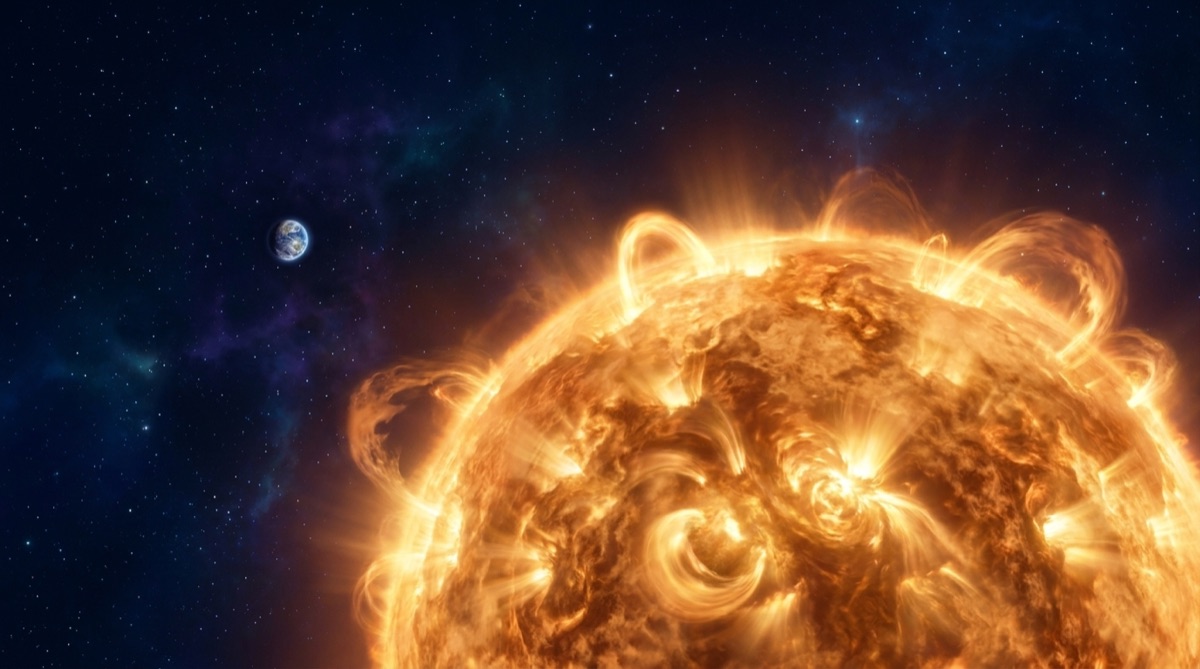
A star is an enormous ball of very hot gas that shines with its own light.
The Sun is a star. It is the closest one: its light takes 8 minutes to reach us.
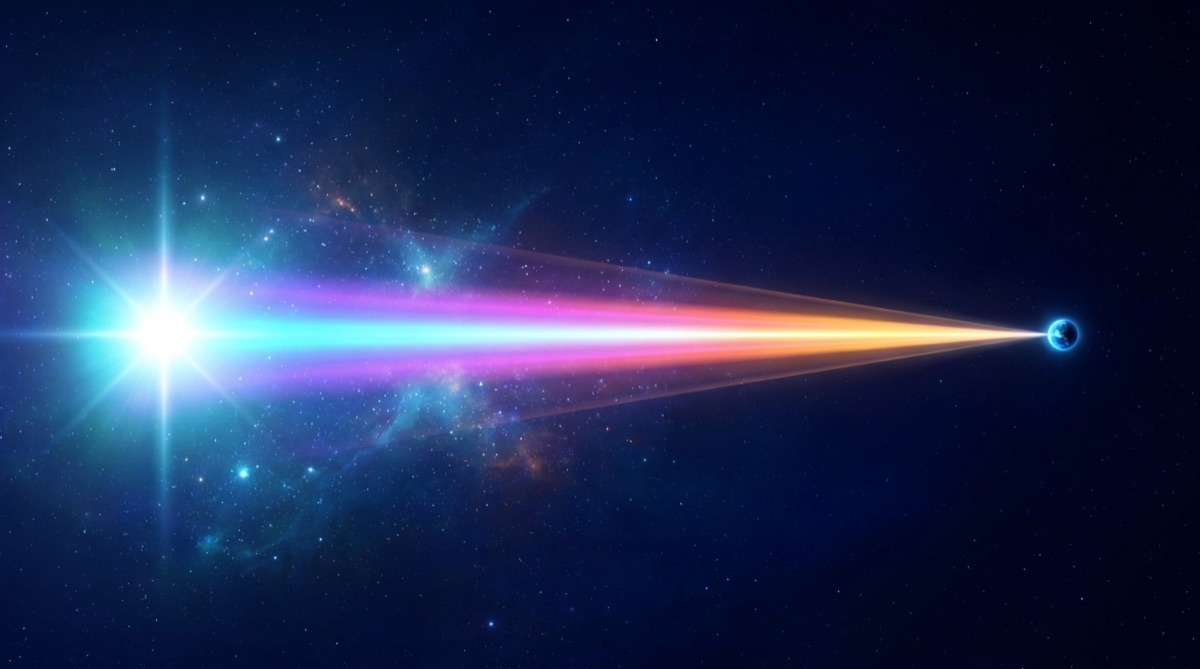
The other stars look like tiny dots because they are incredibly far away. The light from Sirius, the brightest star in the night sky, takes 8 and a half years to reach us. The light from Rigel, in Orion, about 850 years.
If Rigel went out today, we would keep seeing it for another 850 years.
Constellations: invented figures

For thousands of years, people have looked at the stars and joined them with imaginary lines to form figures: a hunter, a scorpion, a cross. Those figures are the constellations.
The stars of a constellation are not really close together. They only look close when seen from Earth. Betelgeuse and Rigel, the two brightest stars in Orion, are hundreds of light-years apart.
Every people invented its own figures. The Greeks saw a hunter in Orion. The Muisca, who lived where Bogotá and Boyacá are today, called the Sun Sué and the Moon Chía, and in Sogamoso there was a Temple of the Sun (today the Sogamoso Archaeological Museum has a reconstruction).
So that all the astronomers in the world speak the same language, the International Astronomical Union (IAU) fixed the names of 88 constellations in 1922 and approved their boundaries in 1928. The whole sky was divided up among them, like a map with 88 countries.
A privileged sky

Colombia is about 4 degrees north of the equator. That is why we can see almost the whole sky over the course of the year:
| Constellation | From which hemisphere? | When is it best seen at nightfall? | Where to look? |
|---|---|---|---|
| Orion | equator | from January to April | overhead, to the west |
| Southern Cross | south | from April to June | low, to the south |
| Scorpius | south | from June to August | to the south, rising |
| Ursa Major | north | from March to June | low, to the north |
Polaris, the North Star, which in the north is used to find your way, sits almost glued to the horizon from Colombia: only 4 or 5 degrees high. It is hard to see.
Your position on Earth decides which constellations you can see. This table is calculated for London (latitude 51.5° N):
| Constellation | Visible from here? | Maximum altitude | Best month at nightfall |
|---|---|---|---|
| Orion | Fully visible | 38° | January |
| Southern Cross | Not visible | never rises | May |
| Scorpius | Partly visible | 12° | July |
| Ursa Major | Fully visible | 86° | April |
The maximum altitude is that of the center of the constellation. Held at arm’s length, your fist covers 10°.
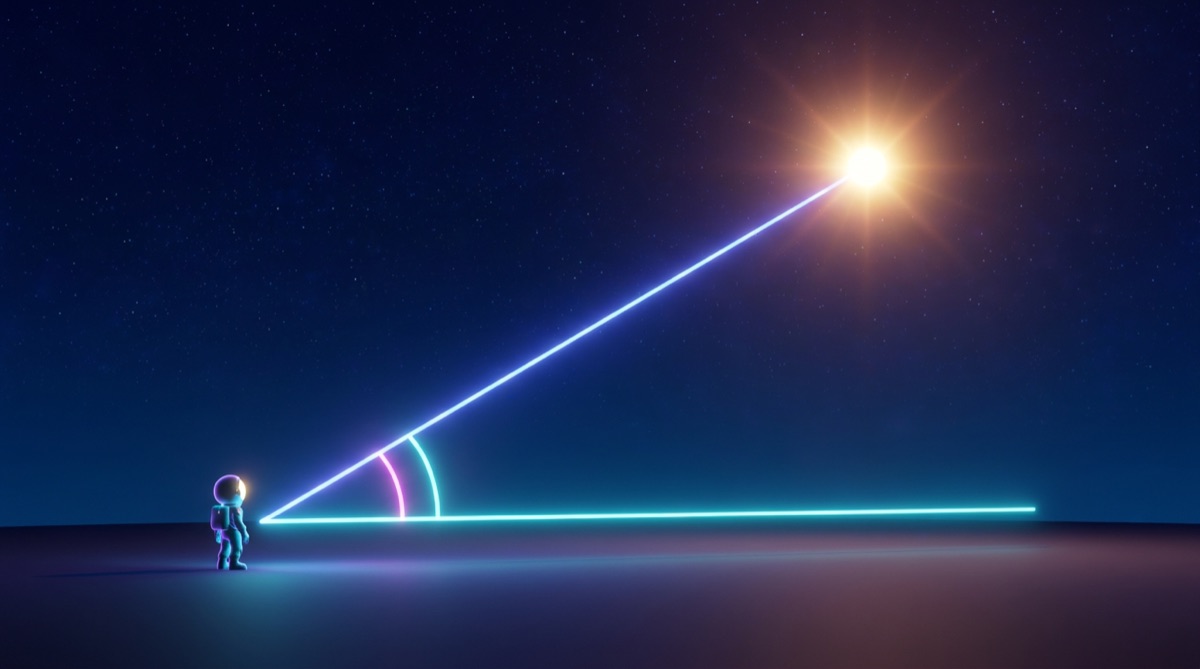
The fixed point of the sky, which in the northern hemisphere is marked by Polaris, the North Star, is seen from London at an altitude of 51.5°: as many degrees as the latitude.
A historical fact from Colombia: in 1803 the National Astronomical Observatory was completed in Bogotá, at the request of the scholar José Celestino Mutis. Its first director was Francisco José de Caldas, who measured the latitude of Bogotá: 4 degrees and 36 minutes north. It is considered the first permanent astronomical observatory built in the Americas.
Coordinates: every star in its square

To say where a star is on a map, we use a grid with two numbers.
- The first number, x, is counted to the right from the corner.
- The second number, y, is counted upward.
They are written in parentheses: (x, y). The star (3, 5) is 3 squares to the right and 5 upward.
Here are the seven main stars of Orion on a 10 by 10 grid (it is a simplified drawing):
| Star | Coordinates | Brightness (magnitude) | Color |
|---|---|---|---|
| Betelgeuse | (8, 9) | 0.5 | red |
| Bellatrix | (2, 8) | 1.6 | blue |
| Mintaka (belt) | (4, 6) | 2.2 | blue |
| Alnilam (belt) | (5, 5) | 1.7 | blue |
| Alnitak (belt) | (6, 4) | 1.8 | blue |
| Saiph | (8, 1) | 2.1 | blue |
| Rigel | (2, 1) | 0.1 | blue |
Draw the grid, mark each star in its square and join them like this: Betelgeuse–Bellatrix (the shoulders), Rigel–Saiph (the feet), and the three belt stars on a diagonal. There is the hunter!
How bright? Magnitude
Astronomers measure brightness with a number called magnitude. It has a catch: the smaller the number, the brighter the star.
- Rigel: 0.1. Very bright.
- Saiph: 2.1. Less bright.
- Sirius: −1.5. A number less than zero! Sirius is so bright that it falls off the bottom of the scale.
To order stars by brightness, we order the magnitudes from smallest to largest: the smallest is the brightest.
The five brightest stars in the night sky are Sirius (−1.5), Canopus (−0.7), Alpha Centauri (−0.3), Arcturus (−0.05) and Vega (0.03). From Colombia you can see all five.From Colombia, near the equator, you can see all five; from other latitudes one of them may be missing.
Color tells the temperature

Look closely at the stars of Orion. Betelgeuse looks reddish. Rigel looks bluish white.
That color is no accident: it tells how hot the star is.
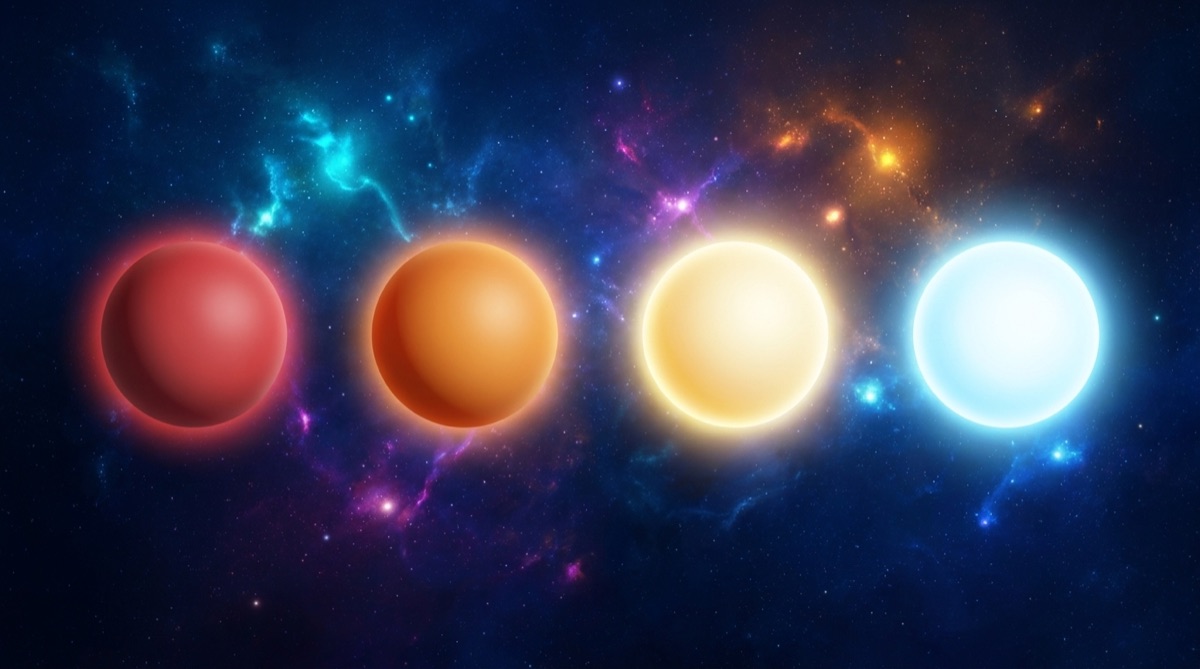
Think of a piece of iron in a forge. First it glows dark red. If it gets hotter, it turns orange, then yellow and, in the end, white. Stars do the same, and the hottest of all reach blue.
It is the opposite of the faucet: in the bathroom, red is hot and blue is cold. In stars, blue is the hottest.
Temperature is measured in kelvin (K). It is like degrees, but starting from absolute cold. Water boils at 373 K.
| Star | Color | Temperature (K) | Where is it? |
|---|---|---|---|
| Rigel | blue | 12 100 | Orion |
| Sirius | white | 9 845 | Canis Major |
| Sun | yellow-white | 5 772 | right next door! |
| Alpha Centauri A | yellow | 5 748 | Centaurus |
| Aldebaran | orange | 3 900 | Taurus |
| Betelgeuse | red | about 3 700 | Orion |
| Antares | red | 3 660 | Scorpius |
Notice: Alpha Centauri A is almost a twin of the Sun. And Rigel is at more than twice the temperature of the Sun: 12 100 ÷ 5 772 ≈ 2.1.
Play with the simulator

The simulator shows the color of a star according to its temperature.
- Move the temperature control slowly from 3 000 K to 30 000 K. Watch the color box: in what order do the colors appear?
- Press the example stars: Betelgeuse, Sun, Sirius, Rigel. Write down the color of each one.
- At what temperature does the star look more or less white?
- Challenge: find a temperature at which the star looks orange, like Aldebaran. Is it close to 3 900 K?
- T
- 5,772 K
- λmax
- 502 nm
- B−V
- 0.65
- σT⁴
- 6.29 × 10⁷ W/m²
- L/L☉
- 1.00
- Mbol
- 4.74
Activity: star chart on the Cartesian plane
Materials: a sheet of black or dark blue poster board, ruler, chalk or white pencil, paper stars (or stickers) in four colors: blue, white, yellow and red; white yarn; glue.
- Draw a 10 by 10 grid of 3 cm squares on the poster board. Number the bottom edge (x) from 0 to 10 and the left edge (y) from 0 to 10.
- Glue the seven stars of Orion at their coordinates. Use a red star for Betelgeuse and blue ones for the rest. Make the bright ones (small magnitude) bigger.
- Join the stars with yarn to form the hunter.
- Now the Southern Cross, on another sheet: Acrux (4, 1), Gacrux (4, 7), Mimosa (1, 4) and Delta Crucis (7, 5). Acrux and Mimosa are blue; Gacrux is red. Join Acrux with Gacrux and Mimosa with Delta: a cross!
- Write next to each constellation in which months it can be seen from the United Kingdom.
- If you can, on a clear night compare your chart with the sky. Orion is visible from January to April; the Cross, from April to June.Look at the table in “A privileged sky” to find out when each one can be seen from London.
Final question: on your Orion chart, which star has the largest x coordinate? And the smallest y? Are there two stars with the same x? Which ones?
Exercises
- On the Orion grid, which star is at (2, 8)? And what are the coordinates of Rigel?
Show solution
At (2, 8) is Bellatrix. Rigel is at (2, 1): 2 to the right and 1 upward.
- Order these stars from brightest to least bright: Saiph (2.1), Rigel (0.1), Betelgeuse (0.5), Mintaka (2.2). Remember the magnitude catch.
Show solution
Smaller magnitude = brighter. Order: Rigel (0.1), Betelgeuse (0.5), Saiph (2.1), Mintaka (2.2). Between 2.1 and 2.2, 2.1 wins because it has fewer tenths.
- Order from hottest to least hot: Sun (5 772 K), Antares (3 660 K), Rigel (12 100 K), Aldebaran (3 900 K). What color is the hottest? And the least hot?
Show solution
Rigel (12 100) > Sun (5 772) > Aldebaran (3 900) > Antares (3 660). The hottest, Rigel, is blue. The least hot, Antares, is red.
- The light from Sirius takes 8 and a half years to reach us. If you are 10 years old today, how old were you when the light you see tonight left Sirius?
Show solution
10 − 8.5 = 1.5 years: you were a year and a half old. Looking at Sirius is looking at light from the past.
- Rigel is at 12 100 K and Betelgeuse at about 3 700 K. Roughly how many times hotter is Rigel? Hint: divide and round.
Show solution
12 100 ÷ 3 700 ≈ 3.3. Rigel is more than three times hotter than Betelgeuse. That is why one is blue and the other red.
✦ Mini-quiz
Remember
- A star is a distant sun; the Sun is our star.
- Constellations are invented figures; the IAU recognizes 88.
- On a map, each star has coordinates (x, y): x to the right, y upward.
- Magnitude runs backward: smaller number, brighter star.
- Color tells the temperature: blue is the hottest, red the least hot.
- Which constellations we see depends on latitude. Near the equator, as in Colombia, we see Orion and the Southern Cross in the same year.
🍎 Teacher guide
- Time
- 2 sessions of 55 min + one night observation at home
- Colombian national standard (MEN)
- Natural Sciences, Grades 4 to 5: 'I record my observations, data and results in an organized and rigorous way (without alterations), in writing and using diagrams, graphs and tables'; 'I describe the main elements of the solar system and establish relationships of size, movement and position'. Natural Sciences, Grades 1 to 3 (revisited): 'I record the movement of the Sun, the Moon and the stars in the sky over a period of time'. Mathematics, Grades 4 to 5: 'I use coordinate systems to specify locations and describe spatial relationships'; 'I use decimal notation to express fractions in different contexts and relate these two notations to that of percentages'; 'I recognize the use of some magnitudes (length, area, volume, capacity, weight and mass, duration, speed, temperature) and of some of the units used to measure quantities of the respective magnitude in additive and multiplicative situations'.
- Evidence of learning
- Places the seven stars of Orion by their coordinates and joins them correctly; orders a list of stars by brightness (magnitude) and by temperature (color), justifying the order; names two constellations visible from Colombia and the time of year when they are seen; explains that the Sun is a star.
Materials
- Dark poster board, rulers, chalk or white pencil
- Paper stars or stickers in four colors (blue, white, yellow, red)
- White yarn and glue
- Photocopy of the coordinate table for Orion and the Southern Cross
- Computer or tablet with the blackbody simulator
- A candle or a photo of red-hot iron for the color example (optional)
Suggested sequence
Session 1. Stars and coordinates (55 min). Opening (10 min): “Is the Sun a star? Why do the others look so tiny?” (recall that light takes 8 minutes from the Sun and 8 and a half years from Sirius). Development (35 min): the coordinate rule with three test points; Orion star chart on poster board in pairs; reading the magnitude table and exercise 2. Closing (10 min): each pair calls out a coordinate and the other pair names the star.
Session 2. Colors and temperatures (55 min). Opening (10 min): photo or video of red-hot iron and of a candle flame; “which color is hotter?” Development (30 min): blackbody simulator, sweeping from 3 000 K to 30 000 K and pressing the example stars; temperature table and exercises 3 to 5; Southern Cross chart. Closing (15 min): table of constellations visible from Colombia, short story of the National Astronomical Observatory (1803) and mini-quiz. Homework: on a clear night, look for Orion (January–April) or the Southern Cross (April–June) and compare with the chart.
Note on the data. The grid coordinates are a simplified drawing to practice the Cartesian plane, not astronomical coordinates. The temperatures and magnitudes come from the references; Betelgeuse is variable and its temperature has been measured between 3 500 and 3 800 K depending on the study, which is why the table says “about 3 700”. For Polaris, its altitude above the horizon equals the latitude of the place (4.6° in Bogotá).
Common mistakes
- Believing that the stars of a constellation are close to one another. Show with the distances (Betelgeuse ≈550 light-years, Rigel ≈850) that they only look close from Earth.
- Associating red with hot and blue with cold, as on the faucet. Use the iron in the forge or the flame of a candle (the blue base is the hottest part) and the simulator.
- Reading magnitude as "brightness points": thinking that magnitude 2 shines brighter than magnitude 0. Repeat the catch: the scale runs backward, and Sirius reaches negative numbers.
- Swapping x and y when placing a point. Agree on the rule "first I walk, then I climb" and practice with three points before the chart.
- Thinking that Polaris looks the same in Colombia as in the north. From Bogotá it is about 4.6 degrees above the horizon, almost always hidden by hills or buildings.