The first clock in the world

Thousands of years ago there were no clocks or paper calendars. How did people know when to sow, when to hold a festival or how long until the harvest?
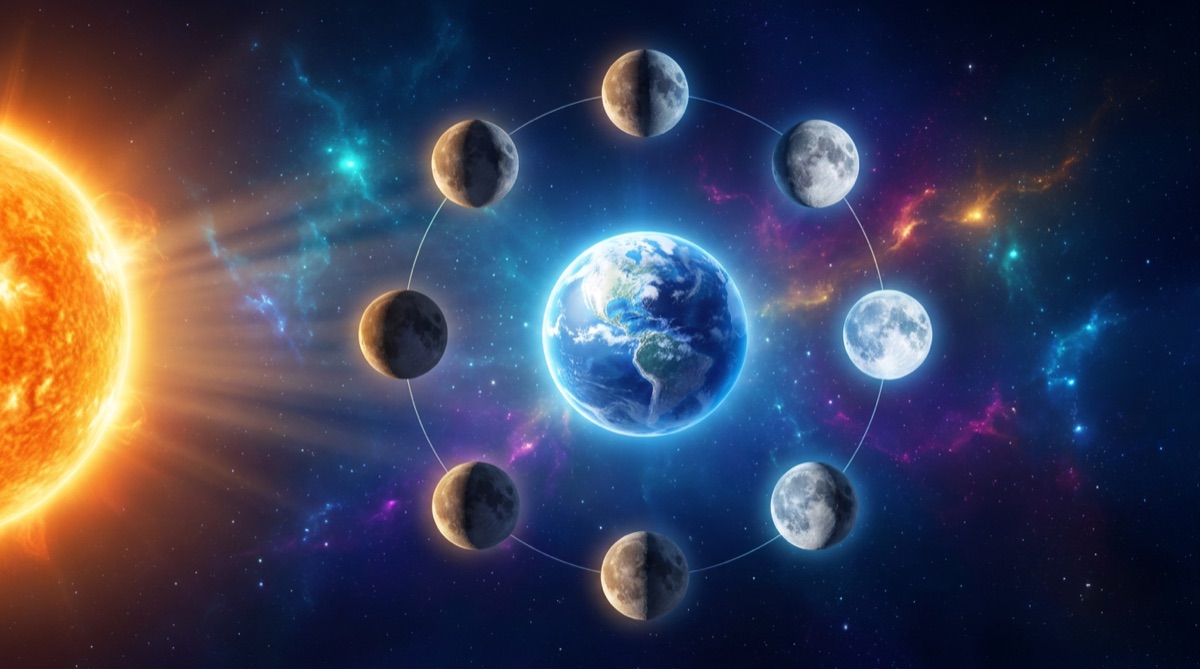
They looked at the Moon.
The Moon changes shape every night, and returns to the same shape after a fixed time. It is a giant clock that everyone can see. It was humanity’s first calendar.
The month of the Moon

In the previous lesson you learned that the Moon goes through its phases in about 29 and a half days. From one new moon to the next: 29 and a half days. From one full moon to the next: 29 and a half days.
That time is called a lunar month.
That is why the word “month” has to do with the Moon. In English, month comes from moon.
Splitting the month: halves and quarters
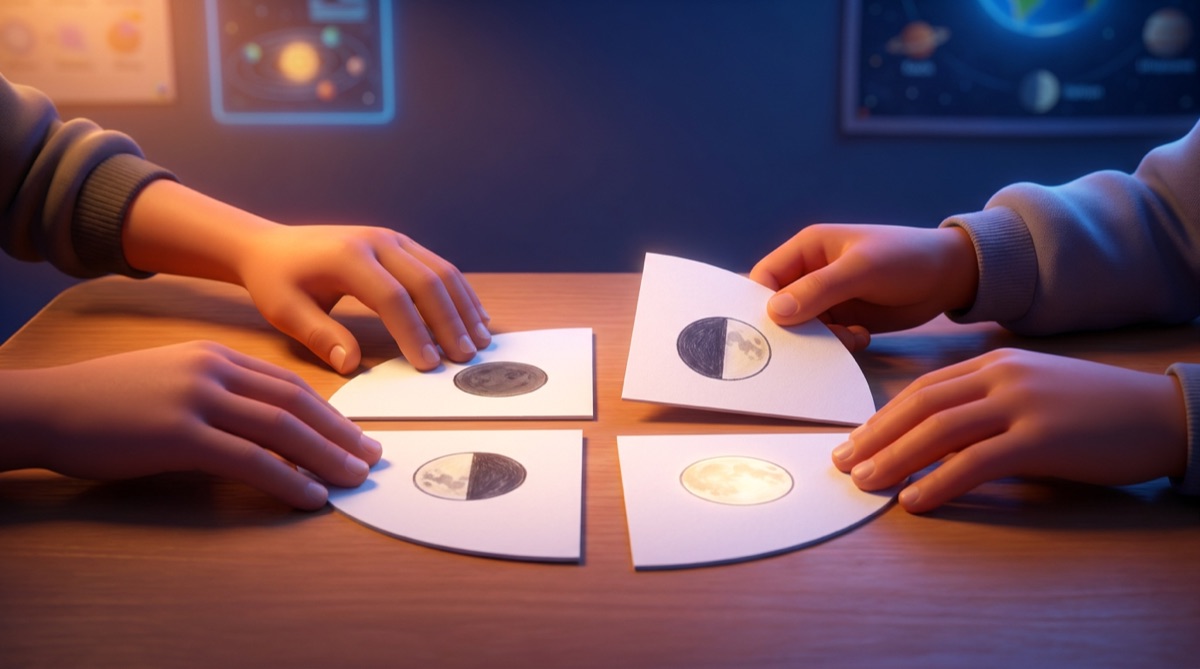
If the lunar month lasts 29 and a half days, how long is it from new moon to full moon? Half:
And from new moon to first quarter? A quarter:
Seven days! That is a week.
The four main phases (new, first quarter, full, last quarter) split the month into four pieces of about 7 days. Many ancient peoples counted this way: four weeks for each moon.
| From… to… | Fraction of the month | Days |
|---|---|---|
| New moon → first quarter | ¼ | about 7 |
| New moon → full moon | ½ | about 15 |
| New moon → last quarter | ¾ | about 22 |
| New moon → new moon | 1 | 29 and a half |
Twelve moons do not fill a year
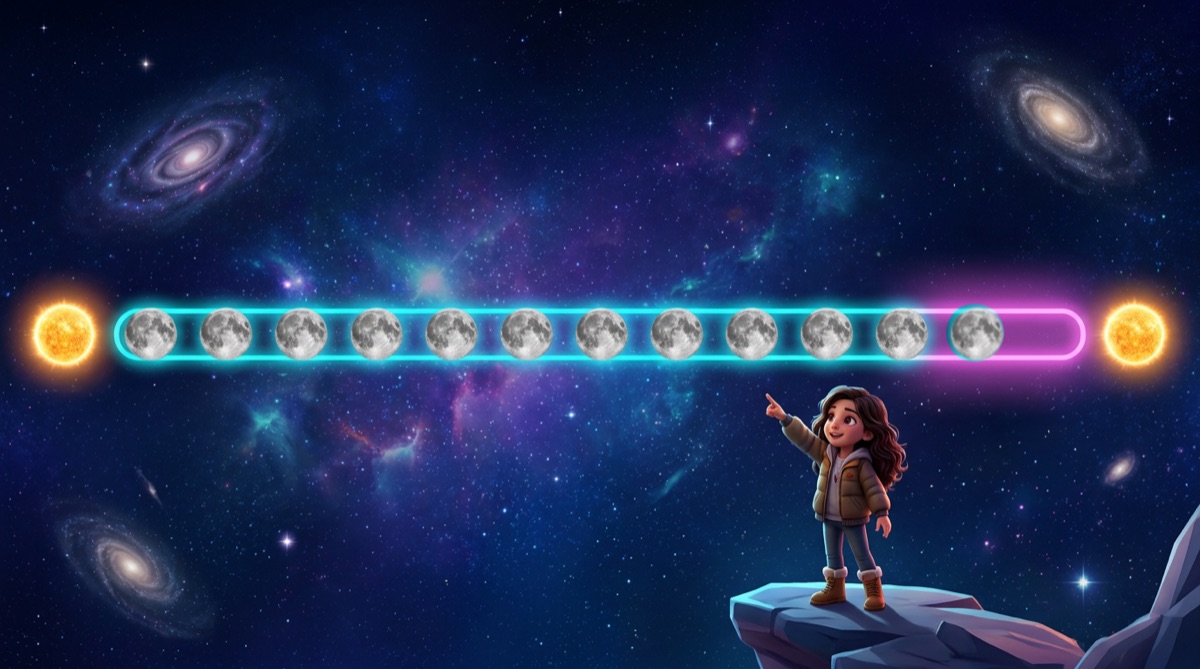
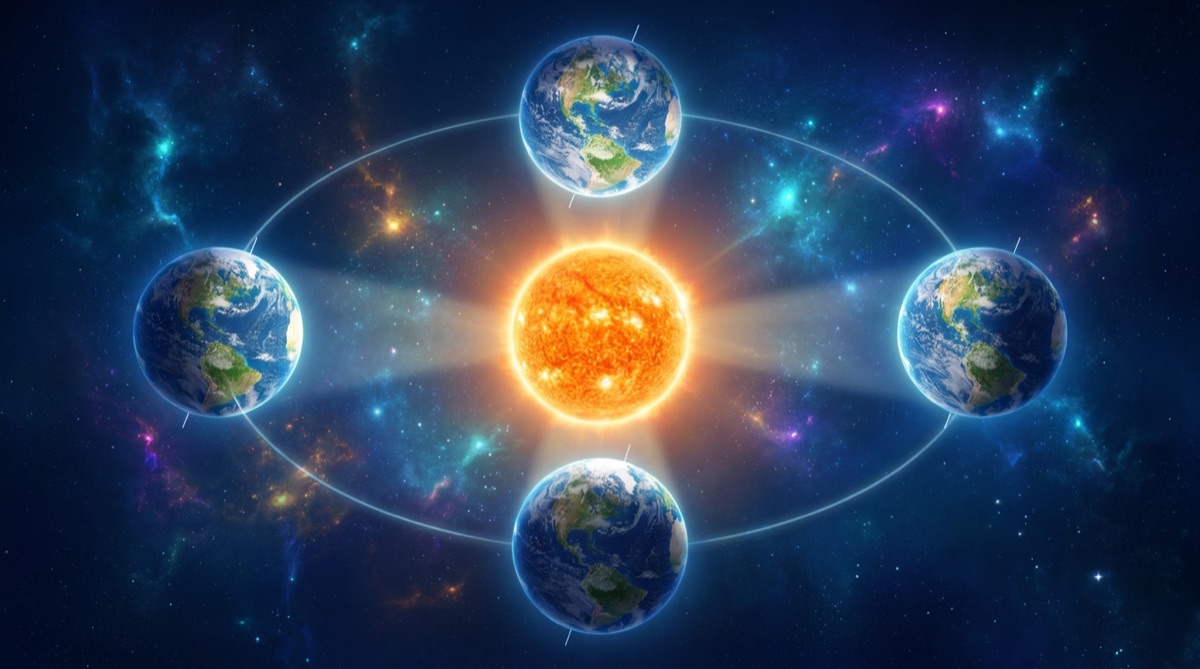
A year is the time the Earth takes to go around the Sun: 365 days (and a little bit more).
How many moons fit in a year? Let’s try 12:
And 365 − 354 = 11. There are 11 days missing!
Twelve moons are 11 days shorter than a year. That small difference is a huge problem for a calendar.
If each year starts 11 days earlier, after 3 years the harvest festival falls 33 days earlier… when there is still nothing to harvest! After about 33 years, the festival has gone all the way around the seasons.
Each culture solved this problem in its own way.
Calendars of many cultures
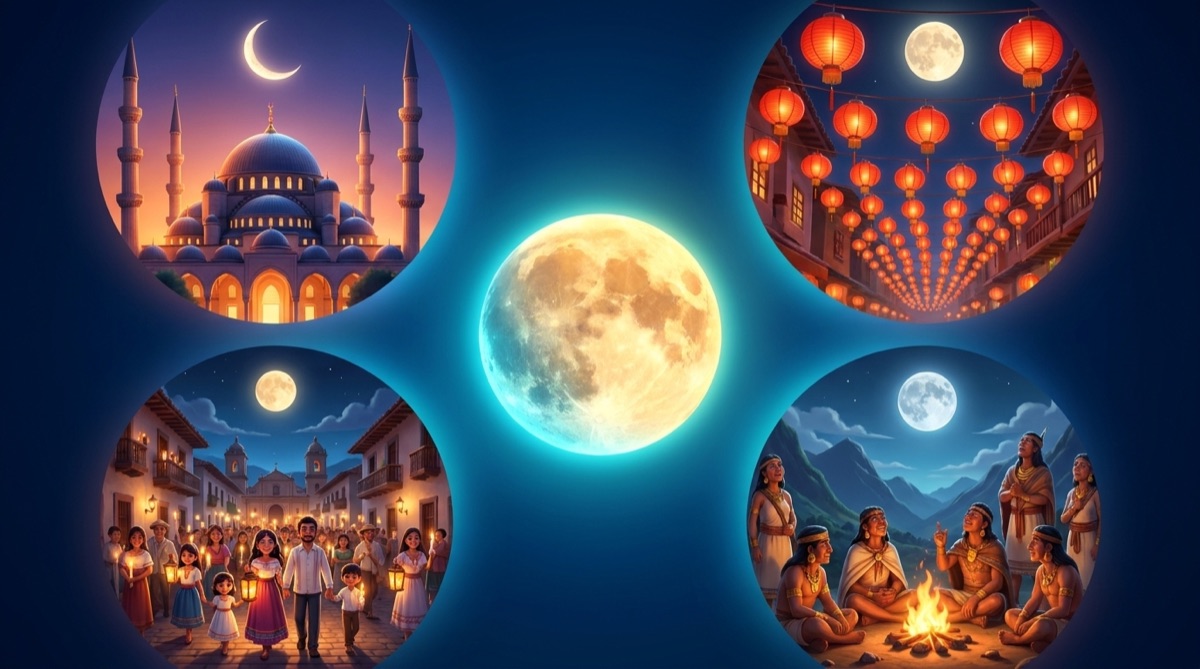
The Muslim calendar. It has 12 lunar months and nothing more: 354 or 355 days. Each month begins when someone sees the first thin crescent after the new moon. That is why the month of Ramadan moves about 11 days earlier each year and travels through all the seasons in about 33 years.
The Chinese and Hebrew calendars. They have lunar months, but every so often they add an extra month: 7 extra months in every 19 years. That way the months follow the Moon and the year follows the Sun. They are called lunisolar calendars. That is why Chinese New Year falls on a different date each year, in late January or in February.
Holy Week. In the United Kingdom, Holy Week changes its date every year. Why? Because Easter Sunday is set by the Moon: it is the Sunday after the first full moon following the start of spring in the north (March 21). Look:
| Year | Easter Sunday |
|---|---|
| 2026 | April 5 |
| 2027 | March 28 |
| 2028 | April 16 |
| 2029 | April 1 |
The Muisca calendar. The Muisca, who lived where Bogotá, Tunja and Sogamoso are today, also counted by moons. A chronicler of the 16th century, Fray Pedro Simón, wrote that they had “a year of twelve moons or months”. A priest of the 18th century, José Domingo Duquesne, also described a long year of 37 moons with an extra month so as not to fall out of step with the sowing seasons. Today’s researchers, such as the anthropologist Manuel Arturo Izquierdo, warn that this description is a reconstruction and that not everything is confirmed. But one thing is certain: for the Muisca, as for almost all ancient peoples, the Moon kept time.
Our calendar. Today’s months (January, February…) have 30 or 31 days and no longer follow the Moon: they follow only the Sun. That is why the full moon falls on a different day each month.
Play with the simulator

Switch the simulator to real date.
- Find today’s date. What phase is the Moon in?
- Move forward day by day until the next new moon. Write down the date.
- Keep moving forward and write down the dates of the first quarter, the full moon and the last quarter. Do about 7 days go by between one and the next?
- Move forward to the next new moon. Count the days: did you get 29 or 30?
Activity: my lunar calendar
You need: a calendar page for next month (or a grid of 5 rows by 7 columns drawn by you), colored pencils, the simulator in real date mode (or a calendar that shows the phases) and a pencil.
- Write the names of the days in the top row and number the days of the month.
- With the simulator, find the date of that month’s new moon and draw a black circle in that box.
- Count 7 boxes forward and draw a half circle: that will be the first quarter. Check it in the simulator: were you right, or is it off by a day?
- Count another 7 or 8 boxes and draw a full circle: the full moon. Check.
- Continue with the last quarter and the next new moon. How many days went by since the first new moon?
- Hang the calendar in your room and, every night you can, look at the Moon and put a check mark if your drawing looks like what you see.
Question: if the calendar month has 31 days and the lunar month has 29 and a half, can there be two full moons in the same month? How many days would have to separate them?
Exercises
- Today there is a new moon. In how many days will there be a full moon? And a last quarter?
Show solution
Full moon at the middle of the lunar month: about 15 days (14.75). Last quarter at three quarters: about 22 days (15 + 7).
- If 12 moons are 354 days and the year has 365, how many days are missing? How many days would be missing after 3 years?
Show solution
365 − 354 = 11 days. In 3 years: 11 × 3 = 33 days, more than a whole lunar month. That is why the Chinese and Hebrew calendars add an extra month every two or three years.
- A lunisolar calendar adds 7 extra months in 19 years. How many months does it have in total in those 19 years? Hint: first 19 × 12.
Show solution
19 × 12 = 228 normal months. Plus the 7 extra ones: 228 + 7 = 235 lunar months in 19 years. Some of those years have 13 months instead of 12.
- The full moon of March 2027 is on March 22. What day is Easter Sunday in 2027? Hint: the Sunday after the first full moon following March 21. Use a calendar.
Show solution
March 22, 2027 is a Monday and it is the first full moon after March 21. The following Sunday is March 28, 2027, just as the table says.
- In the Muslim calendar, a festival falls today on June 10. On about what date will it fall next year?
Show solution
About 11 days earlier: around May 30. Each year it moves 11 days earlier, because 12 moons are 354 days and not 365.
✦ Mini-quiz
Remember
- The lunar month lasts 29 and a half days: from new moon to new moon.
- A quarter of the lunar month is about 7 days: a week. Half, about 15.
- 12 moons = 354 days, 11 days fewer than the year.
- Some calendars follow only the Moon (Muslim); others add an extra month to follow the Sun too (Chinese, Hebrew); ours follows only the Sun.
- The Muisca counted by moons, although the details of their calendar are still being studied.
🍎 Teacher guide
- Time
- 2 sessions of 55 min + a one-month lunar calendar at home
- Colombian national standard (MEN)
- Natural Sciences, Grades 1 to 3 (MEN, 2006): 'I record the movement of the Sun, the Moon and the stars in the sky over a period of time'; 'I record my observations in an organized and rigorous way (without alterations), using drawings, words and numbers'. Mathematics, Grades 1 to 3: 'I describe measurement situations using common fractions'; 'I recognize and describe regularities and patterns in different contexts (numerical, geometric, musical, among others)'; 'I recognize in objects properties or attributes that can be measured (length, area, volume, capacity, weight and mass) and, in events, their duration'.
- Evidence of learning
- Splits the lunar month into halves and quarters and relates them to the week; calculates 12 × 29.5 and the difference from 365; builds a one-month lunar calendar with the four phases and compares it with the sky; explains with an example how a culture fixed the 11 missing days.
Materials
- Calendar pages for next month (one per student)
- Colored pencils
- Paper circles to split into ½ and ¼
- Computer or tablet with the simulator in real date mode
- Calendar of the year with Holy Week marked
Suggested sequence
Session 1. The month and its parts (55 min). Opening (10 min): “how did our grandparents’ grandparents know how long until the harvest?” Development (35 min): review of the 29.5-day cycle; with paper circles the month is split into ½ and ¼ and related to the week; table of fractions and days. Simulator in real date: dates of the next four phases. Closing (10 min): exercise 1 and start of the lunar calendar (activity, steps 1 to 5).
Session 2. Twelve moons and a year (55 min). Opening (10 min): “how many moons fit in a year?”; estimate and then 12 × 29.5 on the board. Development (30 min): reading about the calendars of different cultures; on the year calendar, find Holy Week this year and next; exercises 2 to 5 (exercise 3 for Grade 3). Closing (15 min): mini-quiz and agreement to review the lunar calendar from home in a month.
For Grade 3: exercise 3 (multiply 19 × 12 and add) and the final question of the activity about two full moons in a 31-day month (yes, if the first one falls on the 1st or the 2nd).
Note on the data. The Easter dates are those of the Gregorian calendar, valid for Colombia and for any country that uses the Gregorian calendar. The full moon of March 22, 2027 can be checked in the simulator in real date mode.
Common mistakes
- Believing that the calendar month and the lunar month are the same thing. Show in the simulator that the full moon falls on a different day each month.
- Thinking that a week is "exactly" a quarter of a moon. 29.5 ÷ 4 = 7.4: the week is an approximation, and that is why sometimes 8 days go by between two phases.
- Subtracting 354 − 365 "backward". Work on the subtraction with the number line: from 354 to 365 there are 11 steps.
- Presenting the Muisca calendar as a settled fact. Explain that historians reconstruct it from old texts and that some parts are under discussion; it is a good opportunity to talk about how the past is investigated.