A robot on Mars
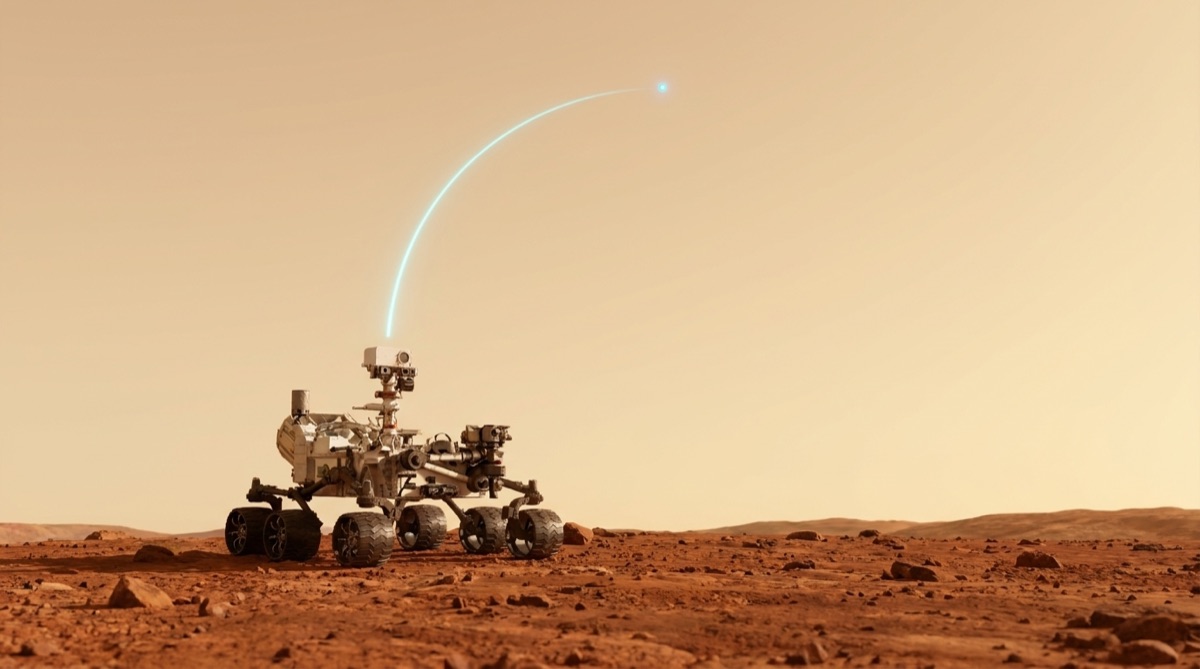
A robot is exploring Mars. From Earth, an engineer sends it the command: “move forward one meter”. Minutes go by… and the robot does not move. Is it broken?
No. The command travels by radio at the speed of light, and even so it takes several minutes to arrive. Today we are going to calculate how many.
What is speed?

Speed tells us what distance something travels in a certain time.
If a bicycle travels 30 km in 2 hours, its speed is km per hour.
Light is extremely fast
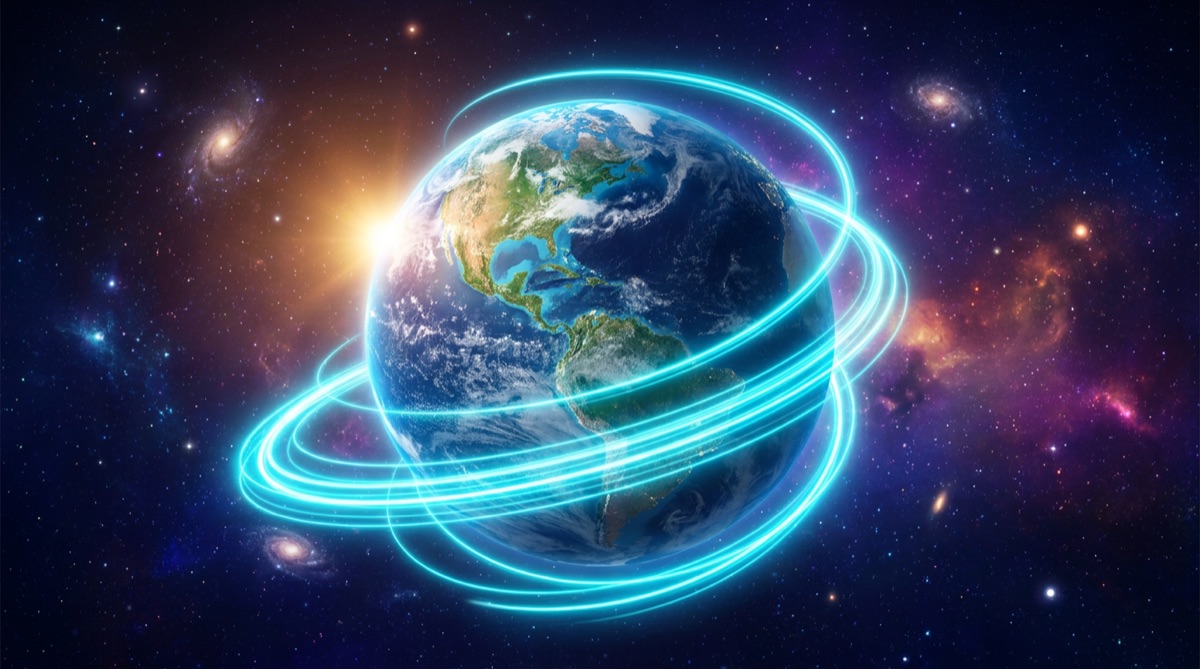
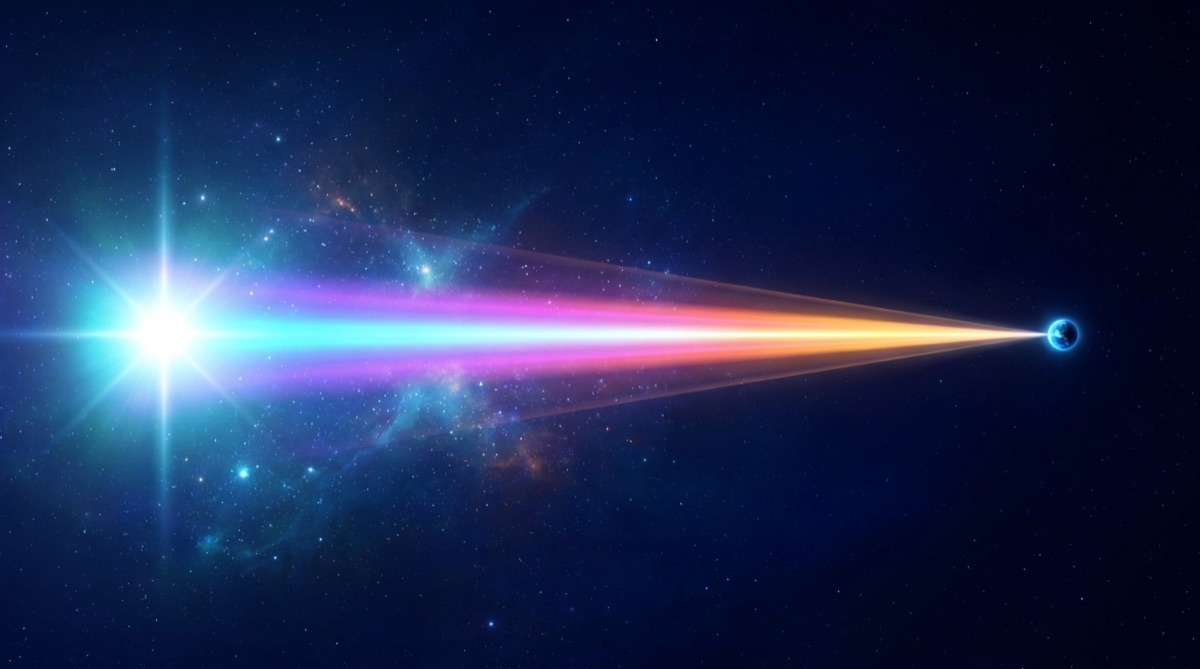
Light travels at about 300 000 km per second.
In a single second it could go around Earth about 7 and a half times. Nothing in the universe travels faster.
But the Solar System is so big that even light takes time to cross it!
How long does sunlight take to reach Earth?
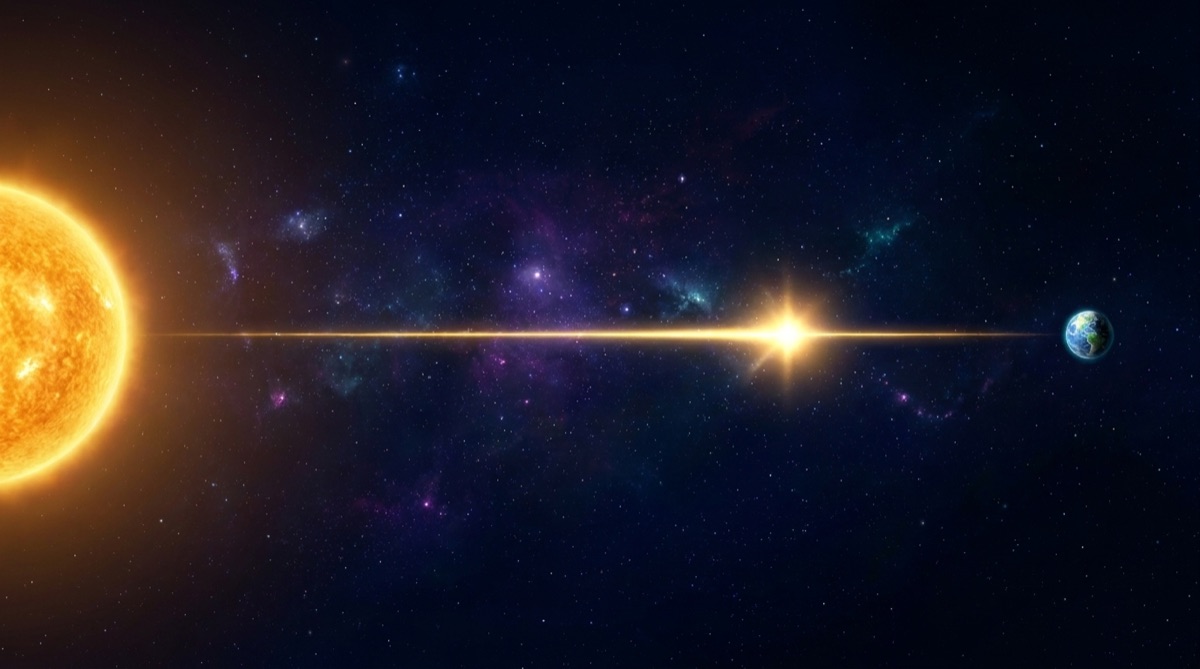
If we know the distance and the speed, we can find the time:
Earth is about 150 000 000 km from the Sun. So:
The zeros trick: we remove the same number of zeros from both numbers (five zeros from each):
From seconds to minutes

A minute has 60 seconds. We divide 500 by 60:
The quotient (8) is the minutes and the remainder (20) is the seconds left over. Sunlight takes 8 minutes and 20 seconds to arrive. (With the exact distance it is 8 min 19 s: our calculation is very good!)
Careful with the calculator: 500 ÷ 60 = 8.33… That “0.33” is not 33 seconds. It is 0.33 of a minute, that is, a third of 60: 20 seconds. That is why it is better to use quotient and remainder.
Looking at the sky is looking into the past
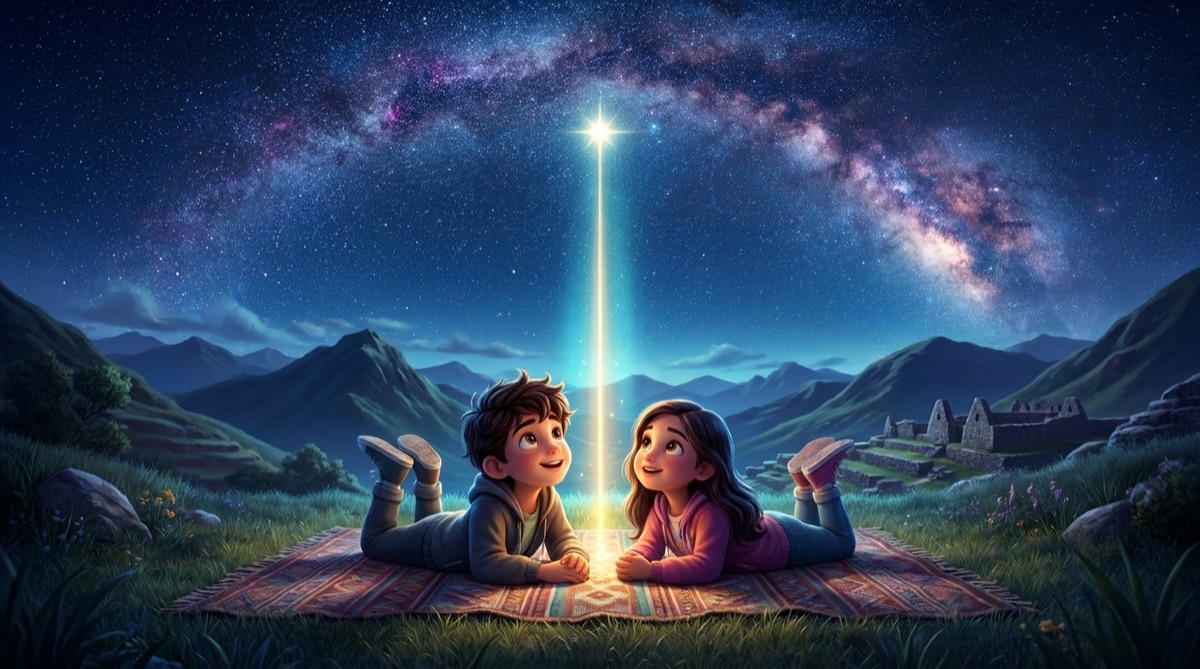
When you see the Sun, you see light that left it 8 minutes ago. If the Sun suddenly went out, it would take us 8 minutes to find out!
Light from the Moon takes a little over 1 second to arrive: 384 400 ÷ 300 000 ≈ 1.3 s.
With the stars it is much longer. The distances are so big that they are measured in light-years: a light-year is the distance light travels in one year (about 9 and a half trillion km). It is a distance, not a time.
| Star | How many light-years away? | The light you see tonight left… |
|---|---|---|
| Alpha Centauri | 4.3 | 4 years ago: when you were in first grade |
| Sirius | 8.6 | 8 and a half years ago: when you were a baby |
| Canopus | 310 | 310 years ago: before Colombia’s Independence |
| Rigel | about 850 | 850 years ago: in the Middle Ages |
| Deneb | about 2 600 | 2 600 years ago: in the time of the ancient Greeks |
The farther we look, the further back in time we see.
The message to the robot
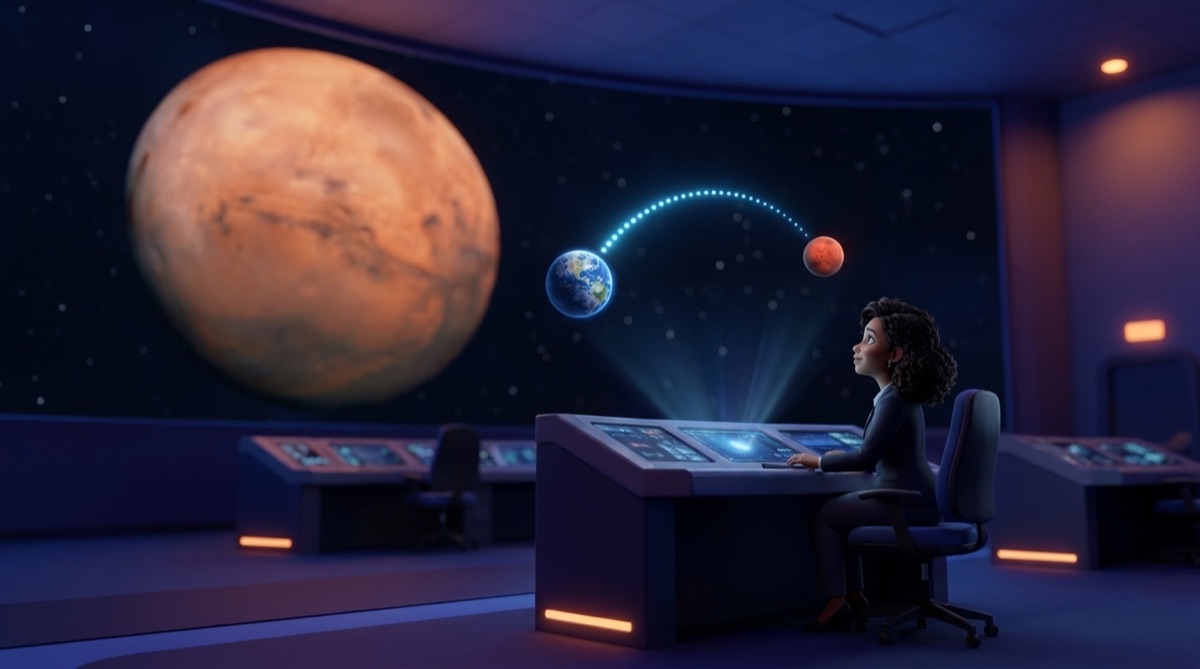
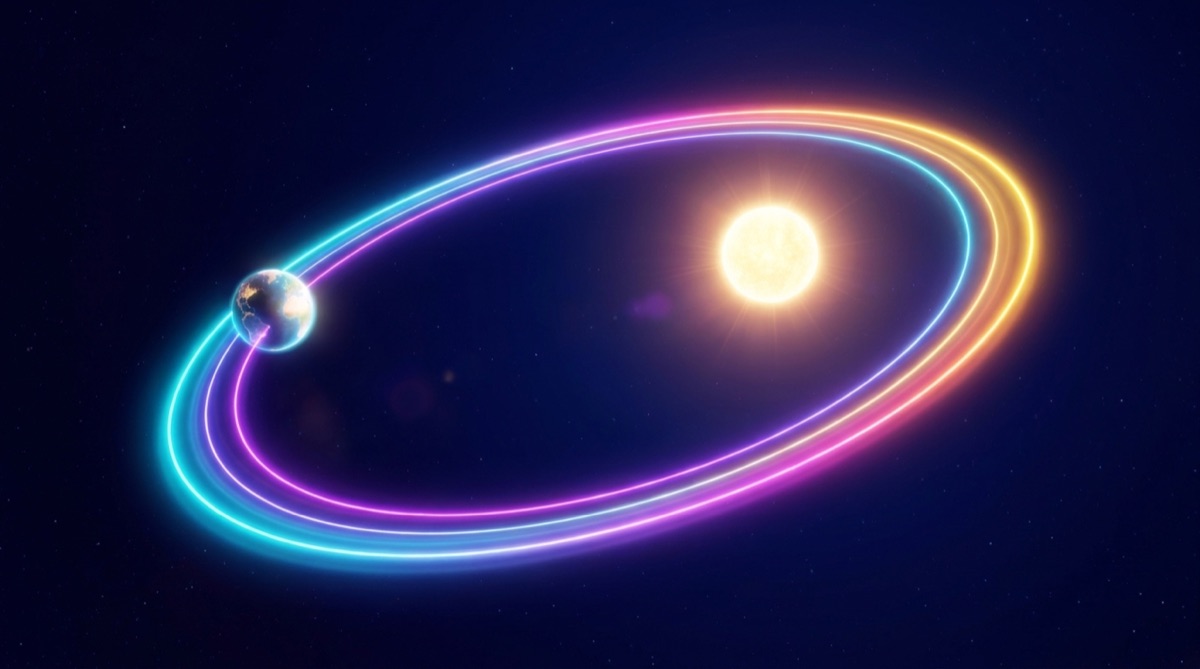
Mars is sometimes close to Earth (about 55 million km) and sometimes far (about 400 million km), depending on where the two planets are in their orbits.
- Close: 55 000 000 ÷ 300 000 = 550 ÷ 3 ≈ 183 s ≈ 3 minutes.
- Far: 400 000 000 ÷ 300 000 = 4 000 ÷ 3 ≈ 1 333 s ≈ 22 minutes.
That is why the engineer waits between 3 and 22 minutes for the command to reach the robot. And just as long to receive the answer. Mars robots have to think for themselves!
The light table
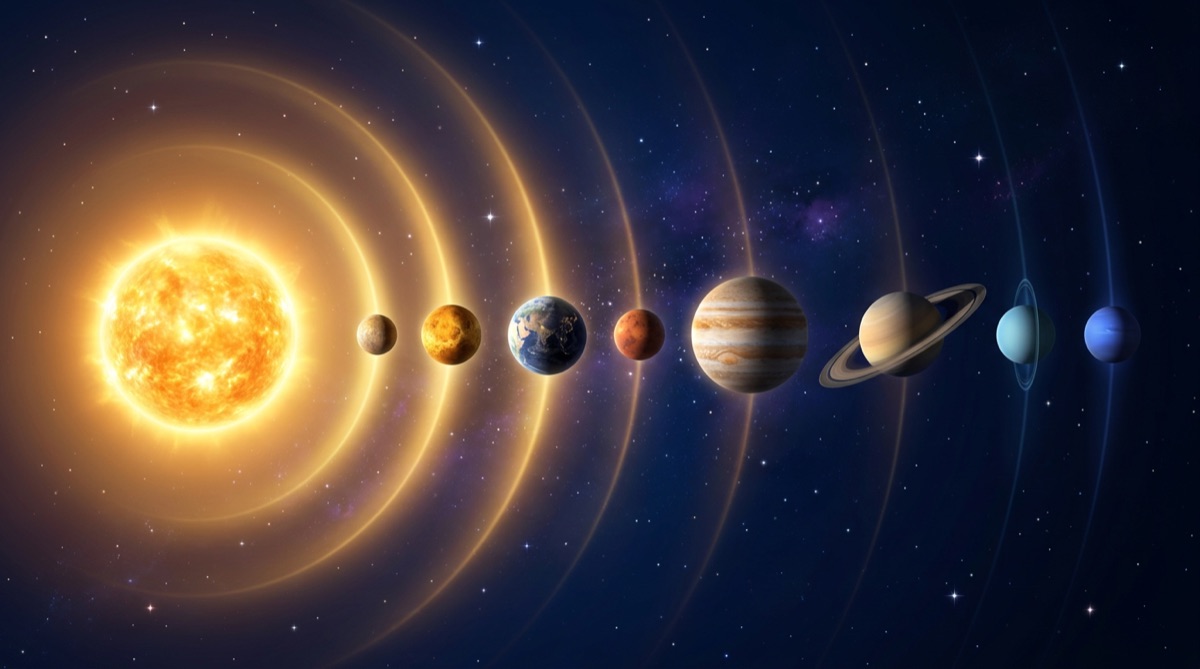
| Planet | Distance to the Sun (millions of km) | Light time |
|---|---|---|
| Mercury | 58 | 3 min 13 s |
| Venus | 108 | 6 min 1 s |
| Earth | 150 | 8 min 19 s |
| Mars | 228 | ? |
| Jupiter | 778 | ? |
| Saturn | 1 427 | 1 h 19 min |
| Uranus | 2 871 | ? |
| Neptune | 4 498 | 4 h 10 min |
Fill in the missing ones (they are exercises 1 to 3). Steps:
- Write the distance with all its zeros (228 million = 228 000 000).
- Divide by 300 000 (remove five zeros from each number and divide by 3).
- Convert the seconds to minutes (÷ 60). If it goes past 60 minutes, convert them to hours (÷ 60 again).
Play with the simulator

Open the Distances tab and launch the light rocket.
- At ×1 (real time), how long do you have to wait for it to reach Earth?
- Switch to ×60: now each second is a minute. How long does it take to reach Jupiter?
- At ×3600 each second is an hour. How long does it take to reach Neptune?
- Switch to the Logarithmic (all at once) scale to see the whole journey at once.
Activity: light at a snail’s pace
In the model from the lesson “The Solar System to scale”, the Sun is a 22 cm ball and Earth is 24 m away.
Materials: tape measure or rope with a knot every meter, chalk, a stopwatch (the one on a phone will do).
- Mark the Sun and Earth with chalk, 24 m apart.
- In the model, light takes the same 8 minutes to cover those 24 m. How many meters does it cover in one minute? meters per minute.
- One student is the “light”: they must move forward 3 m every minute. Another one keeps time and calls it out.
- How fast is that? More or less like a snail in a hurry!
- Mark Mars at 36 m. How many minutes does the “light” take to get there? Compare it with your calculation from exercise 1.
Final question: if light is so slow in the model, why in reality is it the fastest thing there is? (Because the model is 6 300 million times smaller: light also “shrank” in the same proportion.)
Exercises
- How long does sunlight take to reach Mars (228 million km)?
Show solution
228 000 000 ÷ 300 000 = 2 280 ÷ 3 = 760 s. 760 ÷ 60 = 12 remainder 40: 12 min 40 s. (That is the challenge for the “Light Traveler” badge.)
- And to Jupiter (778 million km)?
Show solution
778 000 000 ÷ 300 000 = 7 780 ÷ 3 ≈ 2 593 s. 2 593 ÷ 60 = 43 remainder 13: 43 min 13 s (with exact c, 43 min 16 s).
- And to Uranus (2 871 million km)? Convert it to hours and minutes.
Show solution
2 871 000 000 ÷ 300 000 = 28 710 ÷ 3 = 9 570 s. 9 570 ÷ 60 = 159 min remainder 30 s. 159 ÷ 60 = 2 h remainder 39 min: 2 h 39 min 30 s (with exact c, 2 h 40 min).
- A student uses the calculator for Mars and gets 12.67 minutes. She says: “that is 12 minutes and 67 seconds”. What mistake did she make? What is the correct answer?
Show solution
0.67 minutes is not 67 seconds: it is 0.67 × 60 = 40 seconds. The correct answer is 12 min 40 s. A minute does not have 100 seconds but 60.
- Light from Sirius takes 8.6 years to arrive. If one night you see Sirius and you are 10 years old, how old were you when that light left the star? What would happen if Sirius had gone out 5 years ago?
Show solution
10 − 8.6 = 1.4 years: you were a baby. If Sirius had gone out 5 years ago, we would still see it for 3.6 more years, because its last light is still traveling toward us.
✦ Mini-quiz
Remember
- Speed is distance divided by time; with it we can calculate how long a trip takes.
- Light travels at 300 000 km per second and takes about 8 minutes to get from the Sun to Earth.
- To divide numbers with lots of zeros, we remove the same number of zeros from both.
- To go from seconds to minutes we divide by 60: the remainder is the seconds left over.
- Everything we see in the sky, we see as it was in the past.
🍎 Teacher guide
- Time
- 2 sessions of 55 min
- Colombian national standard (MEN)
- Natural Sciences, Grades 4 to 5: 'I compare movements and displacements of living beings and objects'; 'I describe the main elements of the solar system and establish relationships of size, movement and position'. Mathematics, Grades 4 to 5: 'I solve and pose problems whose solution strategy requires the relationships and properties of the natural numbers and their operations'; 'I recognize the use of some magnitudes (length, area, volume, capacity, weight and mass, duration, speed, temperature) and of some of the units used to measure quantities of the respective magnitude in additive and multiplicative situations'; 'I identify, in the context of a situation, the need for an exact or approximate calculation and the reasonableness of the results obtained'.
- Evidence of learning
- Calculates the light time to Mars, Jupiter and Uranus by canceling zeros and expressing the result in minutes and seconds (or hours and minutes) with quotient and remainder; explains with an example (the Sun going out, Sirius) why seeing the sky is seeing the past; identifies the light-year as a distance.
Materials
- Tape measure or rope with a knot every meter, chalk
- Stopwatch (a phone will do)
- Photocopy of the light table
- Calculator (only to check, after calculating by hand)
- Computer or tablet with the simulator (Distances tab, light rocket)
Suggested sequence
Session 1. Speed and sunlight (55 min). Opening (10 min): the story of the robot on Mars: “why does it not obey right away?”. Development (35 min): speed = distance ÷ time with the bicycle; calculating the 500 seconds with the zeros trick; converting to minutes with quotient and remainder; simulator with the light rocket at ×1 and ×60. Closing (10 min): exercise 1 (Mars) in pairs.
Session 2. Looking into the past (55 min). Opening (10 min): “If the Sun went out, when would we notice?”. Development (30 min): table of stars and light-years; the message to the robot (3 to 22 minutes); light-at-a-snail’s-pace activity in the schoolyard, with Mars at 36 m. Closing (15 min): exercises 2 to 5 and mini-quiz.
Note on the data. We use 300 000 km/s; the exact value is 299 792.458 km/s. The difference (less than 0.1 %) changes the results by at most a few seconds. The distances to Mars (55 and 400 million km) are approximate values for the minimum and maximum Earth–Mars distance. The distances to Rigel and Deneb have large uncertainty; the table rounds them.
Common mistakes
- Reading 8.33 minutes as “8 min 33 s”. Work on the sexagesimal system: 0.33 min = 20 s. Exercise 4.
- Believing that the light-year is a time. Repeat: it is the distance light travels in one year.
- Thinking that light arrives “instantly”. The snail activity and the simulator rocket at ×1 make the 8-minute wait felt.
- Removing zeros from only one number when dividing. Show with 1 500 ÷ 3 and 150 ÷ 3 that the result changes if they are not removed equally.
- Believing that the stars we see “might no longer exist” in general. It is true only for a few very distant, short-lived ones; most bright stars are less than a thousand light-years away and live for millions of years.