Where does the Sun go?
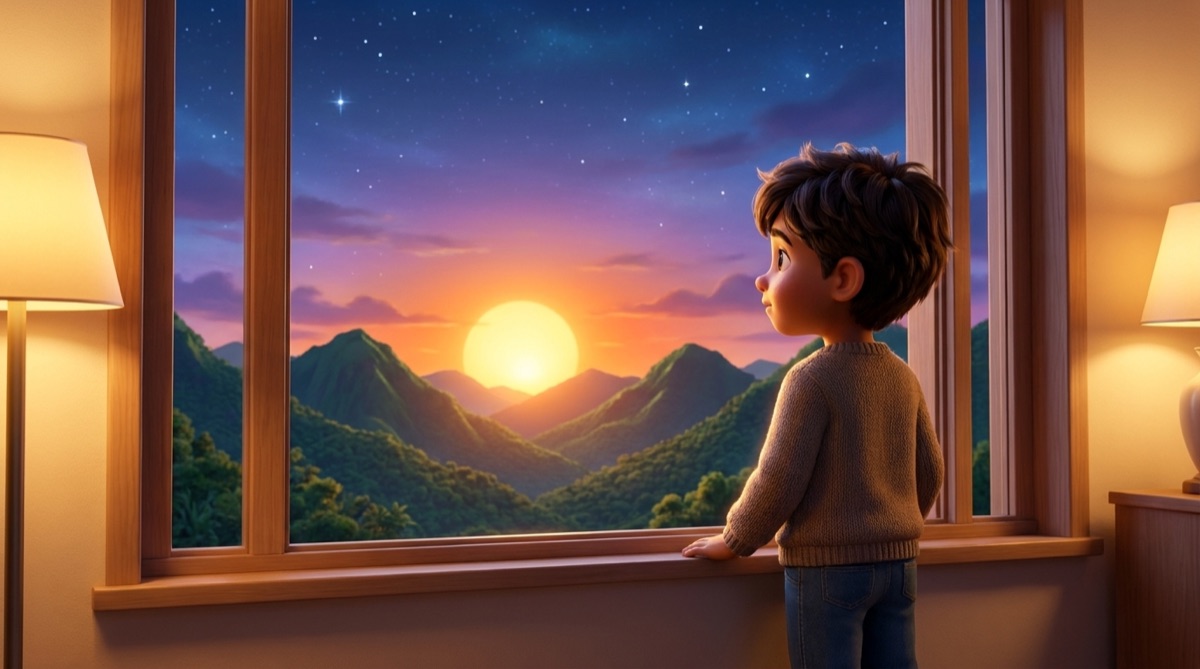
In the afternoon the Sun hides. It gets dark. In the morning it comes back.
Did it go to sleep? Did it hide behind the mountain? Today we are going to find out with an orange and a flashlight.
Earth spins like a top
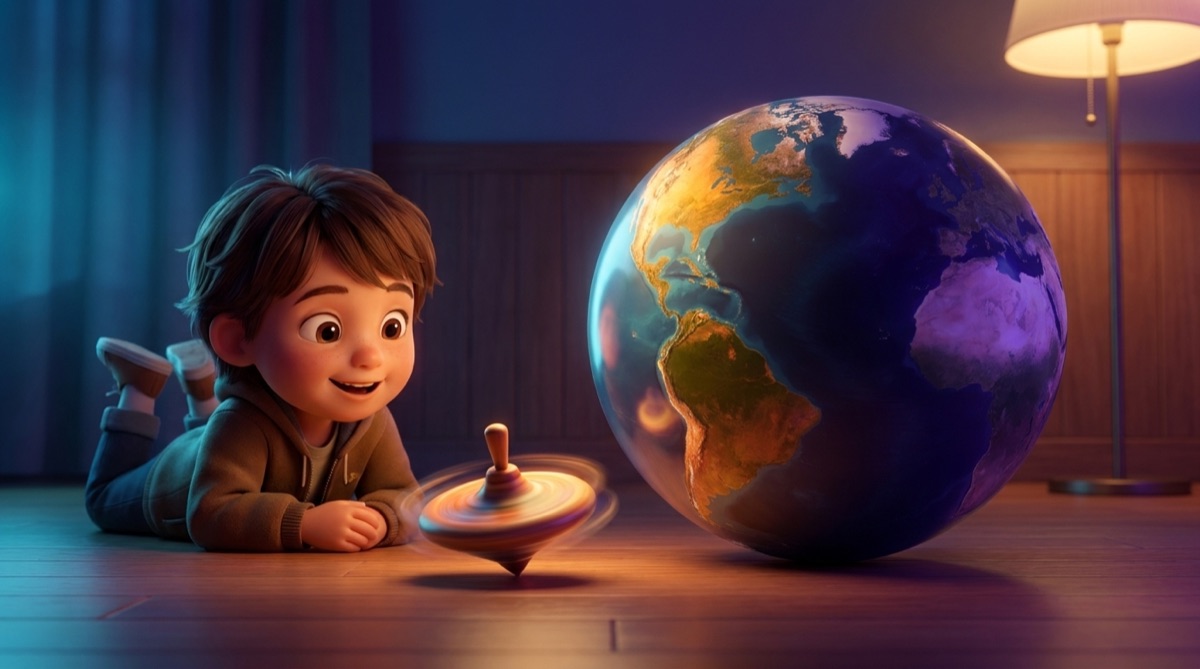
Have you ever played with a spinning top? The top turns round and round.
Earth turns round too. And we are riding on top of it! We do not feel it because it turns very smoothly.
The Sun is a big lamp
The Sun gives light. But it only lights up one side of Earth.
- The side facing the Sun has light: it is daytime.
- The other side is dark: it is nighttime.
Because Earth spins, our side sometimes faces the Sun and sometimes does not. First it is day. Then it is night. And then day again.
The Sun does not move. It is us, with Earth, who are spinning.
The flashlight and orange game
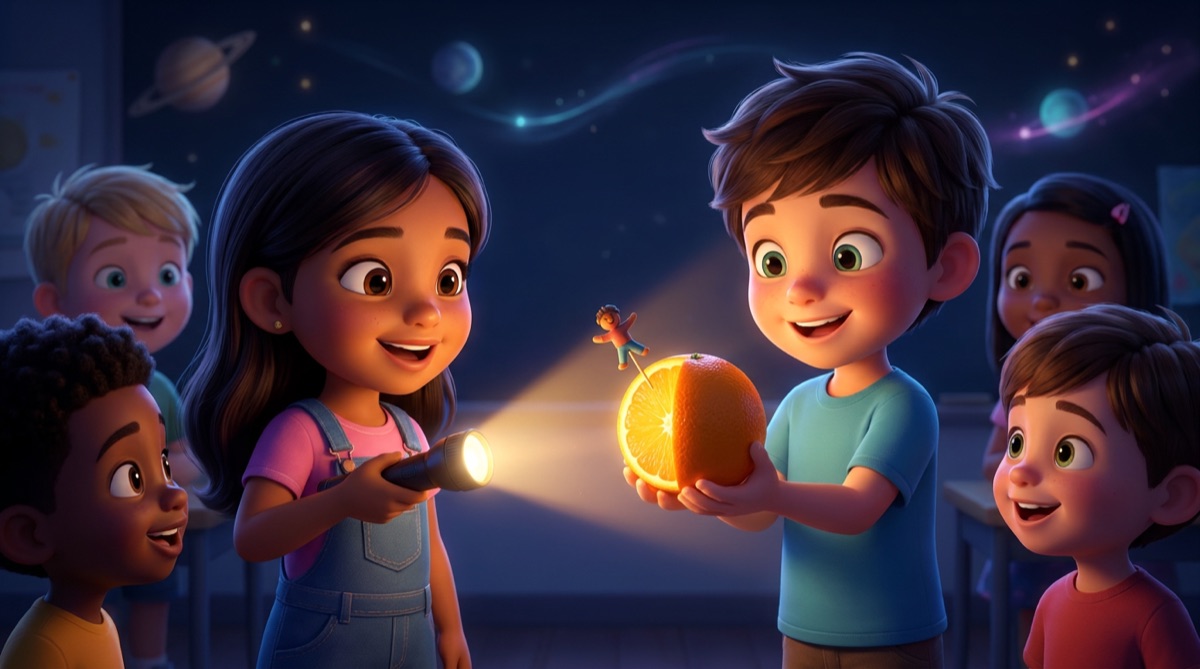
You need: an orange, a toothpick, a little clay figure and a flashlight.
- Stick the little figure on the orange with a bit of modeling clay. It lives in the United Kingdom.
- Push the toothpick through the orange. Now it can spin like a top.
- Turn off the classroom light. One child shines the flashlight on the orange. The flashlight is the Sun.
- Spin the orange slowly, always the same way.
- When the little figure is in the light, everyone says: “It’s daytime!”
- When it is in the dark, everyone says: “It’s nighttime!”
Questions:
- Does the flashlight light up the whole orange or only one side?
- What happens if we stop spinning the orange?
- Is it the flashlight that moves or the orange?
Now put a second little figure on the other side of the orange. When one has day, what does the other one have? That is how it is on Earth: when it is daytime in the United Kingdom, on the other side of the world it is nighttime.
Play with the simulator
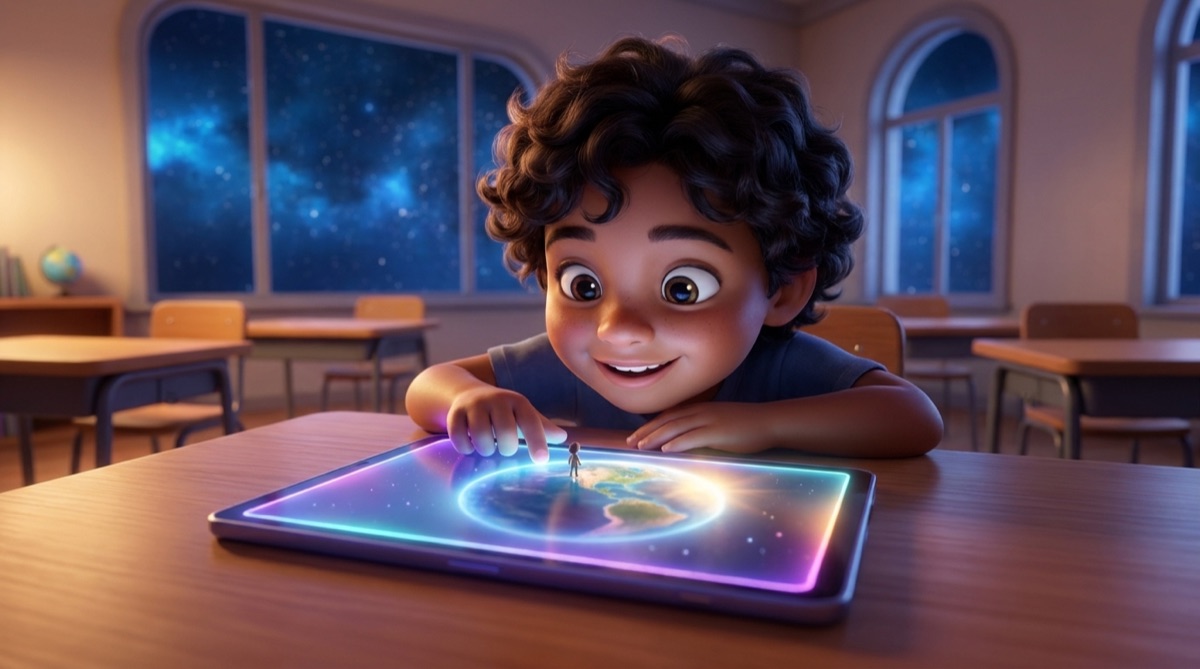
Use Explorer mode.
- Press ▶ Spin. Look at the little figure: it lives in the United Kingdom.
- When is it in the light? When is it in the dark?
- Press Morning, Noon, Afternoon and Night.
- Look at the stick. Does it have a shadow at night?
It’s daytime!
Before and after: the daily routine
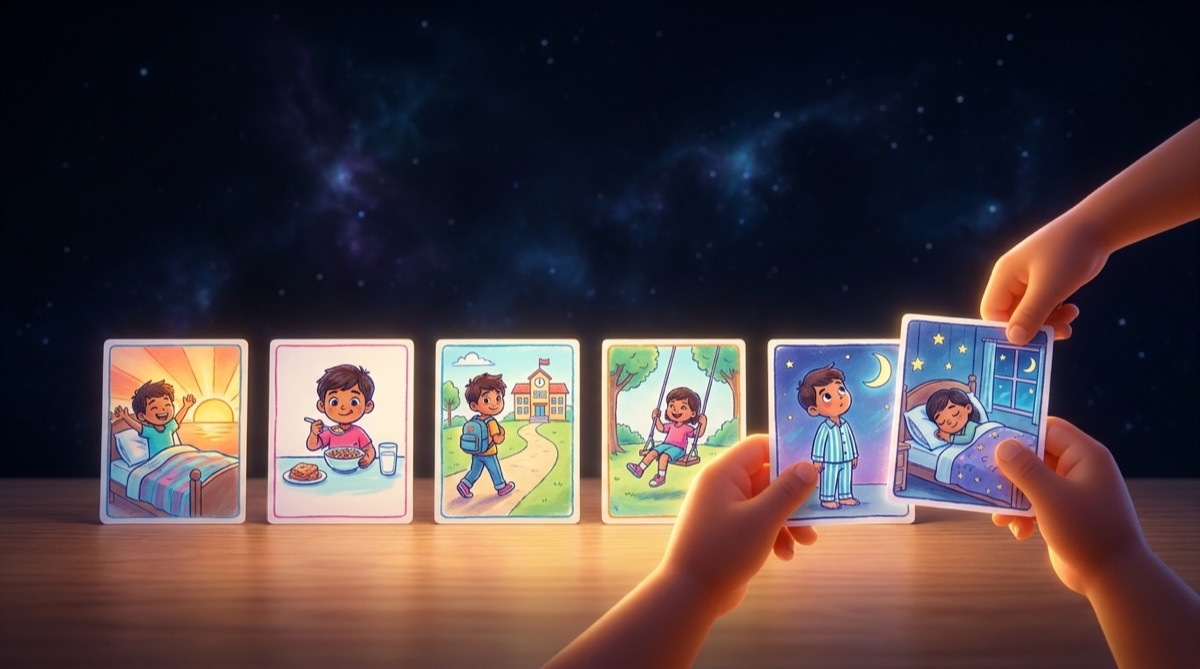
Look at these things we do. Which ones do we do in the daytime? Which ones at night?
| Activity | Day or night? |
|---|---|
| Eat breakfast | |
| Go to school | |
| Play in the park | |
| Look at the Moon and the stars | |
| Put on pajamas | |
| Sleep |
Now put them in order. Draw each one on a card. Put the cards in a row: what goes first? What goes after? What goes last?
Hint: “First I wake up, then I eat breakfast, before going to sleep I put on my pajamas”.
And when the night ends, what comes next? Another day! The routine repeats every day.
The hours of the day
Let’s count the hours
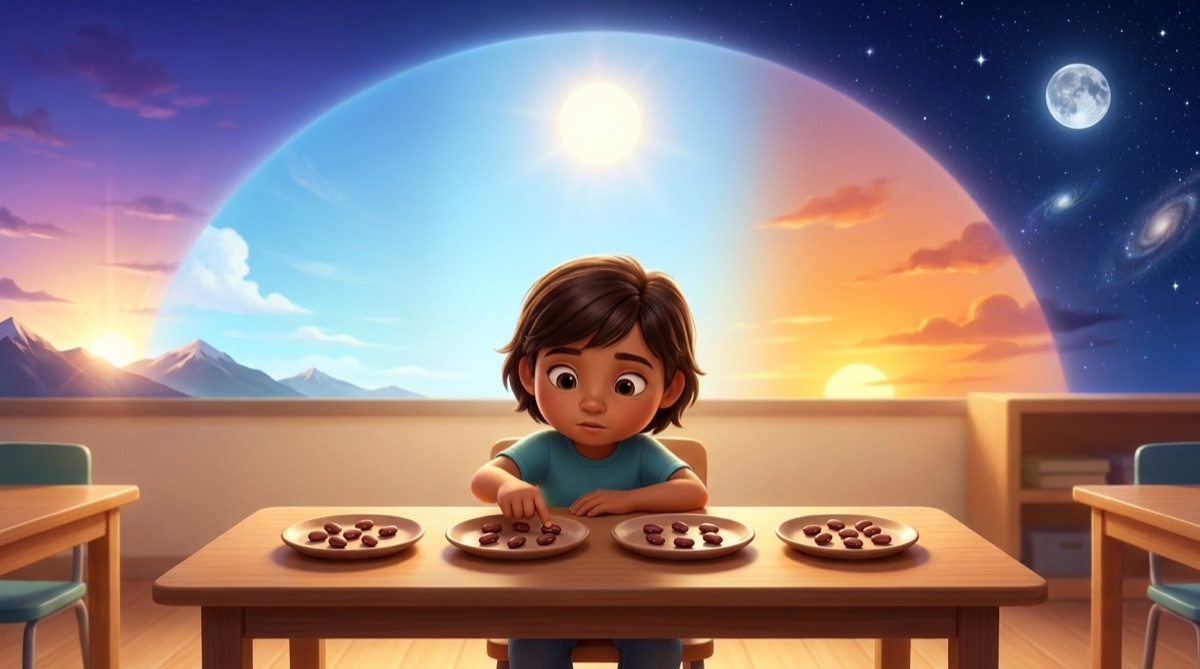
A whole day, with its night, lasts 24 hours. 24 is a big number. Let’s count it in groups.
You need: 24 beans (or bottle caps, or pebbles) and 4 plates.
- Put 6 beans on the first plate. That is the early morning.
- Put 6 on the second plate. That is the morning.
- Put 6 on the third one. That is the afternoon.
- Put 6 on the fourth one. That is the night.
- Now count all the beans, one by one. How many are there?
That is 24 hours! In that time Earth makes one full turn.
The clock and the Sun
In Colombia the Sun rises at about 6 in the morning and hides at about 6 in the afternoon. It is like that all year round, because we live near the middle of Earth.
Near the equator the Sun rises at about 6 in the morning and hides at about 6 in the afternoon. In the United Kingdom the time changes a little during the year. To count, we use a day with 12 hours of light and 12 of night.
Count with the plates:
- Morning and afternoon are 2 plates: 6 + 6 = 12 hours of light.
- Night and early morning are 2 plates: 6 + 6 = 12 hours of darkness.
Half day and half night!
Find the times of your routine on a clock:
| Time | What do I do? | Day or night? |
|---|---|---|
| 6 in the morning | I wake up | Day (the Sun is rising) |
| 7 in the morning | I go to school | Day |
| 12 noon | I eat lunch | Day |
| 6 in the afternoon | The Sun hides | It gets dark |
| 8 at night | I put on my pajamas | Night |
Exercises
- Why does it get dark at night? Explain it with the orange.
Show solution
Because Earth spins. When our side of the orange (Earth) is facing the flashlight (the Sun), it is daytime. When it turns and ends up in the dark, it is nighttime. The Sun does not go out or go away: we are the ones spinning.
- How many hours does a whole day have? How many plates of 6 beans do you need?
Show solution
A whole day has 24 hours. You need 4 plates of 6: 6 + 6 + 6 + 6 = 24.
- Put in order: eat lunch, eat breakfast, sleep, go to school.
Show solution
Eat breakfast, go to school, eat lunch, sleep.
- For Grade 1: if today Earth makes one turn and tomorrow another one, how many hours went by in the two days?
Show solution
24 and 24 are 48 hours. Count: 24 + 24 = 48.
- Near the equator, how many hours of light are there and how many of darkness?
Show solution
About 12 hours of light and about 12 of darkness: 12 + 12 = 24.
✦ Mini-quiz
Remember
- Earth spins like a top.
- The Sun lights up half of Earth.
- If our side faces the Sun, it is daytime. If not, it is nighttime.
- First day, then night, and it starts over again.
- One turn of Earth lasts 24 hours: 12 of light and 12 of night (near the equator).
🍎 Teacher guide
- Time
- 2 moments of 25 min (Preschool) or 1 session of 55 min (Grade 1)
- Colombian national standard (MEN)
- Preschool DBA (MEN, 2016): DBA 14 'Builds notions of space, time and measurement through everyday experiences' (evidence: 'Recognizes the before, the now and the after of an event'); DBA 12 'Establishes relationships between the causes and consequences of events that happen to them or around them'; DBA 16 'Determines the number of objects that make up a collection by establishing correspondence relationships and actions of joining and separating'. Natural Sciences, Grades 1 to 3 (MEN, 2006): 'I ask questions about objects, organisms and phenomena in my environment and explore possible answers'; 'I record the movement of the Sun, the Moon and the stars in the sky over a period of time'. Mathematics, Grades 1 to 3: 'I recognize meanings of number in different contexts (measurement, counting, comparison, coding, location, among others)'; 'I recognize in objects properties or attributes that can be measured (length, area, volume, capacity, weight and mass) and, in events, their duration'.
- Evidence of learning
- Each child shows with the orange and the flashlight where it is day and where it is night and explains that Earth spins; puts at least 3 cards of their routine in order with “before” and “after”; in Grade 1, also makes the 4 groups of 6 and says that the day has 24 hours.
Materials
- Oranges, toothpicks, modeling clay and flashlights (one per group)
- Blank cards to draw the routine
- 24 beans or bottle caps and 4 plates per group
- A wall clock or a toy clock with hands
- Computer or tablet with the simulator (optional)
Suggested sequence
Moment 1. The orange and the flashlight (25 min). Opening question: “where does the Sun go at night?”; the children draw their idea. Orange game in groups with the chants “it’s daytime!” and “it’s nighttime!”; then, the second little figure. Closing: compare the first drawing with what they saw.
Moment 2. Before, after and the hours (25 min). Routine cards in a row; in Preschool only “before / after” is worked on. In Grade 1, the plates of beans to reach 24 and reading the times of the routine on the clock. Simulator in Explorer mode to close (Spin button). Mini-quiz out loud in Preschool; individual in Grade 1.
Common mistakes
- Believing that the Sun “goes to sleep” or “hides behind the mountain”. Do not correct harshly: ask what they see with the flashlight. The key idea is that Earth spins.
- Thinking that the Sun goes around Earth. In the game, the flashlight stays still and only the orange spins.
- Believing that at night it is night all over the world. The second little figure, on the other side of the orange, shows that it is not.
- There is no need to talk yet about the orbit or the seasons; near the equator, as in Colombia, day and night last almost the same all year round (about 12 hours each), and that is why the beans are split 12 and 12.
- Earth takes 24 hours to see the Sun in the same place again (solar day). The turn with respect to the stars is a little shorter (23 h 56 min), but that difference is for higher grades.