A well with no shadow
More than 2 200 years ago, in Egypt, there lived a scholar named Eratosthenes. He was the director of the Library of Alexandria, the largest in the ancient world.
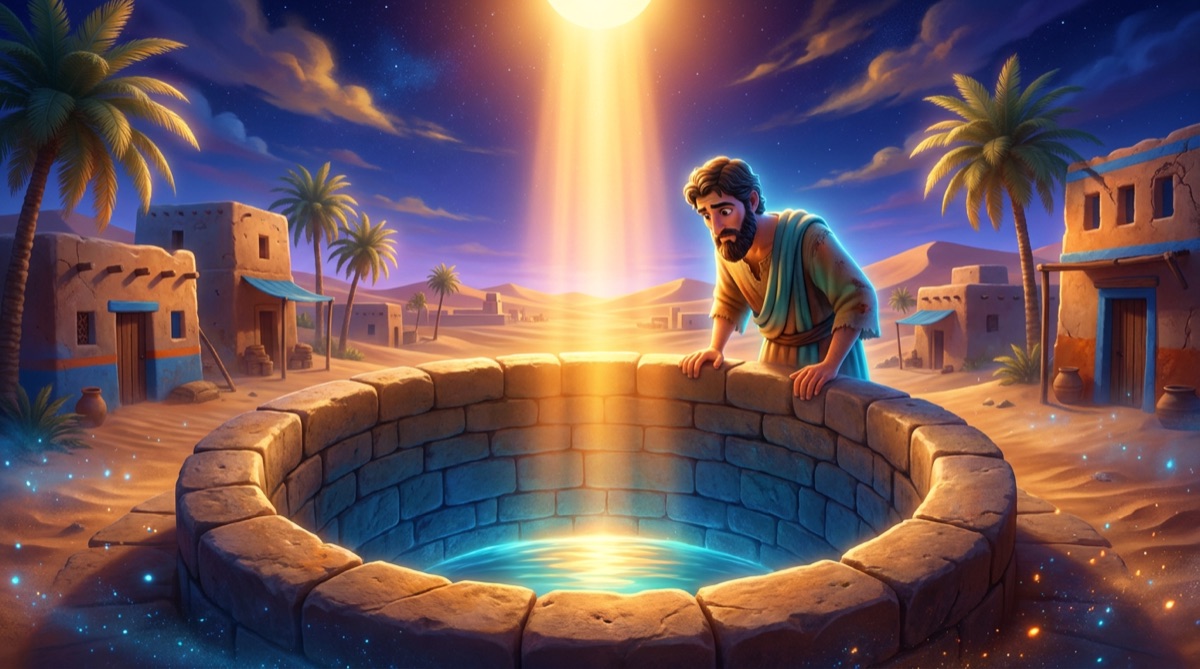
One day he read something curious. In the city of Syene (today Aswan), far to the south, there was a deep well. One day a year, at noon, the Sun lit up the bottom of the well. Sticks cast no shadow. The Sun was right overhead.
Eratosthenes wondered: on that same day, at the same time, do the sticks in Alexandria cast no shadow either?
He measured it. In Alexandria there was a shadow. A short shadow, but a shadow.
How can that be? It is the same Sun and it is the same moment.
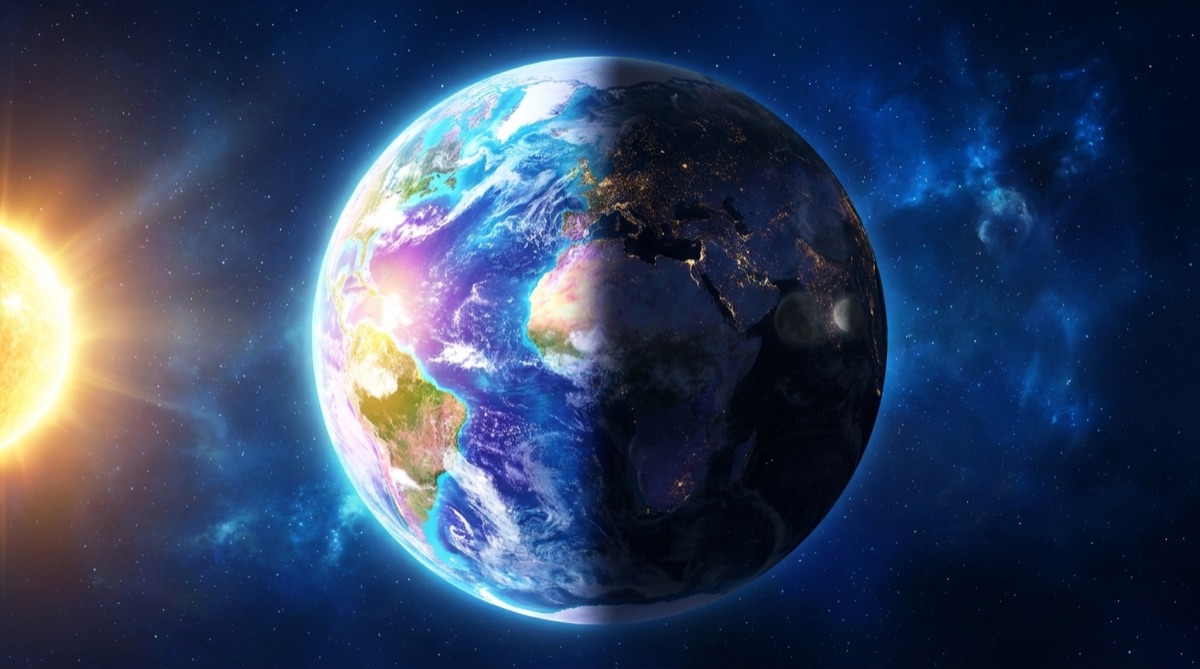
Earth is round
The answer is that Earth is round, like a ball.
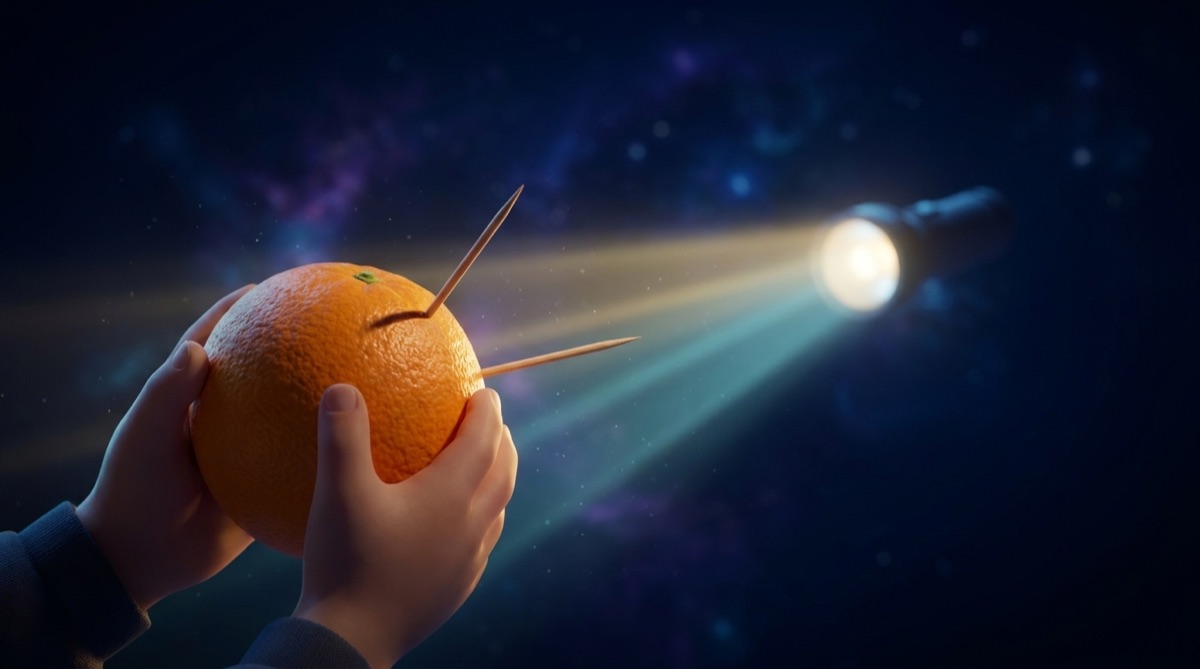
Think of an orange with two toothpicks stuck in it, one at the “equator” and another a little higher up. If you shine a flashlight on the orange from far away, one toothpick points at the light and casts no shadow. The other is a little tilted with respect to the light and does cast a shadow.
Eratosthenes’ two sticks were planted “straight” in the ground, but since Earth curves, they pointed in slightly different directions.
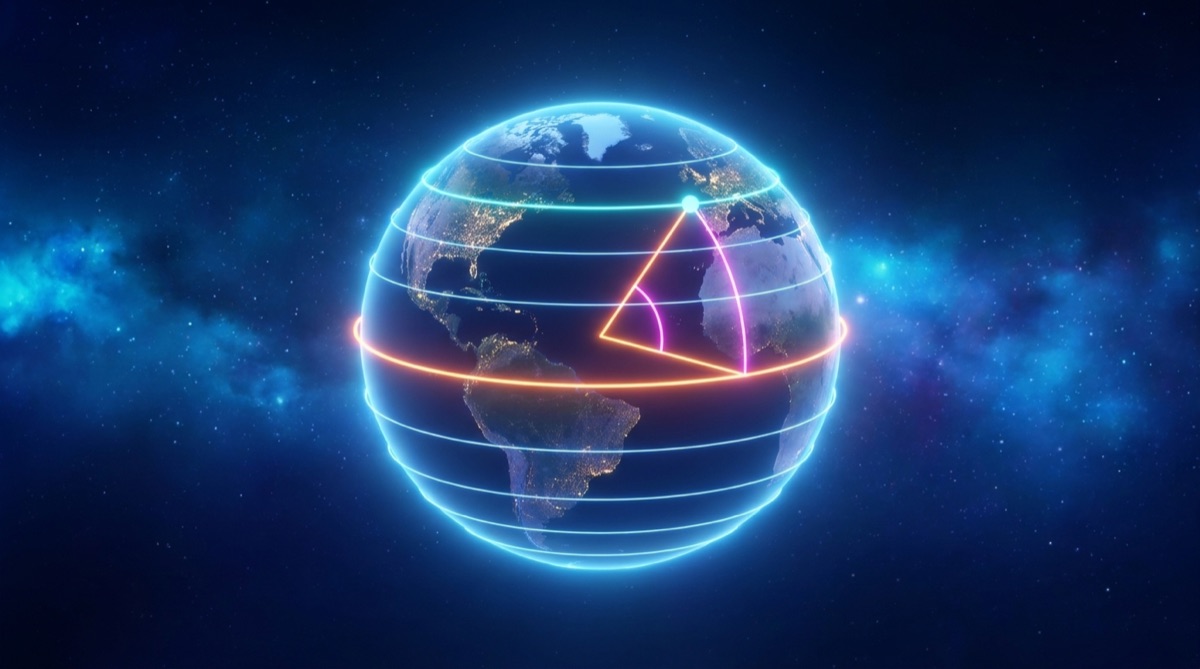
And the most important thing: the angle of the shadow in Alexandria is the same angle by which Earth curves between Syene and Alexandria.
The angle of a shadow
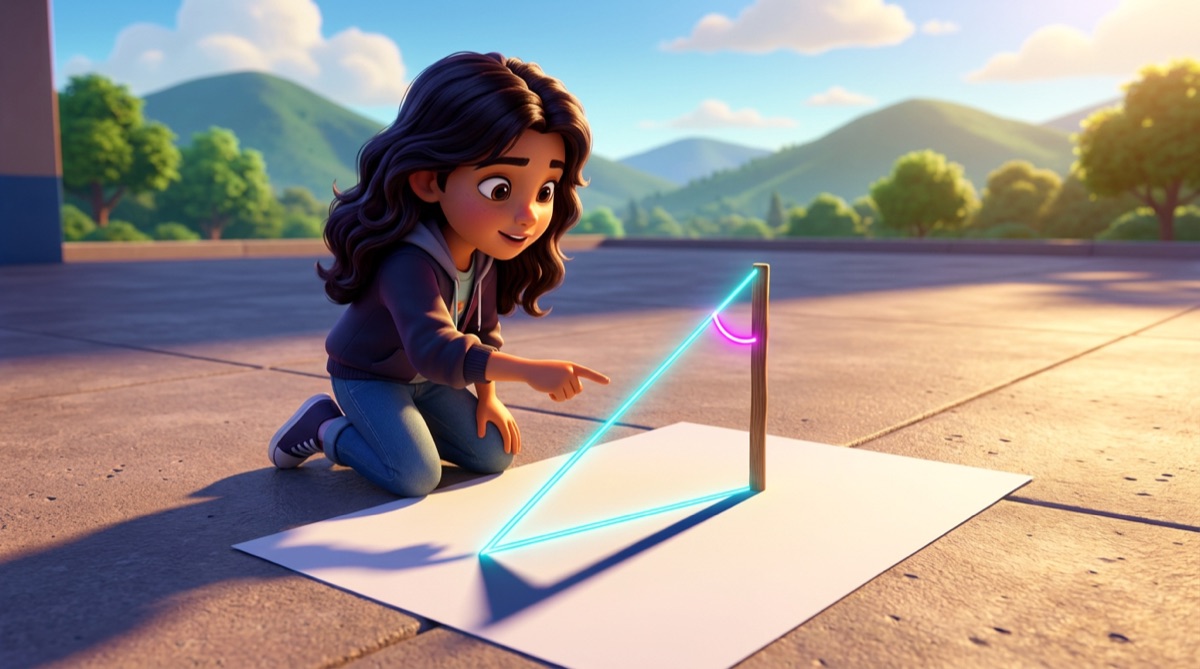
What is the angle of a shadow? Draw the stick standing up and the shadow on the ground. Join the tip of the stick to the tip of the shadow. That line is the ray of sunlight.
The angle between the stick and the ray of sunlight is the angle of the shadow.
- Sun right overhead: no shadow, angle 0°.
- Very short shadow: small angle.
- Shadow as long as the stick: angle of 45°, half a right angle.
Eratosthenes measured an angle of 7.2 degrees in Alexandria. A small angle: a little more than a tenth of a right angle (90 ÷ 10 = 9).
Eratosthenes’ calculation
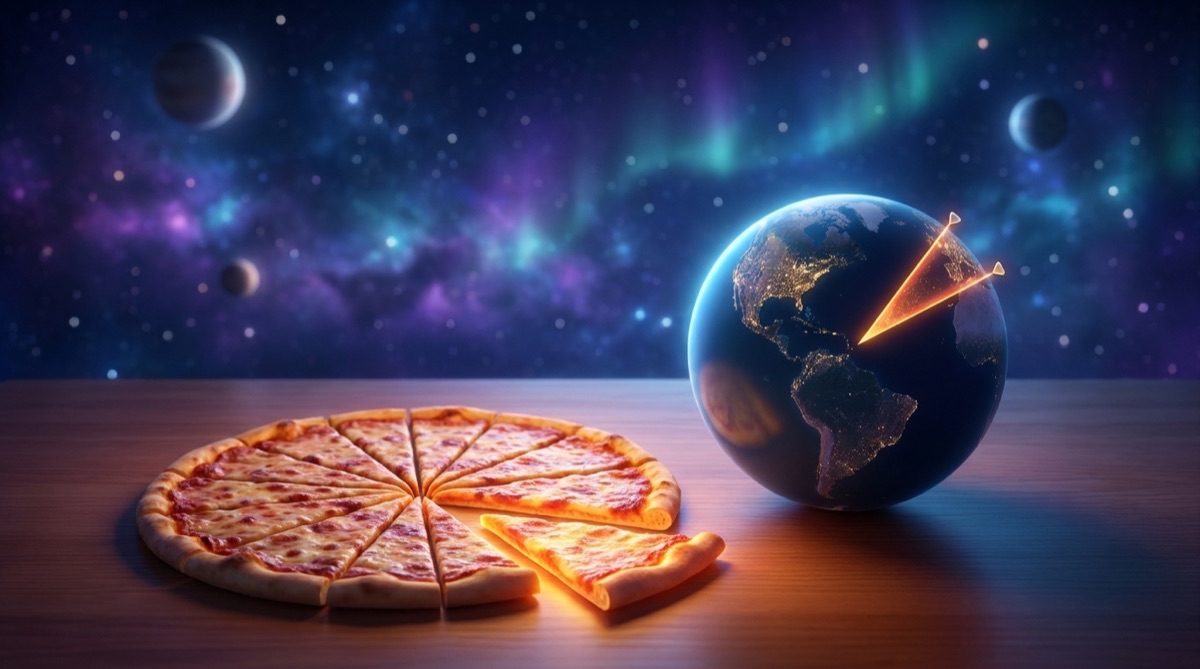
A full circle has 360 degrees. How many times does 7.2 fit into 360?
So the piece of Earth between Syene and Alexandria is one fiftieth of the full circle. As if you cut a pizza into 50 slices and kept one.
Eratosthenes knew the distance between the two cities: 5 000 stadia. The stadion was the Greeks’ unit of length.
If one slice is 5 000 stadia and the full circle has 50 slices:
All the way around Earth! Without leaving Egypt.
How much is that in kilometers?
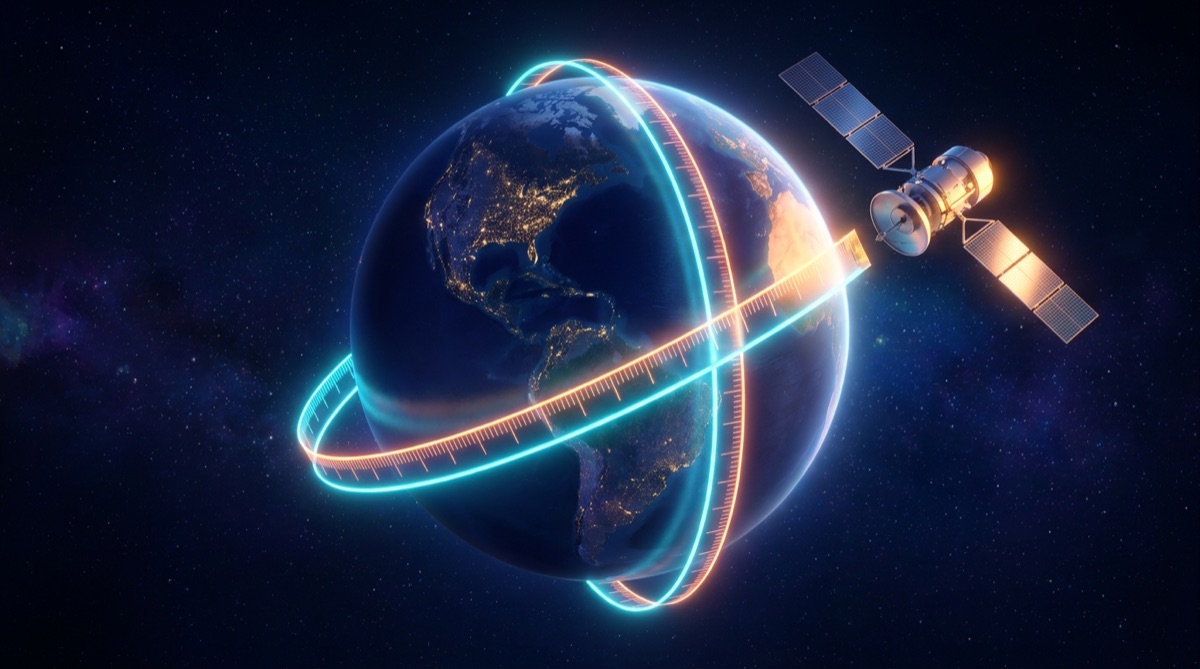
Nobody knows for sure how long Eratosthenes’ stadion was. There are two possible lengths:
| If the stadion was… | 250 000 stadia are… |
|---|---|
| about 157 and a half meters | about 39 000 km |
| about 185 meters | about 46 000 km |
Today, with satellites, we know that the way around Earth through the poles is 40 008 km. Around the equator, a little more: 40 075 km.
Eratosthenes came very close. With a stick, a shadow and a division.
We repeat it in Colombia
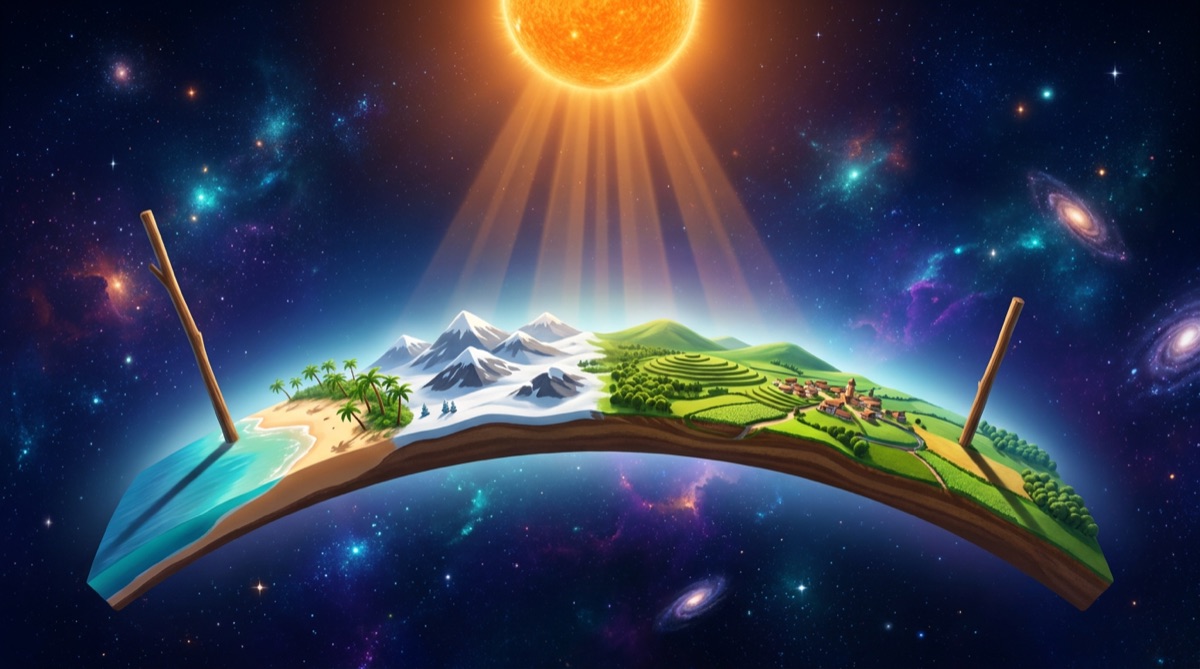
We can do the same calculation with two Colombian cities that lie almost on the same north–south line: Bogotá and Santa Marta.
On March 21, at noon, the angle of the shadow was measured in both cities:
| City | Angle of the shadow |
|---|---|
| Santa Marta | 11.2° |
| Bogotá | 4.7° |
The difference is 11.2 − 4.7 = 6.5 degrees. That is the angle by which Earth curves between the two cities.
The distance from Bogotá to Santa Marta, in a straight line to the north, is about 726 km.
Now, the rule of three: if 6.5 degrees are 726 km, how many kilometers are 360 degrees?
First, how many kilometers there are in one degree:
Then, the 360 degrees of the full circle:
(With the unrounded figures it comes to 40 200 km.) Almost exact! The way around Earth is 40 008 km.
Play with the simulator

The simulator draws Earth, the two sticks and their shadows. It shows the full calculation and how far off it is.
- Press Syene–Alexandria. Check that it gives 250 000 stadia. Switch the unit between “stadia (157.5 m)” and “stadia (185 m)”: with which one is it closer to 40 008 km?
- Press Bogotá–Santa Marta (equinox). How many kilometers does the full circle come to? How far off is it?
- Move the Santa Marta angle a little: from 11.2° to 12.2°. How much does the result change? That is why you have to measure very carefully.
- Uncheck the Exaggerate box. That is how small the sticks are compared with Earth… and even so the shadow is enough to measure it.
- Δα
- 7.20° (1/50.0 of a turn)
- d
- 5 000 stadia (157.5 m) ≈ 788 km
- C
- 250 000 stadia ≈ 39 375 km
- R
- 6 267 km
- Actual
- meridional C = 40 008 km (R = 6 367 km); equatorial 40 075 km
- Error
- −1.6 %
Activity: measure the angle of your shadow
You need: a straight 30 cm stick (or a ruler), modeling clay to stand it upright, a large sheet of paper, a pencil, a tape measure, a protractor and a flat sunny spot near noon.
- Plant the stick in the modeling clay on the sheet, nice and vertical. Check it by looking at it from two sides.
- At 12 noon (or at the time when the shadow is shortest, as you learned with the sundial) mark the tip of the shadow and measure its length. Also write down the height of the stick.
- On a separate sheet, draw the stick and the shadow to scale: for example, 1 cm in the drawing for every 2 real cm. Draw the stick standing up and the shadow lying down, forming a right angle.
- Join the tip of the stick to the tip of the shadow. That is the ray of sunlight.
- With the protractor, measure the angle between the stick and the ray. That is the angle of your shadow.
- Write down the date, the time and the angle. If a school in another city does the same thing on the same day, you can repeat Eratosthenes’ calculation.
Question: at the equinox (March 21 or September 23), the angle of the noon shadow is equal to the latitude of your city. What angle did you get? Look it up on a map and compare.
Exercises
- In Alexandria the angle was 7.2° and 360 ÷ 7.2 = 50. If the angle had been 9°, into how many slices would the full circle be divided?
Show solution
360 ÷ 9 = 40 slices. A bigger angle means the cities are farther apart, so the circle is divided into fewer slices.
- Two cities are separated by 9° of curvature and by 1 000 km. How far is it all the way around that planet?
Show solution
360 ÷ 9 = 40 slices. 1 000 × 40 = 40 000 km. It would be a planet almost like Earth.
- In Bogotá, how many kilometers are there in one degree if 6.5 degrees are 726 km? Round it.
Show solution
726 ÷ 6.5 ≈ 112 km per degree (the exact value is 111.7). It is a useful number: all over Earth, one degree from north to south is about 111 km.
- Eratosthenes got 250 000 stadia. If the stadion was 157.5 m, how many kilometers is that? Hint: 250 000 × 157.5 m, and then go from meters to kilometers by dividing by 1 000.
Show solution
250 000 × 157.5 = 39 375 000 m. In kilometers: 39 375 000 ÷ 1 000 = 39 375 km. Compared with 40 008 km, it was about 630 km short: very little for such a big measurement!
- Lucía measured an angle of 3.5° in Cali on March 21 and her friend in Barranquilla measured 11°. Order the two cities from south to north and explain how you know.
Show solution
At the equinox, the angle of the shadow is the latitude. Cali is at 3.5° and Barranquilla at 11°, so Cali is farther south and Barranquilla farther north. Between the two there are 11 − 3.5 = 7.5° of curvature, about 7.5 × 112 ≈ 840 km from north to south.
✦ Mini-quiz
Remember
- Earth is round: that is why two vertical sticks in different cities cast different shadows at the same time.
- The angle of the shadow is measured between the stick and the ray of sunlight.
- The difference in angles between two cities is how much Earth curves between them.
- Rule of three: if 6.5° are 726 km, one degree is about 112 km and 360° are about 40 000 km.
- Eratosthenes worked it out 2 200 years ago with a stick, a shadow and a division. Today we know the way around is 40 008 km.
🍎 Teacher guide
- Time
- 2 sessions of 55 min + one measurement at noon
- Colombian national standard (MEN)
- Natural Sciences, Grades 4 to 5 (MEN, 2006): 'I describe the physical characteristics of Earth and its atmosphere'; 'I take measurements with conventional instruments (balance, scale, stopwatch, thermometer...) and non-conventional ones (pace, hand span, foot, fathom, cup...)'; 'I record my observations, data and results in an organized and rigorous way (without alterations), in writing and using diagrams, graphs and tables'. Mathematics, Grades 4 to 5: 'I identify, represent and use angles in turns, openings, tilts, figures, points and corners in static and dynamic situations'; 'I solve and pose problems in situations of direct and inverse proportionality and product of measures'; 'I identify, in the context of a situation, the need for an exact or approximate calculation and the reasonableness of the results obtained'.
- Evidence of learning
- Explains with the orange and the flashlight why two vertical sticks cast different shadows; measures the angle of a shadow with a scale drawing and the protractor; solves the Bogotá–Santa Marta rule of three and compares the result with 40 008 km, saying whether the estimate is good.
Materials
- Orange, two toothpicks and a flashlight
- 30 cm sticks, modeling clay, tape measure, protractors and large sheets of paper
- Photocopy of the table of angles for Bogotá and Santa Marta
- Computer or tablet with the simulator
- Map of Colombia with latitudes
Suggested sequence
Session 1. The story and the geometry (55 min). Opening (10 min): the well of Syene; why was there a shadow in Alexandria? Hypotheses on the board. Development (35 min): orange with two toothpicks and a distant flashlight; then each group draws a stick and a shadow to scale and measures the angle with the protractor. Eratosthenes’ calculation is presented step by step (360 ÷ 7.2 = 50; 5 000 × 50). Closing (10 min): exercises 1 and 2.
Session 2. Colombia and the simulator (55 min). Opening (10 min): table of angles for Bogotá and Santa Marta; how much does Earth curve between them? Development (30 min): rule of three in the notebook (km per degree, then × 360) and checking with the simulator, challenges 1 to 4; exercises 3 and 4. Closing (15 min): exercise 5 and mini-quiz. The noon shadow measurement (activity) is scheduled and, if possible, a school in another city is contacted to repeat the calculation with their own data.
Note on the data. The angles for Bogotá (4.7°) and Santa Marta (11.2°) are those for solar noon at the equinox, when the angle of the shadow coincides with the latitude. On another date both angles change, but their difference stays at 6.5°, as can be checked in the simulator with the June 21 preset. The 726 km distance is the north–south separation between the two cities (111.2 km per degree of latitude), not the distance by road.
Common mistakes
- Believing that the shadow changes because “the Sun is farther” from one city. With the orange you can see that the light reaches both toothpicks the same way; what changes is the tilt of the toothpick with respect to the light.
- Measuring the angle between the shadow and the stick instead of between the stick and the ray. Mark the ray in color on the scale drawing before using the protractor.
- Dividing 726 by 360 instead of by 6.5. Go back to the question: “how many kilometers are in ONE degree?”.
- Taking Eratosthenes’ result as “wrong” because it does not give exactly 40 008. Compare: 39 375 versus 40 008 is an error of less than 2 %; discuss what a good estimate is.
- Planting the stick at a tilt. Check the vertical with a plumb line (string and nut) or by looking from two sides.