Around 240 BCE nobody had sailed around the world, there were no satellites, and the known map ended at India. And yet a Greek living in Egypt, Eratosthenes of Cyrene, director of the Library of Alexandria, announced how long the circumference of the Earth was. He did not travel anywhere: all he needed was a vertical stick, a shadow, a known distance and a geometric idea that fits on a napkin.
The central idea
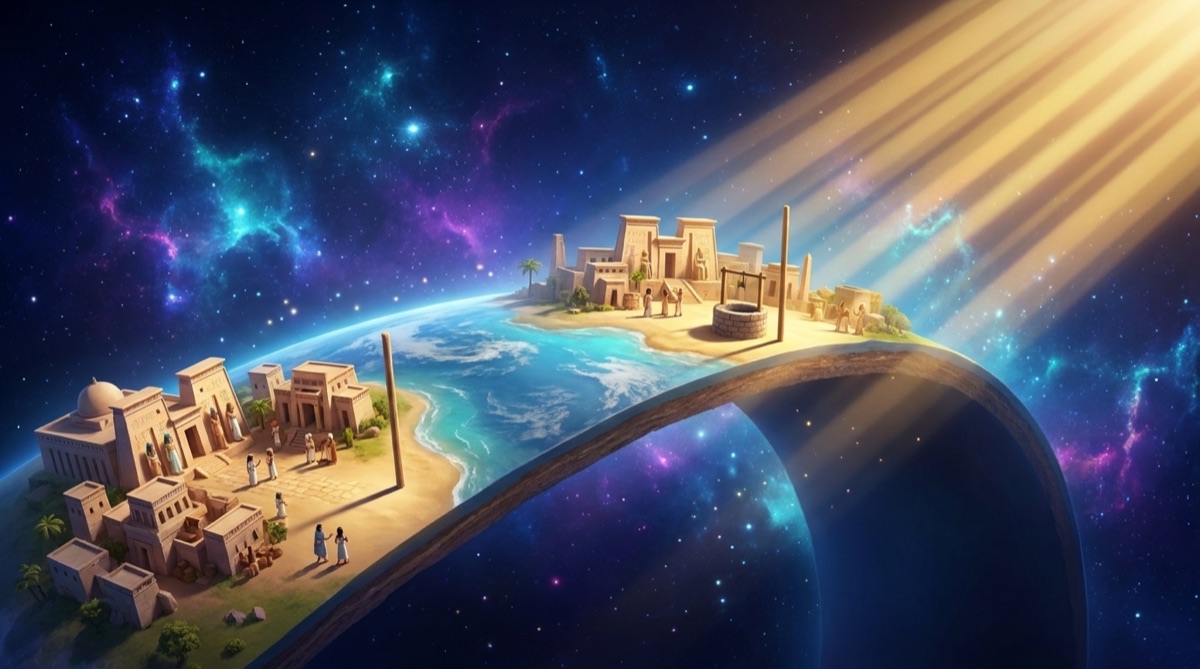
Ancient sources tell that in Syene (today Aswan, in southern Egypt), at noon on the summer solstice, the Sun lit the bottom of the wells and vertical sticks cast no shadow: the Sun was right at the zenith.
On the same day, at the same hour, in Alexandria (almost due north of Syene) a vertical stick did cast a small shadow. Eratosthenes measured the angle between the Sun’s rays and the stick: one fiftieth of a circle, that is, 360° ÷ 50 = 7.2°.
Why is there a shadow in one place and not in the other? Because the Earth is curved. If it were flat, the Sun would be at the zenith in both cities at once. And since the Sun is so far away, its rays arrive parallel at Syene and at Alexandria. A little geometry (two parallel lines cut by a transversal, in this case the radius drawn from the center of the Earth) says that the angle of the shadow in Alexandria is the same angle that separates the two cities as seen from the center of the planet.
The key equation
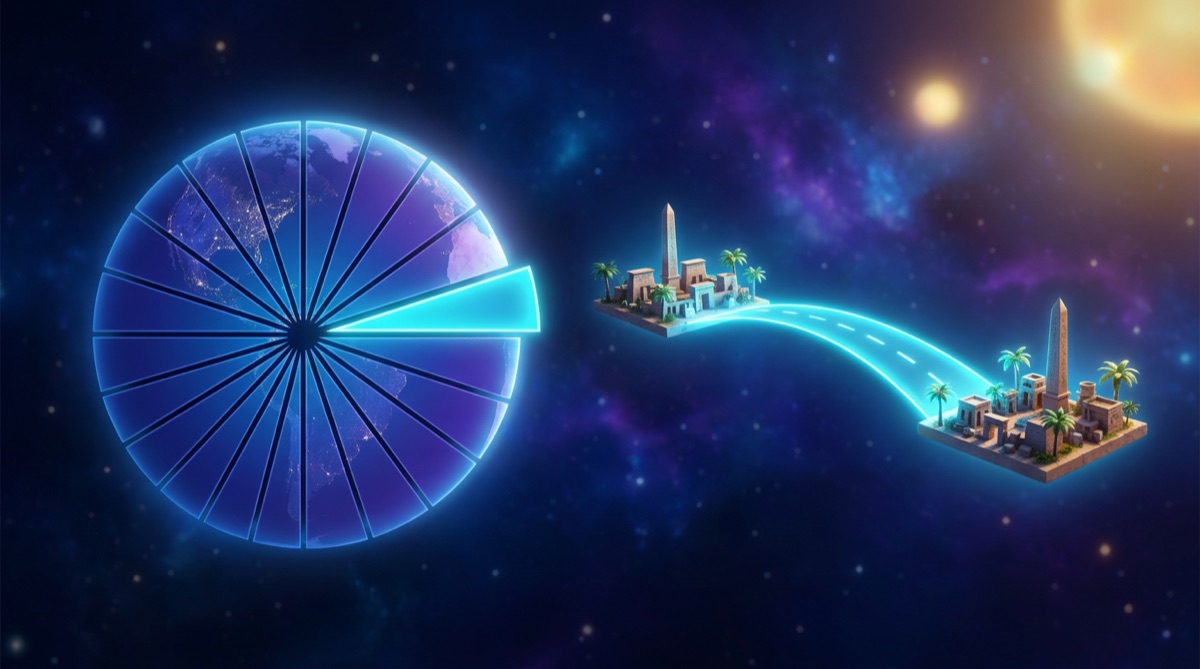
If 7.2° corresponds to the distance between the two cities, the 360° of the full circle corresponds to 50 times that distance. Eratosthenes took the Syene–Alexandria distance to be 5 000 stadia (a Greek unit of length), and so:
In words: the trip around the world is to the distance between the two cities as the full circle is to the angle of the shadow. Later sources, such as Strabo and Pliny, round the result to 252 000 stadia, probably so that it came out to a convenient 700 stadia per degree.
Play with the simulator: choose Syene–Alexandria, check that you get 250 000 stadia and change the length of the stadion to see how much the result changes in kilometers. You can also try two cities in the United Kingdom.
- Δα
- 7.20° (1/50.0 of a turn)
- d
- 5 000 stadia (157.5 m) ≈ 788 km
- C
- 250 000 stadia ≈ 39 375 km
- R
- 6 267 km
- Actual
- meridional C = 40 008 km (R = 6 367 km); equatorial 40 075 km
- Error
- −1.6 %
How close did he get?
Here is the honest part of the story: we do not know for sure how long the stadion Eratosthenes used was. With a stadion of about 157.5 m, 250 000 stadia are about 39 400 km; with the Attic stadion of about 185 m, about 46 300 km. The modern value of the Earth’s circumference along a meridian, which is what Eratosthenes was measuring, is 40 008 km (at the equator, 40 075 km). So the error was between 2 % and 15 %, depending on the stadion. In either case, the order of magnitude was right, and that, 2 200 years ago, was a feat.
There were also several generous approximations: Alexandria is not exactly north of Syene, Syene is not exactly on the tropic, and the 5 000 stadia were a rounded distance, measured in part by how long caravans took. Eratosthenes was somewhat lucky that those errors canceled out.
How do we know?
- The account of Cleomedes. Eratosthenes’ own writings were lost. We know the method mainly through Cleomedes, the author of an astronomy handbook written centuries later, who describes it step by step: the gnomon without a shadow at Syene, the fiftieth of a circle at Alexandria, the 5 000 stadia and the result of 250 000. Strabo and Pliny quote the figure of 252 000.
- You can repeat the experiment. Two schools in different cities that measure the shadow of a stick at solar noon on the same day get two angles; with the distance between the cities, the same rule of three gives the circumference of the Earth. In the secondary lesson Eratosthenes measures the Earth we do it with Bogotá and Santa Marta.
- The modern value comes from geodesy and satellites. The equatorial and polar radii of the Earth (6 378.137 km and 6 356.752 km, according to the NASA fact sheet) are known today to within meters thanks to satellite tracking, and from them comes the meridional circumference of 40 008 km.
Key takeaways
- Two different shadows on the same day, in two different places, show that the Earth is curved.
- If the Sun’s rays are parallel, the angle of the shadow is the angle between the two cities as seen from the center of the Earth.
- Rule of three: angle / 360° = distance / circumference. With 7.2° and 5 000 stadia, 250 000 stadia.
- The uncertainty lies in the stadion: the result came out between 2 % and 15 % of the current value.
- The moral: a good question and simple geometry can measure enormous things.