Ask ten people why it is hotter in summer and most will answer the same thing: “because the Earth is closer to the Sun”. It makes perfect sense: get closer to a bonfire and you warm up. The problem is that, if it were true, the whole planet would have summer at the same time. And it does not: when it is hot in Madrid or New York, it is winter in Buenos Aires or Sydney. Same day, same distance to the Sun, opposite seasons. Distance cannot be the explanation.
What the almanacs say
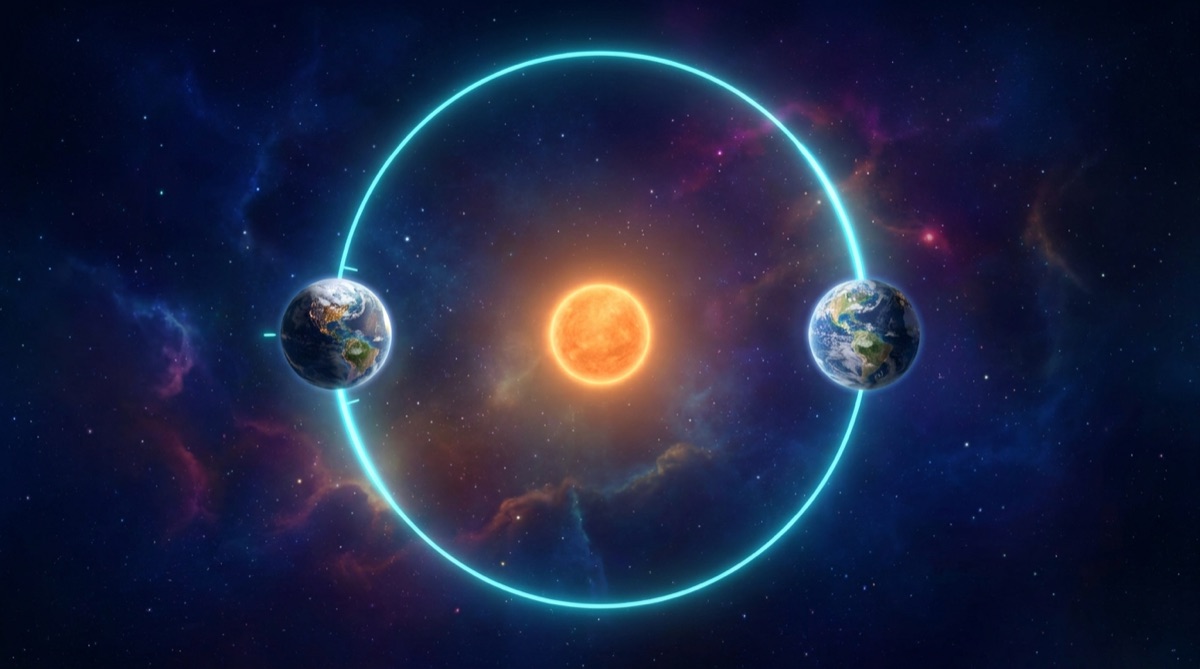
The Earth’s orbit is not a perfect circle, so the distance to the Sun does change a little over the year. According to the U.S. Naval Observatory, the closest point (perihelion) was reached on January 3, 2026, and will be reached again on January 3, 2027; the farthest (aphelion) was on July 6, 2026. At perihelion we are about 147.1 million kilometers from the Sun; at aphelion, 152.1 million.
Look at the dates: we are closest to the Sun in early January, in the middle of the northern hemisphere’s winter, and farthest in early July, at the height of the northern summer. Exactly the opposite of what the myth says. And the difference is small: 5 million kilometers sounds like a lot, but it is barely 3.3 % of the distance. The light we receive changes by about 7 % between January and July. It is noticeable, but it is not what makes the seasons.
The real cause: a tilted axis
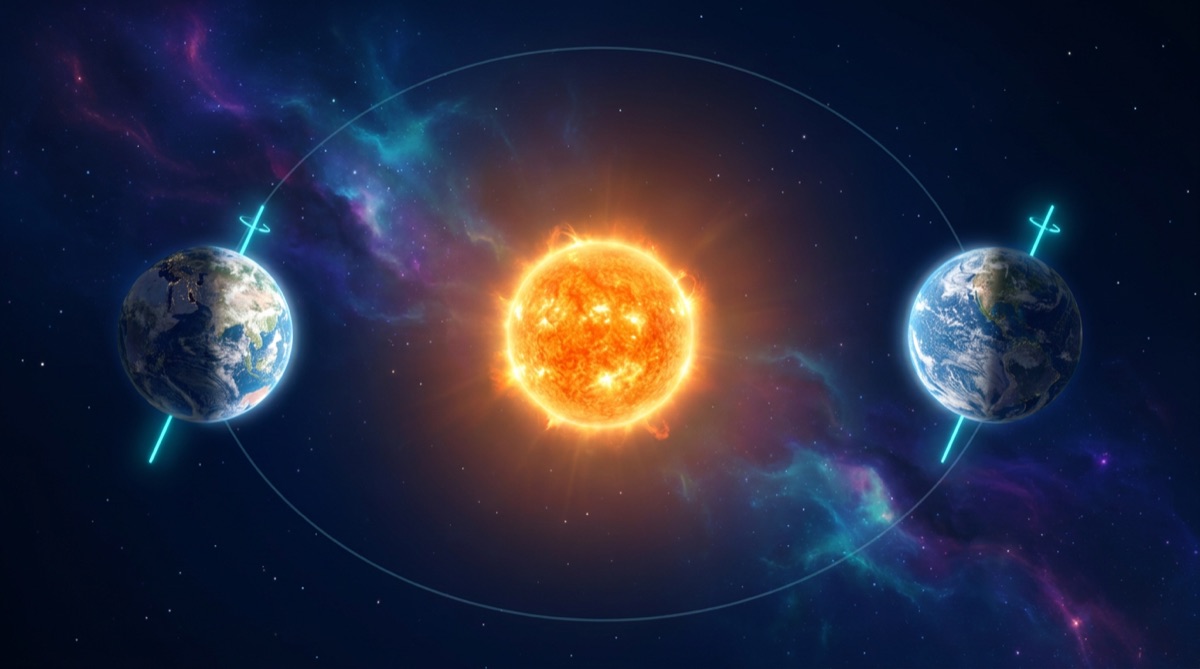
The Earth’s rotation axis is tilted 23.44° relative to its orbit, and it always points in the same direction in space as we go around the Sun. That means that in June the northern hemisphere is “tilted toward” the Sun and the southern one “tilted away”, and in December the other way around. The consequences are two, and both point in the same direction:
- The Sun climbs higher. In the hemisphere tilted toward the Sun, the noon Sun is closer to the zenith. Its rays arrive more vertically and the same amount of light is spread over less ground, so it heats more. It is the same thing that happens with a flashlight: pointed straight on it makes a small, bright circle; tilted, a large, faint oval.
- The day lasts longer. That hemisphere has more hours of daylight and fewer of night: more time warming up and less cooling down.
In Bogotá, on June 21 there are about 12 hours and 20 minutes of daylight; in Madrid, almost 15; in Buenos Aires, less than 10. The distance to the Sun is the same for all three cities.
The key equation

The amount of solar energy received by a square meter of ground depends on the altitude of the Sun above the horizon, :
where is the energy that would arrive with the Sun right at the zenith. In words: with the Sun halfway up (45°), the ground receives 71 % of the energy; at 30°, half; at 10°, only 17 %. Going from a noon Sun 70° high (summer in Madrid) to one at 27° (winter) cuts the energy per square meter to less than half. Compared with this, the 7 % from distance is a detail.
Try it

In the simulator’s Scientist mode you can see the orbit with the tilted axis, the hours of daylight through the year by latitude and the altitude of the Sun at noon. Enter the latitude of your city and then try 40° north and 40° south: you will see that the daylight curves are opposite, even though the Earth is the same.
It’s daytime!
What about Colombia?

Colombia sits almost on the equator (Bogotá at 4.6° north latitude), which is why it does not have the four classic seasons. There the noon Sun is always high: it passes exactly through the zenith twice a year, in early April and early September, and never drops below about 62° of altitude at noon. The day lasts almost the same all year. What Colombians call “winter” and “summer” are rainy and dry seasons, governed by the movement of the equatorial cloud belt, not by the tilt of the axis or the distance to the Sun. That is another clue against the myth: if distance ruled, Colombia would also have temperature seasons.
And where you are, in London (latitude 51.5° N), the noon Sun culminates on June 21 at 62° of altitude and on December 21 at 15°; the day lasts 16 h 38 min in June and 7 h 49 min in December. The bigger that difference, the more marked the seasons, and all with the same distance to the Sun.
How do we know?
The tilt of the axis and the dates of perihelion have been measured precisely for centuries: Kepler already knew in 1609 that the Earth’s orbit is an ellipse and that the point closest to the Sun falls near the December solstice. Today the ephemerides of the U.S. Naval Observatory and the Jet Propulsion Laboratory give the time of perihelion to within minutes. And the proof that the tilt dominates is the very experience of the two hemispheres: opposite seasons at the same instant.
One last detail to think about: the southern hemisphere has its summer when the Earth is closest to the Sun, so it should have somewhat more intense summers and the northern winters should be milder. The effect exists, but it is small and is masked because the south has much more ocean, which dampens temperature changes.
Key takeaways
- The Earth is closest to the Sun in January (perihelion, 147.1 million km) and farthest in July (aphelion, 152.1 million km): the opposite of what the myth says.
- The difference in distance is only 3.3 %; in energy received, 7 %.
- The seasons are caused by the 23.44° tilt of the axis: it changes the altitude of the Sun and the length of the day.
- That is why the two hemispheres have opposite seasons and Colombia, on the equator, has no temperature seasons.
For kids: Seasons and latitude. With trigonometry: Length of the day and altitude of the Sun.