Look at Orion on a clear December night: Betelgeuse, at the shoulder, is clearly orange; Rigel, at the foot, is bluish-white. If you sweep across the sky you will find reddish, yellowish, white and bluish stars. But you will never see a green star. Why?
Color is a thermometer
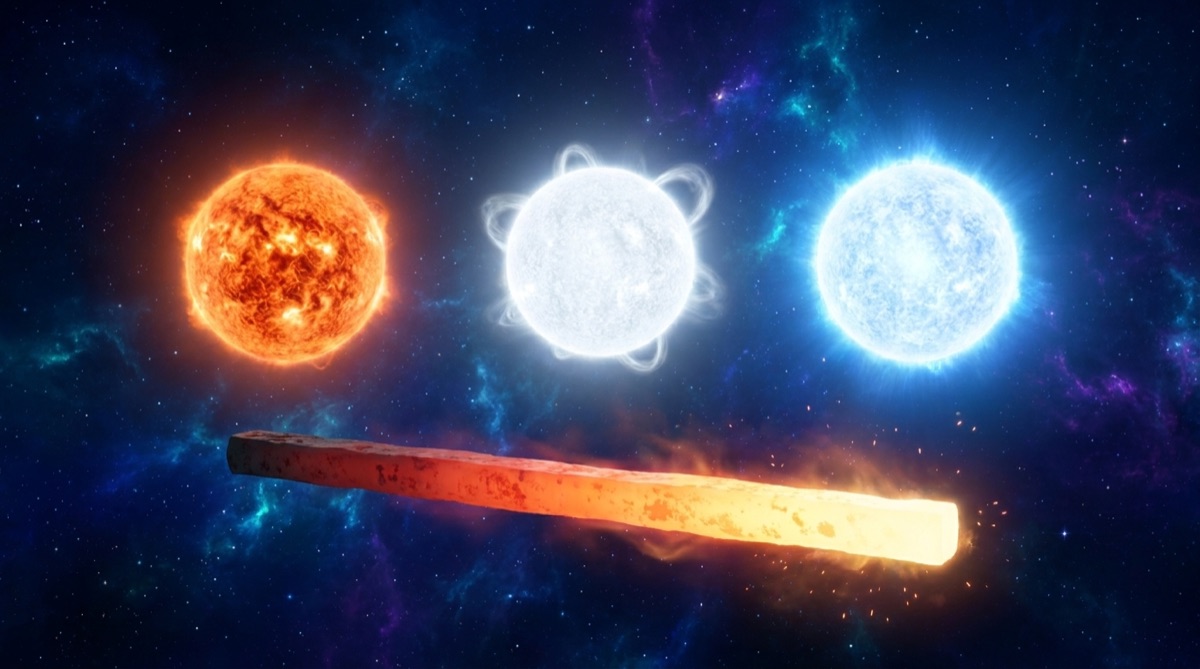
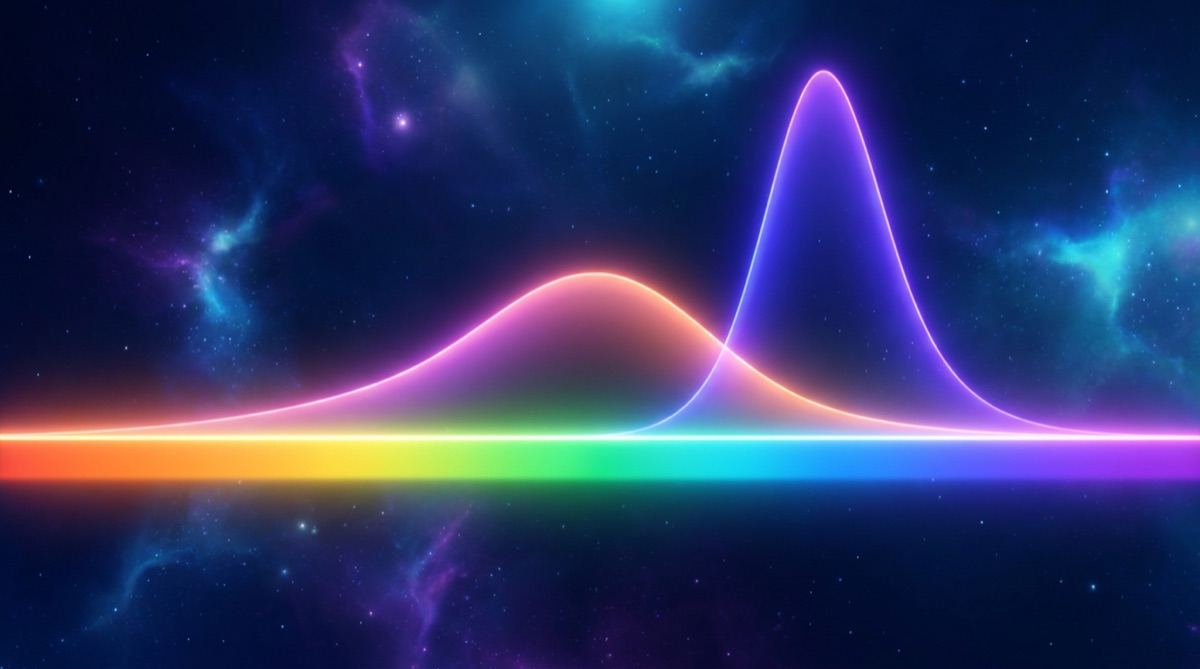
Stars shine because they are hot, just like the element of a stove or a red-hot iron. A hot body does not emit a single color: it emits all of them, in proportions that depend only on its temperature. If we plot how much light comes out at each color we get a hump-shaped curve, the Planck curve.
The hotter the object, the taller the hump and the farther its peak shifts toward the blue colors.
The key equation
That relation is so simple it fits on one line, Wien’s law:
In words: the wavelength at which an object shines brightest () equals 2.898 millimeters divided by its temperature in kelvin (). For the Sun, whose effective temperature is 5 772 K, that gives half a micrometer: about 500 nanometers, right in the blue-green.
So… is the Sun green?
Its peak is in the green, but the Sun is not! And here is the key: the Planck hump is much wider than the rainbow our eyes can see. When the peak falls in the green, the curve is almost flat across the whole visible range: the star emits almost as much blue as green and red. And we perceive the mixture of all the colors as white.
Try it yourself. Move the temperature to about 5 000–6 000 K: the peak (the dashed line) is in the green, but the circle representing the star is white.
- T
- 5,772 K
- λmax
- 502 nm
- B−V
- 0.65
- σT⁴
- 6.29 × 10⁷ W/m²
- L/L☉
- 1.00
- Mbol
- 4.74
- A cool star (3 000–4 000 K) has its peak in the infrared: within the visible, the curve rises toward the red, and we see it as orange or reddish.
- A very hot star (over 10 000 K) has its peak in the ultraviolet: the curve falls toward the red and we see it as bluish-white.
- In between, when the peak falls in the green, all the colors are balanced: white.
For a star to be green, its light would have to be concentrated in the green with little red and little blue. A Planck curve cannot have such a narrow shape, so nature simply does not make green stars.
And isn’t the Sun yellow?
Outside the atmosphere, the Sun is white (in fact, very slightly warm-toned). We see it yellowish, especially at sunrise and sunset, because the air scatters blue light more, and that is the light that paints the sky blue. But that is a matter of our atmosphere, not of the Sun.
How do we know?
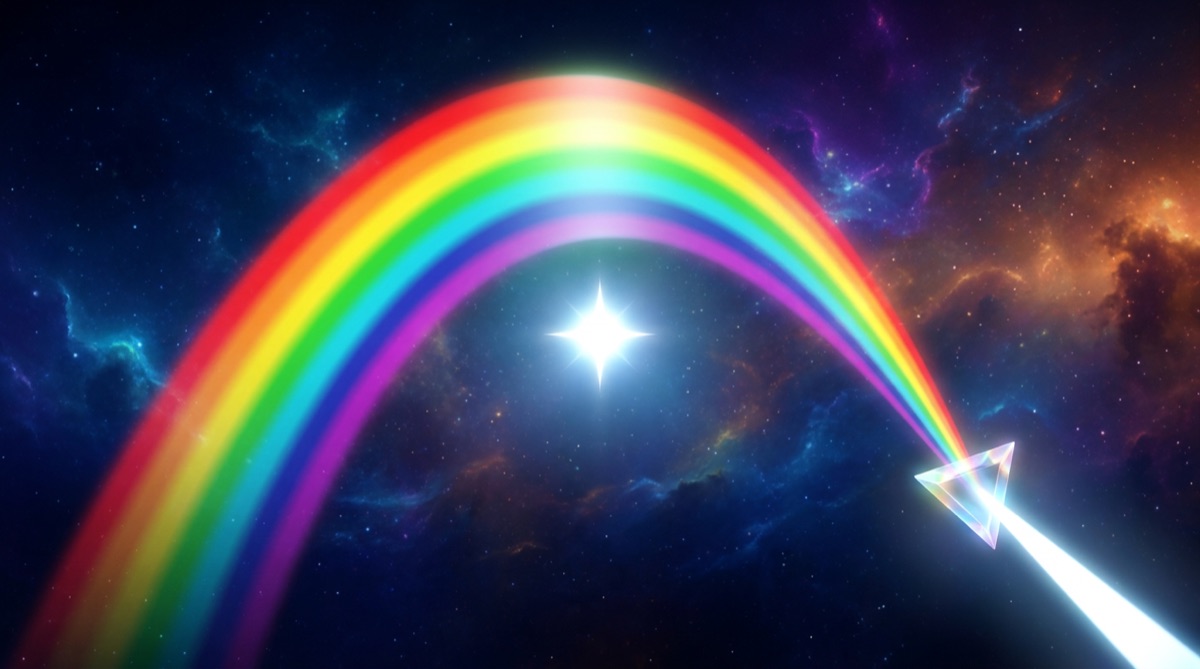
- The spectra of stars are measured. When their light is split with a prism or a grating, the amount of light at each color follows, to a good approximation, the Planck curve; from the position of the peak or from the comparison between blue and red (the color index) the temperature is obtained. That is how we know that Betelgeuse is at about 3 600 K and Rigel at about 12 000 K.
- Wien’s law is checked in the laboratory. The constant 2.898 mm·K is a value recommended by CODATA; the same one that makes an iron go from dull red to yellow and then to white as it heats up.
- The color the eye sees can be calculated. The simulator integrates the Planck curve with the response functions of the human eye (the CIE curves) and paints the result: at no temperature does it come out green.
Key takeaways
- The color of a star depends on its temperature: reddish for the cool ones, bluish for the hot ones.
- Wien’s law says where the peak is; for the Sun it falls in the green (about 500 nm).
- But the curve is so wide that a star peaking in the green emits everything and looks white.
- That is why there are no green stars, and why the Sun, seen from space, is white.
Want the full calculations? In the secondary lesson The blackbody and the color of stars we use these laws to compute the temperature, the luminosity and even the size of Betelgeuse.