A bus leaving Bogotá with a full tank gets farther than a semi-trailer truck with the same tank: the truck burns far more per kilometer. Something similar happens with stars, but with a surprising twist: the most massive stars have more fuel and still live shorter lives, because they spend it at a disproportionate rate. In this lesson you will compute how long a star lives from its mass, with a power function, and discover that what is left at the end (a white dwarf, a neutron star or a black hole) is also decided by the mass.
1. The fuel: E = mc²
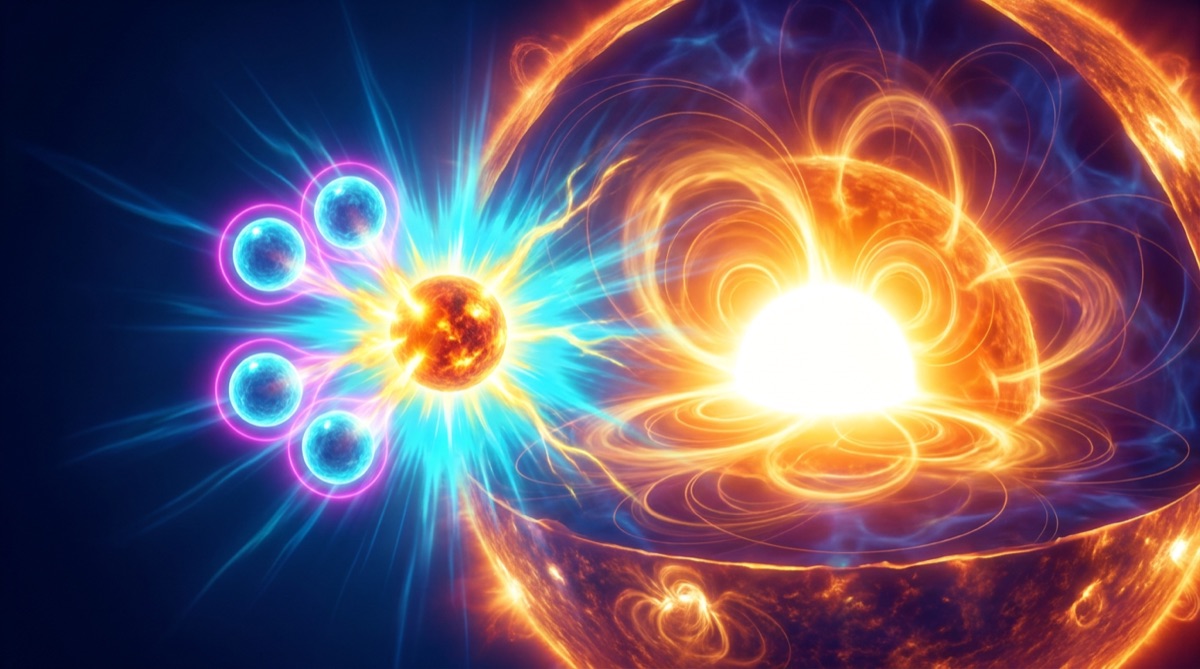
A main-sequence star shines because in its core it fuses hydrogen into helium. Four hydrogen atoms (4 × 1.007 825 u = 4.031 300 u) turn into one helium atom (4.002 602 u): 0.028 698 u are missing, 0.7 % of the mass, which is transformed into energy according to
where is the energy released (J), the mass that disappears (kg) and m/s the speed of light.
Worked example 1: how much mass the Sun loses every second. The Sun emits W, that is, J every second. The converted mass is
four million tons per second. And since only 0.7 % of the fused hydrogen becomes energy, the Sun “burns” kg of hydrogen per second.
Worked example 2: how long it lasts. Only the core, about 10 % of the star’s mass, is hot enough to fuse. The Sun’s usable fuel is then kg, of which 0.7 % becomes energy:
(a year has s). Ten billion years on the main sequence. The Solar System is years old (dating of the oldest meteorites), so the Sun is halfway through its life: it has about 5 billion years left.
2. More mass, much more luminosity
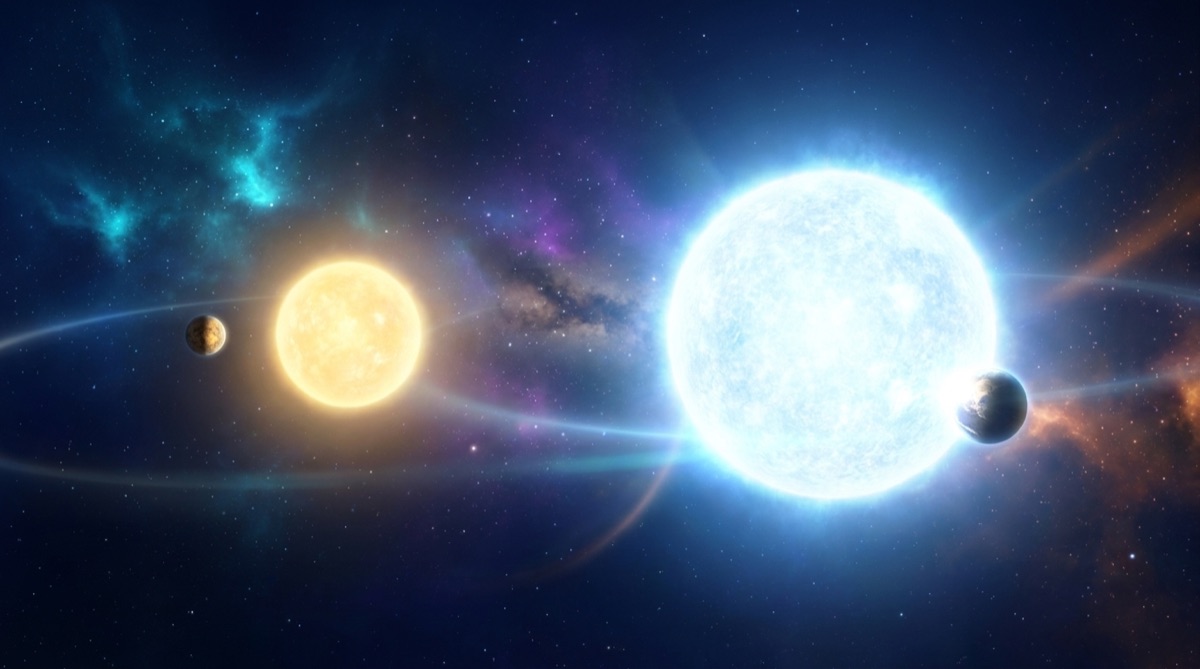
Stellar masses are measured in binary systems with Kepler’s third law. When they are compared with the luminosities, a very steep power function appears, the mass–luminosity relation:
approximately valid for main-sequence stars between 0.5 and 20 (the real exponent changes piecewise between 2 and 6; 3.5 is a useful average). A star with twice the mass does not shine twice as bright, but
Worked example 3: Sirius A. Its mass is . Prediction: . With logarithms, , so . The measured value is : the order of magnitude is right, but the “average” law falls short by a factor of 2, because in that mass range the real exponent is closer to 4.5. That is what happens with every empirical law: it is good for estimating, not for replacing the measurement.
More examples: ; ; .
In logarithmic form, : in a plane it is a straight line of slope 3.5 through the origin (the Sun). That is how it is drawn, and that is how the exponent is measured from the data: from the slope.
3. Lifetime: t ∝ M^−2.5

The time a star spends on the main sequence is fuel divided by the rate of consumption. The fuel is proportional to the mass and the consumption is the luminosity :
Calibrating with the Sun ( years):
Note the sign: a negative exponent, so more mass means a shorter life. The semi-trailer truck.
Worked example 4: three stars.
| (years) | Comparison | ||
|---|---|---|---|
| 20 | the dinosaurs went extinct years ago | ||
| 2 | less than the age of the Earth | ||
| 1 | 1 | the Sun, halfway through | |
| 0.5 | four times the age of the universe (13.8 billion years) | ||
| 0.1 | detailed models give even more: trillions of years |
To compute : , and the negative sign inverts it. With logarithms: , .
Two enormous consequences follow from that table:
- No red dwarf has died yet. With the lifetime exceeds the age of the universe. Every one that ever formed is still there.
- The massive stars we see are young. Rigel or the blue stars of Orion are only a few million years old: they were born when there were already mammals on Earth. And if we see a region full of blue stars, stars are forming there right now.
Worked example 5: Betelgeuse. With a mass of about : , years. Betelgeuse has already exhausted the hydrogen in its core (that is why it is a supergiant, off the main sequence) and is in its last few hundred thousand years.
4. And afterwards? It depends on the mass
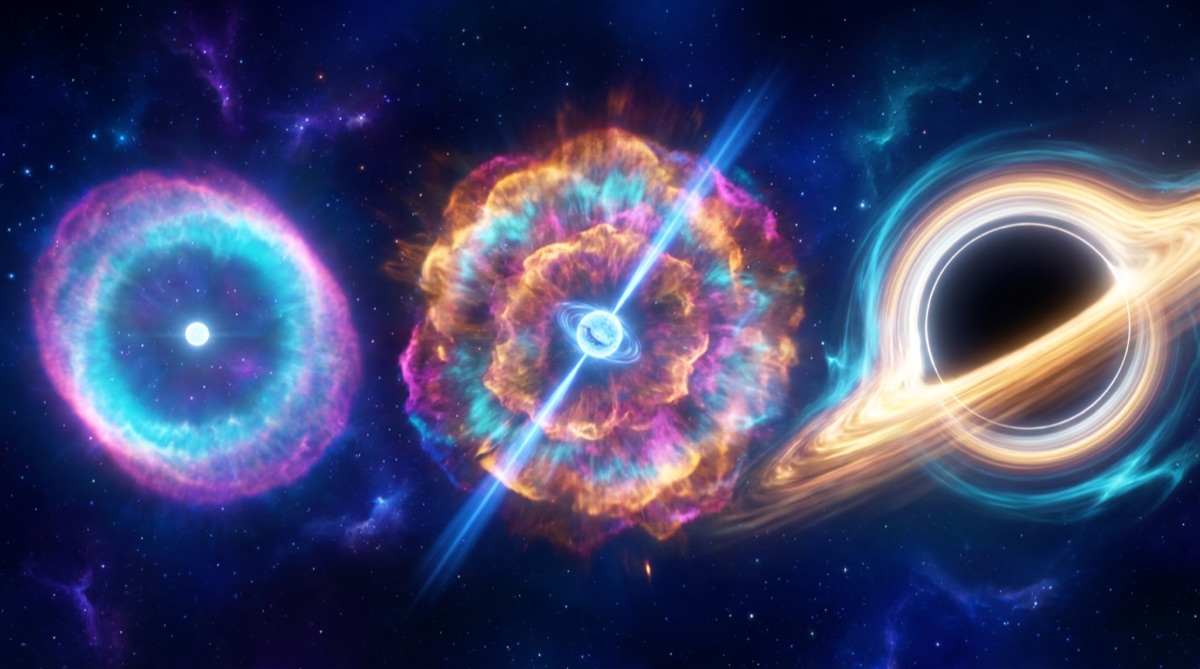
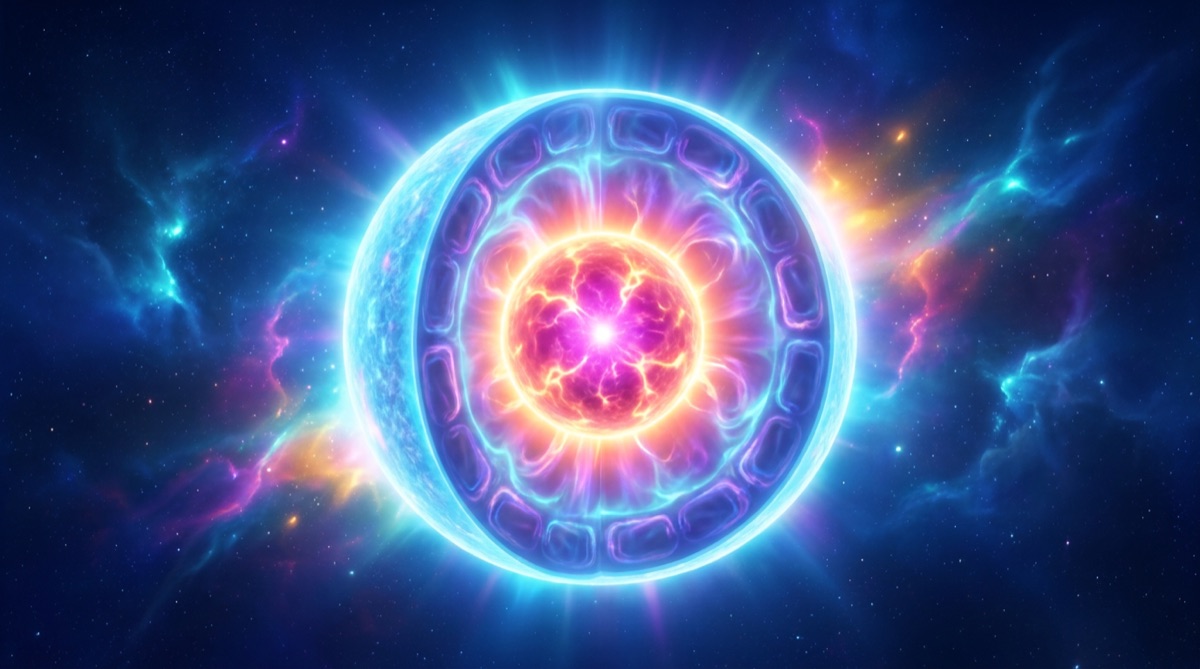
When the hydrogen in the core runs out, the star reorganizes itself: the core contracts and heats up, the outer layers swell and cool, and the star climbs to the giant region of the H–R diagram (Arcturus and Aldebaran are suns of the future). What happens next is decided, once again, by the initial mass:
Less than ~8 M☉: white dwarf
The star manages to fuse helium into carbon and oxygen, but no further. It sheds its outer layers (a planetary nebula) and the bare core remains: a white dwarf, with a mass similar to the Sun’s compressed into a radius similar to the Earth’s. It no longer produces energy; it cools for billions of years. Sirius B is one.
Worked example 6: the density of Sirius B. kg and m:
One cubic centimeter of Sirius B weighs 2.7 tons: a teaspoonful, as much as a car.
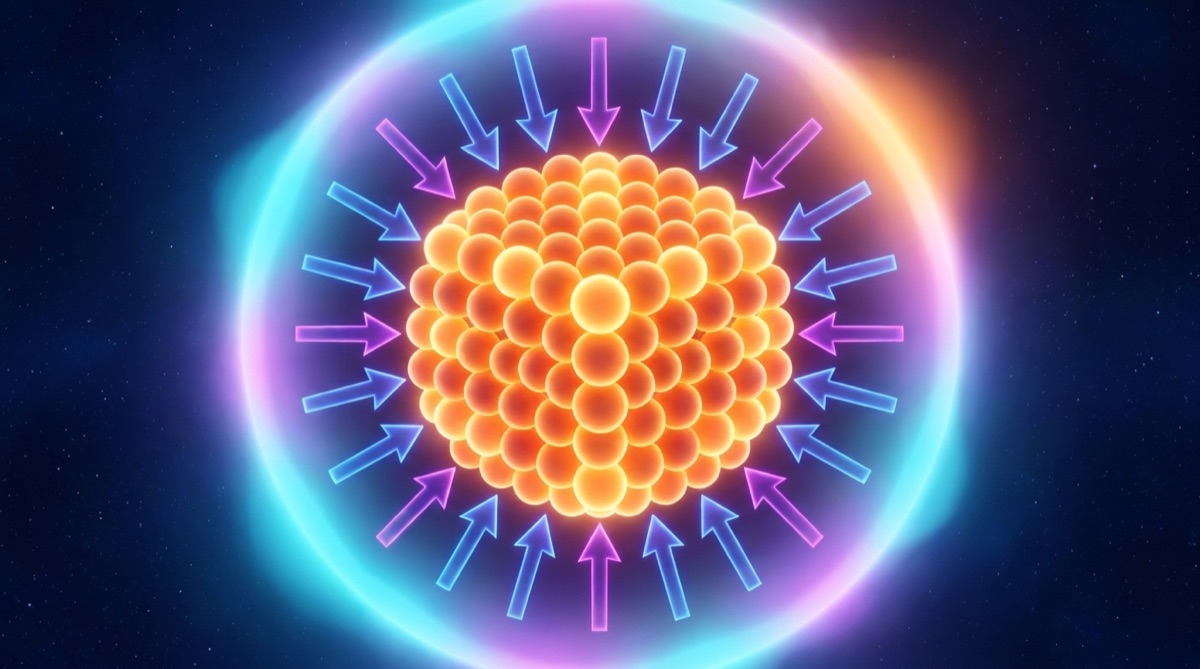
What holds it up, if there is no more fusion? The electron degeneracy pressure: a quantum effect by which electrons refuse to be squeezed any closer. That pressure has a limit. In 1930, at 19 years of age and during the boat trip from India to England, Subrahmanyan Chandrasekhar calculated (and published in 1931) that above a certain mass the electrons cannot hold:
This is the Chandrasekhar limit. No white dwarf can exceed it. And it has a strange property: the more mass a white dwarf has, the smaller it is (); as it approaches the limit, the radius tends to zero. That is why stars of up to ~8 can end as white dwarfs: they lose most of their mass before dying, and the core that remains is below 1.44 .
In the simulator (turn on “Simple mode”) move the central density: the white dwarf gains mass and shrinks. Find Sirius B and compare its radius with the Earth’s. What happens to the radius when the mass approaches the limit line?
- Mass
- 1.018 M☉ (69.9 % of M_Ch)
- Radius
- 5582 km = 0.88 R⊕ = 0.0080 R☉
- Chandrasekhar limit
- M_Ch = 5.83 μₑ⁻² M☉ = 1.456 M☉
- Mean density
- 2.78×10⁹ kg/m³ (2.8e+6 g/cm³)
- Center
- ρ_c = 3.16×10¹⁰ kg/m³, x_c = p_F/m_e c = 2.532, P_c = 4.36×10²³ Pa
- Surface gravity
- g = 4.34×10⁶ m/s² (log g = 8.64 cgs)
- n = 3/2 polytrope at the same M
- R_NR = 8825 km (58.1 % larger)
- Regime
- relativistic transition (x_c ~ 1)
Between ~8 and ~20–25 M☉: supernova and neutron star
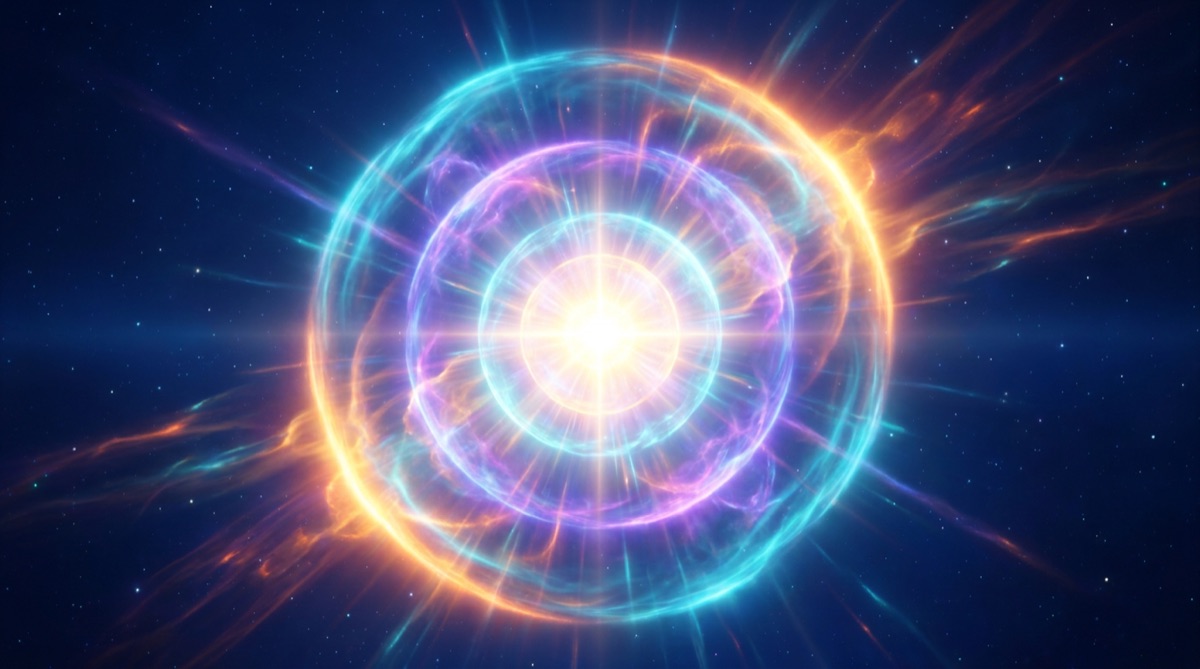
A massive star fuses ever heavier elements until it reaches iron, which no longer releases energy when fused. The iron core grows, exceeds the Chandrasekhar limit and collapses in a fraction of a second: the electrons merge with the protons and form neutrons. The energy released blows the outer layers away in a supernova and leaves a neutron star: ~1.4 in a radius of about 12 km, held up by neutron degeneracy. Many spin tens of times per second and emit radio pulses: the pulsars, discovered by Jocelyn Bell in 1967.
Worked example 7: the density of a neutron star. The pulsar J0030+0451 has and km (measured by the NICER telescope):
One cubic centimeter: 310 million tons, the mass of a mountain. It is the density of the atomic nucleus: the whole star is, in practice, a giant nucleus.
More than ~20–25 M☉: black hole
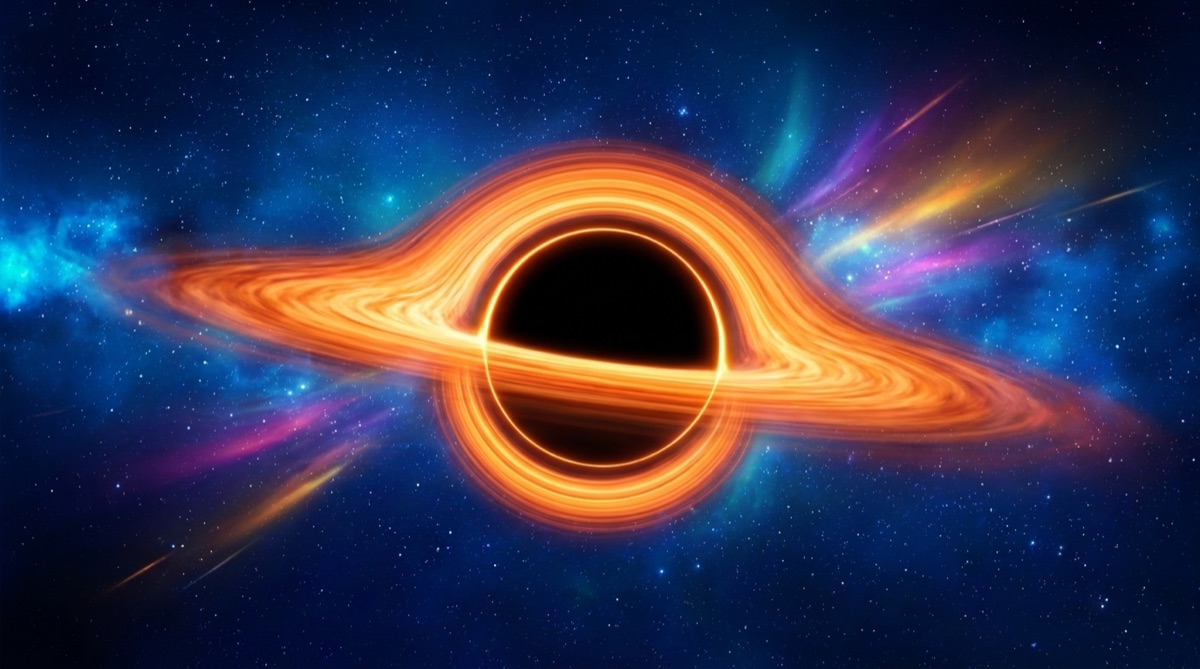
Neutron stars also have a limit, about (deduced from the merger of two neutron stars detected by gravitational waves in 2017). If the collapsing core exceeds it, nothing can stop the collapse: a black hole forms, a region from which not even light escapes. Its “size” is the Schwarzschild radius:
with . For example, Cygnus X-1, the first black hole identified, has and km. The one at the center of the Milky Way, Sagittarius A*, has and km au, 18 times the radius of the Sun: it is not “stellar”, but the formula is the same.
Summary
| Initial mass | Main-sequence lifetime | End | Remnant | Limit |
|---|---|---|---|---|
| 0.08–0.5 | years | (none has died yet) | helium white dwarf | — |
| 0.5–8 | – years | planetary nebula | white dwarf (, ~Earth) | Chandrasekhar |
| 8–20 | – years | supernova | neutron star (, ~12 km) | NS maximum mass |
| years | supernova or direct collapse | black hole ( km/) | — |
The boundaries (8, 20–25 ) are approximate and depend on the composition and on how much mass the star loses through winds. Below ~0.08 hydrogen never gets to fuse: it is a brown dwarf, not a star.
Simulator: the Sun, before and after
Use the blackbody simulator to see how the appearance of the Sun changes over its life (the luminosity is computed with ):
- Today: K, . Write down and the color.
- Red giant (in ~5 billion years): K and (of the order of the orbit of Venus). How many times more luminous than today? Despite being cooler, why does it shine so much more?
- White dwarf (the end): K, (radius slider at its minimum). Compare the luminosity with today’s: hotter, but how much fainter? With the logarithmic vertical axis, pin the three curves and compare them.
- T
- 5,772 K
- λmax
- 502 nm
- B−V
- 0.65
- σT⁴
- 6.29 × 10⁷ W/m²
- L/L☉
- 1.00
- Mbol
- 4.74
Activity: the lives of stars on a measuring tape
We are going to draw stellar lives to scale: 1 meter = 10¹⁰ years, that is, 1 mm = 10 million years.
You need:
- a roll of masking tape or paper (at least 6 m) and a schoolyard or a long hallway;
- a measuring tape, colored markers;
- a calculator;
- the table from example 4.
- Fix the end of the tape to the floor: it is the birth of every star (t = 0). All times are measured from there.
- Mark the lifetime of the Sun: years → 1.00 m. Mark its current age: years → 45.7 cm. Also mark the age of the universe: 13.8 billion years → 1.38 m.
- Compute with and mark: a 2 star (18 cm), a 5 star (work it out: 1.8 mm), a 20 star (0.56 mm: barely the width of a marker line). Where would a 0.5 star end up (5.7 m: it takes the whole roll) and a 0.1 star (300 m: the schoolyard is not long enough!)?
- Add milestones of the Earth on the same scale from the birth of the Sun: formation of the Earth (about 50 million years after the Sun: 5 mm), first cells (~3.8 billion years ago: at 8 cm), extinction of the dinosaurs (66 million years ago: 6.6 mm before “today”), Homo sapiens (300 000 years ago: 0.03 mm before “today”).
- Each member of the group chooses a star from the H–R table (Rigel, Sirius A, Proxima…) with its estimated mass, computes its lifetime and marks it with its name.
Final question: if the entire life of a 20 star fits in half a millimeter of your tape, what does it mean that we see thousands of such stars in the Milky Way today? What does that tell us about star formation?
Exercises
Basic level
- Compute for stars of 3 and of 0.3 with .
Show solution
; .
- How long does a 4 star live on the main sequence?
Show solution
; years.
- Compute the Schwarzschild radius of a 10 black hole and of one with the mass of the Earth ().
Show solution
km. Earth: km mm: the Earth would have to be squeezed to the size of a marble.
Intermediate level
- In a star cluster, all the stars were born at the same time. The most massive stars still on the main sequence have 3 . How old is the cluster? (This method, the “turnoff point”, is how clusters are dated.)
Show solution
Those above 3 have already left; those with 3 are about to. Age years.
- Using the logarithmic form , what is the mass of a star whose lifetime is years?
Show solution
.
- A 0.6 white dwarf has . Using , estimate the radius of a 1.2 one and compare the two densities.
Show solution
: (6900 km). The density : the 1.2 one is times denser. More mass, smaller and much denser: on the way to the Chandrasekhar limit.
Challenge level
- Measure the exponent of the mass–luminosity relation with two real stars: Sirius A (, ) and Proxima (, ). Compute the slope of the line joining them in the plane.
Show solution
: and ; : and . Slope . Very close to 3.5 (with only two stars it is a coincidence that it comes out so well; with 500, as in Eker et al. 2018, the separate segments show up).
- A 15 star ends as a 1.4 neutron star. What fraction of its initial mass remains in the remnant? Where did the rest go? If part of that ejected mass contains iron, oxygen and calcium, what does that have to do with your own body?
Show solution
. The remaining 90 % left in winds during the star’s life and in the supernova, enriched with the elements the star manufactured. The iron in your blood and the calcium in your bones were formed inside stars that died before the Sun was born: we are, literally, supernova debris.
- Derive the mean density of a neutron star of mass and radius in terms of that of an atomic nucleus: an iron-56 nucleus has mass kg and radius m. Compare with example 7.
Show solution
; . The neutron star () is only slightly denser than an atomic nucleus: it is nuclear matter on the scale of kilometers.
✦ Mini-quiz
Remember
- Fusion: 0.7 % of the mass of the hydrogen becomes energy (). The Sun loses 4 million tons per second and lives years on the main sequence; it has used up 4567 million.
- Mass–luminosity: (straight line of slope 3.5 in log-log). Lifetime: years: 20 → 6 million years; 0.5 → 57 billion.
- : planetary nebula + white dwarf (, Chandrasekhar limit; ; kg/m³).
- –: supernova + neutron star (, 12 km, kg/m³).
- : black hole, .
🍎 Teacher guide
- Time
- 3 sessions of 55 min
- Colombian national standard (MEN)
- Mathematics, Grades 10 to 11, numerical thinking: “I establish relationships and differences between different notations of real numbers in order to decide on their use in a given situation”; metric thinking: “I design strategies to tackle measurement situations that require specific degrees of precision”; variational thinking (revisited from Grades 8 to 9): “I identify and use exponentiation, roots and logarithms to represent mathematical and non-mathematical situations and to solve problems” and “I analyze, in Cartesian graphical representations, the patterns of change of specific functions belonging to the families of polynomial, rational, exponential and logarithmic functions”. Natural Sciences, Grades 10 to 11: “I use biological, physical and chemical models to explain the transformation and conservation of energy”; “I relate mass, distance and the force of gravitational attraction between objects”; “I establish differences between models, theories, laws and hypotheses”; “I use mathematics to model, analyze and present data and models in the form of equations, functions and conversions”.
- Evidence of learning
- Estimates the lifetime of the Sun with E = mc², computes luminosities and lifetimes with the power functions M^3.5 and M^−2.5 (and their logarithmic forms), builds the scale timeline, assigns to each initial mass its final remnant using the Chandrasekhar and neutron-star limits, and computes densities and Schwarzschild radii in scientific notation.
Materials
- Masking tape or paper roll (≥ 6 m), measuring tape and markers
- Scientific calculator with fractional powers (xʸ) and log
- Printed table of masses and luminosities
- Computer or tablet with the blackbody simulator
Suggested sequence
Session 1. Fuel and mass–luminosity (55 min). Hook (5 min). and examples 1 and 2 with the calculator (20 min). Mass–luminosity relation, fractional exponent and example 3 (20 min). Exercise 1 (10 min).
Session 2. Lifetimes (55 min). Derivation of and the table of example 4 in groups (20 min). Tape activity in the schoolyard (30 min). Closing: final question and exercise 2 (5 min).
Session 3. Final fates (55 min). Section 4 with examples 6 and 7 (densities) and the Schwarzschild radius (25 min). Simulator: the Sun today, red giant and white dwarf (10 min). Exercises 3–5 and mini-quiz (20 min). Challenges 7–9 as homework; number 8 connects with nucleosynthesis and the origin of the elements.
Common mistakes
- Believing that more fuel means a longer life. Make the truck/bus comparison and the M/L ratio explicit.
- Computing 2^3.5 as 2 × 3.5 or as 2³ + something. Break it down: 2³ × 2^0.5, and check with the xʸ key.
- Thinking that stars "evolve along the main sequence". The position is set by the mass; the star moves on the H–R diagram only at the end (giant, white dwarf).
- Confusing the Chandrasekhar limit (white dwarfs) with the maximum mass of neutron stars (≈ 2.2 M☉) or with the initial mass of 8 M☉ for a supernova. They are three different boundaries; the summary table keeps them apart.
- Taking the boundaries (8, 20–25 M☉) and the exponent 3.5 as exact. They are approximations with uncertainty; Sirius A in example 3 shows the size of the error.