One day in March, at noon, a 1 m stick planted in a schoolyard in Bogotá casts a shadow of barely 8 cm. On the same day, at the same solar time, an identical stick in Madrid (Spain) casts a shadow of 85 cm. The Sun is the same and the sticks are identical. Why are the shadows so different?
The answer lies in an angle. And that angle, as you will see at the end, is the same one that forms at the center of the Earth. With this idea, 2 200 years ago, Eratosthenes measured the size of the planet. Today you are going to learn the geometry that made it possible.
1. Angles: measuring how wide something opens
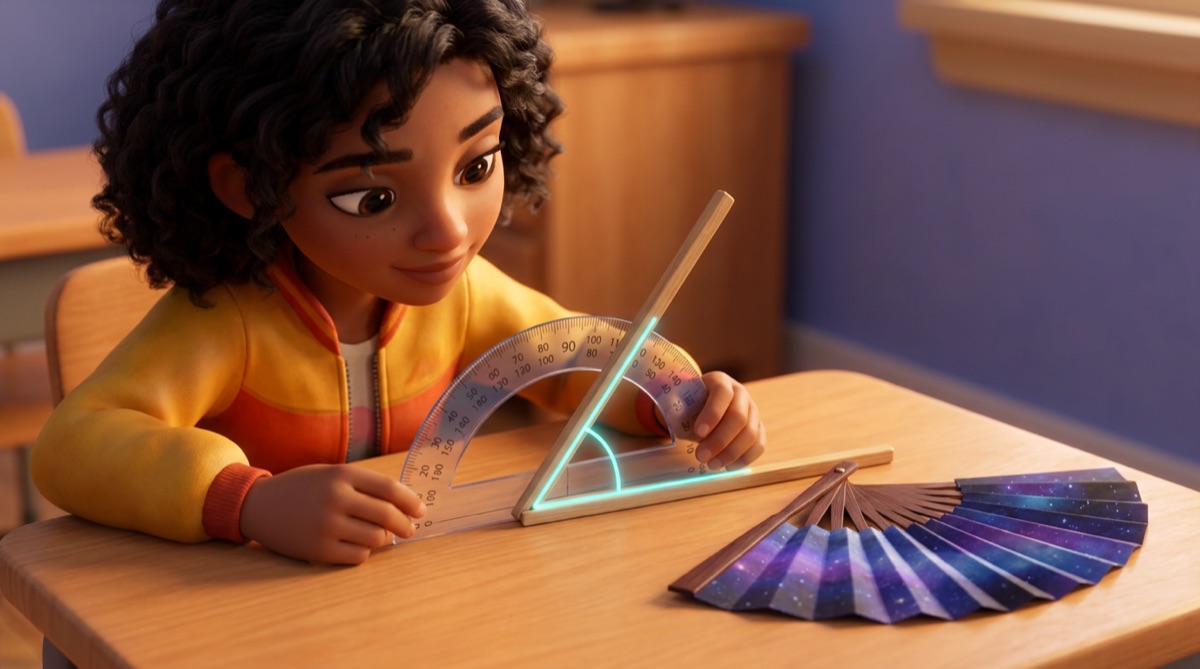
An angle is the opening between two rays (the sides) that start from the same point (the vertex). It is measured in degrees (): a full turn is , so
| Fraction of a turn | |||||
|---|---|---|---|---|---|
| Angle |
According to its measure, an angle is acute (less than ), right (), obtuse (between and ) or straight ().
To measure it we use the protractor: the center of the protractor goes on the vertex, the zero on one of the sides, and you read where the other side crosses.
Two pairs that come up a lot:
- Two angles are supplementary if they add up to (for example, and ).
- Two angles are complementary if they add up to (for example, and ).
2. Two parallel lines cut by a transversal

Two lines are parallel if they lie in the same plane and never meet, however far we extend them: they always keep the same distance from each other, like the rails of a train.
A line that cuts two other lines is called a transversal (or secant). When a transversal cuts two parallel lines and , eight angles are formed, four at each crossing. We name them by their position:
- Interior: the four that lie between the two parallels. Exterior: the four that lie outside.
- Alternate: two angles on opposite sides of the transversal.
- Corresponding: two angles that occupy the same position at each crossing (for example, “top right” at both).
- Vertical angles: two angles at the same crossing that share only the vertex.
Property. If two parallel lines are cut by a transversal:
- the alternate interior angles are equal;
- the corresponding angles are equal;
- the vertical angles are equal;
- two neighboring angles at the same crossing (adjacent) are supplementary: they add up to .
Why are the alternate interior angles equal? An angle and its alternate interior angle correspond to each other when the figure is rotated half a turn around the midpoint of the segment of the transversal that lies between the parallels. That rotation takes each parallel onto the other and the transversal onto itself, so one angle lands exactly on the other.
Worked example 1: the eight angles
Two parallel lines are cut by a transversal. One of the interior angles measures . How much do the other seven measure?
- Its adjacent angle measures .
- Its vertical angle also measures ; the vertical angle of the adjacent one, .
- At the other crossing, the corresponding angle measures and, applying steps 1 and 2, there too there are two of and two of .
In total: four angles of and four of . With two parallels and a transversal, knowing one angle is enough to know all eight.
3. The Sun’s rays arrive parallel
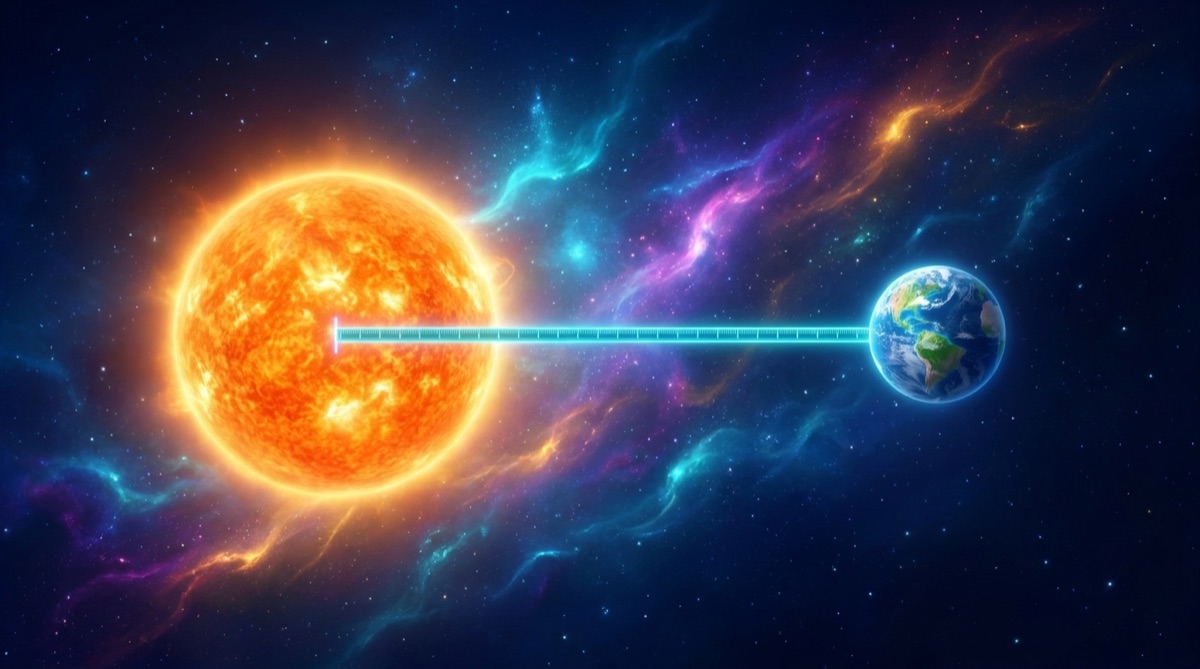
The Sun is about million kilometers away (exactly, the mean Earth–Sun distance is km, the astronomical unit). Its rays go out in all directions, but the ones that reach the Earth form a tiny angle with each other.
Think of it this way: two rays that fall on two cities km apart form at the Sun an angle that spans km at a distance of km: it is like looking at a 1 cm coin from 1.5 km away. That angle measures about , impossible to notice with a protractor.
That is why, for everything we are going to do, the Sun’s rays that reach different places on the Earth are parallel lines. That is Eratosthenes’ first idea.
4. Measuring an angle with a shadow
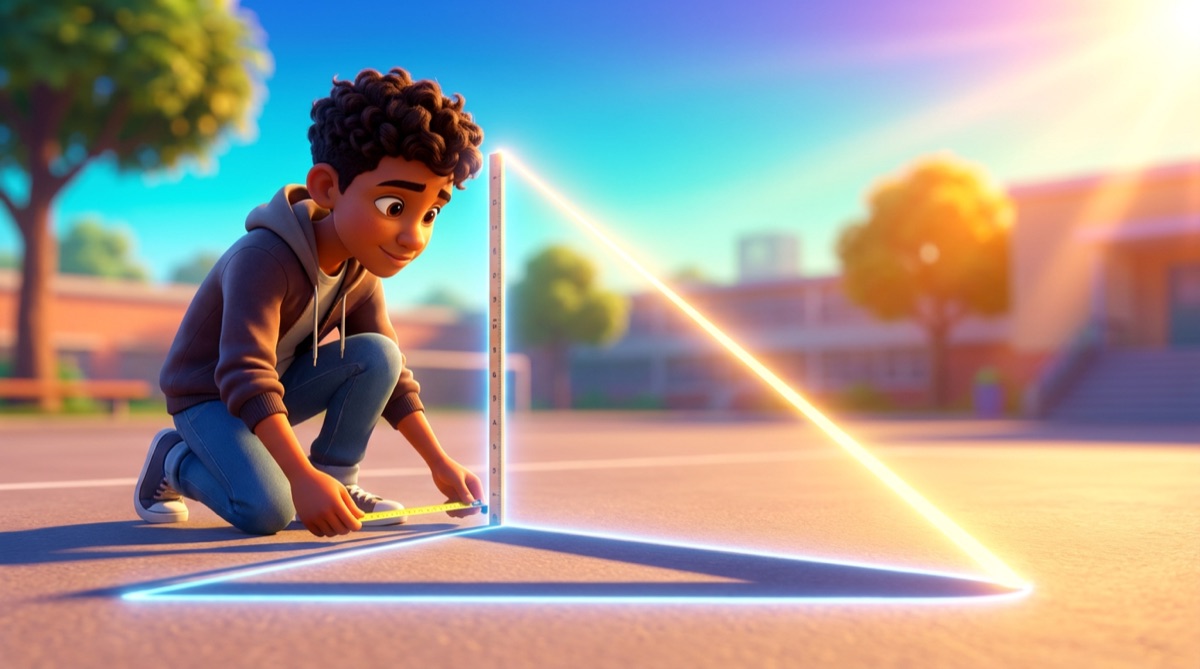
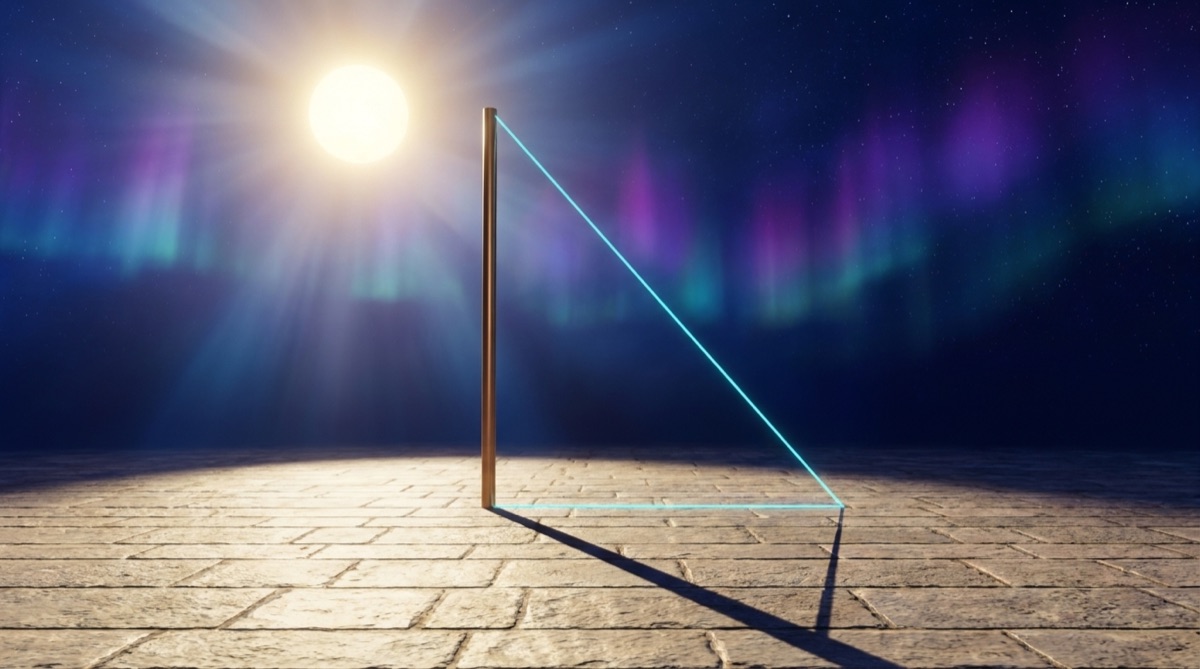
A vertical stick used to study shadows is called a gnomon. If the gnomon measures and its shadow measures , the stick, the shadow and the Sun’s ray that grazes the tip form a right triangle:
- the right angle is at the base (the stick is vertical and the ground horizontal);
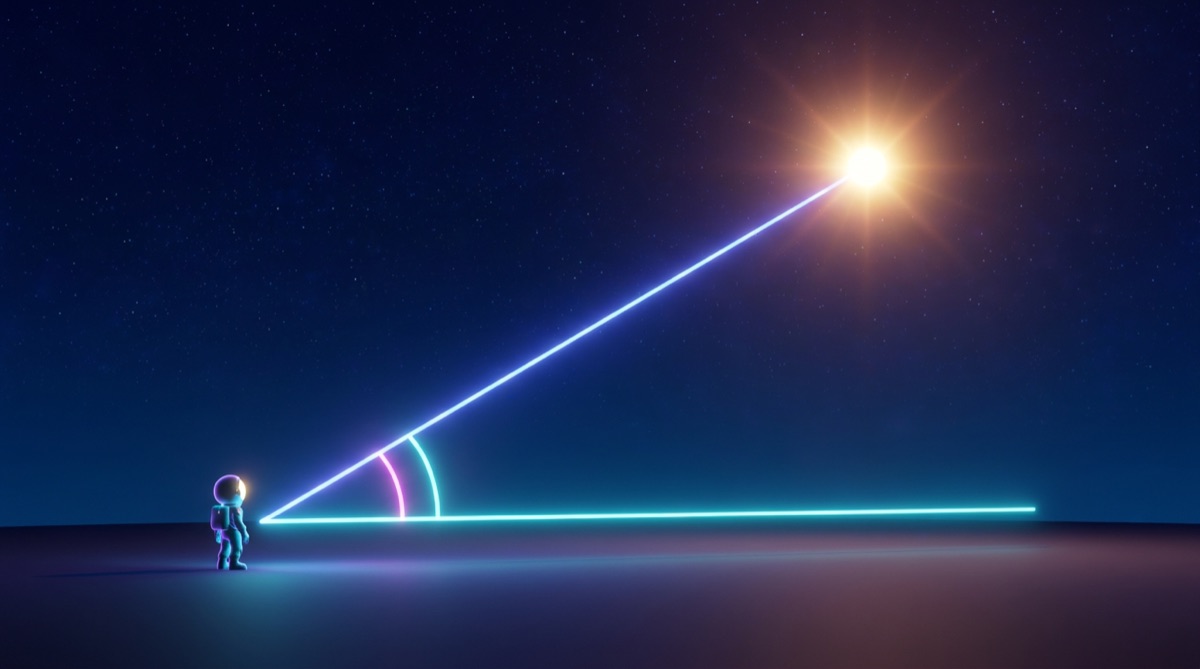
- the angle at the tip of the gnomon, between the stick and the ray, we will call : it is the shadow angle (astronomers call it the zenith distance, because it measures how far the Sun is from the point right above your head, the zenith);
- the angle at the end of the shadow, between the ground and the ray, is the altitude of the Sun above the horizon, .
Since the three angles of a triangle add up to and one is a right angle, and are complementary:
How do we find without climbing to the tip of the stick?
Method 1: scale drawing. Draw the triangle on paper, with the stick and the shadow reduced in the same proportion (for example, 1 m → 10 cm, scale 1:10). Measure with the protractor. The angle does not change with the scale: that is the beauty of similar triangles.
Method 2: the shadow/height ratio. The angle depends only on the quotient . A shadow twice as long as the stick always gives the same angle, whether the stick measures 10 cm or 3 m. This table (calculated precisely) saves you the drawing:
| 0 | 0.09 | 0.18 | 0.27 | 0.36 | 0.47 | 0.58 | 0.70 | 0.84 | 1.00 | 1.19 | 1.43 | 1.73 | 2.75 | 5.67 | |
|---|---|---|---|---|---|---|---|---|---|---|---|---|---|---|---|
Notice: with the angle is exactly (the triangle has two equal legs). For intermediate values of , interpolate between the two nearest columns or make the scale drawing. (In Grade 10 you will learn that this table is the tangent of the angle.)
Worked example 2: the angle of a shadow
A gnomon of cm casts a shadow of cm.
The Sun is above the horizon, very high, and only away from the zenith.
Worked example 3: Bogotá and Madrid
Back to the opening question. At the equinox (around March 20) the noon Sun passes right over the equator. Then the shadow angle of each city equals its latitude, the angular distance to the equator:
| City | Latitude | Shadow of a 1 m stick | ||
|---|---|---|---|---|
| Bogotá | N | cm | ||
| Madrid | N | cm |
The shadows are different because the cities are at different latitudes: the shadow angle “measures” how tilted the ground of each city is with respect to the Sun’s ray.
5. From the gnomon to the center of the Earth
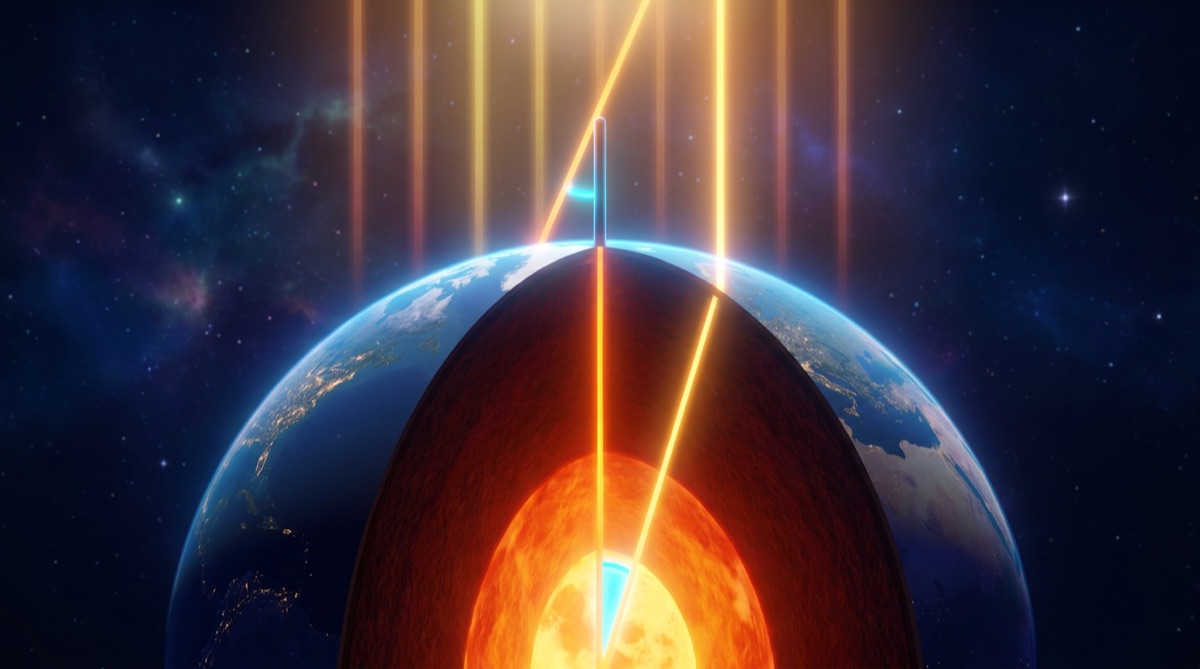
Now let us put it all together. Imagine the Earth cut in half and two lines:
- the Sun’s ray that grazes the tip of the gnomon;
- the Sun’s ray that falls exactly vertically at some place on the Earth (the subsolar point) and, extended, passes through the center of the planet.
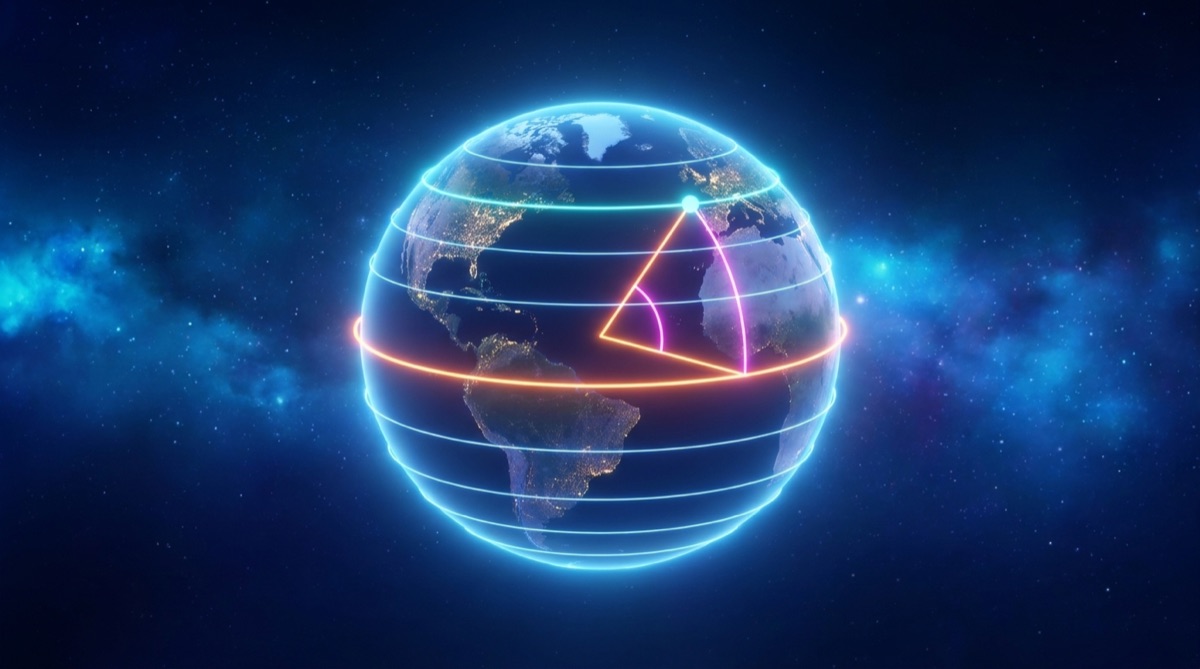
Both are rays of the Sun: they are parallel (section 3). Now extend the gnomon downward: being vertical, it also passes through the center of the Earth. That line is a transversal that cuts the two parallels.
Between that transversal and the two parallels there are two alternate interior angles:
- one at the tip of the gnomon: the shadow angle, ;
- the other at the center of the Earth: the angle between the gnomon and the subsolar point.
They are equal. When you measure the shadow of a stick you are measuring, without knowing it, an angle at the center of the Earth.
That explains example 3: at the equinox the subsolar point is on the equator, so the central angle between your city and the equator is your latitude… and that is why = latitude.
If two cities measure their shadows on the same day, the difference of their angles is the central angle between them. With that angle and the distance between the cities you can calculate the full turn around the Earth. That is the next lesson: Eratosthenes measures the Earth.
6. Explore with the simulator
- Δα
- 7.20° (1/50.0 of a turn)
- d
- 5 000 stadia (157.5 m) ≈ 788 km
- C
- 250 000 stadia ≈ 39 375 km
- R
- 6 267 km
- Actual
- meridional C = 40 008 km (R = 6 367 km); equatorial 40 075 km
- Error
- −1.6 %
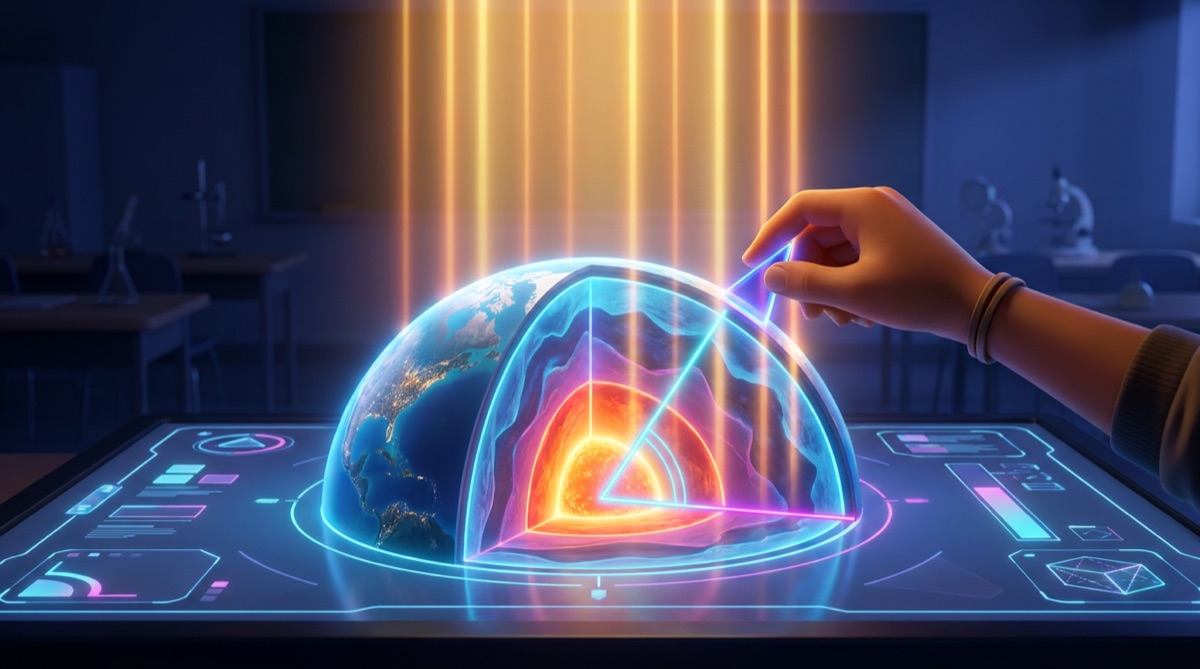
The drawing is a cross-section of the Earth; the Sun’s rays are the vertical parallel lines.
- Press Syene–Alexandria and turn on Exaggerate to see the gnomons clearly. Locate the shadow angle in Alexandria () and the angle formed at the center of the Earth. What pair of angles are they?
- Move the shadow angle of city B to . How much does the central angle measure now? And if you raise it to ?
- Set city A to and city B to . Check that the central angle between them is the difference, .
- Turn off Exaggerate. The gnomons become minuscule compared with the Earth, but the angle does not change: why?
Activity: measure the angle of the Sun in your schoolyard
You need: a straight stick 50 cm to 1 m long (or a PVC tube), a plumb line (a stone tied to a string), a tape measure, chalk, grid paper, a ruler and a protractor.
- Plant the stick in horizontal ground (check with a marble that does not roll) and make it vertical with the plumb line: the string should stay flush against the stick on all sides.
- Measure the height of the stick from the ground to the tip.
- Every 20 minutes, between 10:00 and 14:00, mark the tip of the shadow with chalk, measure its length and note the time.
- For each measurement calculate and find with the table; then .
- Choose one measurement and draw the triangle at scale 1:10 on the grid paper. Measure with the protractor. Does it agree with the table?
- Make a time–Sun altitude table. At what time was the shadow shortest? That is solar noon (it does not fall exactly at 12:00: depending on your longitude, your time zone and daylight saving time it can fall quite a bit earlier or later).
Final question: which way did the shortest shadow point, north or south? What does that tell you about where the Sun was?
Exercises
Basic level
- What fraction of a turn is an angle of ? And of ? How many degrees is of a turn?
Show solution
of a turn; ; .
- Two parallel lines are cut by a transversal and one of the angles measures . How much do its alternate interior angle, its corresponding angle and its adjacent angle measure?
Show solution
Alternate interior: . Corresponding: . Adjacent: .
- A 50 cm gnomon casts a shadow of 29 cm. Calculate , the shadow angle and the altitude of the Sun .
Show solution
(table). .
Intermediate level
- A m gnomon casts a shadow of m. Without using the table, what is ? Explain why.
Show solution
. The right triangle has two equal legs, so its two acute angles are equal and, since they add up to , each one measures .
- At the equinox, at solar noon, a 1 m gnomon in Santa Marta casts a shadow of 20 cm. What is the approximate latitude of Santa Marta? Compare with the value from the atlas ( N).
Show solution
. It lies between () and (), closer to : . At the equinox = latitude, so Santa Marta is at about N. It agrees with the atlas.
- An angle and its alternate interior angle measure and . Find and the angle adjacent to them.
Show solution
The alternate interior angles are equal: . The angle measures and its adjacent angle .
Challenge level
- To measure the same shadow angle, one group uses a 20 cm gnomon and another a 2 m one. Both are off by 1 cm when measuring the shadow. Which group gets a more precise angle? Reason it out with the ratio for .
Show solution
With , . 20 cm gnomon: cm; a 1 cm error changes from to (or ), about of difference. 2 m gnomon: cm; 1 cm changes to (or ), less than half a degree. The tall gnomon is more precise: the same measurement error is spread over a greater length.
- If the Earth were flat and the Sun’s rays parallel, what would happen to the shadows of two gnomons in Bogotá and Madrid at the same instant? What, then, does the real difference in shadows tell us?
Show solution
On a flat Earth all vertical gnomons would be parallel to each other and would form the same angle with the parallel rays: the shadows would be equal in the two cities. The fact that they are different ( cm versus cm) shows that the vertical of Bogotá and that of Madrid are not parallel: the ground is curved. The difference in angles () is the angle between the two cities seen from the center of the Earth.
✦ Mini-quiz
Key takeaways
- One degree is of a turn. Supplementary angles add up to ; complementary ones, to .
- Parallels plus transversal: eight angles, four equal to each other and four supplementary to them. The alternate interior angles are equal.
- The Sun’s rays arrive parallel because the Sun is extremely far away.
- The shadow angle is found with the ratio (or a scale drawing) and the altitude of the Sun is .
- That angle is equal to the angle at the center of the Earth between your city and the subsolar point.
🍎 Teacher guide
- Time
- 2 sessions of 55 min + one morning of measurements in the schoolyard
- Colombian national standard (MEN)
- Mathematics, Grades 6 to 7: “I solve and formulate problems using geometric models”; “I solve and formulate problems that involve relations and properties of similarity and congruence using visual representations”; “I use techniques and tools for the construction of plane figures and solids with given measurements”. Natural Sciences, Grades 6 to 7: “I take measurements with instruments and equipment suited to the characteristics and magnitudes of the objects and express them in the corresponding units”; “I record my observations and results using diagrams, graphs and tables”.
- Evidence of learning
- Names the eight angles of parallels and transversal and finds the remaining seven from one; obtains the shadow angle of a gnomon by scale drawing and by the s/L table with less than 2° of difference; explains with a drawing why that angle equals the central angle.
Materials
- Protractors, rulers and grid paper
- Straight stick or tube 50 cm to 1 m long per group
- Plumb line (string and stone) and tape measure
- Chalk
- Computer or tablet with the simulator (optional)
Suggested sequence
Session 1. Angles and parallel lines (55 min). Opener: the hook of the two shadows (Bogotá and Madrid); hypotheses in the notebook. Development: measuring angles with a protractor, then drawing two parallels with a ruler and cutting them with a transversal; measuring the eight angles and discovering the equalities (section 2). Closing: worked example 1 and exercises 1, 2 and 6.
Measurements in the schoolyard (a sunny morning, 10:00 to 14:00). “Measure the angle of the Sun” activity; each group keeps a time–shadow table. If it is cloudy, replace it with a tall lamp and a 10 cm gnomon in the classroom.
Session 2. From the shadow to the center of the Earth (55 min). Opener: scale drawing of one of the schoolyard measurements and comparison with the s/L table. Development: sections 4 and 5 with the simulator (challenges 1 to 4); exercises 3, 4, 5 and 7. Closing: mini-quiz and bridging question: “if two cities measure their shadow on the same day, what else do we need to measure the Earth?” (the distance: link to the Eratosthenes lesson).
Common mistakes
- Confusing the shadow angle z with the altitude of the Sun h. Insist on the triangle: z is at the tip of the stick, h at the tip of the shadow, and they add up to 90°.
- Believing that a taller stick gives a different angle. Have two groups measure at the same instant with sticks of different heights and compare s/L.
- Thinking that the Sun's rays diverge “like those of a flashlight”. Use the calculation from section 3 and the image of a coin seen from 1.5 km away.
- Reading the protractor on the wrong scale (getting 130° instead of 50°). Always ask for a prior estimate: is it acute or obtuse?