On a first-quarter afternoon, around four o’clock, you can see at the same time the Sun sinking in the west and the half Moon high in the sky. About 2300 years ago, Aristarchus of Samos looked at that same scene and asked himself a question nobody had been able to answer with numbers: how many times farther away is the Sun than the Moon? He had no telescope and no clock, but he had geometry. His method is correct; his number is not. Understanding why it failed is the best lesson of this unit.
1. The half-Moon triangle
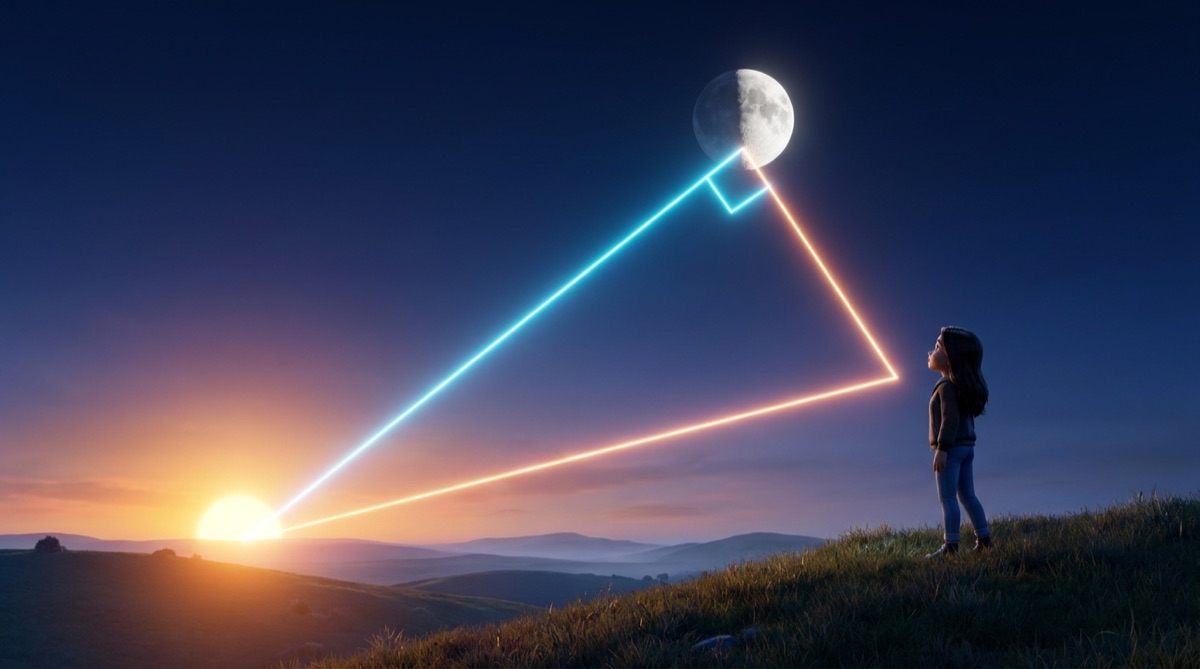
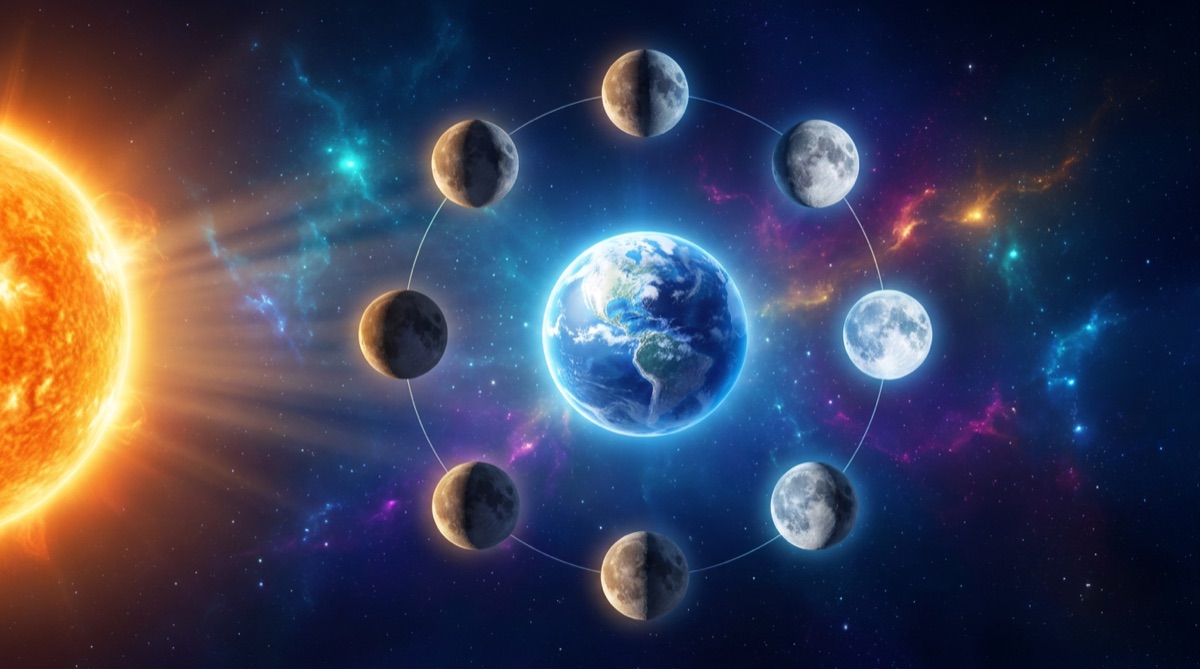
The Moon shines because it reflects sunlight: exactly the half that faces the Sun is always lit. At first quarter (or last quarter) we see exactly half of the disk lit. That happens only when the terminator (the line separating the lit part from the dark part) points toward us, that is, when the line Moon→Sun is perpendicular to the line Moon→Earth.
Put in geometric terms: at the exact instant of the half Moon (the dichotomy), the Sun–Moon–Earth triangle has a right angle at the Moon.
Let us call:
- : the Earth–Moon distance,
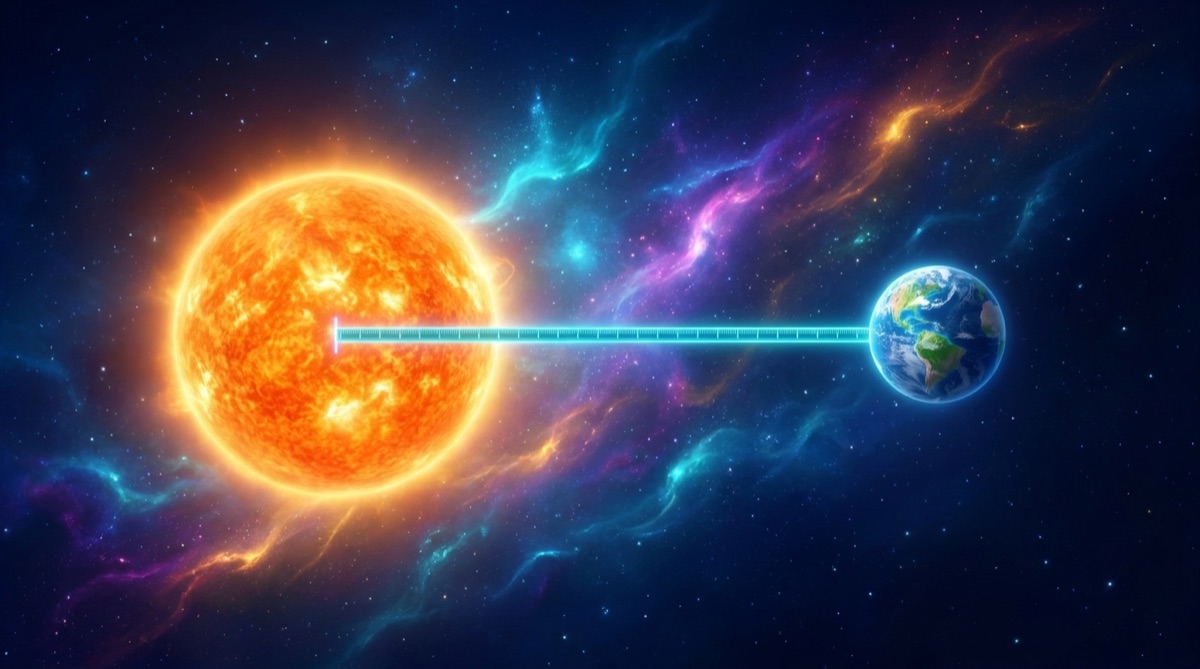
- : the Earth–Sun distance,
- : the Sun–Earth–Moon angle, with its vertex at the Earth (the elongation of the Moon at that instant).
In a right triangle, the adjacent leg divided by the hypotenuse is the cosine of the angle:
That is the whole idea. It is enough to measure one angle in the sky to know how many times farther away the Sun is than the Moon.
Worked example 1: Aristarchus’ calculation
Aristarchus stated that at dichotomy the angle is “less than a quadrant by one thirtieth of a quadrant”: . Then
Aristarchus did not know the cosine function (trigonometry would be invented centuries later); with geometric inequalities in the style of Euclid he proved that the ratio was between 18 and 20. That number was accepted for almost two thousand years.
Worked example 2: the real value
Today we know that km (mean distance) and km, so
The real angle at dichotomy is therefore
Aristarchus was off in the angle by less than 3°, and the result came out 20 times smaller than the real one! His geometry was impeccable; the problem lay elsewhere.
2. Why such a large error? Sensitivity of the method
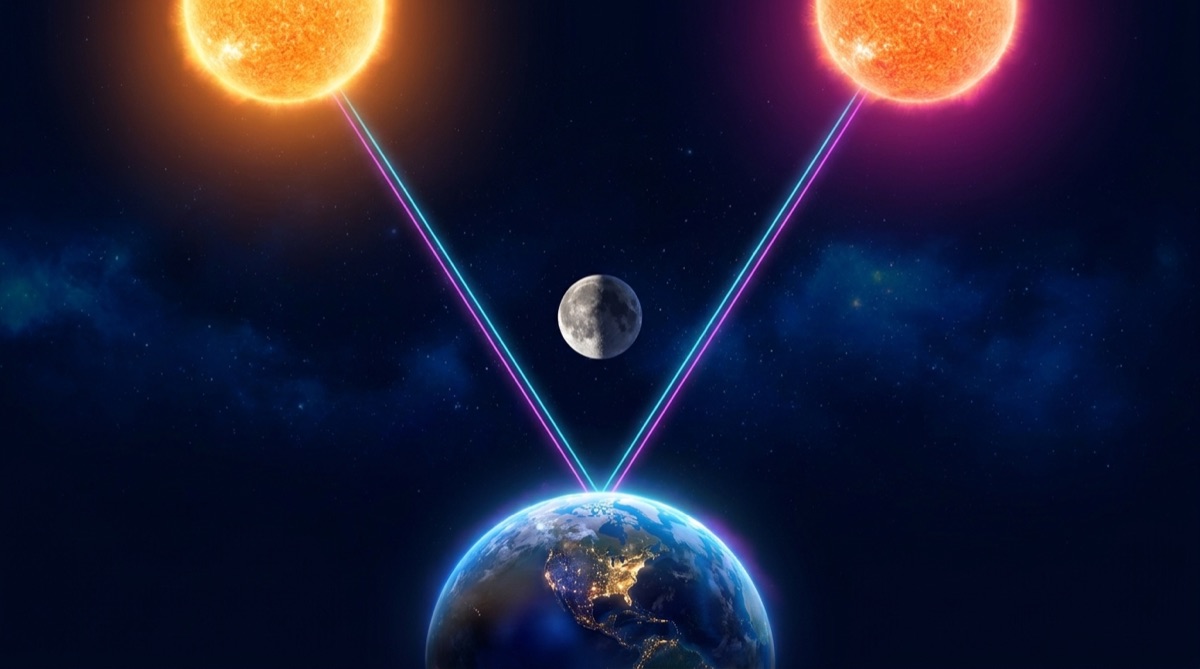
Near 90° the cosine is almost zero and changes very fast. Look at the table:
| 85° | 0.0872 | 11.5 |
| 87° | 0.0523 | 19.1 |
| 89° | 0.01745 | 57.3 |
| 89.5° | 0.00873 | 114.6 |
| 89.85° | 0.00262 | 382 |
| 89.9° | 0.00175 | 573 |
| 89.95° | 0.00087 | 1146 |
Between 89.85° and 89.95°, a difference of one tenth of a degree, the ratio triples. We say that the method is very sensitive to the error in the angle: a small error in the input produces an enormous error in the output.
We can quantify it without calculus. If with small (in radians), , so that
The ratio of distances is the inverse of the small angle missing to 90°. If is measured with a relative error of 10 %, the ratio comes out with a relative error of 10 %; but if the true value is and Aristarchus measured , his relative error was 1900 %. There was no way to measure a tenth of a degree with the naked eye at the moment of dichotomy:
- The terminator is not a sharp line: mountains and craters make it irregular, and with the naked eye it is impossible to say whether the Moon is 50.0 % or 50.5 % lit.
- The moment of dichotomy is hard to pin down. The Moon moves away from the Sun at a rate of per day per hour. An error of 2.85° in the angle is equivalent to being off by hours when deciding when the Moon is exactly “half.” To get it right to you would have to fix the instant with a precision of 12 minutes.
- The angle has to be measured between the Sun and the Moon, in broad daylight, with the blinding Sun: you cannot look directly.
Aristarchus’ method is correct, but the instruments of his time could not give him the data he needed. This distinction, a valid method with an insufficient measurement, is one of the central ideas of science.
Simulator challenge. Drag the Moon until the illuminated fraction reads 50.0 % and read the Sun–Earth–Moon angle: the simulator shows 90°. The exact model (Meeus, eq. 48.3) gives 89.85°: the difference from 90° is smaller than the precision with which the angle is displayed, and much smaller than what an eye can detect. Now drag the Moon from 80° to 100° and notice how little the appearance of the disk changes: between 49 % and 51 % lit.
3. The size of the Moon: the Earth’s shadow
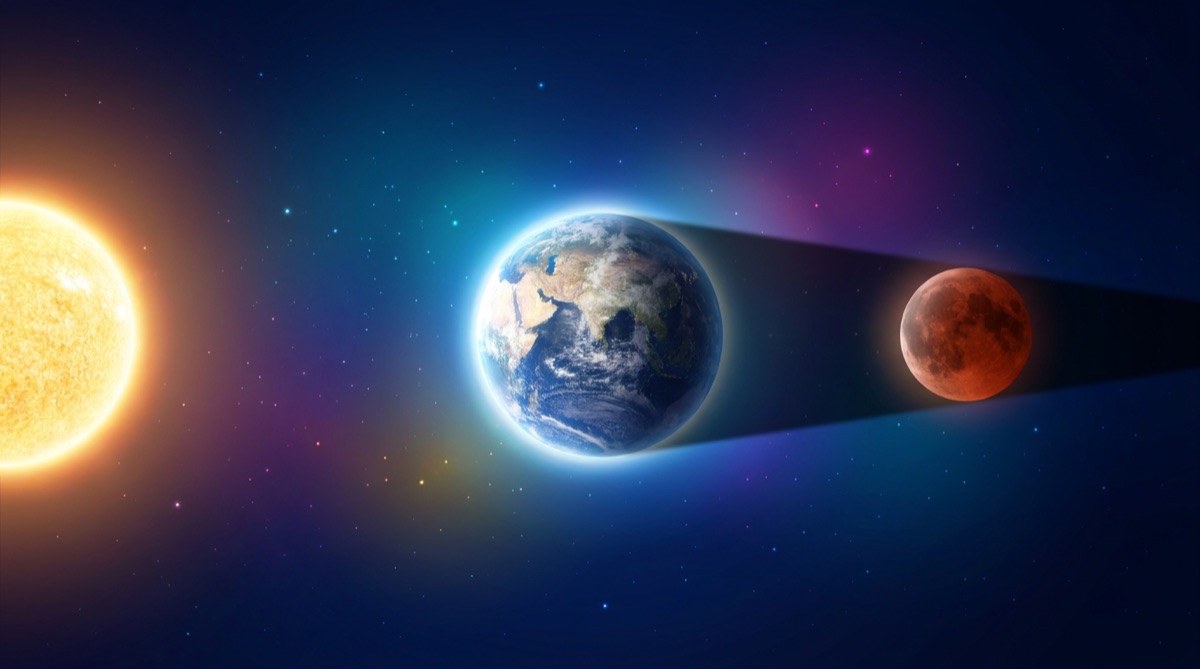
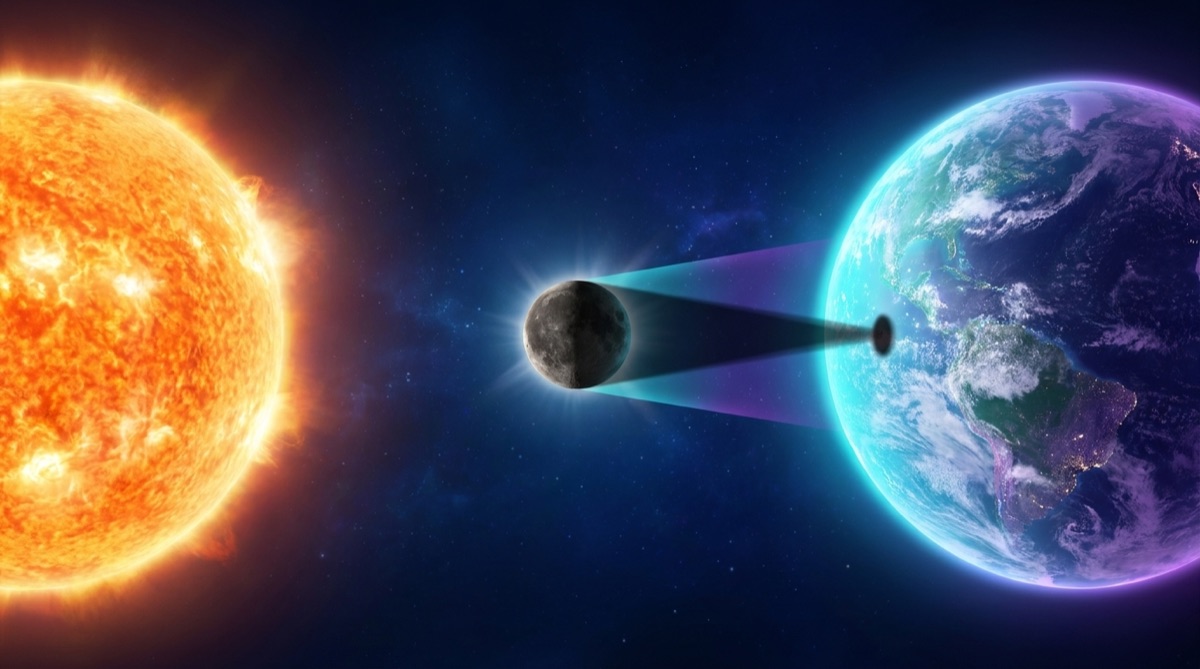
Aristarchus combined the previous ratio with a second observation: in a lunar eclipse, the Moon crosses the Earth’s shadow, and by timing how long it takes to enter and to cross it you get the width of the shadow in lunar diameters. Aristarchus assumed the shadow was 2 lunar diameters wide; modern measurements give 2.65.
Why the shadow is narrower than the Earth
The Earth’s shadow is a cone, because the Sun is larger than the Earth. A fortunate fact simplifies the geometry: the Sun and the Moon have the same angular size in the sky (about ; that is why total solar eclipses exist). Let us call that half-angle ().
- The radius of the Moon is (right triangle Earth–center of the Moon–edge of the Moon).
- The shadow cone narrows, per unit of distance, by , where is the radius of the Sun and that of the Earth. Since , is practically the half-angle of the Sun, equal to .
So, at the distance of the Moon the radius of the shadow is
The Earth’s shadow at the distance of the Moon is one lunar radius smaller than the Earth. If the shadow measures lunar radii (),
Worked example 3: with Aristarchus’ figure and with the modern one
- Aristarchus, : . The Moon would be one third the size of the Earth. (With his geometry of inequalities he obtained a ratio of diameters between and .)
- Modern, : , that is, km. The measured value is 1737.4 km: an error of 0.4 %.
Check of the modern figure with the exact geometry: km, and . ✓
4. From the Moon to the Sun: Aristarchus’ chain
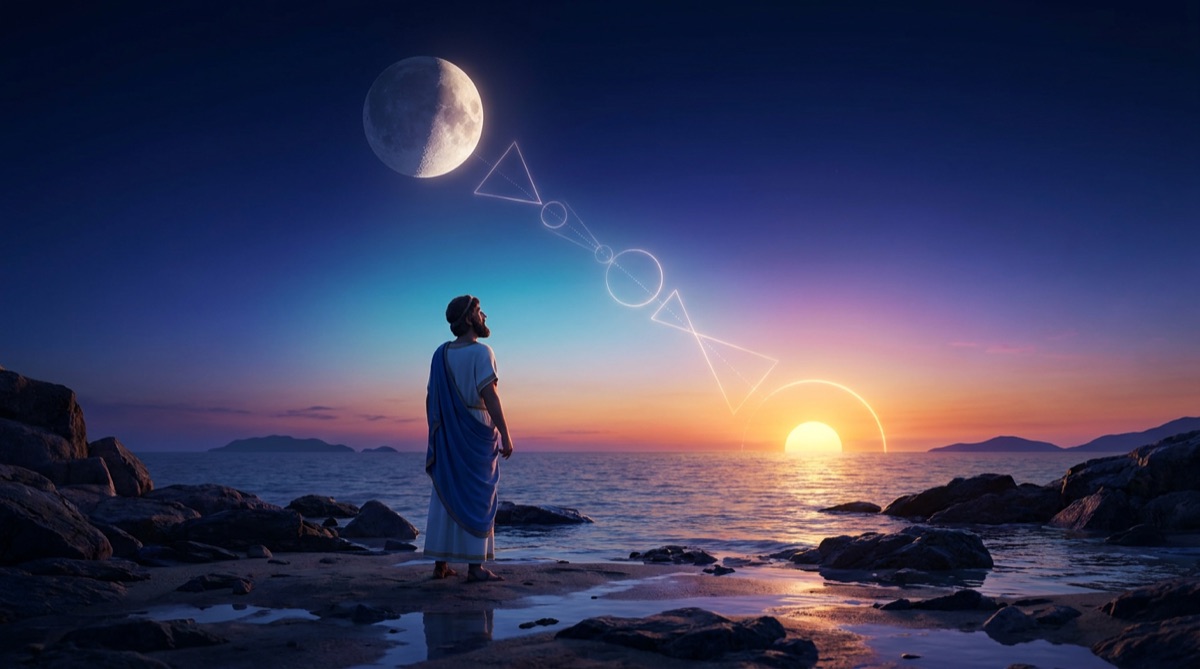
With the radius of the Earth (which Eratosthenes would measure a few decades later) everything else follows in a chain:
- Distance to the Moon. The angular diameter of the Moon is (NASA: rad). Since the angle is small, (Real mean: 384 400 km .) In his treatise Aristarchus used an angular diameter of , four times too large; Archimedes tells us that he later corrected it to of a circle, that is, 0.5°.
- Distance to the Sun. according to Aristarchus; in reality .
- Size of the Sun. Since Sun and Moon have the same angular size, . With the ratio 19 and : . (Real: .)
Even though he was off by a factor of 20, Aristarchus reached a revolutionary conclusion: the Sun is much larger than the Earth. And he asked himself what was more reasonable: that the enormous thing should revolve around the small one, or the other way around. That is why he proposed, seventeen centuries before Copernicus, that the Earth revolves around the Sun.
Activity: measuring the Sun–Moon angle without looking at the Sun
You need: a board or stiff cardboard about 40 × 40 cm, a large protractor (or a printed one), two straws, adhesive tape, an afternoon with the first-quarter Moon visible next to the Sun (look up the date in the simulator: age ≈ 7 days) and, optionally, a phone with a compass.
Never look at the Sun directly or through a straw. The Sun straw is aimed by its shadow.
- Tape the protractor to the center of the board. Fix one straw with tape along the 0° line so that it turns with the board.
- Hold the board edge-on (vertical or tilted) and turn it until the plane of the board contains both the Sun and the Moon: you will know because the shadow of the first straw falls on the board as a line, not as a wide spot.
- Aim the first straw at the Sun by watching its shadow: when it points exactly at the Sun, its shadow shrinks to a dot at the end.
- Without moving the board, aim the second straw at the Moon by looking through it. Read on the protractor the angle between the two straws: that is .
- Repeat three times and average. Calculate with each reading.
Final question: your three readings probably differ by 1° or 2°. Between what values does fall? What precision would you have to reach to distinguish 89.85° from 90°? What would you change about the instrument?
Exercises
Basic
- Calculate for , and . How much does the result change per degree?
Show solution
; ; . From 86° to 88° the ratio doubles: the increase per degree grows as we approach 90°.
- If km, how far away would Aristarchus have placed the Sun? Express it in km and in au.
Show solution
km au: about 20 times closer than it really is.
- In a lunar eclipse the Moon takes about 60 min to enter the shadow completely and totality lasts about 100 min. Estimate the width of the shadow in lunar diameters (use the fact that the edge of the Moon crosses the shadow at constant speed).
Show solution
In 60 min it advances one lunar diameter. Totality lasts from when the trailing edge enters until the leading edge leaves: in that time the leading edge covers (width − 1 diameter). So width diameters, very close to 2.65.
Intermediate
- With and small, (radians). Calculate the ratio for and with this approximation and compare it with the table.
Show solution
rad ; rad . It agrees with in both cases (19.1 and 389): for angles this close to 90° the approximation is excellent.
- The Moon moves away from the Sun by per hour. If an observer fixes the instant of dichotomy with an error of ±2 h, between what values does fall if the true value of the angle is 89.85°?
Show solution
, so lies between 88.85° and 90.85°. For 88.85°, ; for 90.85° the cosine is negative: the Sun would be “on the other side” (an absurd result). With ±2 h the method cannot bound the distance; it does not even guarantee a positive result.
- Prove that, if the Earth’s shadow at the distance of the Moon measures lunar radii, then , and calculate with and km. What relative error does the result have compared with 1737.4 km?
Show solution
From and we get . With : km; error . (The real shadow appears 2 % wider because of the Earth’s atmosphere, which explains part of the difference.)
Challenge
- In his treatise Aristarchus used a lunar angular diameter of . Redo step 1 of section 4 with that figure and explain why such a “large” Moon would have to be so close. Then use and compare.
Show solution
With rad: km . With rad: km . For the same real size, an object that looks four times larger has to be four times closer ().
- The Earth–Moon distance varies between 363 300 km (perigee) and 405 500 km (apogee). Calculate the dichotomy angle in each case with au and explain whether Aristarchus could have noticed the difference.
Show solution
Perigee: . Apogee: . The difference is 0.016°, one hundredth of a degree: impossible to notice without a telescope and a precision clock; in fact, even today the distance to the Sun is not measured by this method (radar and space probes are used).
✦ Mini-quiz
Key takeaways
- At half Moon the Sun–Moon–Earth triangle has its right angle at the Moon: .
- Aristarchus: . Real: . An error of 3° in the angle becomes a factor of 20 in the distance.
- Near 90°, with in radians: the method is extremely sensitive.
- In a lunar eclipse the Earth’s shadow measures lunar radii, and : the Moon has 27 % of the Earth’s radius.
- With the angular diameter () and the radius of the Moon, the Earth–Moon distance comes out .
- A method can be correct and give a bad result if the measurement does not have the precision the method demands.
🍎 Teacher guide
- Time
- 2 sessions of 55 min
- Colombian national standard (MEN)
- Mathematics, Grades 10 to 11, spatial thinking: “I use geometric arguments to solve and formulate problems in mathematical contexts and in other sciences”; metric thinking: “I design strategies to approach measurement situations that require specific degrees of precision” and “I justify results obtained through processes of successive approximation, ranges of variation and limits in measurement situations”. Natural Sciences, Grades 10 to 11, I approach knowledge as a natural scientist: “I take measurements with appropriate instruments and equipment”, “I interpret the results taking into account the order of magnitude of the experimental error” and “I establish differences between models, theories, laws and hypotheses”. Natural Sciences, Grades 8 to 9 (revisited): “I recognize that the models of science change over time and that several can be valid simultaneously”.
- Evidence of learning
- Draws the dichotomy triangle, calculates d_S/d_L for several angles and explains with the table of 1/cos θ why Aristarchus' result came out 20 times too small; derives R⊕ = (n + 1)·R_M from the geometry of the shadow and obtains the distance to the Moon in Earth radii; measures the Sun–Moon angle with the homemade instrument and bounds the result with the three readings.
Materials
- Scientific calculator (cosine)
- Board or cardboard, large protractor, two straws and tape (one per group)
- Computer or tablet with the phases simulator
- Lunar calendar for the month (to choose the first-quarter afternoon)
Suggested sequence
Session 1. The triangle and its sensitivity (55 min). Opener: the hook question and a drawing of the triangle with a ball lit by a lamp (5 min). Development: section 1 with examples 1 and 2; each group completes the table of and discusses section 2 (25 min). Simulator challenge (10 min). Closing: exercises 1 and 4 (15 min).
Session 2. The shadow and the chain (55 min). Opener: how can you find the size of the Moon without going there? (5 min). Development: section 3 with the drawing of the shadow cone, example 3 and exercise 6; section 4 as guided reading (25 min). Building the instrument for the activity and practice aiming at objects in the classroom (15 min); the real measurement is done at home or in the schoolyard on the first-quarter afternoon. Closing: mini-quiz (10 min). Challenges 7 and 8 can be left as homework.
Common mistakes
- Believing that Aristarchus “got the arithmetic wrong”. Insist that the geometry is correct and that the flaw is in the measurement of the angle; use the sensitivity table.
- Confusing the angle with its vertex at the Earth (θ, the one that is measured) with the right angle at the Moon. Draw the triangle and name the three vertices every time.
- Using degrees in the approximation 1/ε. Require the conversion to radians and check with 1/cos θ.
- Thinking that the Earth's shadow is the same size as the Earth. Draw the shadow cone and explain that it narrows with the angle of the Sun.
- Looking at the Sun during the activity. Supervise the use of the straw by its shadow; never by eye.