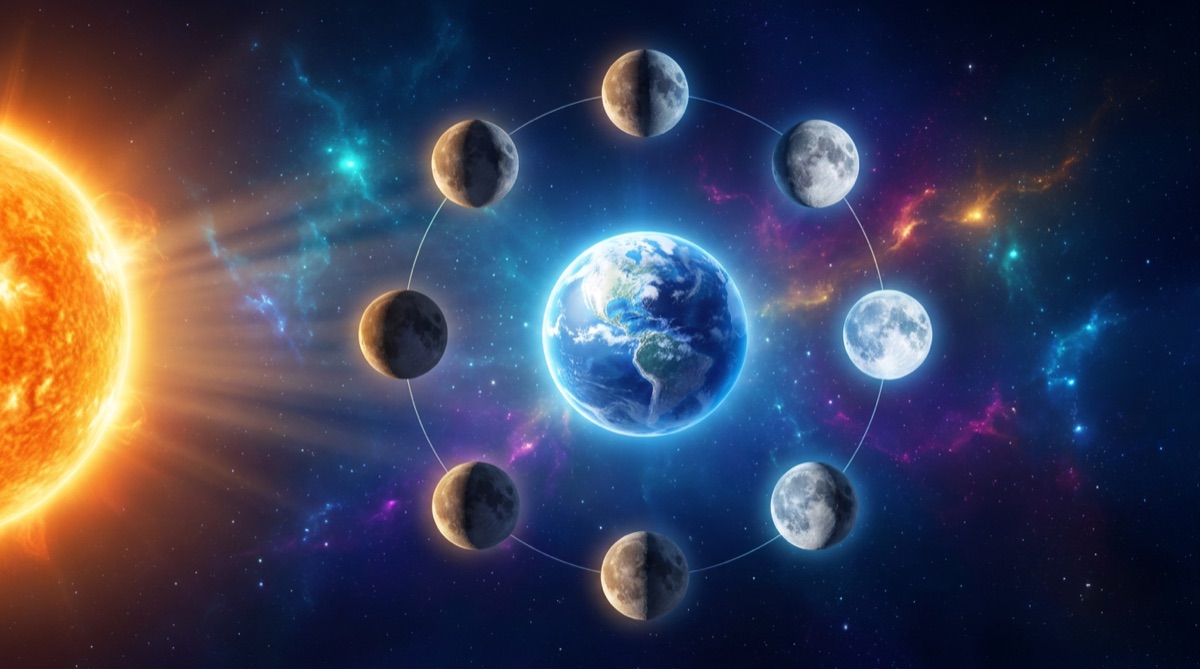
The Moon does not shine on its own
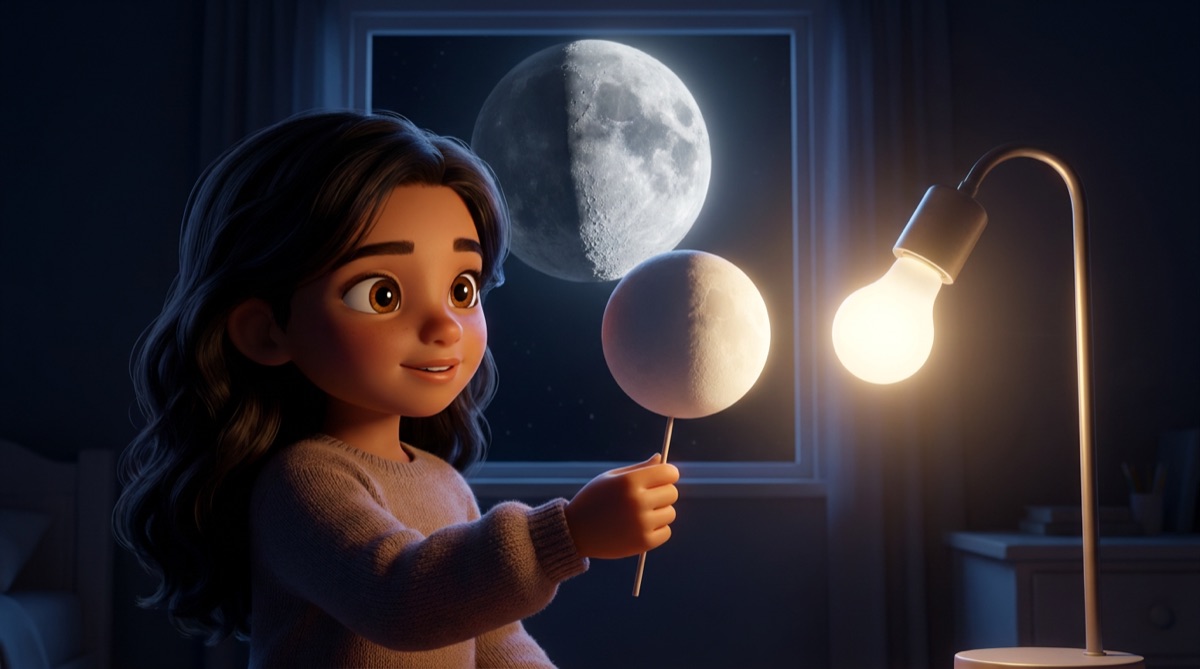
The Moon has no light of its own. The Moon is like a dull mirror: it reflects the light of the Sun.
The Sun always lights up half of the Moon. It is like your face when you look at a lamp: the half facing the lamp has light; the other half, shadow.
So why does it change shape?
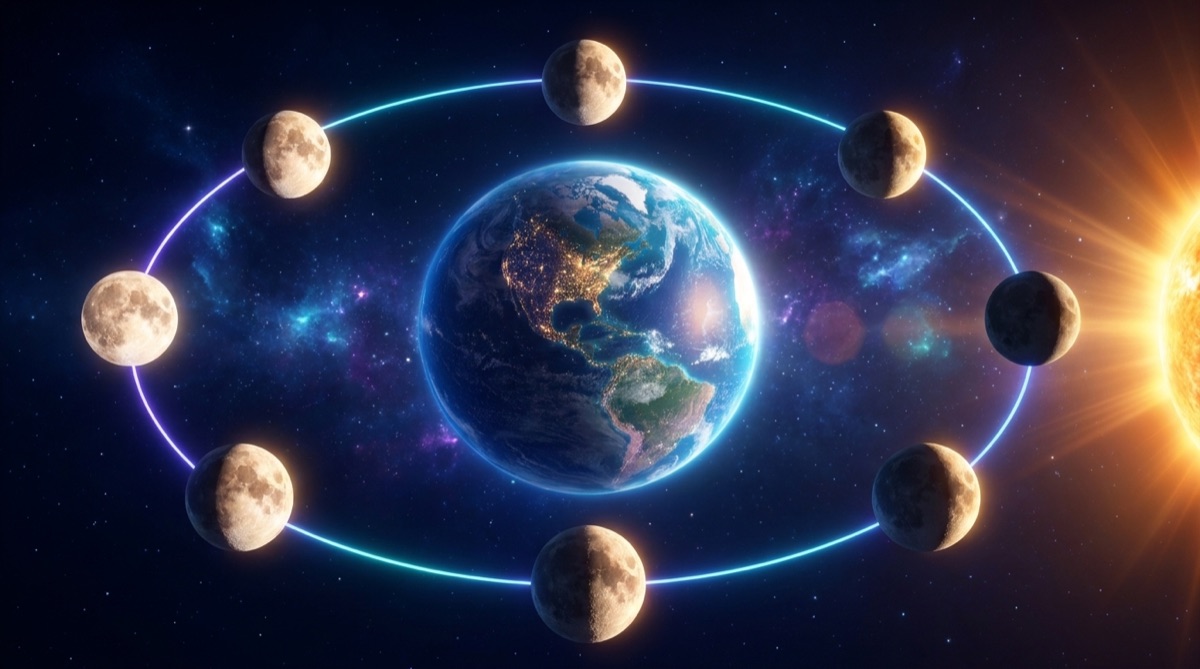
The Moon goes around the Earth. Depending on where it is, from here we see a different part of its lit-up half.
- If the Moon is between the Earth and the Sun, the half with light faces the Sun, not us. We do not see it: it is a new moon.
- If the Moon is on the other side of the Earth, we see its whole lit-up half: it is a full moon.
- Halfway in between we see half of the half: a quarter.
That is why it is called a “quarter”: we see ¼ of the whole Moon, even though it looks like a half circle!
The eight phases
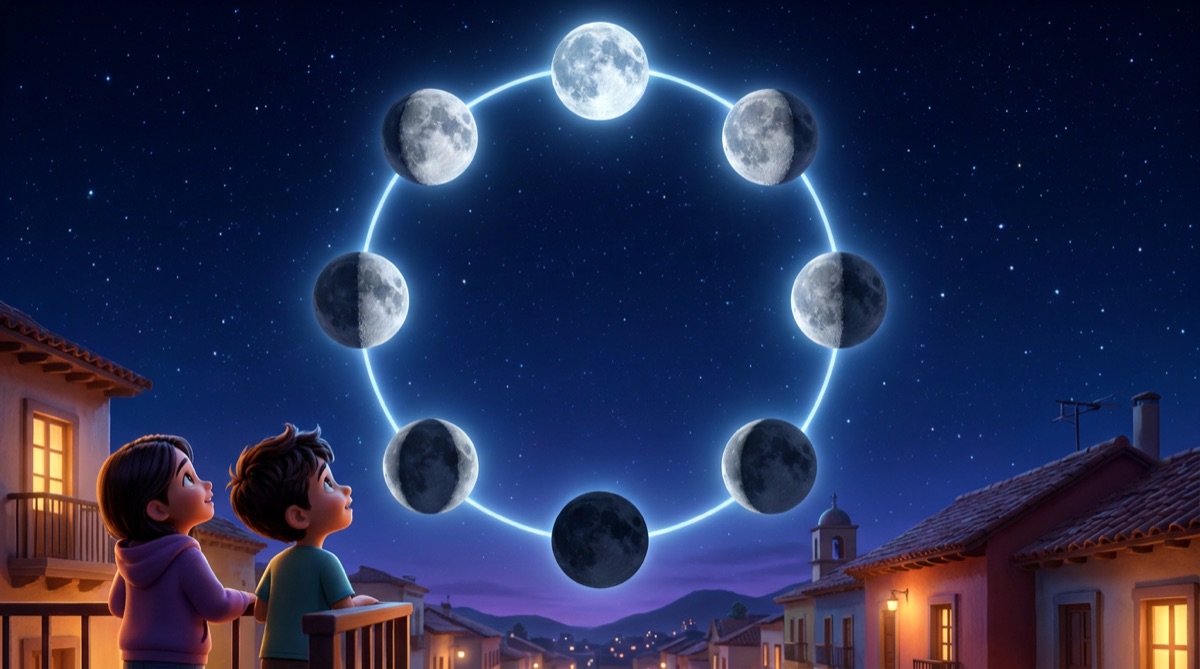
| Phase | How much of the disk do we see lit up? | Days since the new moon (more or less) |
|---|---|---|
| New moon | nothing (0) | 0 |
| Waxing crescent | a little bit | 4 |
| First quarter | half of the disk (½) | 7 |
| Waxing gibbous | almost all | 11 |
| Full moon | all (1) | 15 |
| Waning gibbous | almost all | 18 |
| Last quarter | half of the disk (½) | 22 |
| Waning crescent | a little bit | 26 |
After about 29 and a half days the new moon comes back. That is the lunar month.
Why do we always see the same face?
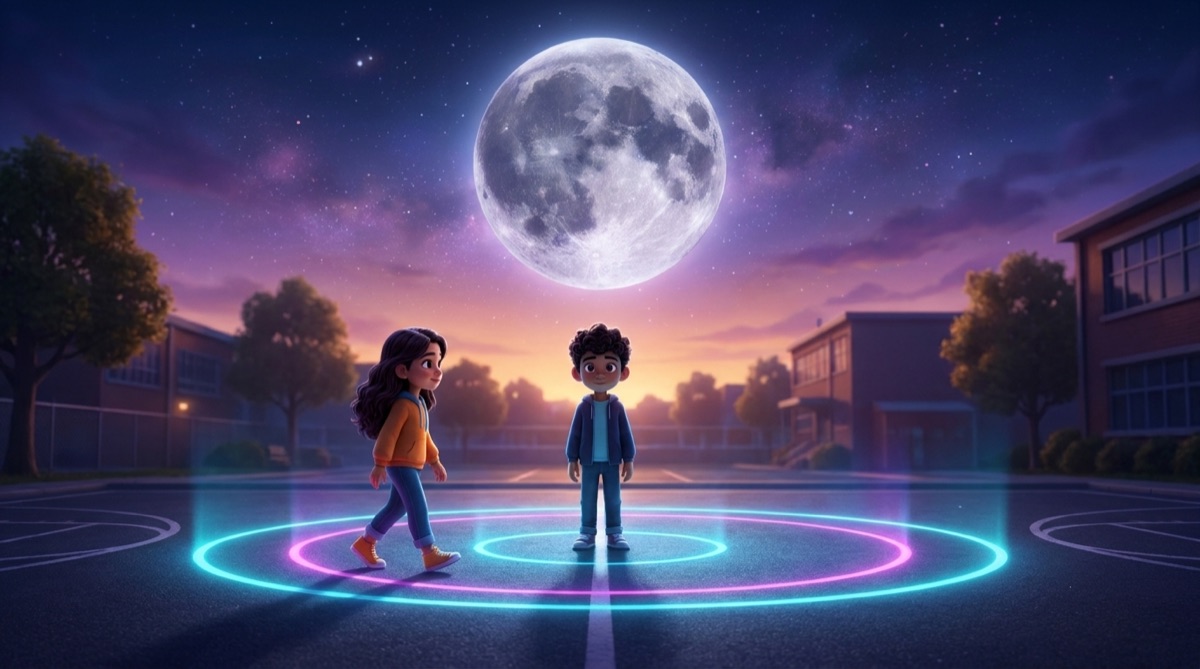
The Moon has dark patches. From Earth they look like a face, a rabbit or a person carrying a bucket. Those patches always look the same: we never see the “back” of the Moon.
Could it be that the Moon does not spin? It does spin! The Moon makes one turn around itself in the same time it takes to make one trip around the Earth: about 27 days.
Try it with a friend:
- Your friend stands in the center: they are the Earth.
- You are the Moon. Walk in a circle around your friend always looking at their face.
- When you finish the lap, think: did you face every wall of the classroom? Yes! You turned once around yourself.
- And your friend only saw your face, never your back.
The Moon does the same thing. That is why there is a side of the Moon we never see from Earth. It is not a dark side: it gets sunlight too. At new moon, that side is completely lit up!
Play with the simulator

On the left you see the Earth and the Moon from above. Sunlight comes from the right. On the right you see the Moon as we see it from Earth.
- Drag the Moon along its path. Where is it when it is a full moon?
- Notice: the lit-up half of the Moon always faces the Sun.
- Switch to real date and look for the Moon on your birthday.
- Change the hemisphere. What happens to the drawing of the Moon?
“C” or “D”? It depends on where you live
You are in the United Kingdom, in the northern hemisphere.
In the northern hemisphere (Mexico, Colombia, Spain) the waxing moon has its light on the right: it looks like a D.
In the southern hemisphere (Argentina, Chile, Uruguay, Peru, most of Brazil) we see it the other way around: the waxing moon looks like a C.
That is why the Spanish saying “the Moon is a liar: when it looks like a C, it shrinks (decrece); when it looks like a D, it grows (crece)” only works in the north. In the south, the Moon tells the truth! A C is Creciente: waxing.
Activity: the Moon in your hand
You need: a lamp without a shade (it will be the Sun), a white ball about 6 cm across stuck on a pencil (it will be the Moon) and your head (it will be the Earth).
- Darken the room. Turn on the lamp and place it about 3 steps away from you, at the height of your head.
- Hold the ball with your arm outstretched, a little above your head.
- Look at the ball while facing the lamp. Do you see light on the ball? That is the new moon.
- Turn slowly to your left, with the ball always in front of your face.
- When the lamp is on your right, you will see the ball half lit: first quarter.
- When the lamp is behind you (without blocking it with your head), you will see the ball fully lit: full moon.
- Keep turning until you get back to the start. You saw a lunar month in one minute!
Question: how many turns did you make to see all the phases? Did the half of the ball lit by the lamp change?
30-day Moon diary
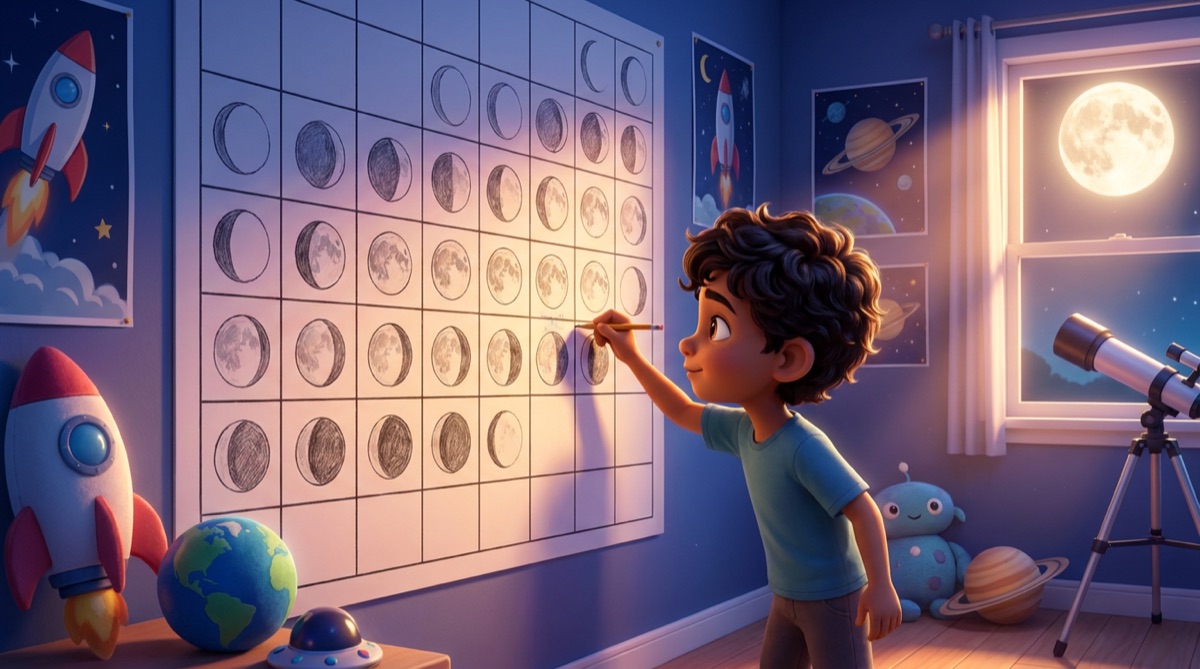
For a month, go out every night (or every afternoon) to look at the Moon and draw it in a table like this one:
| Day | Date | Drawing of the Moon | Bigger or smaller than yesterday? | Where was it? |
|---|---|---|---|---|
| 1 | ||||
| 2 | ||||
| … | ||||
| 30 |
To think about when you finish:
- How many days went by between two full moons? (You should get 29 or 30.)
- If the cycle lasts 29 and a half days, how many days go by from new moon to full moon? Hint: half of 29½.
- Some nights you could not see it. Why? (Clouds… or maybe it was in the sky during the day.)
- Compare your diary with the real date mode of the simulator.
Exercises
- If there is a full moon today, in about how many days will there be another full moon?
Show solution
In about 29 or 30 days, because the cycle of phases lasts 29 and a half days.
- Ana saw the first quarter on day 7. What phase will she see on day 15? And on day 22? Use the table of the eight phases.
Show solution
On day 15, more or less, a full moon. On day 22, the last quarter. About 7 days go by between one main phase and the next.
- Color one circle to show ¼ and another to show ½. Which of the two shows what we see at first quarter if we think about the whole Moon, including the back?
Show solution
The ¼ one. We see half of the disk, but the disk is only the half of the Moon that faces us: ½ of ½ = ¼.
- Pedro says: “The Moon does not spin, that is why we always see the same face.” Is he right? Explain it with the friend game.
Show solution
No. The Moon does spin: it turns once around itself every time it goes once around the Earth. If it did not spin, we would gradually see all of its sides.
✦ Mini-quiz
Remember
- The Sun always lights up ½ of the Moon.
- What changes is how much of that half we see from Earth.
- A complete cycle of phases lasts about 29 and a half days.
- In the southern hemisphere, the waxing moon looks like a C.
- The Moon spins, but it always shows us the same face.
🍎 Teacher guide
- Time
- 3 sessions of 55 min + a 30-day Moon diary at home
- Colombian national standard (MEN)
- Natural Sciences, Grades 1 to 3: 'I record the movement of the Sun, the Moon and the stars in the sky over a period of time'. Mathematics, Grades 1 to 3: 'I describe measurement situations using common fractions'.
- Evidence of learning
- Puts the eight phases in order, explains with the lamp-and-ball model why they change and completes at least 15 days of the Moon diary.
Materials
- Lamp without a shade (or a powerful flashlight)
- White Styrofoam balls about 6 cm across on a stick
- A classroom that can be darkened
- Photocopy of the Moon diary
- Computer or tablet with the simulator (optional)
Suggested sequence
Session 1. Exploration (55 min). Opening question: “Why does the Moon change shape?” The children draw their hypothesis. Then, the lamp-and-ball model in pairs (activity “The Moon in your hand”). Closing: they compare their first drawing with what they observed.
Session 2. Cycle and fractions (55 min). Table of the eight phases, fractions ½ and ¼ with paper circles and exercises 1 to 3. The Moon diary starts; it is a good idea to check in the simulator, in real date mode, which phase it starts in.
Session 3. The same face and closing (55 min, about 4 weeks later). The friend game for the hidden face (exercise 4) and sharing of the diary: how many days between two full moons? Individual mini-quiz.
For Grade 3: ask them to work out half of 29½ with the diary and to compare the records of two classmates in a two-way table.
Common mistakes
- Believing that the phases are the shadow of the Earth on the Moon. Clarify with the model: the shadow of the Earth only falls on the Moon during an eclipse, and that happens very few times a year.
- Thinking the Moon only comes out at night. Invite them to look for it during the day at first quarter, in the afternoon, or at last quarter, in the morning.
- Confusing "quarter" with "a quarter of the disk". Use ½ of ½ with two paper circles.
- Saying that the "dark side" never gets light. Show with the ball that at new moon the hidden face is lit up.