 8 years old · Grades 1 to 3 · Elementary Education
Grade 3
“Are all the planets like Earth?”
Units of the year
- Unit 1
The Moon, our neighbor
- Phases and fractions
- Why do we always see the same face?
- 📘 The phases of the Moon · 60 min
- 📘 Eclipses · 110 min
- Unit 2
The planets
- Rocky, gaseous and icy
- Sorting by size and distance
- 📘 Rocky planets and giant planets · 110 min
- Unit 3
Big numbers
- Place value with distances
- Comparing and ordering
- 📘 Big numbers · 110 min
Math you will use
Numbers to 10 000 and place valueOrdering and comparingTwo-way tablesClassification
Complementary lessons
-
How many stars can I see?
Nobody can count all the stars in the sky one by one. With a paper tube, ten counts and a multiplication we estimate them, and we discover why so few can be seen in Bogotá and so many in the Tatacoa Desert.
⏱ 110 min
-
The lunar calendar
The Moon was humanity's first calendar. We count its 29 and a half days, split them into weeks, discover why 12 moons do not fill a year and visit the lunar calendars of different cultures, including the Muisca one.
⏱ 110 min
Simulators
-
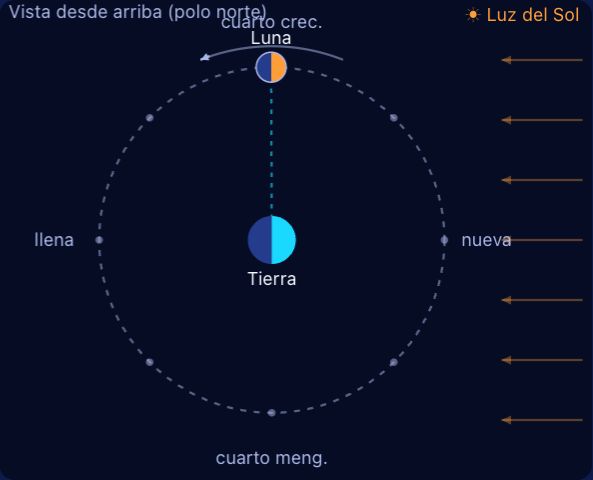
Phases of the Moon
Sun–Earth–Moon geometry seen from above and from Earth (northern or southern hemisphere); the real phase for any date, and the latitude of the Moon to understand eclipses.
-
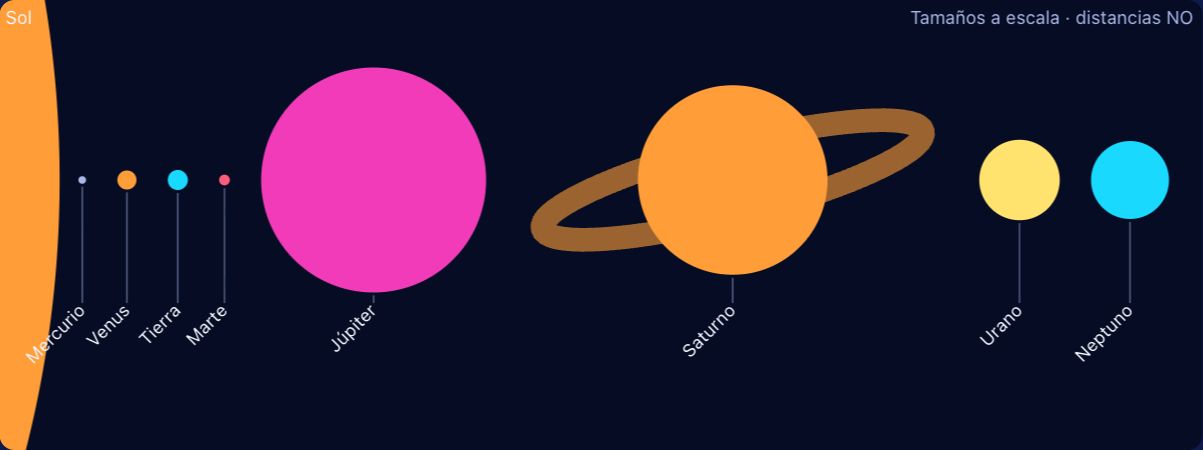
The Solar System to scale
Real sizes of the planets, distances with logarithmic zoom and a “light rocket” (×1, ×60, ×3600), a schoolyard model with everyday objects, and your weight and age on other worlds.
Collectible planet cards with their data in order.
Full project sheet: 4 weeks, materials, phases and rubric →
Order the 8 planets by size and by distance.