The day the Sun went out in the middle of the morning
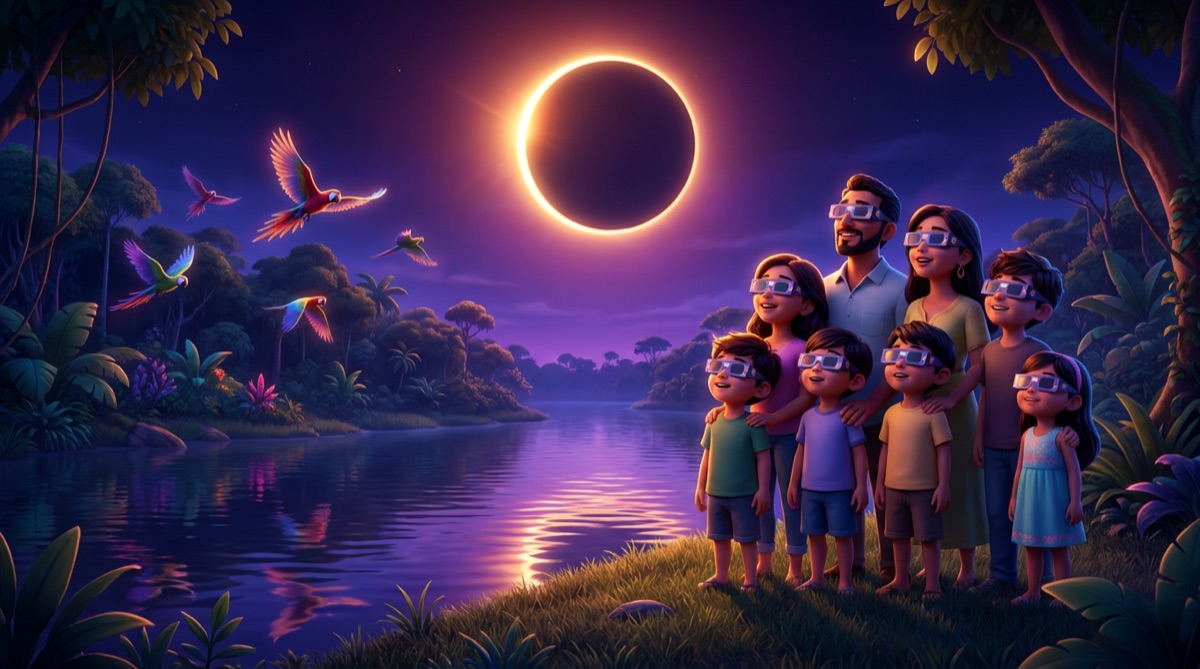
On January 26, 2028, at nine in the morning, in Leticia, in the Amazon, the Sun will turn into a ring of light for nine minutes. In Bogotá, Medellín and Cali, at that same time, a big piece of the Sun will be missing, as if someone had taken a bite out of it.
It is not magic. It is an eclipse. And it can be explained with a flashlight and two balls.
An eclipse is a shadow
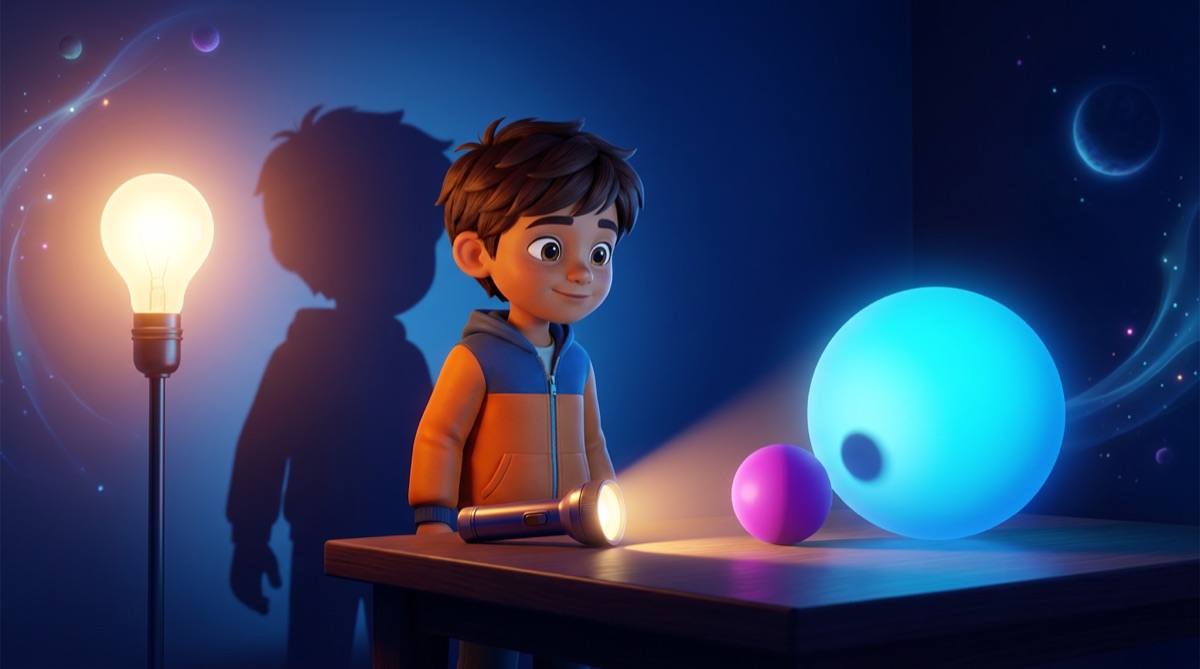
When you stand between a lamp and the wall, your body blocks the light and your shadow appears on the wall.
An eclipse is the same thing, but with worlds. The Moon and the Earth are enormous balls that cast shadows. The Sun is the lamp.
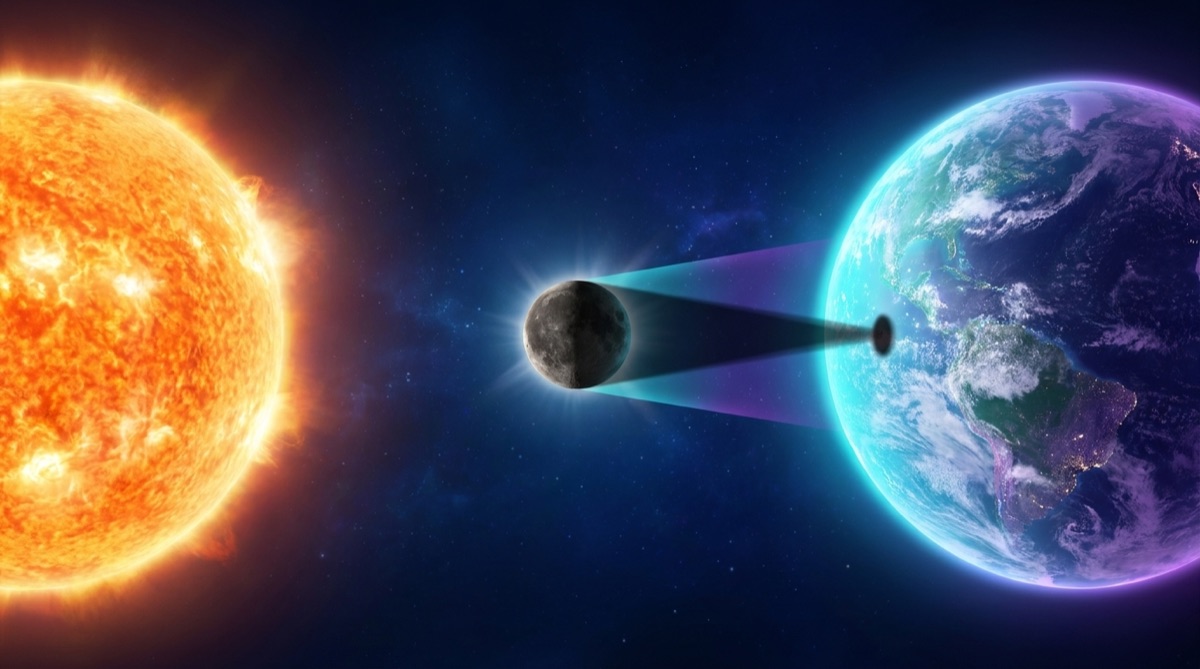
If the Moon gets between the Sun and the Earth, its shadow falls on the Earth. That is a solar eclipse.
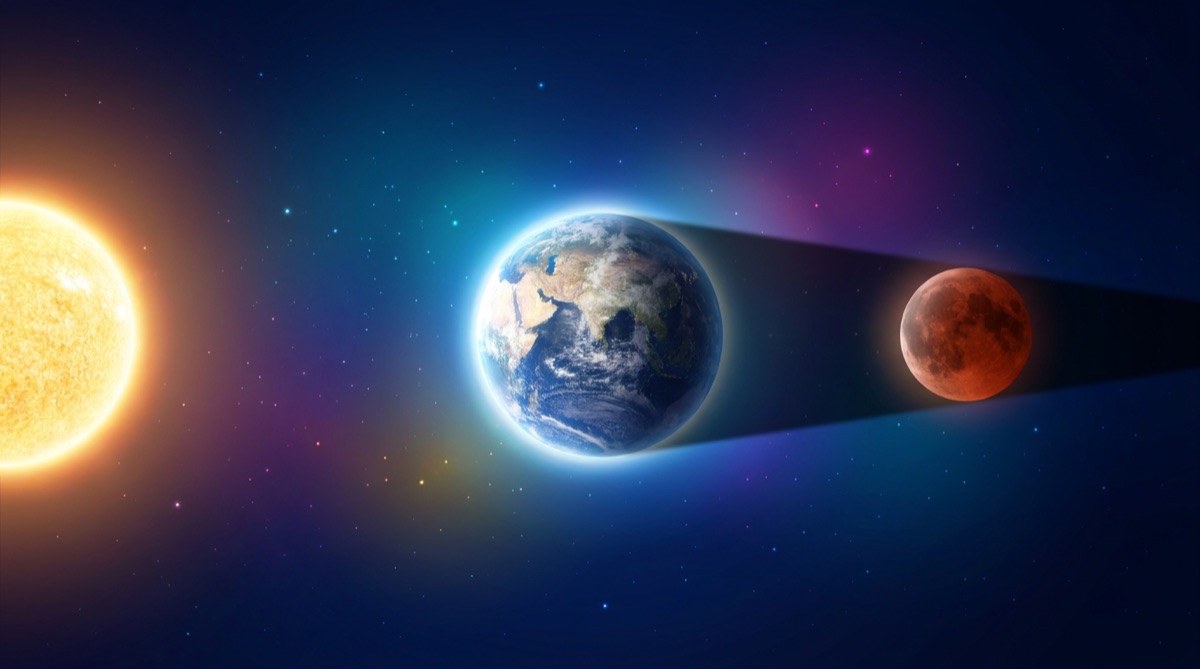
If the Earth gets between the Sun and the Moon, its shadow falls on the Moon. That is a lunar eclipse.
For there to be an eclipse, all three have to be lined up: in a straight line, like three beans on a string.
Solar eclipse: the Moon blocks the Sun
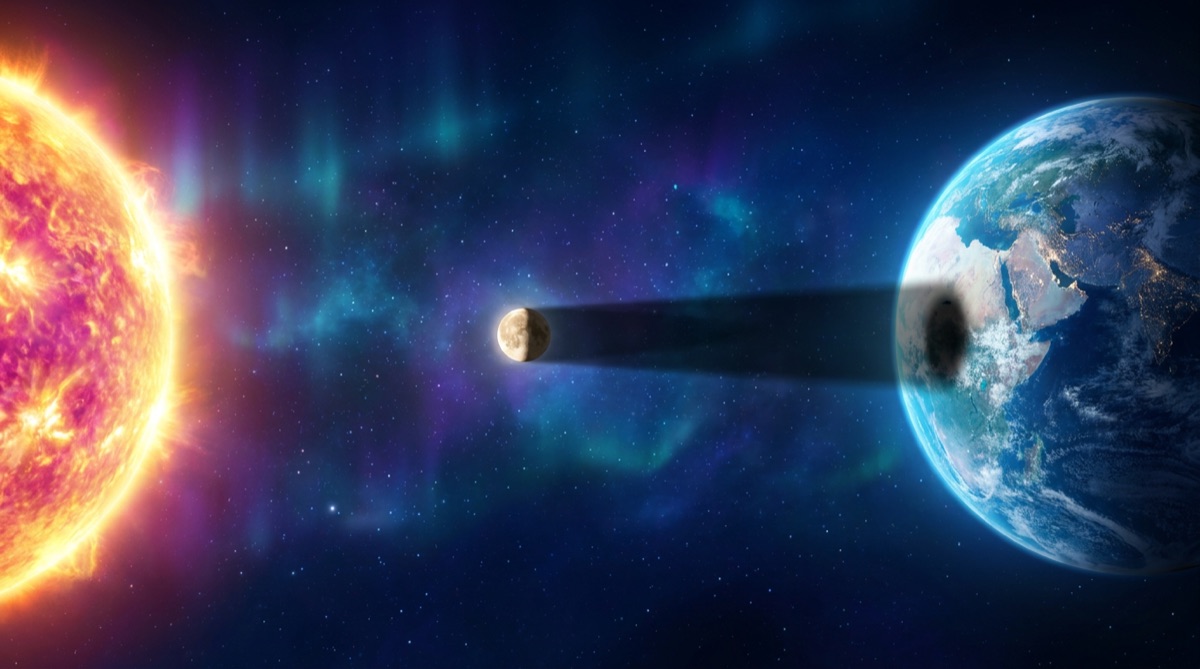
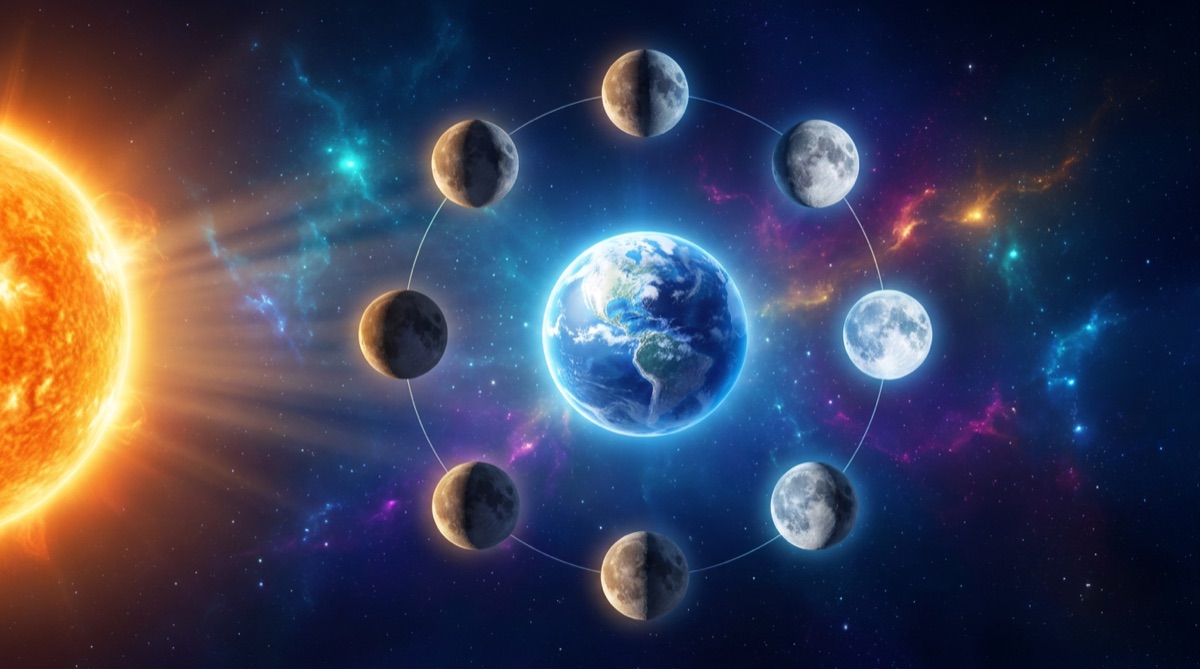
The Moon is between the Sun and the Earth in only one phase: the new moon. That is why a solar eclipse always happens at new moon.
The shadow of the Moon on the Earth is small: a patch a few hundred kilometers across. Only those inside the patch see the complete eclipse. Everyone else sees only a piece blocked, or nothing.
There are three types:
| Type | What you see | Why |
|---|---|---|
| Total | The Sun disappears completely; it gets dark for a few minutes | The Moon blocks the whole disk |
| Partial | A piece of the Sun is missing | The Moon blocks only a part |
| Annular | A ring of light is left around the Moon | The Moon is a little farther away and looks smaller than the Sun |
The one in Leticia in 2028 will be annular: a ring of fire.
Lunar eclipse: the Earth blocks the light
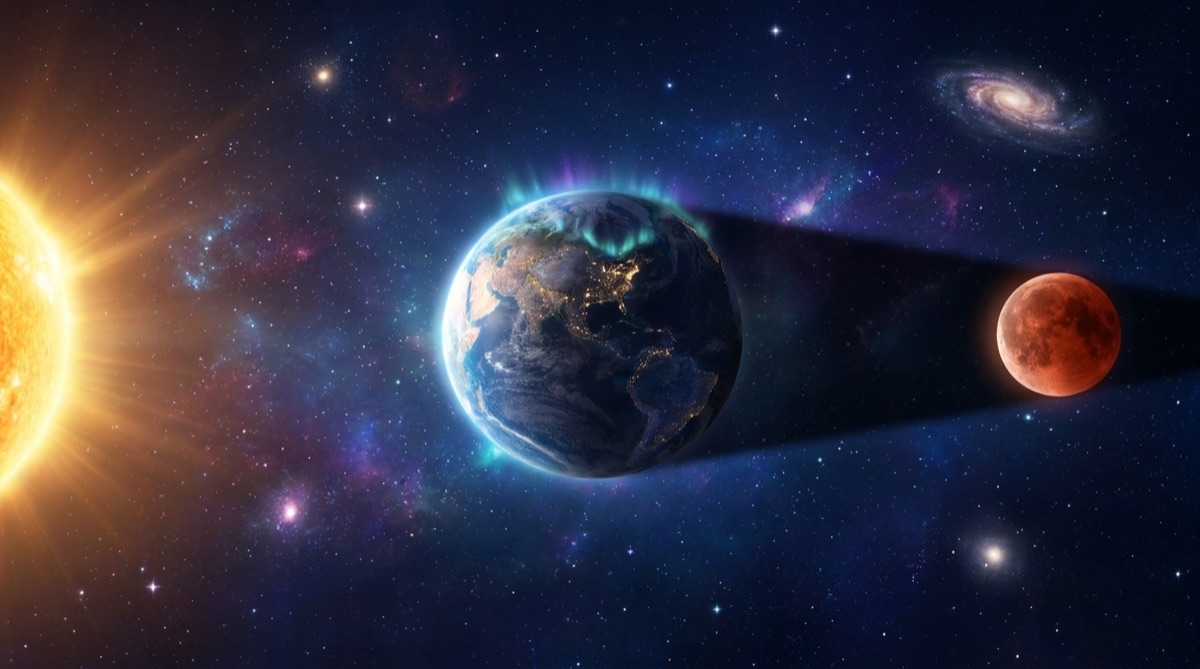
The Earth is between the Sun and the Moon only at full moon. That is why a lunar eclipse always happens at full moon.
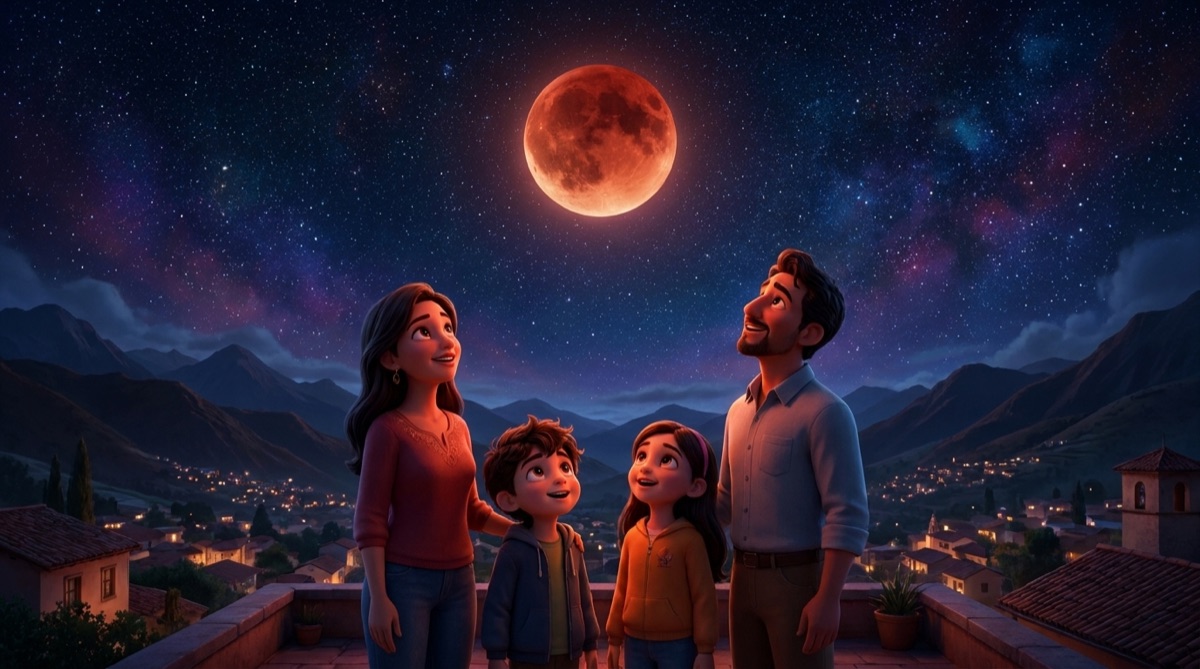
The shadow of the Earth is much bigger than the Moon. When the Moon enters it, it darkens little by little and turns a coppery red color: a little bit of light reaches it after passing through the Earth’s air, like the light of sunsets.
A lunar eclipse is seen by half the planet at the same time: everyone who has the Moon above the horizon. It lasts hours and can be watched with no danger at all.
Why is there not an eclipse every month?
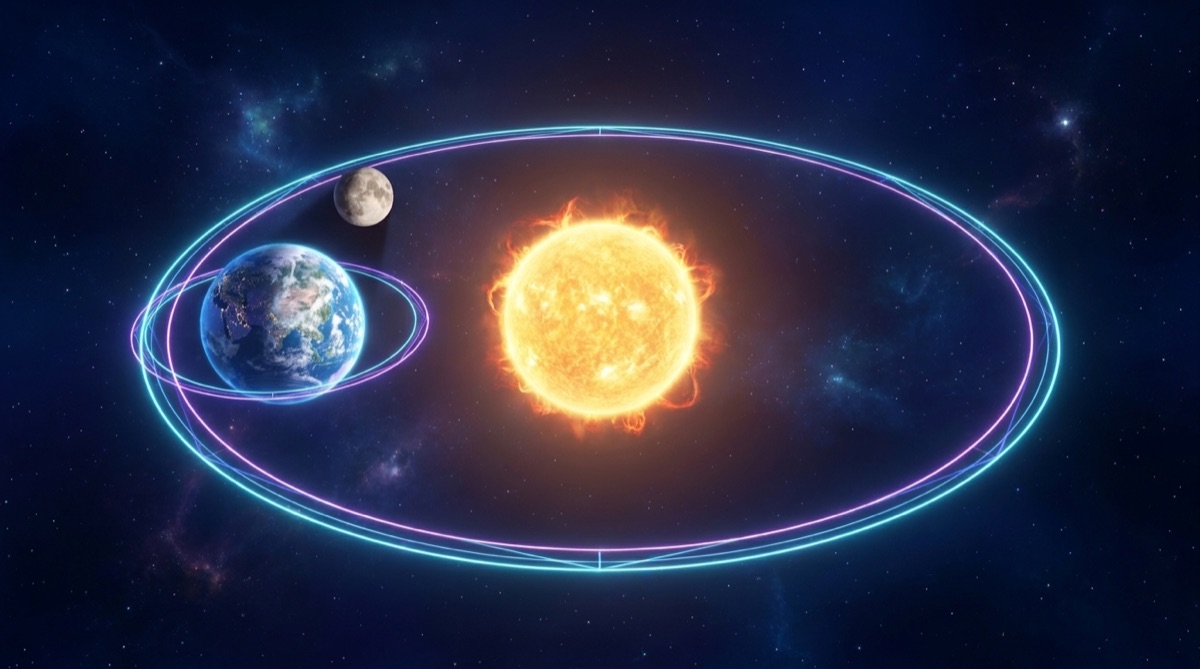
Every month there is a new moon and a full moon. So why is there not a solar eclipse and a lunar eclipse every month?
Because the path of the Moon around the Earth is tilted a little bit: about 5 degrees.
Imagine two hoops, one inside the other. The big hoop is the path of the Earth around the Sun. The small hoop is the path of the Moon. If the small hoop is tilted, the Moon almost always passes above or below the straight line, and the shadow does not fall where it should.
Only twice a year, roughly every six months, do the hoops cross right where they need to. That is when there are eclipses: sometimes a solar one, sometimes a lunar one, sometimes both, fifteen days apart.
A coincidence of 400
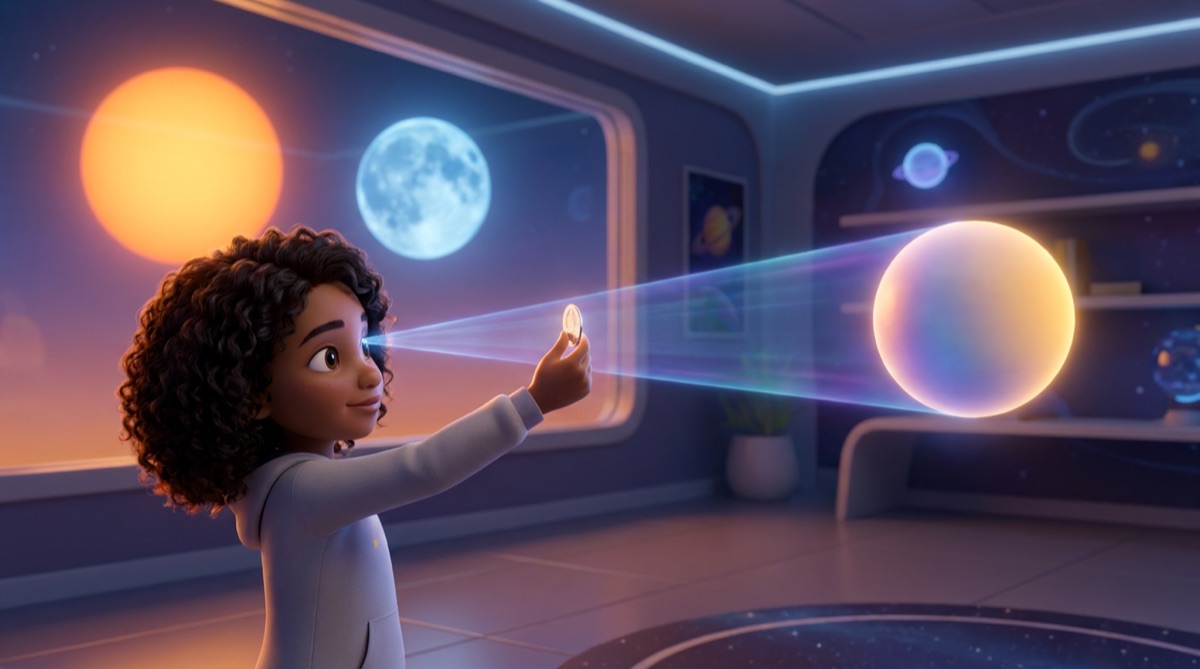
The Sun is gigantic: about 400 times wider than the Moon.
But it is also about 400 times farther from us.
Because it is 400 times farther, it looks 400 times smaller than it really is. The two things balance out, and that is why, from Earth, the Sun and the Moon look the same size.
Try it: a coin near your eye covers a ball on the other side of the classroom.
Thanks to that coincidence, the Moon can cover the Sun just exactly. When the Moon is a bit farther away than usual, it looks a little bit smaller, it cannot quite cover everything and the ring is left: an annular eclipse.
The next eclipses from Colombia
| Date | Type | Time in Colombia | What will it look like? |
|---|---|---|---|
| Night of January 11, 2028 | Lunar, partial | 11:13 p.m. | A very small nibble on the edge of the Moon |
| January 26, 2028 | Solar, annular | 8:53 to 9:02 a.m. in Leticia | Ring of light in Leticia; in the rest of the country, a big piece of the Sun will be missing (in Bogotá, almost three quarters of its width). Only with a filter! |
| Night of June 25, 2029 | Lunar, total | 10:22 p.m. | The Moon, high in the sky, will turn red; visible from the whole country |
| December 20, 2029 | Lunar, total | 5:42 p.m. | The Moon will rise already eclipsed, at sunset |
This table is for Colombia. From London some of these eclipses will look different or will not be visible. Check which ones can be seen from your country with the simulator or on an eclipse website.
Write these dates on your calendar. You have a date with the sky!
Looking at the Sun safely
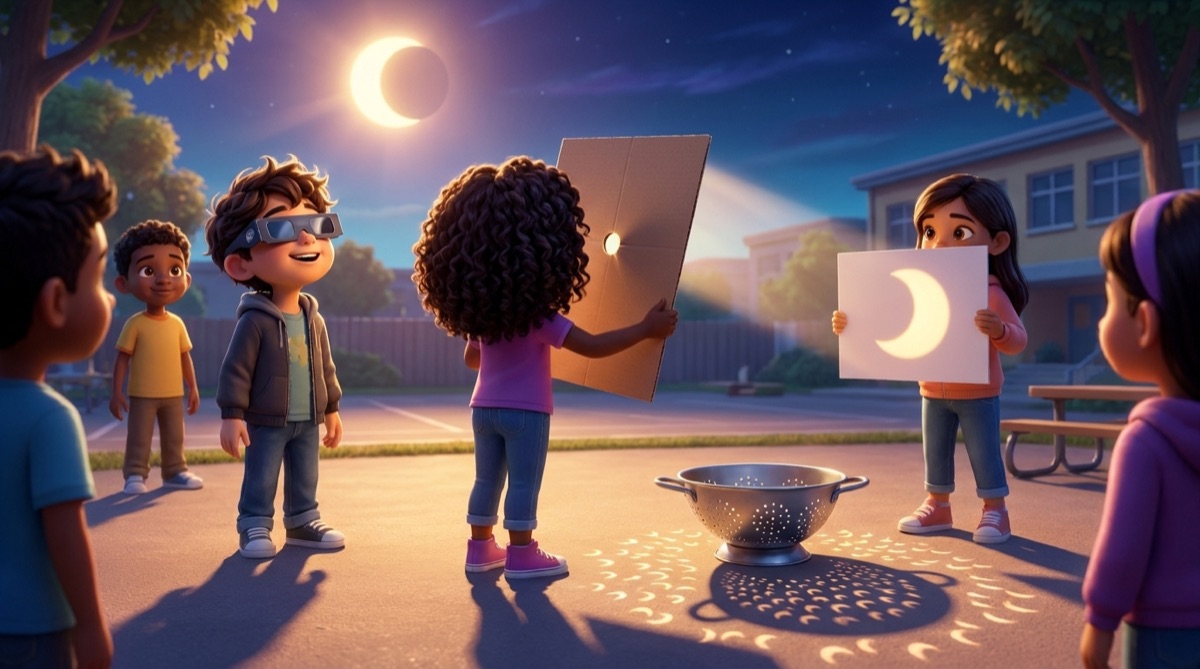
Never look at the Sun directly, not during an eclipse and not on a normal day. Sunlight can burn the back of the eye without it hurting, and the damage does not heal.
Rules:
- Only eclipse glasses with the ISO 12312-2 mark will do. An adult checks them before use: if they are scratched or torn, into the trash.
- Sunglasses are no good, however dark they are. Neither are X-ray films, CDs or smoked glass.
- The safest way is to project: make a tiny hole with a pin in a piece of poster board, stand with your back to the Sun and let the light pass through the hole onto another piece of poster board or the ground. You will see the image of the Sun with its bite. Do not look through the hole.
- A colander or the leaves of a tree make hundreds of little suns on the ground. During an eclipse they all have a bite!
- Lunar eclipses are watched with nothing at all: it is like looking at the full moon.
Play with the simulator
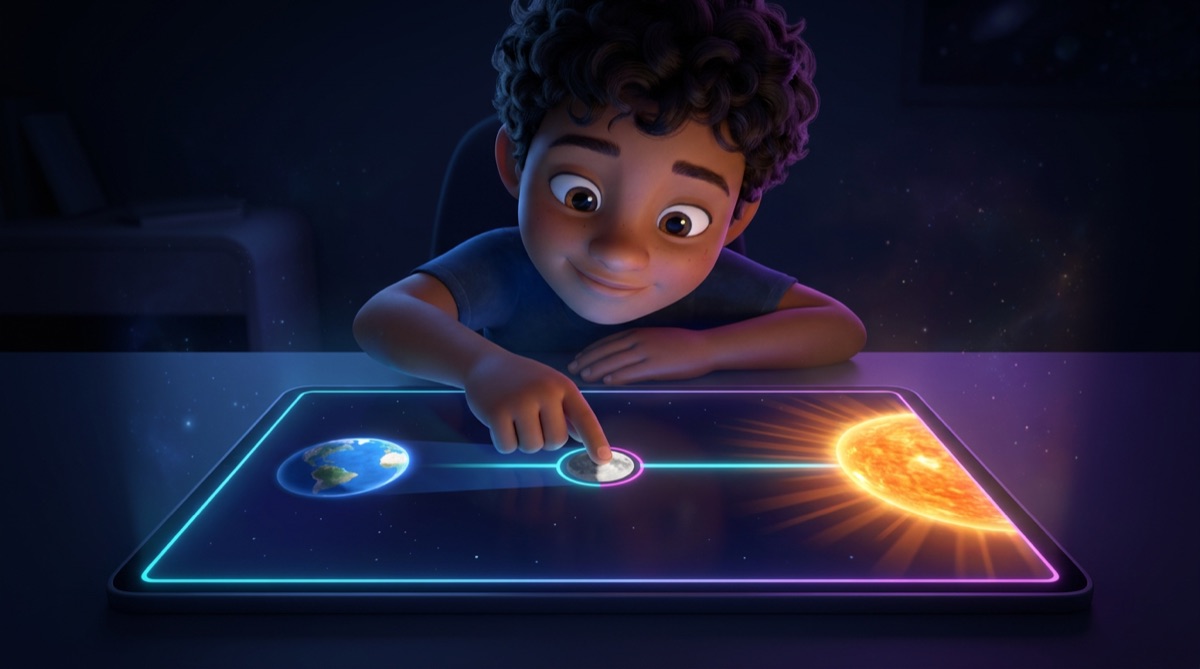
The simulator does not draw eclipses, but it does show the positions.
- Drag the Moon to the new moon: it is between the Earth and the Sun. If it were exactly on the line, its shadow would fall on the Earth. Solar eclipse.
- Drag it to the full moon: the Earth is in the middle. If it were exactly on the line, the Moon would enter the Earth’s shadow. Lunar eclipse.
- Switch to real date and look for January 26, 2028. What phase is the Moon in? And June 25, 2029?
Activity: pocket eclipses
You need: a flashlight (the Sun), a ball about 8 cm across (the Earth), a small ball 2 cm across stuck on a stick (the Moon), a tape measure, a dark room and two friends.
- Measure: the big ball is 4 times wider than the small one. Just like the Earth and the Moon, which is 3.7 times smaller!
- Put the flashlight on a table, switched on, pointing along the room. A friend holds the Earth about 3 meters away.
- You carry the Moon. The real distance from the Earth to the Moon is 30 Earths: 30 × 8 cm = 240 cm. Stand 2 and a half meters from the Earth, toward the flashlight, and find the exact spot where the shadow of the Moon falls on the Earth. Solar eclipse. See how small the patch is.
- Now move the Moon to the other side, behind the Earth, and into its shadow. Lunar eclipse. Notice how big the Earth’s shadow is compared to the Moon.
- Lift the Moon a little bit above the line and go around again. Is there an eclipse? That is the 5-degree tilt: almost always the Moon passes above or below.
Question: what phase is your Moon in when it makes a solar eclipse? And when it makes a lunar eclipse?
Exercises
- Draw three circles lined up for a solar eclipse and write the names: who goes in the middle? Do the same for a lunar eclipse.
Show solution
Solar eclipse: Sun – Moon – Earth (the Moon in the middle). Lunar eclipse: Sun – Earth – Moon (the Earth in the middle). In both cases, the one in the middle blocks the light.
- Can there be a solar eclipse at full moon? Why?
Show solution
No. At full moon the Moon is on the other side of the Earth, not between the Earth and the Sun. To block the Sun it has to be at new moon.
- In Bogotá, on January 26, 2028 the Moon will cover almost three quarters of the width of the Sun. Draw a circle and color the covered part. What fraction will be left shining?
Show solution
If ¾ is covered, ¼ is left shining. Even so, that quarter of the Sun is extremely dangerous for the eyes: you have to use a filter or project.
- The Sun is 400 times wider than the Moon and is 400 times farther away. If the Moon were 800 times closer than the Sun (instead of 400), would it look bigger or smaller than the Sun?
Show solution
Bigger. It would be relatively closer, so it would cover the Sun with room to spare: all eclipses would be total and there would be no annular ones.
- Verónica wants to watch the 2028 solar eclipse with her dark sunglasses. What do you tell her?
Show solution
No. Sunglasses do not block the light that burns the eye. Only eclipse glasses with the ISO 12312-2 mark and in good condition will do, or better still, project the Sun through a tiny hole in a piece of poster board without looking through the hole.
✦ Mini-quiz
Remember
- An eclipse is a shadow: Sun, Earth and Moon in a straight line.
- Solar eclipse: the Moon in the middle, at new moon. Seen from a small strip of the Earth.
- Lunar eclipse: the Earth in the middle, at full moon. Seen by half the planet and safe to watch.
- There is not an eclipse every month because the path of the Moon is tilted 5 degrees.
- The Sun is 400 times wider than the Moon and 400 times farther away: that is why they look the same.
- Next ones from Colombia: annular solar in Leticia on January 26, 2028; total lunar on the night of June 25, 2029.
- To look at the Sun: only an ISO 12312-2 filter or projection. Sunglasses are no good.
🍎 Teacher guide
- Time
- 2 sessions of 55 min
- Colombian national standard (MEN)
- Natural Sciences, Grades 1 to 3 (MEN, 2006): 'I propose experiments to verify the propagation of light and sound'; 'I record the movement of the Sun, the Moon and the stars in the sky over a period of time'. Natural Sciences, Grades 4 to 5: 'I describe the main elements of the solar system and establish relationships of size, movement and position'. Mathematics, Grades 1 to 3: 'I describe measurement situations using common fractions'. Mathematics, Grades 4 to 5: 'I solve and pose problems in situations of direct and inverse proportionality and product of measures'; 'I interpret information presented in tables and graphs (pictographs, bar charts, line charts, pie charts)'.
- Evidence of learning
- Reproduces a solar eclipse and a lunar eclipse with the flashlight and the two balls, names the phase of each one, shows with the raised Moon why there is not an eclipse every month, reads in the table the date and time of the next eclipse visible in their city and states the solar safety rules.
Materials
- Powerful flashlight
- 8 cm balls and 2 cm balls on sticks (one pair per group)
- Tape measure
- Poster board and pins for the pinhole projector; a colander
- ISO 12312-2 eclipse glasses (optional, to show them)
- Computer or tablet with the simulator
Suggested sequence
Session 1. Shadows in a line (55 min). Opening (10 min): the body’s shadow on the wall; “what would happen if the Moon cast a shadow?” Development (35 min): “Pocket eclipses” activity in groups, with the measurement of 4 times and 30 Earths; each group names the phase of each eclipse and tries the “raised” Moon. Closing (10 min): exercises 1 and 2 and the proportion of 400 with the coin and the ball.
Session 2. Colombia and safety (55 min). Opening (10 min): the eclipse table; each student copies the date and time for their city. Development (30 min): building the pinhole projector and testing it with the Sun in the schoolyard (without an eclipse you see a round disk); reading the safety rules; simulator in real date to check the phase on January 26, 2028 and June 25, 2029. Exercises 3 to 5. Closing (15 min): mini-quiz and commitment to watch the next lunar eclipse as a family.
Note on the data. Dates and times taken from the NASA GSFC tables and verified in the secondary lesson “Phases of the Moon and eclipses”, which contains the calculation of the local circumstances for 2028. The penumbral eclipses of 2027 are not included because they are hardly noticeable to the naked eye. Before organizing an outing, it is best to check the time again on the NASA eclipse website.
Common mistakes
- Confusing phases with eclipses ("the new moon is an eclipse"). With the model, show that at each month's new moon the shadow passes by; an eclipse requires exact alignment.
- Believing that a lunar eclipse is the Moon's shadow on itself or "the Moon switching off". Have the small ball enter the shadow of the big ball.
- Thinking that a solar eclipse can be watched "for a little while" without a filter. Insist: the damage does not hurt and is permanent; practice pinhole projection before the eclipse.
- Believing that the solar eclipse looks the same all over the country. Compare Leticia (annular) with Bogotá (partial) in the table.
- In the model, putting the Moon too close to the Earth. Measure the 30 Earths (240 cm) so that the scale is real and the shadow small.