Does the Solar System fit in the school?
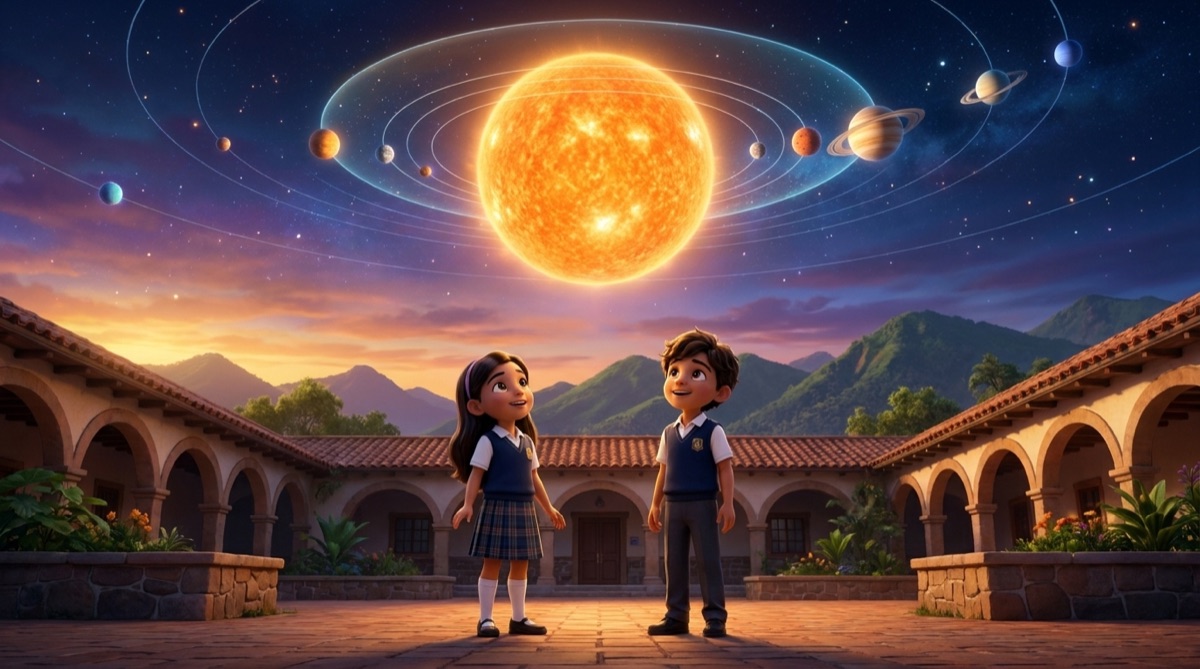
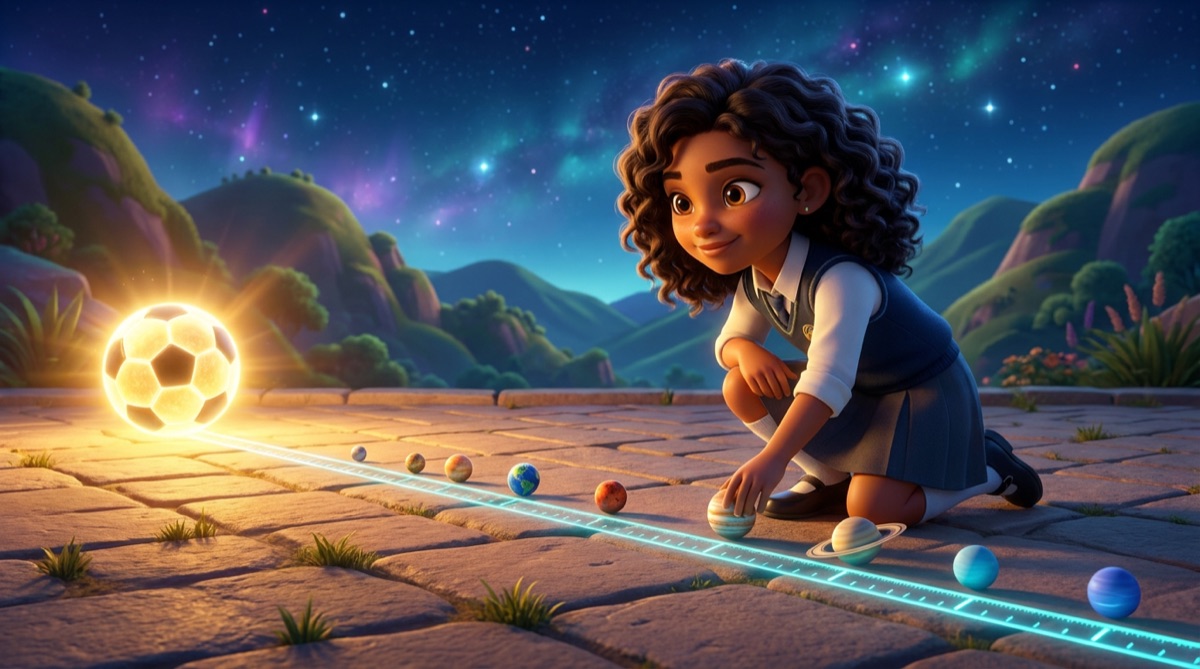
In books, the planets appear side by side, like fruit on a table. But that is a trick: if the real distances were drawn, Earth would be an invisible dot.
Today we are going to build the Solar System to scale: everything shrunk in the same proportion, sizes and distances. Will it fit in the schoolyard? Let’s work it out.
A Sun the size of a ball

The Sun is about 1 400 000 km across. A soccer ball is about 22 cm across. If we shrink everything in the same proportion:
Earth (12 756 km across) would be the size of… a 2 mm peppercorn! And it would be 24 meters from the ball.
The rule of three
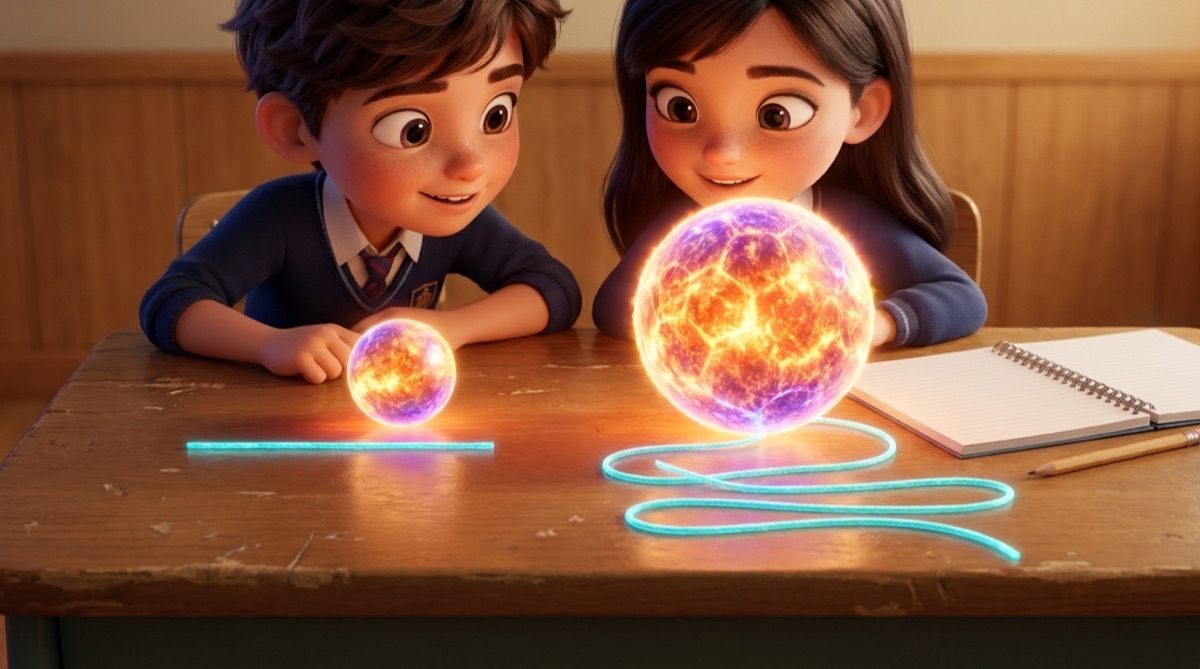
To work these things out we use the rule of three (cross-multiplying). It works when two quantities are proportional: if one doubles, the other doubles too.
We know it from the Sun: 1.4 million real km are 22 cm in the model. How much is 150 million km (the distance from Earth to the Sun)?
| Real distance (millions of km) | Distance in the model (cm) |
|---|---|
| 1.4 | 22 |
| 150 | ? |
We multiply crosswise and divide:
Earth ends up 24 meters from the ball!
A trick: the scale factor
Doing the rule of three eight times takes a while. It is better to calculate just once how much one million kilometers is worth in the model:
That number is the factor. For any planet, we multiply its distance (in millions of km) by 15.7 cm.
So, for Jupiter (778 million km):
To estimate before calculating: 15.7 is almost 16, and 778 is almost 800. So 800 × 16 = 12 800 cm, about 128 m. Our result (122 m) is close: good!
Sizes in the model
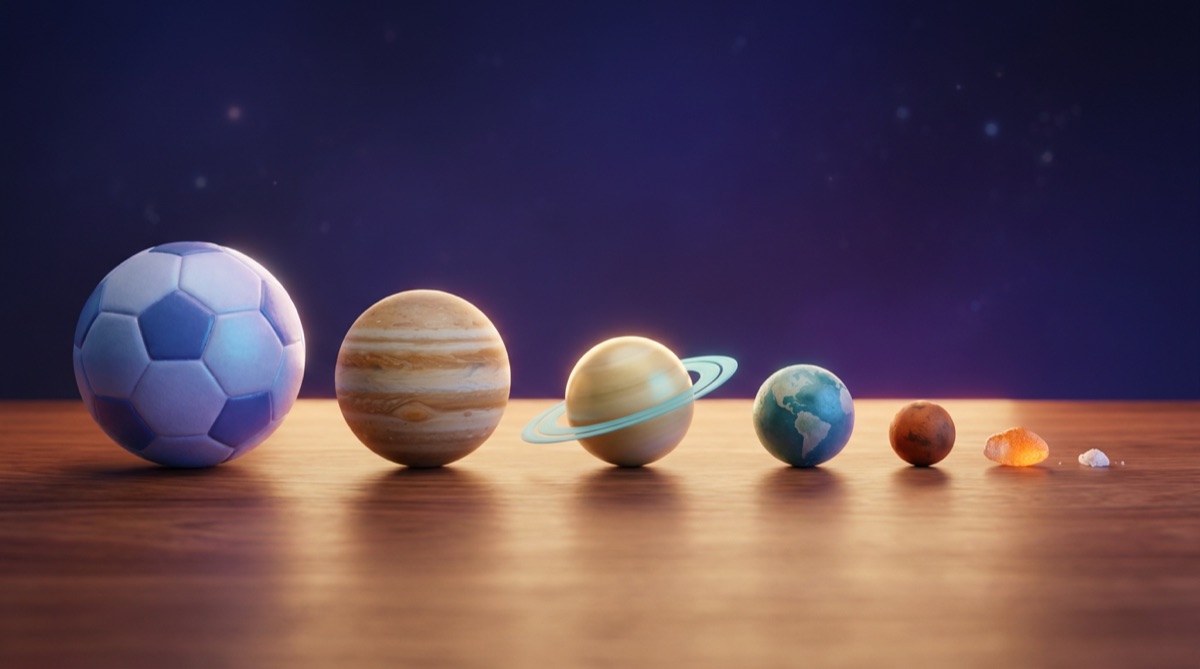
The same factor works for sizes. But the diameters are in kilometers, not in millions, so the number comes out very small.
| Body | Real diameter (km) | In the model | It looks like… |
|---|---|---|---|
| Sun | 1 400 000 | 22 cm | a soccer ball |
| Jupiter | 142 984 | about 2.2 cm | a grape or a large marble |
| Saturn | 120 536 | about 1.9 cm | a marble |
| Earth | 12 756 | about 2 mm | a peppercorn |
| Mars | 6 792 | about 1 mm | a grain of coarse sand |
| Mercury | 4 879 | less than 1 mm | a grain of salt |
Distances in the model
Complete the table with the factor of 15.7 cm per million km (some rows are already done):
| Planet | Real distance to the Sun (millions of km) | Distance in the model (m) |
|---|---|---|
| Mercury | 58 | 9 |
| Venus | 108 | ? |
| Earth | 150 | 24 |
| Mars | 228 | ? |
| Jupiter | 778 | 122 |
| Saturn | 1 427 | ? |
| Uranus | 2 871 | ? |
| Neptune | 4 498 | 706 |
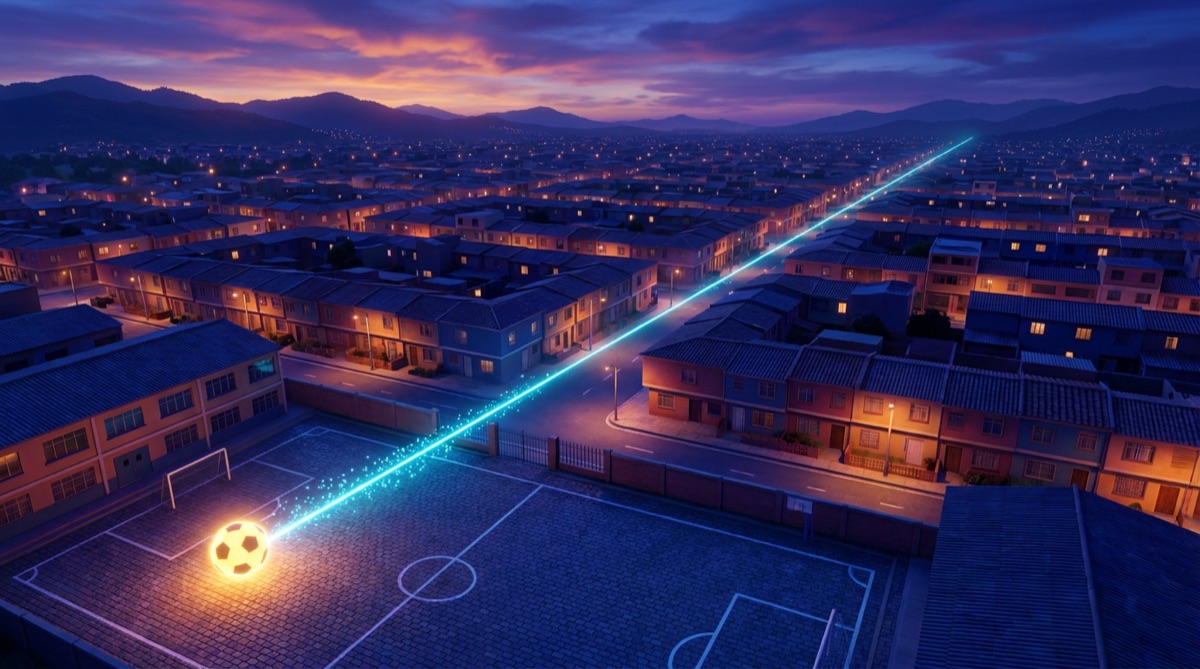
Neptune ends up more than 700 m away! It probably will not fit in the school: place it on a map of the neighborhood.
Check with the simulator

- In Sizes you see the planets to scale with one another. How many Earths fit across Jupiter?
- In Distances the Sun is on the left. Move the zoom: what happens to Mercury when you can see all the way to Neptune?
- In Schoolyard model choose “a soccer ball” and compare with your table. The simulator uses 1 391 400 km for the Sun, so its numbers come out slightly different (Jupiter at 123 m, Neptune at 711 m).
- Change the Sun to a marble. How many meters away is Earth now? And Neptune?
Activity: the Solar System in the schoolyard
Materials: a soccer ball (the Sun), peppercorns, grains of salt and sand, a grape, a marble, two chickpeas, modeling clay, a tape measure or a 10 m rope with a knot every meter, sticks or cones to mark spots, cards with the name of each planet.
- Put the ball in a corner of the schoolyard. It is the Sun.
- With the 10 m rope, measure 9 m in a straight line and plant Mercury’s stick with a grain of salt stuck to it.
- Keep going along the same line: Venus at 17 m, Earth at 24 m (a peppercorn), Mars at 36 m (a grain of sand).
- Jupiter at 122 m (the grape): you have probably left the schoolyard by now. Measure with the rope 12 times, plus 2 m.
- Saturn at 224 m, Uranus at 451 m, Neptune at 706 m: find them on a map of the neighborhood and mark which corner they would be on.
- Each student stands on “their” planet and looks toward the Sun. Can you see the ball from Earth? And from Jupiter?
Final question: if the schoolyard is 50 m long, which planets fit inside? What would you have to change in the model so that Neptune fits?
Exercises
- Calculate the distance of Venus (108 million km) in the ball model. Estimate first, then calculate.
Show solution
Estimate: 100 × 16 = 1 600 cm, about 16 m. Calculation: 108 × 15.7 = 1 695.6 cm ≈ 17 m.
- Calculate the distances of Mars (228), Saturn (1 427) and Uranus (2 871).
Show solution
- Mars: 228 × 15.7 = 3 579.6 cm ≈ 36 m.
- Saturn: 1 427 × 15.7 = 22 403.9 cm ≈ 224 m.
- Uranus: 2 871 × 15.7 = 45 074.7 cm ≈ 451 m.
- A friend says that in the ball model Earth should be the size of an orange “because it is an important planet”. Is he right? Use the rule of three: 1 400 000 km → 22 cm; 12 756 km → ?
Show solution
No. 12 756 × 22 ÷ 1 400 000 ≈ 0.2 cm = 2 mm: a peppercorn. In a scale model everything shrinks in the same proportion, no matter how important it is.
- If the Sun were a 1.6 cm marble, how much would one million km be worth in the model? How far away would Earth be?
Show solution
Factor: 1.6 ÷ 1.4 ≈ 1.15 cm per million km. Earth: 150 × 1.15 ≈ 172 cm ≈ 1.7 m. (Neptune would be about 52 m away: now it does fit on a sports field!)
- In the ball model, how many times farther away is Neptune (706 m) than Earth (24 m)? And in reality (4 498 and 150 million km)? What do you notice?
Show solution
706 ÷ 24 ≈ 29. 4 498 ÷ 150 ≈ 30. It comes out (almost) the same: the scale shrinks everything, but keeps the proportions. (The small difference comes from rounding.)
✦ Mini-quiz
Remember
- With a rule of three we can shrink enormous things without changing their proportions.
- The scale factor (15.7 cm per million km) saves us from repeating the rule of three.
- Estimating before calculating (800 × 16) tells us whether the result is reasonable.
- If the Sun were a ball, Earth would be a peppercorn 24 long steps away.
- The Solar System is almost empty: the planets are tiny and very far from one another.
🍎 Teacher guide
- Time
- 2 sessions of 55 min (the second one in the schoolyard)
- Colombian national standard (MEN)
- Natural Sciences, Grades 4 to 5: 'I describe the main elements of the solar system and establish relationships of size, movement and position'; 'I take measurements with conventional instruments (balance, scale, stopwatch, thermometer...) and non-conventional ones (pace, hand span, foot, fathom, cup...)'. Mathematics, Grades 4 to 5: 'I solve and pose problems in situations of direct and inverse proportionality and product of measures'; 'I model situations of dependence through direct and inverse proportionality'; 'I identify, in the context of a situation, the need for an exact or approximate calculation and the reasonableness of the results obtained'; 'I select units, both conventional and standardized, appropriate for different measurements'.
- Evidence of learning
- Calculates with the rule of three (or with the factor) the distance of at least four planets in the model, estimating the result first; measures and marks in the schoolyard the positions from Mercury to Mars; explains why Neptune does not fit and proposes changing the scale.
Materials
- Soccer ball, marble, grape, chickpeas, peppercorns, salt and sand
- 10 m rope with a knot every meter, or a tape measure
- Sticks, cones or chalk for marking
- Cards with the name of each planet
- Map of the neighborhood (printed or on screen) to place Saturn, Uranus and Neptune
- Calculator (optional, after estimating)
Suggested sequence
Session 1. Rule of three and table (55 min). Opening (10 min): show a book drawing of the Solar System and ask “is it done right?”. Development (35 min): rule of three with Earth, scale factor, estimate and calculation for Jupiter; students complete the table (exercises 1 and 2) and the table of sizes with real objects in hand. Closing (10 min): simulator in Schoolyard model to check; exercise 3.
Session 2. The schoolyard (55 min). Opening (5 min): hand out planets and materials. Development (40 min): measure and mark from Mercury to Jupiter; place Saturn, Uranus and Neptune on the map; each student looks at the ball from their planet. Closing (10 min): exercises 4 and 5 and mini-quiz (it can be done in the classroom the next day).
Note on the data. The scale of the model is approximately 1 : 6 300 000 000. The lesson rounds the Sun to 1 400 000 km (the IAU value is 1 391 400 km, the one the simulator uses); the distances are the JPL semi-major axes. Insist that, in the same model, sizes and distances use the same scale: that is the goal of the unit.
Common mistakes
- Thinking that in a scale model Earth “deserves” to be bigger. Exercise 3: the scale does not depend on importance.
- Believing that books show the real distances. After the schoolyard, compare with a drawing from a book.
- Applying the factor to the diameters in km as if they were millions of km (and getting a 200 m Earth). Always check the unit before multiplying.
- Accepting any result from the calculator. Require the prior estimate (800 × 16) and compare.
- If the schoolyard is small, choose a marble as the Sun: Earth ends up 1.7 m away and Neptune 52 m away (exercise 4).