 9 years old · Grades 4 and 5 · Elementary Education
Grade 4
“How big is the Solar System?”
Units of the year
- Unit 1
The Solar System to scale
- Rule of three
- Schoolyard model
- 📘 The Solar System to scale · 110 min
- Unit 2
Mass and weight
- How much would you weigh on Mars?
- Multiplying by a factor
- 📘 How much would you weigh on Mars? · 110 min
- Unit 3
Seasons and latitude
- Why is there no winter in Colombia?
- Earth's tilted axis
- 📘 Seasons and latitude · 110 min
Math you will use
Proportionality (rule of three)Multiplication and divisionSimple decimalsScales and maps
Complementary lessons
-
How many stars can I see?
Nobody can count all the stars in the sky one by one. With a paper tube, ten counts and a multiplication we estimate them, and we discover why so few can be seen in Bogotá and so many in the Tatacoa Desert.
⏱ 110 min
-
Eclipses
An eclipse is a giant shadow. We line up the Sun, the Earth and the Moon with a flashlight and two balls, discover why there is not an eclipse every month and write down the next ones visible from Colombia, with the rules for looking at the Sun safely.
⏱ 110 min
-
Eratosthenes and the size of Earth
More than 2 200 years ago, a librarian measured the whole Earth with a stick, a shadow and a rule of three. We repeat his calculation with Bogotá and Santa Marta and get almost the same as the satellites.
⏱ 110 min
Simulators
-
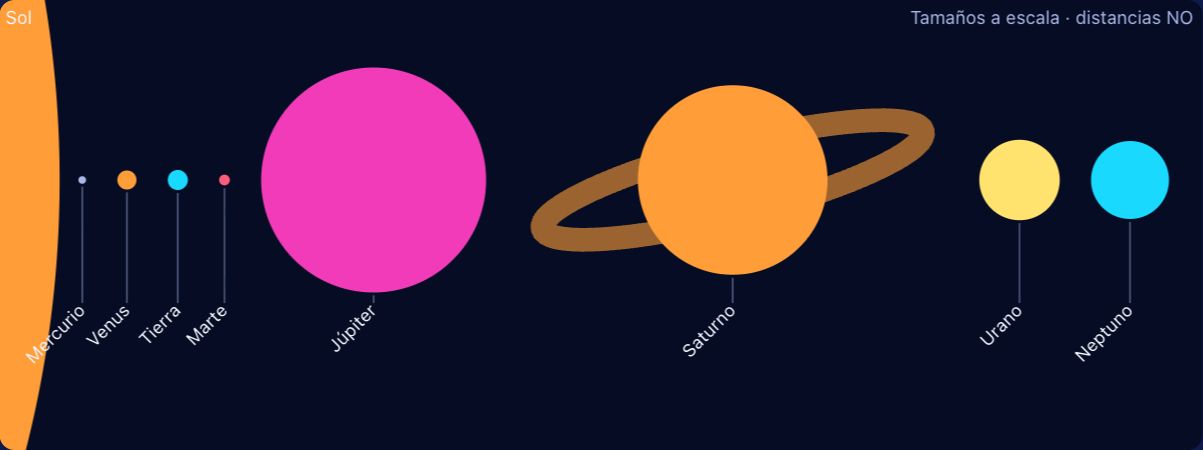
The Solar System to scale
Real sizes of the planets, distances with logarithmic zoom and a “light rocket” (×1, ×60, ×3600), a schoolyard model with everyday objects, and your weight and age on other worlds.
-
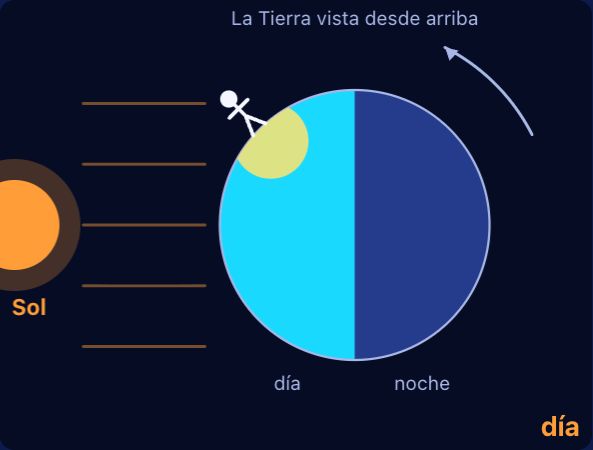
Day, night and the seasons
Explorer mode (the spinning Earth, day and night in Colombia, the shadow of a stick) and Scientist mode (orbit with the axis tilted 23.44°, hours of daylight through the year by latitude, altitude of the Sun at noon).
Build the Solar System to scale on the school sports field.
Full project sheet: 4 weeks, materials, phases and rubric →
Calculate where Neptune goes in the schoolyard model.