How much is a million?

From Bogotá to Cartagena, on the Colombian Caribbean coast, it is about 1 000 km by road. It is a long trip: almost a whole day by bus.
From Earth to the Moon it is 384 400 km. That is like going from Bogotá to Cartagena 384 times.
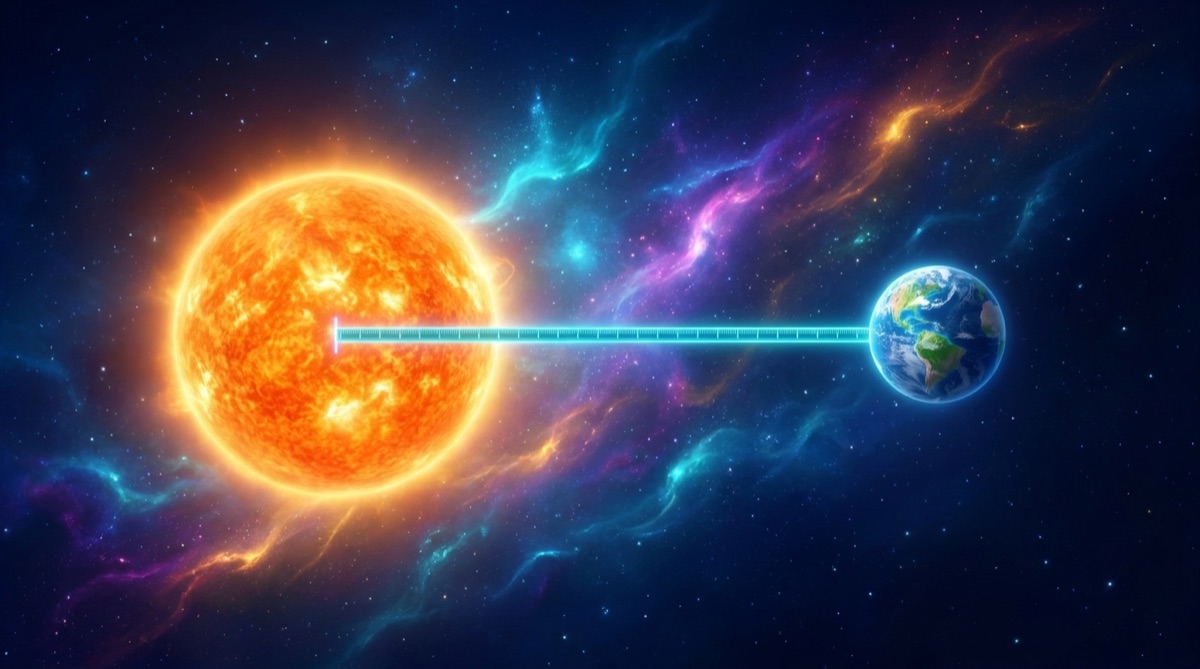
From Earth to the Sun it is 150 000 000 km: one hundred fifty million kilometers.
In astronomy the numbers are enormous. So as not to get lost, we need a tool: place value.
Each digit is worth something according to its place
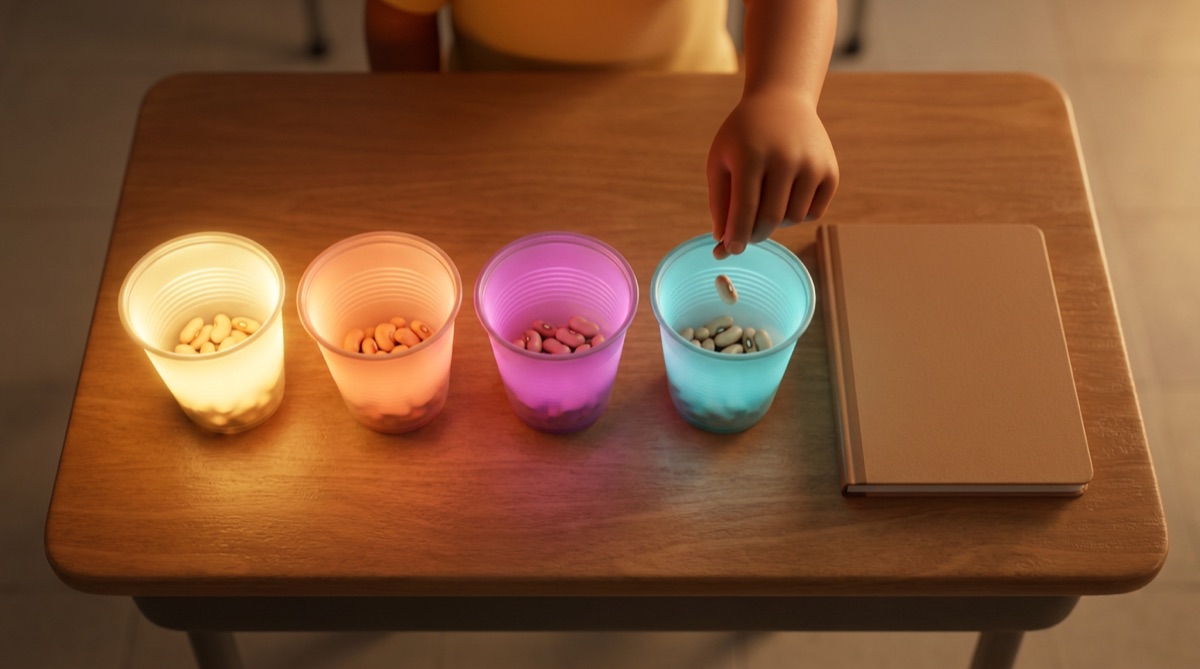
In a number, each digit has a place. The place tells you how much it is worth.
Look at the diameter of Mercury: 4 879 km.
| Thousands | Hundreds | Tens | Ones |
|---|---|---|---|
| 4 | 8 | 7 | 9 |
- The 4 is in the thousands place: it is worth 4 000.
- The 8 is in the hundreds place: it is worth 800.
- The 7 is in the tens place: it is worth 70.
- The 9 is in the ones place: it is worth 9.
It is read: four thousand eight hundred seventy-nine.
Notice: we leave a small space between the 4 and the 879. That space separates the thousands. That way the number is easier to read.
A thousand is ten hundreds

How much is a thousand? Count by hundreds:
100, 200, 300, 400, 500, 600, 700, 800, 900, 1 000.
Ten hundreds make one thousand. Ten thousands make ten thousand (10 000). And a thousand thousands make one million (1 000 000): a 1 with six zeros!
| Name | It is written | How many zeros |
|---|---|---|
| one hundred | 100 | 2 |
| one thousand | 1 000 | 3 |
| ten thousand | 10 000 | 4 |
| one hundred thousand | 100 000 | 5 |
| one million | 1 000 000 | 6 |
A trick: choosing a good unit

The diameter of Jupiter is 142 984 km. That is six digits: a hard number.
But if we measure it in thousands of kilometers, it looks like this: Jupiter is about 143 thousand km across. And 143 is a three-digit number: easy!
The same with distances. Earth is 150 000 000 km from the Sun. If we use millions of kilometers, Earth is 150 million km away.
Astronomers do this all the time: they choose a big unit so that the number is small.
| Planet | Diameter (km) | Diameter (thousands of km) | Distance to the Sun (millions of km) |
|---|---|---|---|
| Mercury | 4 879 | almost 5 | 58 |
| Venus | 12 104 | 12 | 108 |
| Earth | 12 756 | almost 13 | 150 |
| Mars | 6 792 | almost 7 | 228 |
| Jupiter | 142 984 | 143 | 778 |
| Saturn | 120 536 | almost 121 | 1 427 |
| Uranus | 51 118 | 51 | 2 871 |
| Neptune | 49 528 | almost 50 | 4 498 |
Look at the last column: all the numbers have four digits or fewer. Now we can read and compare them.
Neptune is 4 498 million km away. It is read: “four thousand four hundred ninety-eight million kilometers”.
Comparing two big numbers

To find out which number is bigger we use two rules, in order.
Rule 1: count the digits. The number with more digits is bigger.
- Saturn: 1 427 (four digits). Jupiter: 778 (three digits).
- 1 427 has more digits. Saturn is farther away than Jupiter.
Rule 2: if they have the same number of digits, compare from left to right. In the first place where they differ, the bigger digit wins.
- Venus: 12 104. Earth: 12 756. Both have five digits.
- Ten thousands: 1 and 1, the same. Thousands: 2 and 2, the same. Hundreds: 1 and 7. The 7 wins.
- Earth is a little bit bigger than Venus.
We write it with the “less than” sign:
The point of the sign always points to the smaller number.
Ordering
Ordering is comparing many times. Let’s order the diameters of the four rocky planets, from smallest to biggest:
- First we group by number of digits: 4 879 and 6 792 have four digits; 12 104 and 12 756 have five.
- The four-digit ones are the smallest. Between them: 4 879 < 6 792.
- Between the five-digit ones: 12 104 < 12 756.
Result: Mercury < Mars < Venus < Earth.
And if we order the eight planets by distance to the Sun? They come out in the same order they are in the sky! Mercury, Venus, Earth, Mars, Jupiter, Saturn, Uranus and Neptune.
The Solar System number line
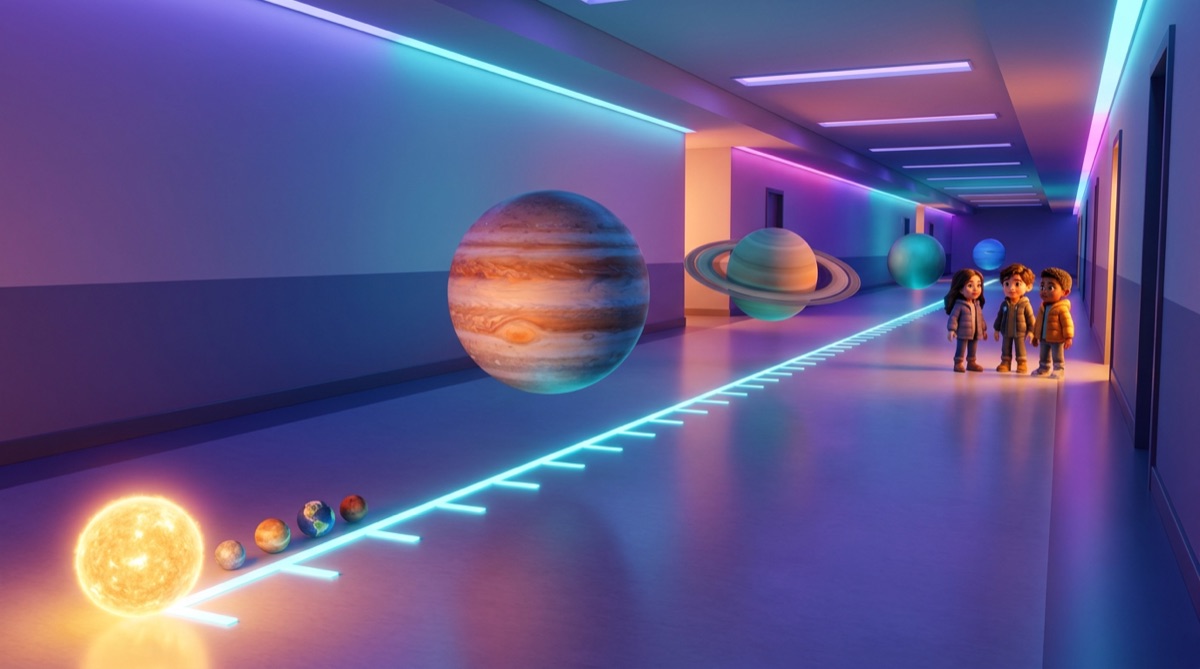
Draw a line. Each mark is worth 500 million km. Up to 5 000 million there are 10 marks.
Sun                                                              Neptune
|----|----|----|----|----|----|----|----|----|----|
0 500 1000 1500 2000 2500 3000 3500 4000 4500 5000 (millions of km)- Mercury (58), Venus (108), Earth (150) and Mars (228) fit before the first mark. They are crowded together near the Sun!
- Jupiter (778) goes between the 500 mark and the 1 000 mark, closer to 1 000.
- Saturn (1 427) goes between 1 000 and 1 500, near 1 500.
- Uranus (2 871) goes almost at the 3 000 mark.
- Neptune (4 498) goes between 4 000 and 4 500, near 4 500.
The number line shows us something the table does not: the four giants are extremely far from one another.
Play with the simulator

Open the Distances tab.
- With the Normal (with zoom) scale, find Mercury, Venus, Earth and Mars. Do they all fit in a tiny little stretch?
- Zoom out until you see Neptune. What happens to the rocky planets?
- Read the number of au for each planet. One au is the distance from Earth to the Sun (150 million km). How many au away is Neptune? Is it more or less than 30?
Then open the Sizes tab and check your order of the planets from smallest to biggest.
Activity: the cup abacus
Materials: 4 plastic cups, a marker, about 40 beans (or counters, buttons or bottle caps), the cards from the previous lesson.
- Write on the cups, from left to right: Th (thousands), H (hundreds), T (tens) and O (ones).
- Take the diameter of Mercury: 4 879. Put 4 beans in Th, 8 in H, 7 in T and 9 in O.
- A classmate looks at the cups and says the number out loud and in words.
- Now the other way around: your classmate puts in beans and you write the number.
- Do the same with the distance to Neptune in millions of km: 4 498. Which cup has the most beans? And which has the fewest?
- Challenge: put 9 beans in O and add one more. It does not fit in the ones anymore! Take out the 10 and swap them for 1 bean in T. That is “carrying”.
Final question: if you have 10 beans in the thousands cup, what number are you representing? Would you need a fifth cup? What would you call it?
Activity: the planet line in the hallway
Materials: 9 cards (Sun and 8 planets), chalk or masking tape, a hallway or the sports field.
In this activity one pace = 100 million km.
- The Sun stands at the start of the hallway.
- Mercury is 58 million km away: not even one full pace. It stands very close to the Sun.
- Venus (108): one pace. Earth (150): a pace and a half. Mars (228): two paces and a little bit.
- Jupiter (778): almost 8 paces. Saturn (1 427): about 14 paces.
- Uranus (2 871): about 29 paces. Neptune (4 498): 45 paces!
- Each planet writes on its card how many paces it took and why.
Final question: how many more paces did Neptune take than Uranus? And how many times farther away is Neptune than Earth? (Hint: 45 paces and 1 pace and a half.)
Exercises
- Write the diameter of Mars, 6 792 km, in a place value table and then in words.
Show solution
| Thousands | Hundreds | Tens | Ones |
|---|---|---|---|
| 6 | 7 | 9 | 2 |
6 792 = 6 000 + 700 + 90 + 2. It is read six thousand seven hundred ninety-two kilometers.
- Which is bigger: the distance from Saturn to the Sun (1 427 million km) or that of Uranus (2 871 million km)? Explain which rule you used.
Show solution
Both have four digits, so we use rule 2: we compare from left to right. In the thousands, 1 < 2. So 1 427 < 2 871: Uranus is farther away.
- Order these diameters from smallest to biggest: Uranus 51 118 km, Neptune 49 528 km, Saturn 120 536 km, Jupiter 142 984 km.
Show solution
First by number of digits: 51 118 and 49 528 have five; 120 536 and 142 984 have six. The five-digit ones are smaller.
Between 49 528 and 51 118: in the ten thousands, 4 < 5, so 49 528 is smaller. Between 120 536 and 142 984: hundred thousands the same (1 and 1); ten thousands, 2 < 4.
Order: Neptune (49 528) < Uranus (51 118) < Saturn (120 536) < Jupiter (142 984).
- The Moon is 384 400 km from Earth. Write that distance in thousands of kilometers. How many digits does the new number have?
Show solution
384 400 km is 384 thousand km (plus 400 km more, which hardly count). The new number, 384, has three digits instead of six.
- On the number line where each mark is worth 500 million km, between which two marks does Jupiter (778) go? Is it closer to one mark than to the other?
Show solution
Between the 500 mark and the 1 000 mark. From 778 to 1 000 there are 222 left; from 500 to 778 there are 278. It is closer to 1 000.
✦ Mini-quiz
Remember
- Each digit is worth something according to the place it occupies: ones, tens, hundreds, thousands.
- One thousand is ten hundreds. One million is a thousand thousands: a 1 with six zeros.
- To read enormous numbers, we choose a big unit (thousands of km, millions of km).
- To compare: first how many digits, then digit by digit from left to right.
- On the number line you can see that the rocky planets are close together and the giants extremely far apart.
🍎 Teacher guide
- Time
- 2 sessions of 55 min
- Colombian national standard (MEN)
- Mathematics, Grades 1 to 3: 'I use representations –mainly concrete and pictorial– to explain place value in the decimal numeral system'; 'I describe, compare and quantify situations with numbers, in different contexts and with various representations'; 'I recognize properties of numbers (being even, being odd, etc.) and relationships between them (being greater than, being less than, being a multiple of, being divisible by, etc.) in different contexts'. Natural Sciences, Grades 1 to 3: 'I establish relationships between magnitudes and appropriate units of measurement'; 'I record my observations in an organized and rigorous way (without alterations), using drawings, words and numbers'.
- Evidence of learning
- Breaks down a four-digit number on the cup abacus and reads it in words; orders the eight planets by diameter and by distance, justifying with the two comparison rules; places at least four planets on the number line.
Materials
- 4 plastic cups per pair and about 40 beans or counters
- Planet cards (from the lesson “Rocky planets and giant planets”)
- Chalk or masking tape for the line in the hallway
- Photocopy of the blank place value table
- Computer or tablet with the simulator (optional)
Suggested sequence
Session 1. Place value (55 min). Opening (10 min): “How much is a million? Could you count to a million?” (at one number per second, it would take more than 11 days without sleeping!). Development (35 min): place value table with Mercury and Mars; cup abacus in pairs with the four rocky planets; the “carrying” challenge. Closing (10 min): table of the names of one hundred, one thousand, ten thousand, one hundred thousand and one million; exercise 1.
Session 2. Comparing, ordering and the number line (55 min). Opening (10 min): “Which planet is farther away, Saturn or Uranus? How do you know without looking at the drawing?”. Development (30 min): the two comparison rules with the diameters; ordering the eight planets with the cards; the planet line in the hallway (one pace = 100 million km). Closing (15 min): number line in the notebook, exercises 2 to 5 and mini-quiz.
Note on the data. The diameters come from NASA’s Planetary Fact Sheet. The distances are the JPL semi-major axes (the same ones the simulator uses), rounded to millions of km; NASA’s Fact Sheet gives slightly different values for the distant planets (Saturn 1 432, Uranus 2 867, Neptune 4 515) because it uses another reference epoch. At this age the difference does not matter; if a student notices it, it is a good opportunity to talk about orbits not being perfect circles.
Common mistakes
- Reading 4 879 as “four, eight, seven, nine” or as “forty-eight, seventy-nine”. Go back to the abacus: each cup has a name and a value.
- Believing that the number that is “longer to write” is always bigger without counting digits (for example, getting confused by the thousands spaces). Have them count the digits with a finger.
- Comparing from right to left (starting with the ones). Show with 12 104 and 12 756 that the ones do not decide: the first different digit from the left decides.
- Thinking that “millions of km” is a shorter distance than “km” because the number is smaller. Use the hallway line: one pace is worth one hundred million km.
- For Grade 3, six-digit numbers (142 984) go beyond the range of the grade (up to 10 000). Work with them only in “thousands of km” and leave the full number as a challenge.