Think of the Solar System. Mercury, the planet closest to the Sun, travels its orbit at about 47 km/s; Neptune, the farthest, at only 5 km/s. The farther from the center of attraction, the slower the orbit: that is what Kepler’s laws and Newton’s gravitation say. A spiral galaxy should behave the same way: almost all its light (and, it was assumed, almost all its mass) is concentrated at the center, so the stars on the outskirts should move slower and slower. Vera Rubin measured those speeds and found that they do not drop. They hold steady. And that leaves only two ways out: either gravity works differently, or there is a great deal of matter we cannot see.
An astronomer who chose the quiet problem
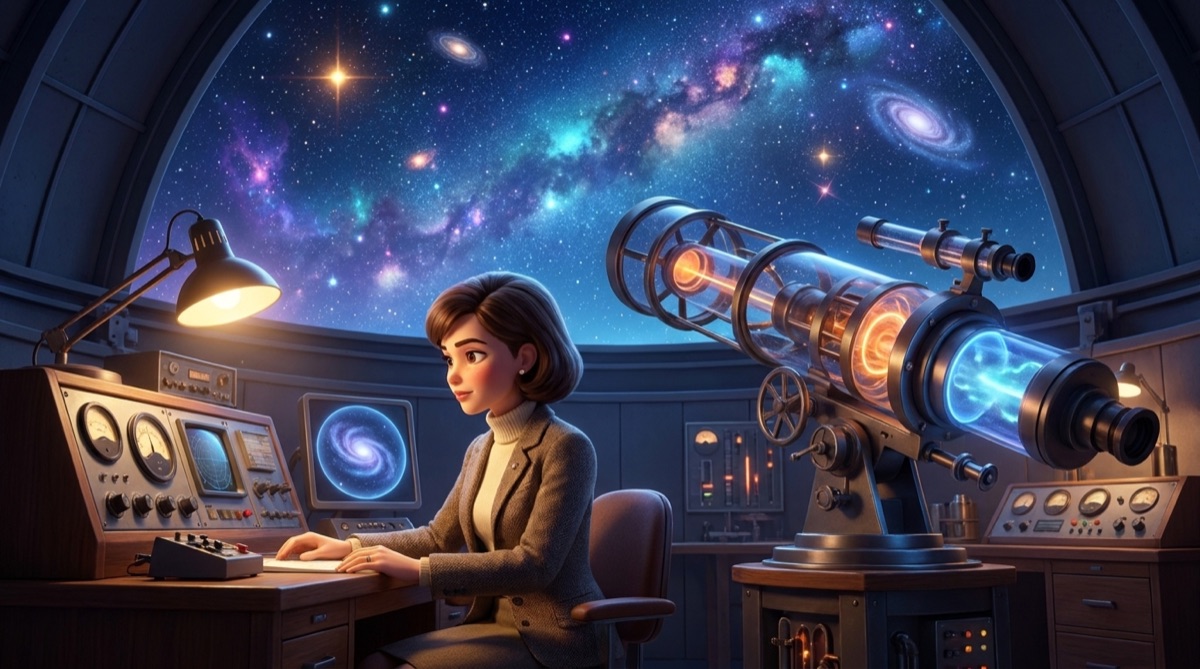
Vera Cooper Rubin (1928–2016) had to make her way in a profession that did not expect women. Princeton did not admit women to its astronomy graduate program when she wanted to enroll; she did her PhD at Georgetown in 1954. In the sixties, at the Carnegie Institution’s Department of Terrestrial Magnetism, in Washington, she teamed up with Kent Ford, a physicist who had built a spectrograph with an image-intensifier tube, far more sensitive than earlier ones. With it, one could measure the velocity of faint regions on the outskirts of galaxies, something that used to require whole nights of exposure.
Rubin used to say she chose to study the rotation of galaxies because it was a quiet topic, with little competition, where nobody would fight her for telescope time. It turned out to be one of the most important problems in the physics of the century.
Andromeda, and then 21 galaxies
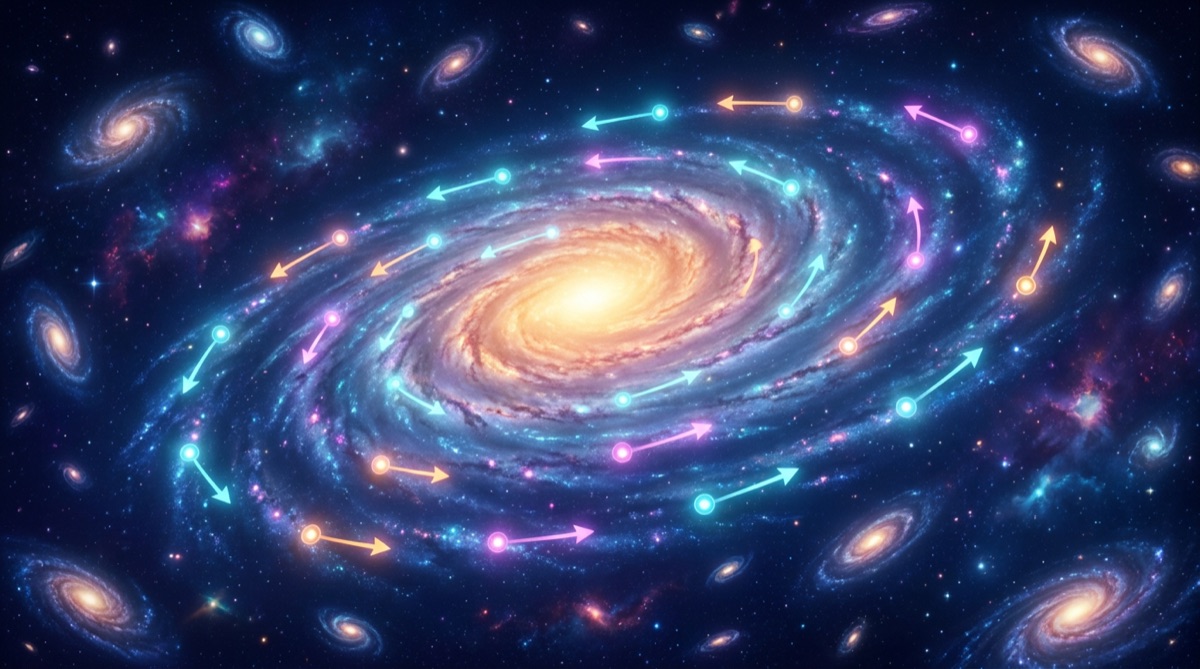
In 1970, Rubin and Ford published the rotation of the Andromeda galaxy measured at 67 regions of ionized hydrogen, from the center out to 24 000 parsecs. The velocity rose quickly near the nucleus and then, instead of falling, stayed almost constant at about 250 km/s out to the last point measured.
It could have been a quirk of Andromeda. So over the following years they repeated the measurement in more galaxies. The key paper, with Norbert Thonnard, appeared in 1980: 21 spiral galaxies, from a small one with a radius of 4 000 parsecs to the giant UGC 2885, with 122 000. In all of them, the rotation curve (the graph of velocity against distance from the center) rises and then flattens out. None of them drops. The stars on the outskirts turn as fast as those in the interior.
The key equation
For a star orbiting at a distance from the center of its galaxy, Newton says that
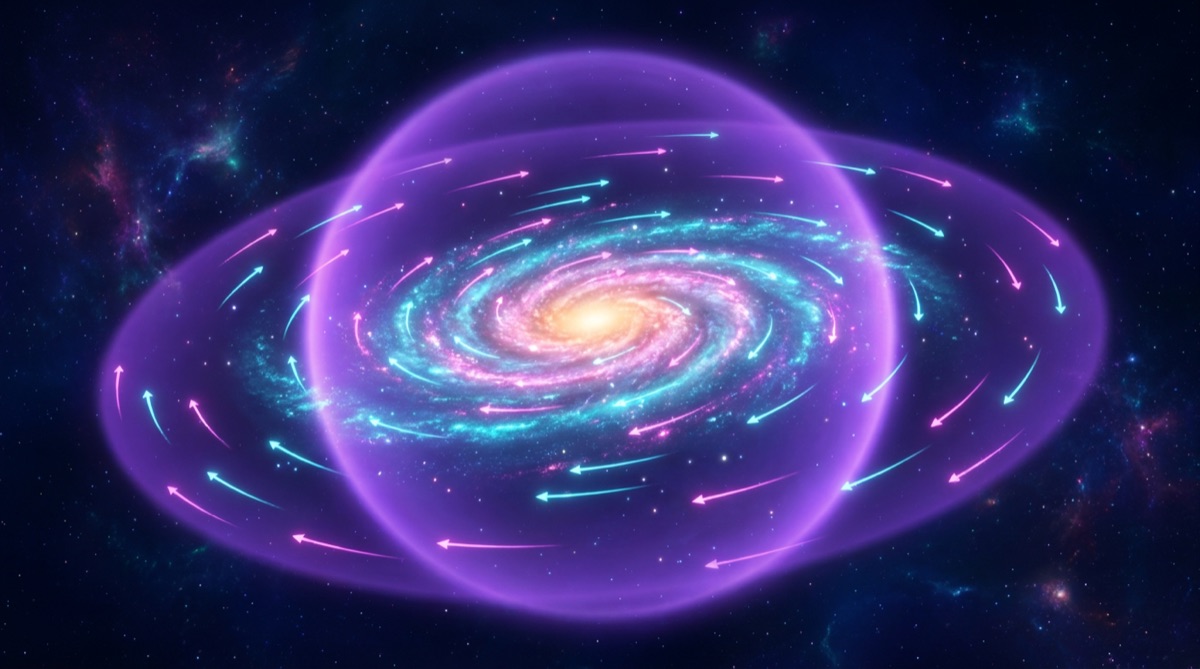
where is the orbital velocity, the gravitational constant and the mass contained within the radius . Read it like this: the velocity squared is the interior mass divided by the distance. If, as we move outward, there is no more mass (because the light runs out), stops growing and has to fall as , just like the planets. But if stays constant, the only way to satisfy the equation is for to keep growing in proportion to : every time you double the radius, you double the mass. There is mass where there is no light, and a lot of it: in Rubin’s galaxies, the invisible matter outweighs the visible several times over.
Try it yourself: in the simulator choose “Visible matter only” and watch how the velocity drops far from the center. Then choose “Milky Way with halo”: the curve stays almost flat, just as Rubin measured it.
- total (quadrature)
- bulge (Hernquist)
- exponential disk
- halo NFW
- Keplerian v ∝ R^−½ from R☉
- Eilers et al. 2019 (5–25 kpc)
How do we know?
Rubin was not the first to suspect. Fritz Zwicky had calculated in 1933 that the galaxies in the Coma cluster were moving too fast for the visible mass, and had spoken of “dark matter”. But his data were scarce and the result was ignored for decades. What changed with Rubin and Ford was the quality and the quantity: dozens of galaxies, hundreds of points, small errors and a trend that allowed no excuses. At the same time, Dutch radio astronomers (Albert Bosma, in 1978, among others) were measuring the neutral hydrogen gas, which extends far beyond the stars, and finding the same thing: the curves stay flat as far out as there is gas.
Since then the evidence has piled up along independent routes: the way galaxy clusters bend light (gravitational lensing), the temperature of the hot gas that fills them, and the small irregularities of the cosmic microwave background, whose analysis by the Planck satellite indicates that dark matter is about 27 % of the content of the universe, against barely 5 % of ordinary matter. What dark matter is remains unknown: no experiment has detected it directly.
Rubin never received the Nobel Prize. But in 2019 the United States Congress gave her name to the most ambitious observatory under construction: the Vera C. Rubin Observatory, on Cerro Pachón, in the Chilean Andes, with an 8.4 m mirror and the largest digital camera ever built. It released its first images on June 23, 2025, and in late June 2026 it began its ten-year survey, the LSST, which will photograph the entire southern sky every few nights. One of its main goals is, precisely, to measure how dark matter distorts the light of billions of galaxies.
Key takeaways
- In a galaxy, the stars on the outskirts should turn more slowly than those in the interior, like the distant planets.
- Rubin, Ford and Thonnard measured 21 galaxies (1980) and saw that the velocity does not drop: the rotation curves are flat.
- According to , that requires the mass to keep growing outward: dark matter, several times more abundant than the visible kind.
- The Rubin Observatory, in Chile, bears her name and has just begun mapping the sky to study it.
The gravitation and orbits behind the key equation are in Gravitation and satellites; the role of dark matter in the expansion of the universe, in the higher-education lesson Friedmann equations.