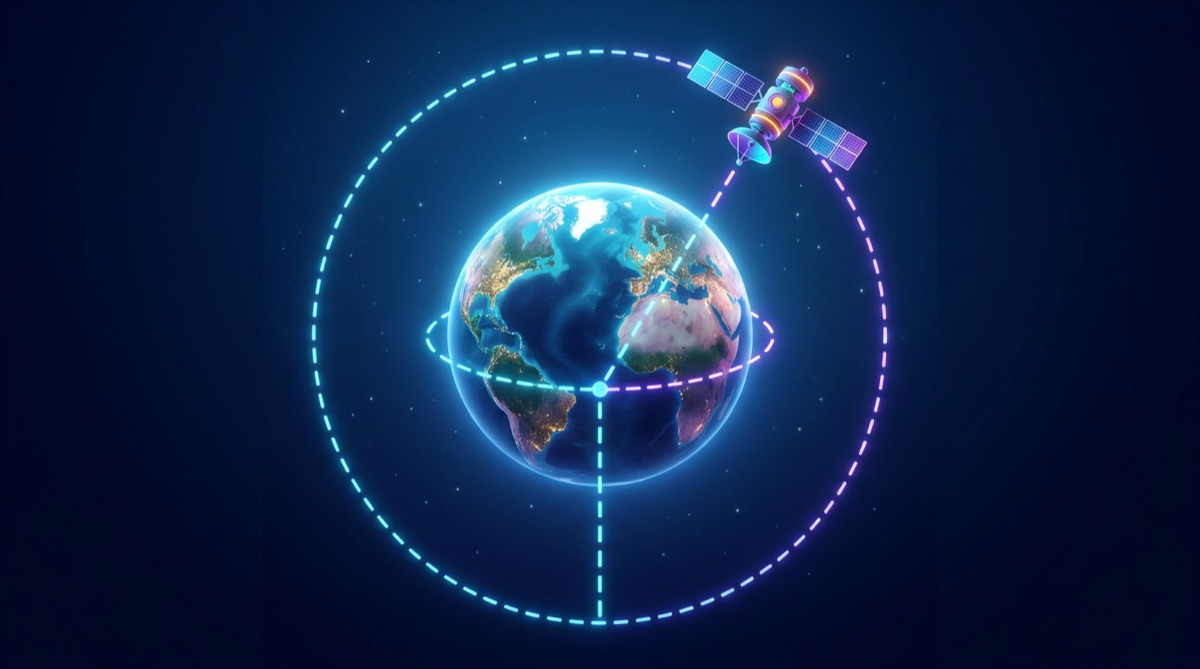
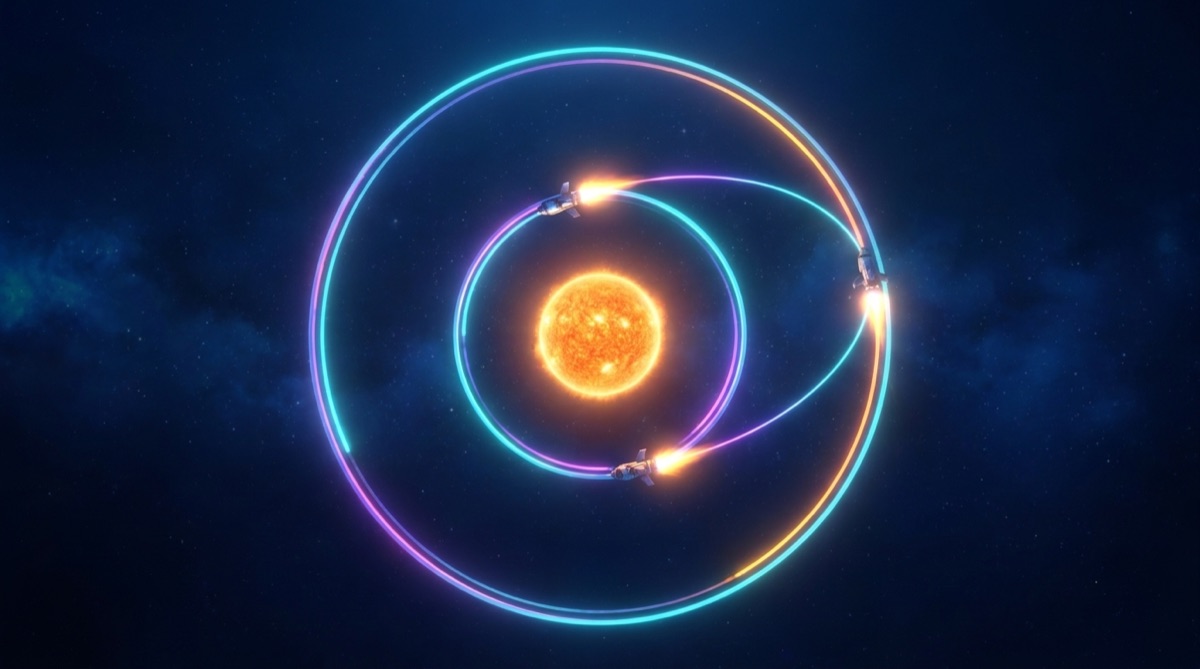
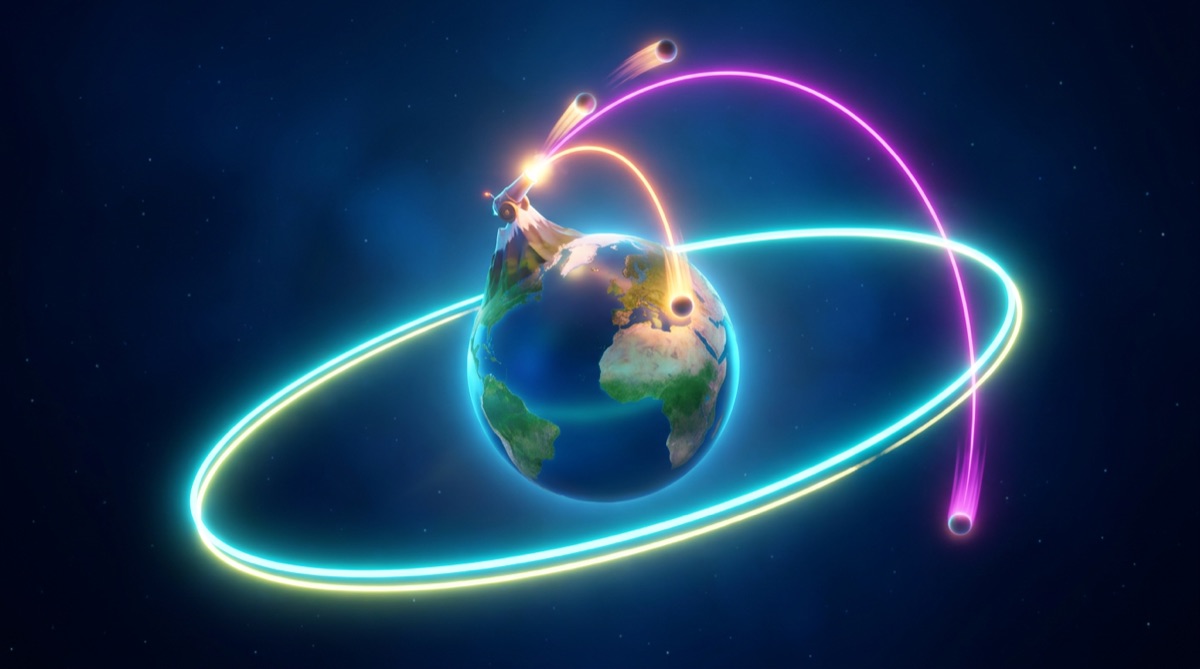
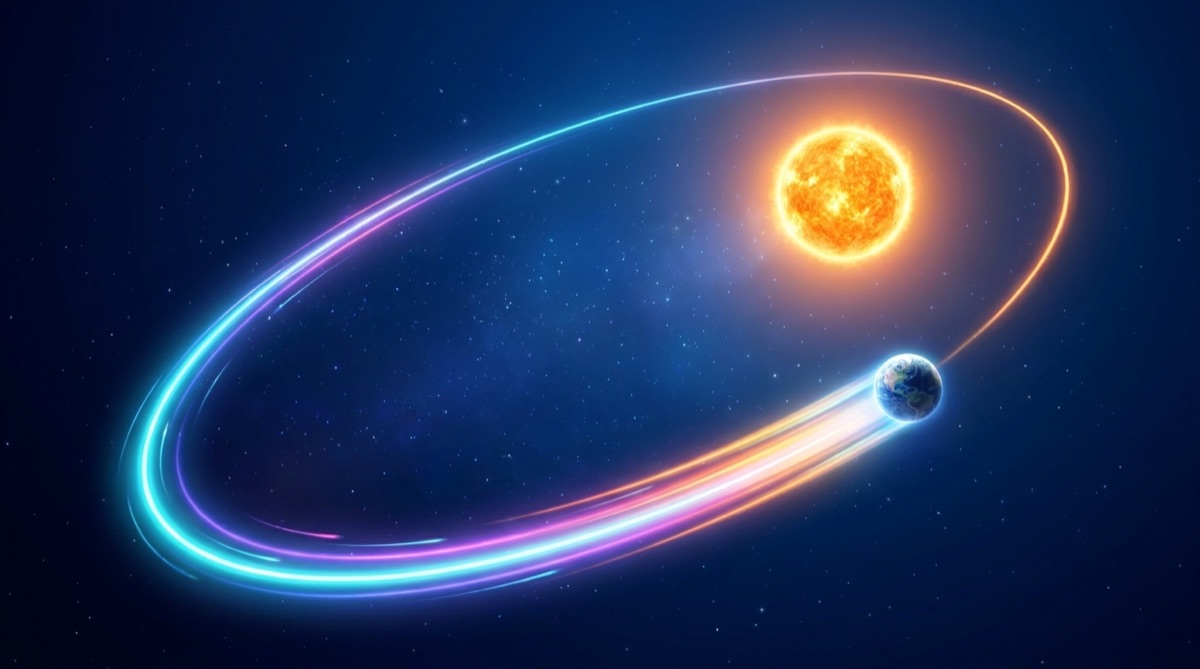
Between 2018 and 2023, a Colombian satellite the size of a shoebox, FACSAT-1, passed over Colombia about fifteen times a day at almost 7.6 km/s, 500 km up. Why didn’t it fall? The answer is surprising: it was falling the whole time. What kept it in orbit was moving sideways so fast that, as it fell, Earth curved away beneath it. To turn that idea into numbers we need the law Newton published in 1687.
1. The law of universal gravitation
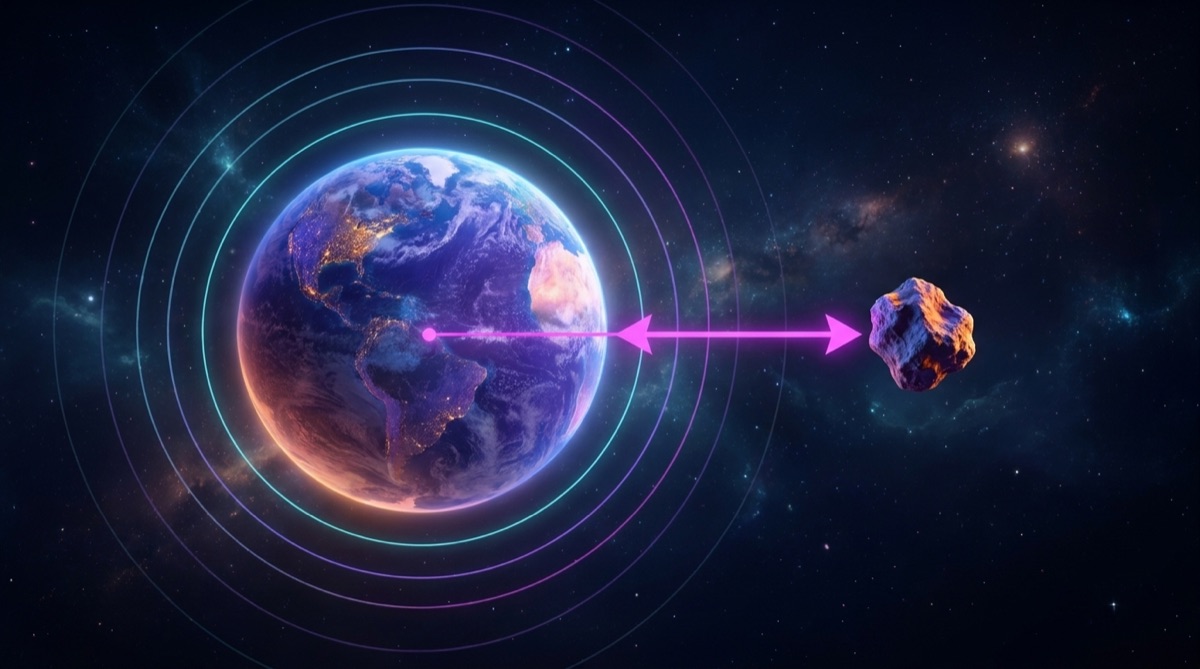
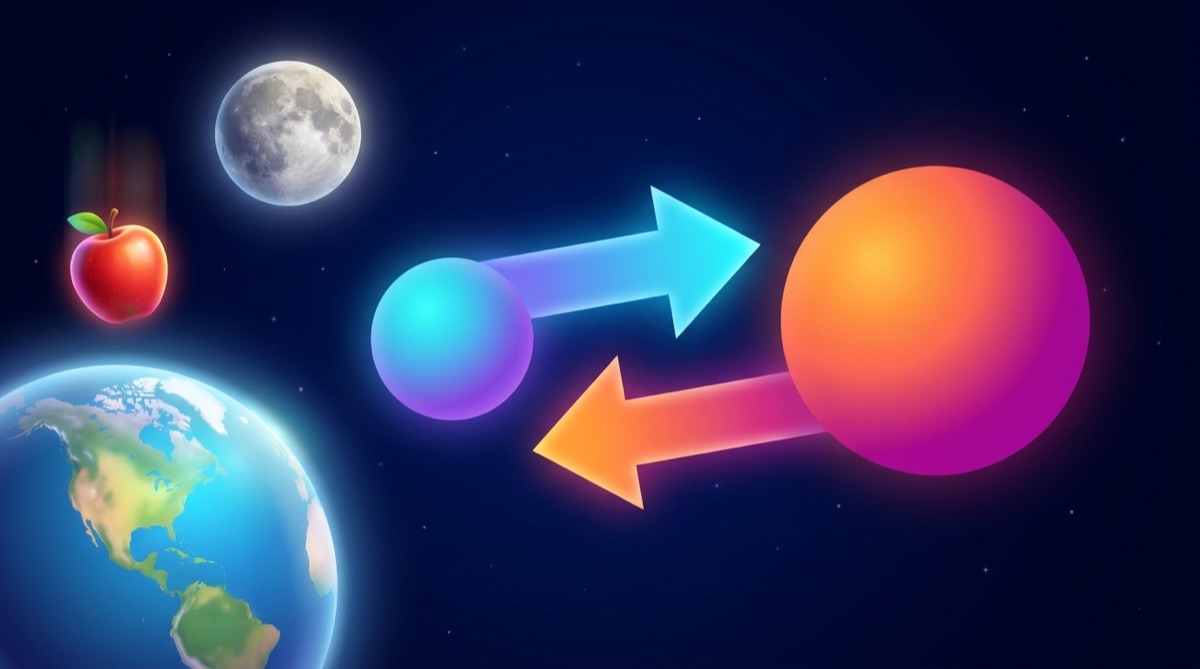
Two bodies of masses and separated by a distance (between their centers) attract each other with a force
where is the universal gravitational constant, (CODATA 2018). It is an inverse-square law: if the distance doubles, the force is divided by ; if it triples, by 9.
The force is a vector: it has a magnitude and a direction. If is the vector from the center of to the body , the force on points toward :
where is a vector of length 1 in the direction of and the minus sign reverses it (attraction).
The gravitational field
Since the force is proportional to , it is convenient to define the gravitational field , the acceleration that any mass placed at that point would feel:
For Earth, astronomers do not use and separately, but the product (IAU 2015 nominal value), which is known with far greater precision than or alone, because it is measured directly from the orbits of satellites.
Worked example 1: weight at the surface. With the equatorial radius ,
A 60 kg student weighs .
Worked example 2: is there gravity 500 km up? At the altitude of FACSAT-1, :
86 % of the value at ground level. Astronauts do not float because “there is no gravity”: they float because they fall together with their spacecraft, exactly as you would fall inside an elevator whose cable had been cut.
Worked example 3: the mass of Earth. If we really want , we divide:
2. Satellites: the circular orbit
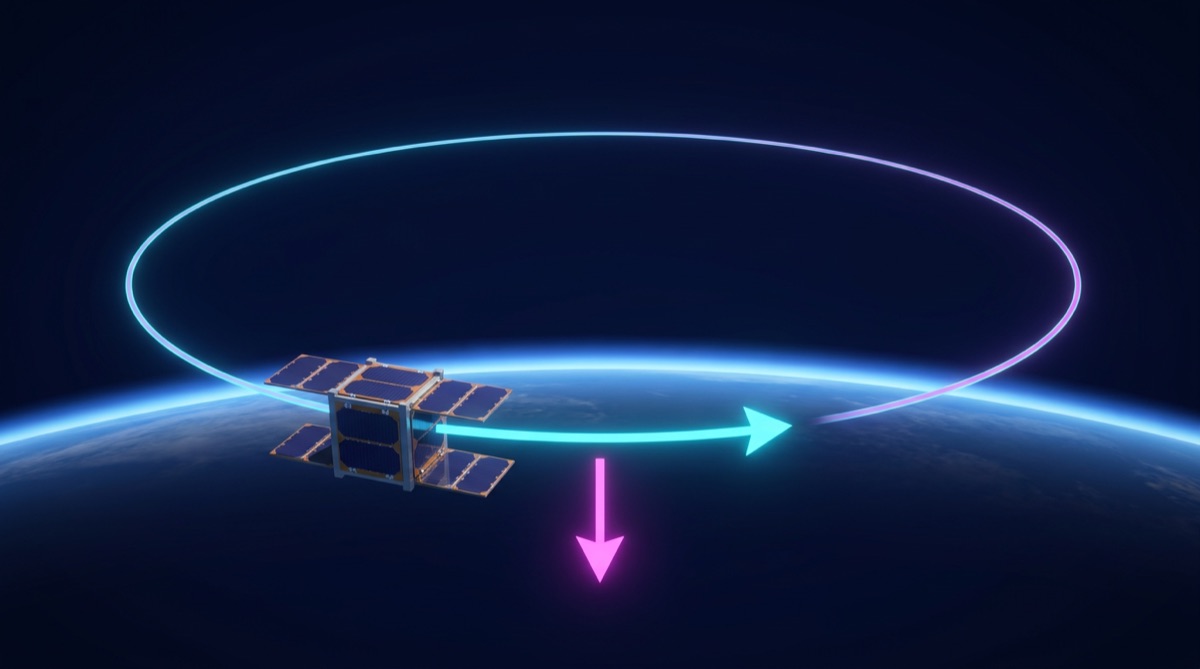
A body moving in a circle of radius with speed needs an acceleration toward the center (centripetal acceleration). In a circular orbit, all of that acceleration is provided by gravity:
The satellite needs no engine: gravity does the work of bending its path. Look at the square root: the higher the orbit, the slower the satellite goes, with .
The period is the time for one revolution, the circumference divided by the speed:
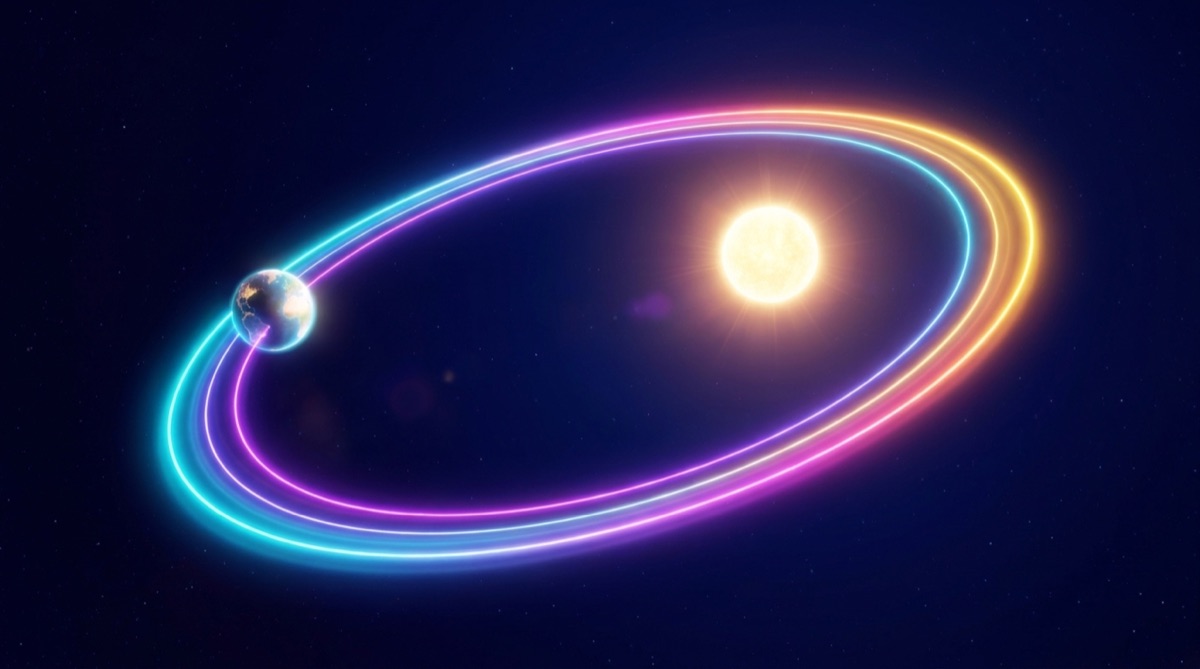
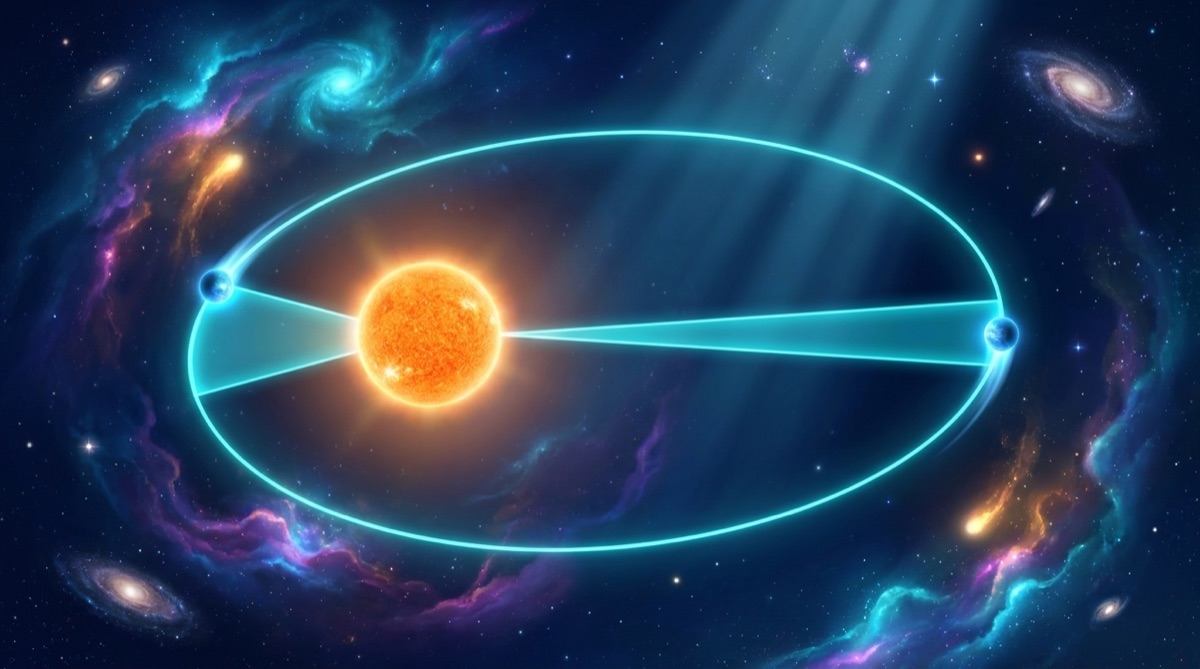
It is Kepler’s third law! Newton not only explained it: he told us the value of the “constant”, , and that is why the law can be used to weigh any body that has satellites.
Worked example 4: FACSAT-1. Its orbit was between 476 and 499 km up; let us take above the mean radius , that is, :
A day of 1440 min holds orbits. The Air Force reported that in its first two years FACSAT-1 completed 11 069 orbits around Earth: per day. Our three-line model gets it right.
| Orbit | (km) | (km/s) | |
|---|---|---|---|
| Low, 500 km (FACSAT, Space Station) | 6 878 | 7.61 | 94.6 min |
| GPS, 20 200 km | 26 578 | 3.87 | 11 h 58 min |
| Geostationary, 35 786 km | 42 164 | 3.07 | 23 h 56 min |
| The Moon, 384 400 km | 384 400 | 1.02 | 27.5 days |
3. The geostationary orbit
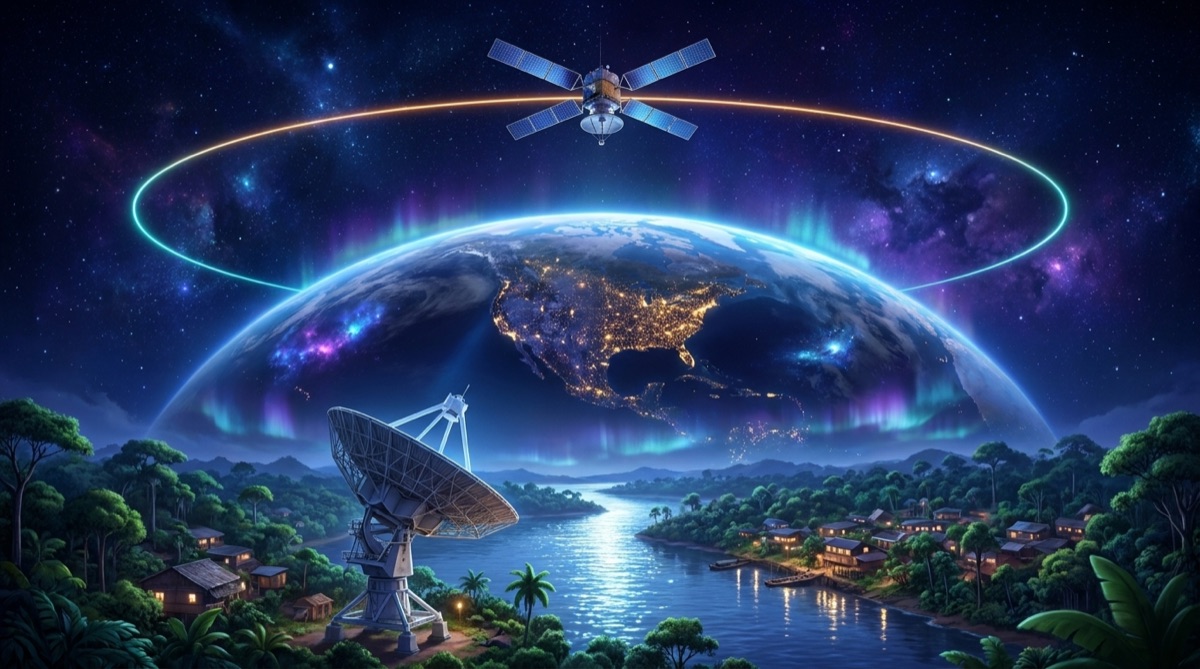
Satellite television dishes always point at the same spot in the sky. That is only possible if the satellite completes one revolution in the same time that Earth turns once on its axis: the sidereal day, (not 24 h: the solar day is a bit longer because Earth also advances along its orbit).
We solve the third law for :
Subtracting the equatorial radius, the altitude is . And the speed, .
A geostationary orbit has to be above the equator: the plane of any orbit passes through the center of Earth, and only the equatorial plane turns “together with” a fixed point on the ground. Places near the equator (Colombia, which it crosses at Leticia, is one) see these satellites almost at the zenith; the higher the latitude, the lower they appear above the horizon.
4. Escape velocity
How fast do you have to launch something so that it never comes back? We use energy. A body of mass at distance with speed has mechanical energy
The gravitational potential energy is negative and equals zero “at infinity”. Energy is conserved, so the body reaches infinity (with zero speed, the limiting case) exactly when :
Notice: the mass cancels (a feather and a rocket need the same speed) and : escaping requires 41 % more speed than orbiting at surface level.
Worked example 5: Earth.
(NASA gives 11.186 km/s with the mean radius.) The Moon: with and , : that is why the Apollo lunar module could lift off with such a small engine.
Simulator: Newton’s cannonball
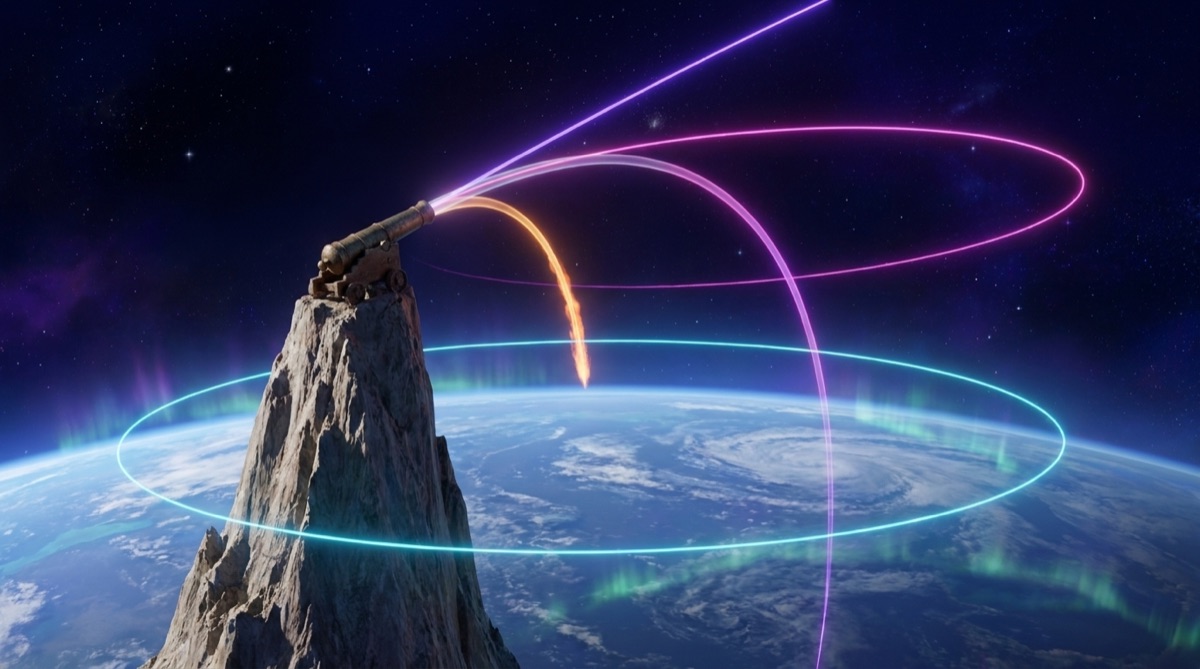
Newton imagined a cannon on a mountain above the air. The simulator integrates Earth’s real gravity:
- With the 10 km mountain, find the lowest speed at which the ball goes all the way around. Compare it with for km.
- Raise the speed a little: the orbit becomes elliptical. Where is the perigee?
- Multiply the circular speed by : the ball escapes. Check that it is the escape velocity of the previous section.
- Change the altitude to 400 km (that of the Space Station) and read the period of the circular orbit.
Orbits: nearly circular orbit with period 84.7 min; perigee at 10 km and apogee at 13 km altitude. It falls around the Earth without touching it.
- Cannon altitude
- 10 km (r₀ = 6 388 km)
- Circular v at that altitude
- 7.90 km/s
- Escape v at that altitude
- 11.17 km/s (= √2 · v_c)
- Specific energy ε
- -31.19 MJ/kg (bound)
- Eccentricity e
- 0.000
- Simulated time
- 0 s
5. The Colombian satellites
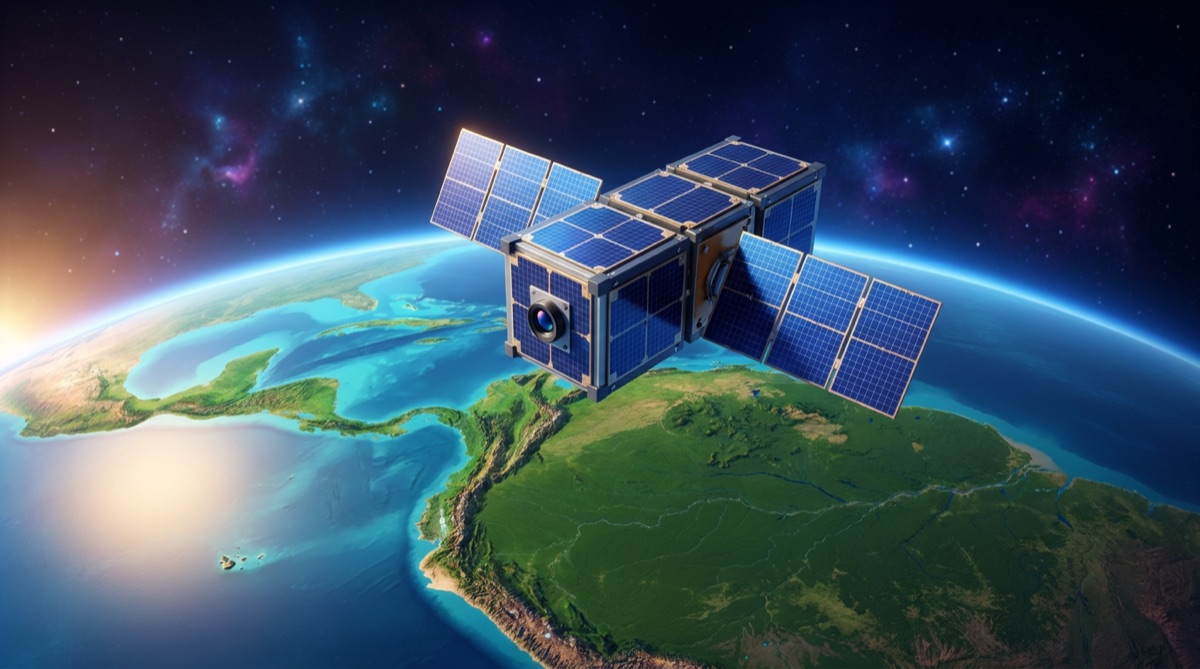
FACSAT-1 was the first satellite of the Colombian Air Force: a 3U CubeSat (three 10 cm cubes stacked), weighing 4 kg, with a platform from the Danish company GomSpace and a camera of 30 m per pixel. It lifted off on November 29, 2018 at 04:15 UTC (23:15 on the 28th in Colombia) on India’s PSLV-C43 rocket, from the Satish Dhawan Space Centre, together with 30 other satellites. Its orbit: 476–499 km altitude and inclination 97.48°.
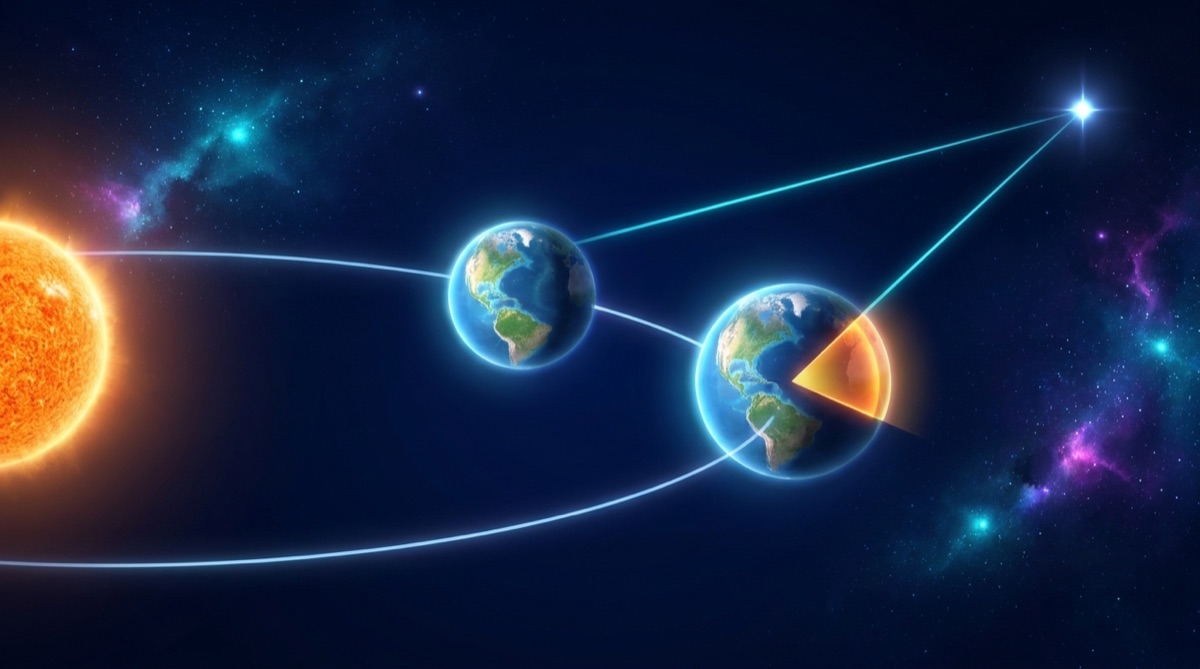
That inclination, greater than 90°, means the satellite went almost from pole to pole and slightly “against” Earth’s rotation. It is a Sun-synchronous orbit: the orbital plane turns over the year at the same rate as Earth around the Sun, so that the satellite passes over each place at the same solar time every day, ideal for comparing photos.
FACSAT-1 reentered the atmosphere on June 3, 2023. Why does a satellite fall if there is no engine braking it? At 500 km there is still a tenuous atmosphere. Drag takes energy away, the orbit lowers and, paradoxically, the satellite speeds up (remember: grows if decreases). Lower and lower there is more and more air, so the fall accelerates until reentry. The lower the orbit, the shorter the satellite’s life; in geostationary orbit, where there is no air left, it practically does not decay.
FACSAT-2 “Chiribiquete”, a 6U CubeSat, lifted off on April 15, 2023 on a SpaceX Falcon 9 (Transporter-7 mission) from Vandenberg, California, into a Sun-synchronous orbit of about 500 km, with a multispectral camera and a spectrometer for greenhouse gases. According to the press, it reentered on October 27, 2025.
Simulator: speed depends on distance
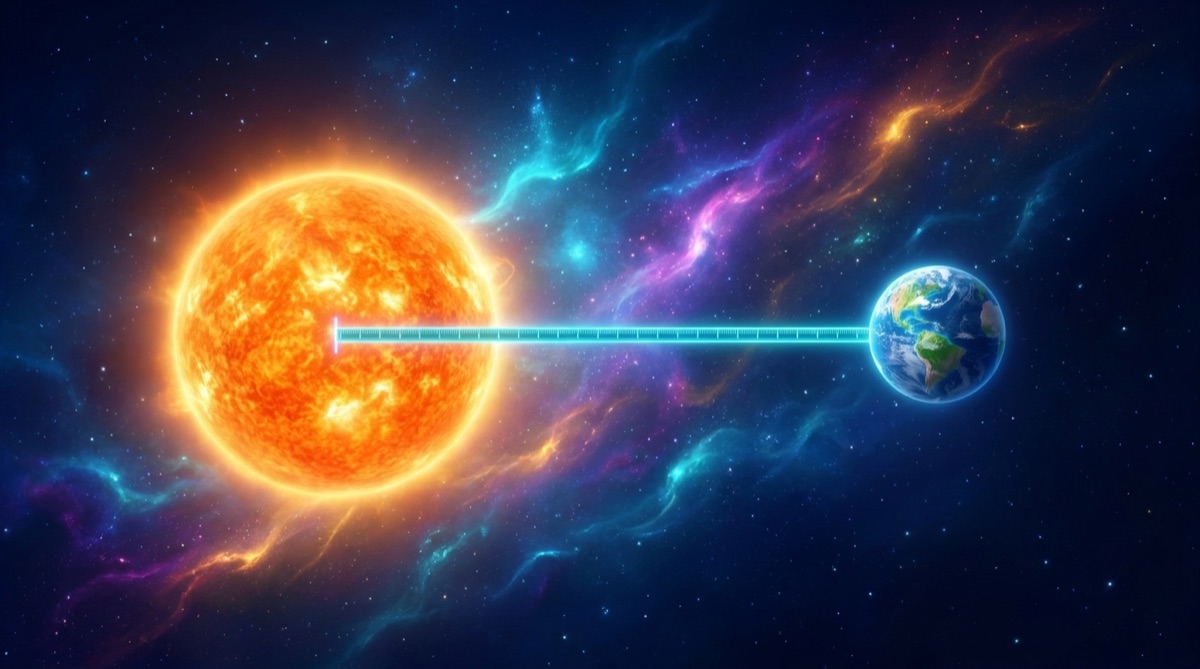
The simulator solves the exact orbit around the Sun and shows , and below. It uses and .
- Set and au. Read : it should give , Earth’s speed.
- Move up to 4.00 au. To what fraction did drop? (Prediction: .) And ? (Prediction: years.)
- Set au (Mercury). Check that .
- Now au and : watch how changes between perihelion and aphelion. The formula is no longer enough (the orbit is not circular); the one that holds is the vis-viva equation, . Check it with any reading of and .
Challenge: a trip to Mars
To go to Mars, a spacecraft does not aim at the planet: it accelerates in the direction Earth is moving and climbs along an ellipse that touches Earth’s orbit and that of Mars (the Hohmann transfer). The trip takes about 259 days, so you have to leave when Mars is about 44° ahead of Earth.
- Choose Mars and press “Use optimal angle”. Write down the flight time and the total .
- Change the phase angle by 10° and relaunch. By how many millions of kilometers does the spacecraft miss?
- Read the synodic period: it is how often the launch window repeats. Express it in years.
Success: with γ = 44° the spacecraft reaches Mars after 259 d (offset -0.3° from the optimum).
- Δv₁ (departure)
- 2.94 km/s
- Δv₂ (arrival)
- 2.65 km/s
- Total heliocentric Δv
- 5.59 km/s
- Time of flight
- 259 d
- Optimal phase angle γ
- 44.3°
- Synodic period (window)
- every 780 d
- Departure v∞ · C3
- 2.94 km/s · 8.7 km²/s²
- Δv from LEO (300 km)
- 3.59 km/s
- Elapsed time
- 0 d
Activity: weighing Earth with a pendulum
Materials: 1 m of thread, a nut, tape measure, stopwatch (the one on a phone).
- Hang the nut from the thread and measure the length from the suspension point to the center of the nut.
- Pull it less than 10° from the vertical and release it. Time 10 complete oscillations and divide by 10: that is the period .
- Repeat three times and average. For small angles, , so
- With and the mean radius , compute the mass of Earth: With and we get and .
Final question: if you are off by 0.05 s when measuring , by what percentage does change? (Hint: , so the relative error of is twice that of .) Why is it better to time 10 oscillations rather than one?
Exercises
Basic
- Two 60 kg students are sitting 1.0 m apart (between centers). With what force do they attract each other? Compare it with the weight of a hair (about N).
Show solution
: about 40 times less than the weight of a hair. Gravity is only noticeable when one of the masses is planet-sized.
- The International Space Station orbits at about 420 km altitude. Compute its speed and its period (use km).
Show solution
. ; .
- Compute the gravitational field at the surface of the Moon (, ). How much would the 60 kg student weigh there?
Show solution
, one sixth of Earth’s. Weight: (her mass is still 60 kg).
Intermediate
- GPS satellites complete two orbits per sidereal day (). Compute the radius of their orbit and their altitude.
Show solution
; altitude .
- The Moon is from the center of Earth. With compute its orbital speed and its period in days. Compare with the measured sidereal period, 27.32 days.
Show solution
. . It comes out 0.5 % higher than the measured value. Exercise 8 explains the difference.
- Mars: , . Compute its escape velocity and compare it with Earth’s.
Show solution
(NASA: 5.03), less than half of Earth’s 11.2 km/s: lifting off from Mars is much cheaper than lifting off from Earth.
Challenge
- With and , compute Earth’s period in days from . Explain why this result proves that Kepler’s third law is a consequence of Newton’s law.
Show solution
. When deriving from , the relation appears with a constant that depends only on the central mass: it is exactly what Kepler had found empirically for all the planets.
- In exercise 5 the computed period (27.45 d) exceeded the measured one (27.32 d). Suppose the correct formula uses the sum of the parameters, , and solve for from the measured period. What fraction of do you get?
Show solution
. Subtracting : , about of . The real value is (1.23 %, that is, 1/81); the remaining difference comes from 384 400 km being a rounded mean distance and from the pull of the Sun. The important idea: the Moon is so massive that Earth also orbits around the common center of mass.
- A satellite in a circular orbit has mechanical energy (use to check it). Explain with this formula why atmospheric drag, which removes energy, makes the satellite go faster.
Show solution
. Removing energy makes more negative, which requires a smaller ; and with a smaller , is larger. The energy lost to drag all comes out of the potential energy (which drops by twice as much as the kinetic energy rises).
✦ Mini-quiz
Key takeaways
- : inverse square; the field is and at Earth’s surface it equals 9.80 m/s².
- Circular orbit: and , which is Kepler’s third law with constant .
- Geostationary: s km, 35 786 km altitude, only above the equator.
- Escape velocity: ; for Earth, 11.2 km/s.
- A low satellite falls because of atmospheric drag and, as it falls, it speeds up: FACSAT-1 (2018–2023) and FACSAT-2 (2023–2025).
🍎 Teacher guide
- Time
- 3 sessions of 55 min
- Colombian national standard (MEN)
- Natural Sciences, Grades 10 to 11, physical environment: “I relate mass, distance and the force of gravitational attraction between objects”, “I establish relations between the gravitational field model and the law of universal gravitation” and “I model mathematically the motion of everyday objects from the forces acting on them”; science, technology and society: “I identify technologies developed in Colombia”. Mathematics, Grades 10 to 11, numerical thinking: “I establish relations and differences between different notations of real numbers in order to decide on their use in a given situation”; spatial thinking: “I use geometric arguments to solve and formulate problems in mathematical contexts and in other sciences”; metric thinking: “I design strategies to tackle measurement situations that require specific degrees of precision”.
- Evidence of learning
- Computes v and T of a real satellite from its altitude, derives the geostationary radius and the escape velocity by solving square and cube roots, and obtains the mass of Earth with a pendulum, estimating the percentage error.
Materials
- Scientific calculator
- Thread, nut, tape measure and stopwatch (one per group)
- Computer or tablet with the simulator
- Printout of the orbit table and of the FACSAT-1 data
Suggested sequence
Session 1. The law and the field (55 min). Opening with the hook question (why doesn’t FACSAT-1 fall?). Development: Newton’s law with its symbols, worked examples 1–3 (including the difference between , and ). Closing: exercises 1 and 3.
Session 2. Orbits (55 min). Derivation of and on the board; FACSAT-1 example and comparison with the 11 069 reported orbits; geostationary orbit. Guided challenge in the simulator (steps 1–3). Closing: exercises 2, 4 and 5.
Session 3. Escape, Colombian satellites and pendulum (55 min). Escape velocity with energy (10 min); reading of the section on Colombian satellites with a discussion of why orbits decay (10 min); pendulum activity in groups with the calculation of and error analysis (25 min); mini-quiz (10 min). Challenges 7–9 can be left as homework or for the group that finishes first.
Common mistakes
- Believing that there is no gravity in orbit. Compute g at 500 km (86 % of the ground value) and use the image of the free-falling elevator.
- Thinking that a faster satellite is higher. Insist on v ∝ 1/√r with the orbit table and the simulator.
- Using the altitude instead of the orbital radius (forgetting to add R⊕) or mixing km and m in GM. Require SI units throughout the calculation.
- Confusing mass and weight when changing planet. Repeat the example of the 60 kg student on the Moon.
- Assuming that the escape velocity depends on the mass of the rocket. Show the cancellation of m in the energy balance.