Go out on a moonless night to the Tatacoa Desert, in Huila, one of the darkest skies in Colombia. You will see thousands of stars and the band of the Milky Way, and between them, black. A lot of black. Now ask yourself a question that sounds like a small child’s: why? If the universe is infinite and full of stars, wherever you look your line of sight should end, sooner or later, on the surface of some star. And then the whole sky, day and night, should shine like the Sun. This question has a name, Olbers’s paradox, and its answer is one of the simplest proofs that the universe had a beginning.
An infinite forest

Imagine you are in a forest. If the forest is small, between the trunks you see the landscape outside. But if the forest is big enough, in whatever direction you look you end up seeing a trunk: the distant trees are smaller, but there are many more of them, and together they block the horizon. The same happens with stars. The distant ones look tiny and faint, but in an infinite universe there are infinitely many.
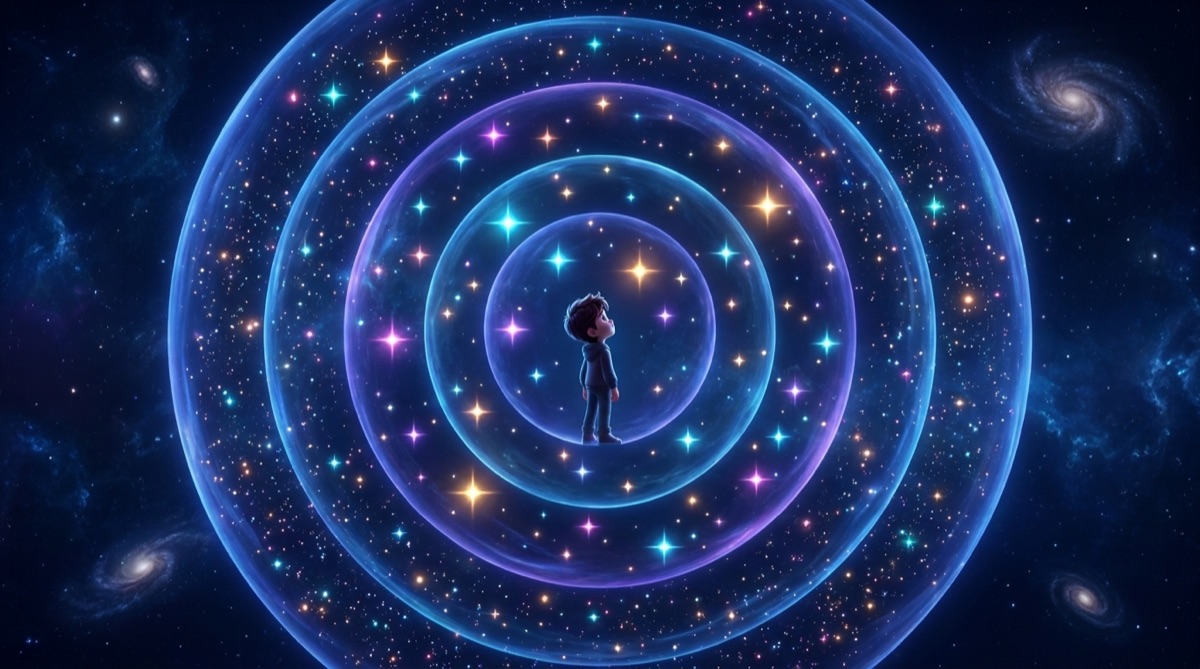
To make it more precise, think of space divided into spherical shells around us, like the layers of an onion, all of the same thickness. A shell twice as far away has four times more surface and, if the stars are spread evenly, four times more stars. But each of those stars looks four times fainter, because its light is spread over a sphere four times larger. The two things cancel: every shell contributes the same light to the sky, whether near or far. If there are infinitely many shells, the total light is infinite. The sky should be blinding.
The key equation
This is the only calculation in the article. If is the number of stars per unit volume, the light each one emits and the distance, the light we receive from a shell of thickness is
a value that does not depend on the distance . The surface of the shell grows as and the brightness of each star decreases as ; they cancel out. Adding up infinitely many shells gives infinity. Something in the assumptions has to be wrong.
The false exits
For centuries, explanations were proposed that do not work:
- “There is dust that absorbs the light.” That was Olbers’s own idea in 1823. But dust that absorbs light heats up, and in time it would shine as brightly as the stars it hides. It only postpones the problem.
- “Stars cluster into galaxies, and galaxies into clusters.” It makes no difference: the shell argument works for galaxies instead of stars.
- “The universe expands and distant light arrives reddened and weakened.” This is true and it helps, but calculations show that by itself it would not be enough to keep the sky dark.
The answer: the universe has an age
The false assumption is “eternal”. The universe is 13.8 billion years old, and light travels at a finite speed. That means we can only see the stars whose light has had time to reach us: those less than about 13.8 billion light-years of travel away. However large (or infinite) the universe may be, the part we see is finite, and within it there are not enough stars to cover the sky. The layers of the onion are not infinite; they run out. Besides, the stars themselves have an age: they have not been shining forever and will not shine forever, so there has not been time to fill space with light either.
There is a beautiful detail. The sky does shine everywhere, but not in visible light: it shines in microwaves. It is the cosmic microwave background, the light of the universe when it was 380 000 years old and was a ball of incandescent gas. The expansion has stretched it so much that today it corresponds to a temperature of only 2.7 degrees above absolute zero. The “wall of fire” the paradox imagined does exist; it has just cooled down until it became invisible.
How do we know?
The story is older than Olbers. Kepler already posed the problem in 1610 and used it as an argument that the universe had to be finite. Edmond Halley in 1721 and Jean-Philippe de Chéseaux in 1744 did the shell calculation. Heinrich Olbers published his version in 1823 (hence the name, although he was not the first). And, curiously, the poet Edgar Allan Poe wrote in 1848 that the only explanation was that the light from the most distant stars “has not yet reached us”. Lord Kelvin proved it with numbers in 1901.
Today the argument is backed by direct measurements: the age of the universe is obtained from the cosmic microwave background with an uncertainty of a few tens of millions of years, and telescopes see galaxies whose light left more than 13 billion years ago, close to the limit. The dark night sky is, literally, the proof that there is a limit.
You can play with the age of the universe in this simulator: change the content of matter and energy and see how the time elapsed since the Big Bang and the distance light has been able to travel change.
Key takeaways
- In an infinite, eternal and uniform universe, every line of sight would end on a star and the sky would be as bright as the Sun.
- Every “shell” of space contributes the same light: more stars exactly make up for their lower brightness.
- The sky is dark because the universe has a finite age (13.8 billion years) and light travels at a finite speed: we only see a limited region.
- The sky shines everywhere in microwaves: it is the cooled echo of the young universe.
To understand the speed of light and why looking far away is looking into the past: The speed of light and the light-year. On the expansion: The universe is expanding and, with the full calculation, Friedmann equations.