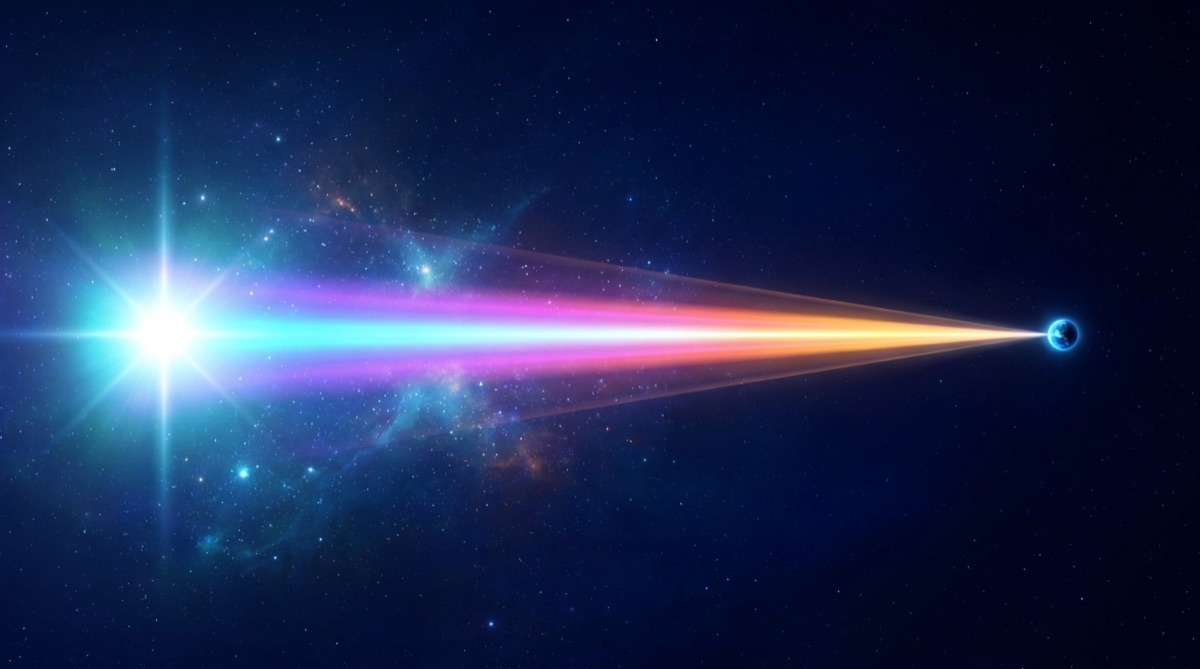
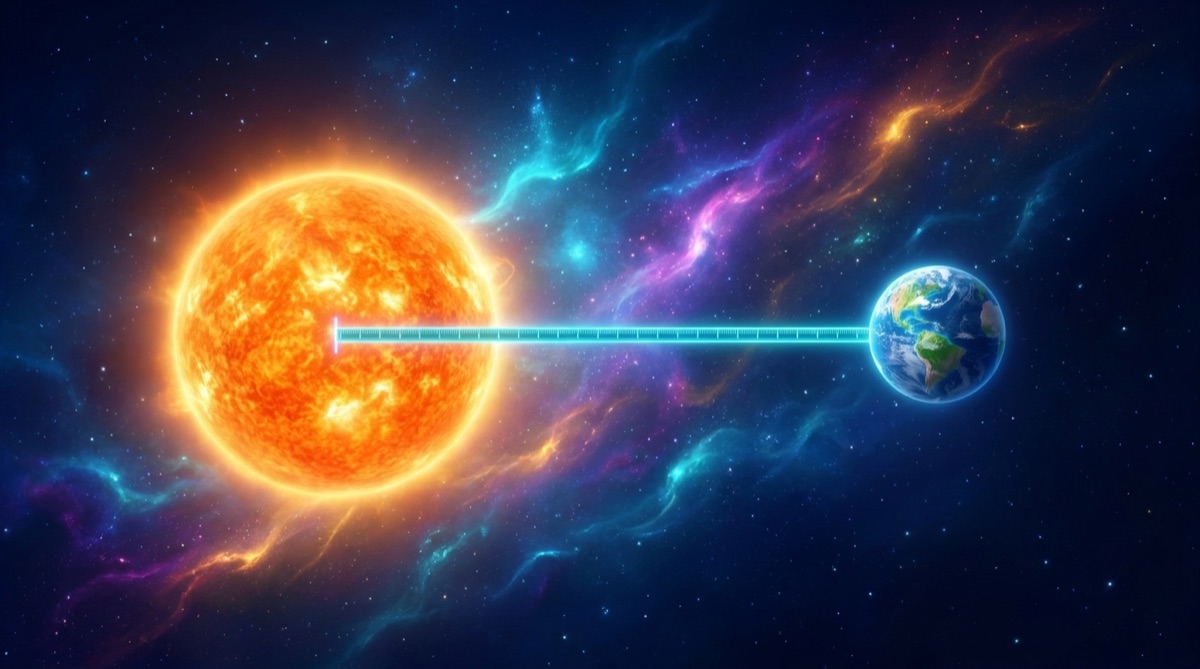
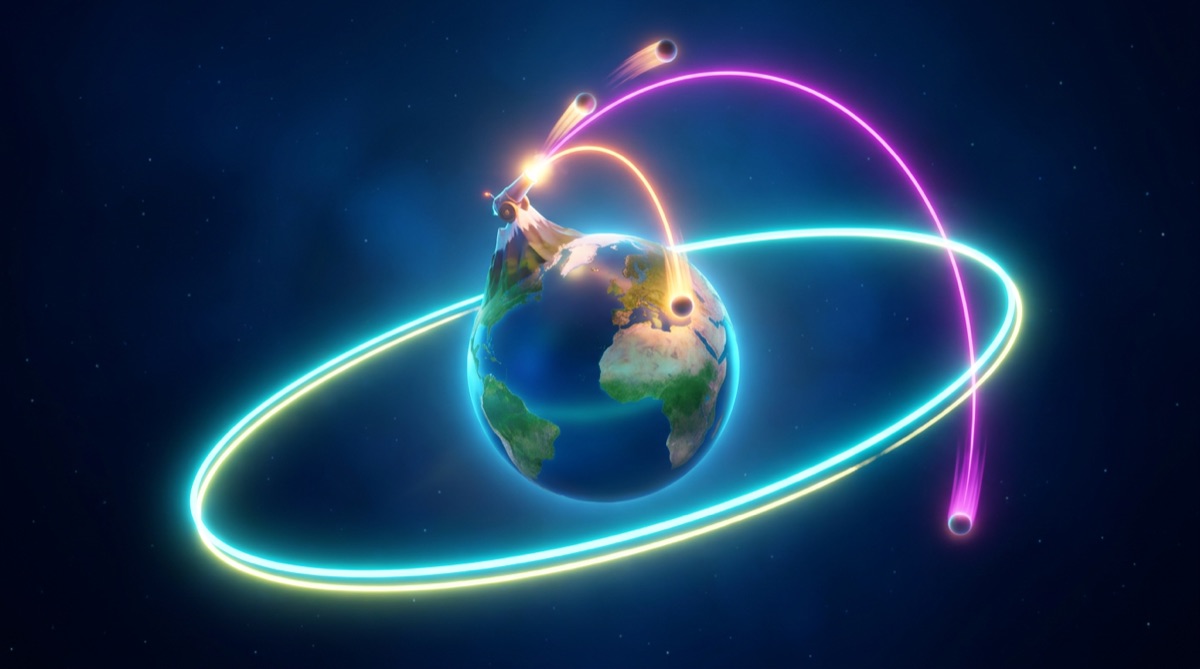
When you look at the Sun, you do not see it as it is now: you see it as it was about 8 minutes ago. That is the delay of the light in getting here. Light is the fastest thing there is, but it is not instantaneous. In this lesson we are going to describe its journey with one of the most useful tools of algebra: the linear function.
1. A constant speed: direct proportionality
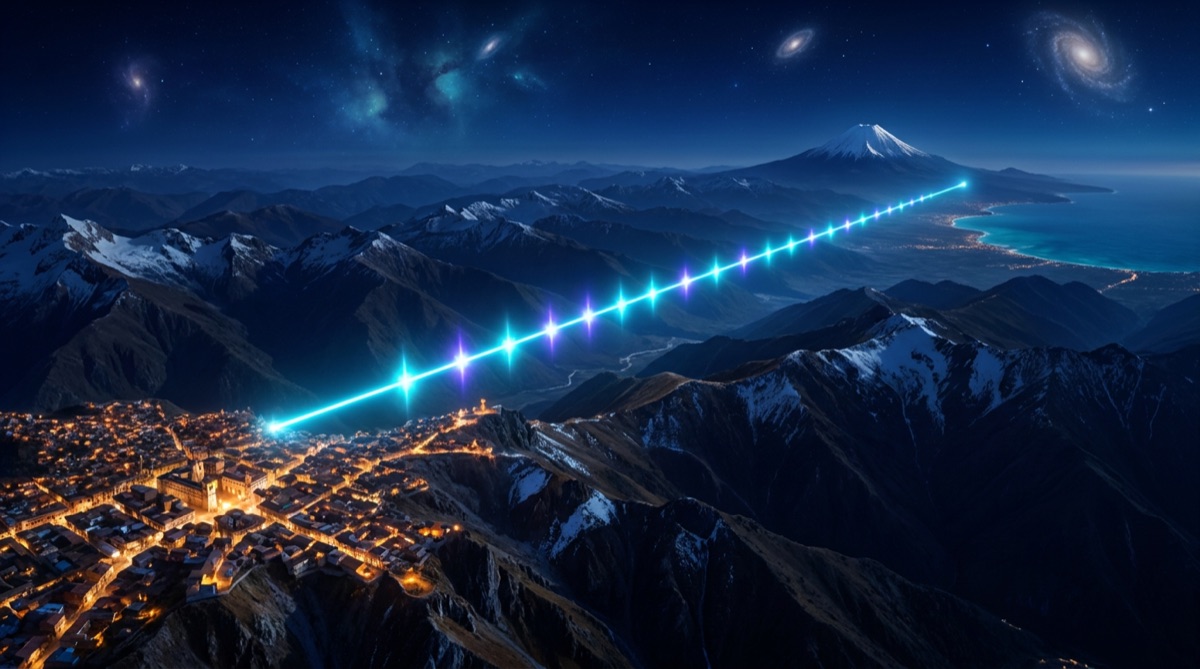
In a vacuum, light always travels at the same speed:
This value is exact by definition: since 1983 the meter has been defined from .
If light travels for a time , the distance it covers is
Here (distance) and (time) are directly proportional: if the time doubles, the distance doubles. The constant of proportionality is :
| (s) | 0 | 1 | 2 | 3 | 4 |
|---|---|---|---|---|---|
| (km) | 0 |
Worked example 1: from Bogotá to Santa Marta
How long does light take to cover the km between Bogotá and Santa Marta? We solve for in :
Less than three thousandths of a second: in everyday life light seems instantaneous.
2. The graph: a straight line whose slope is the speed
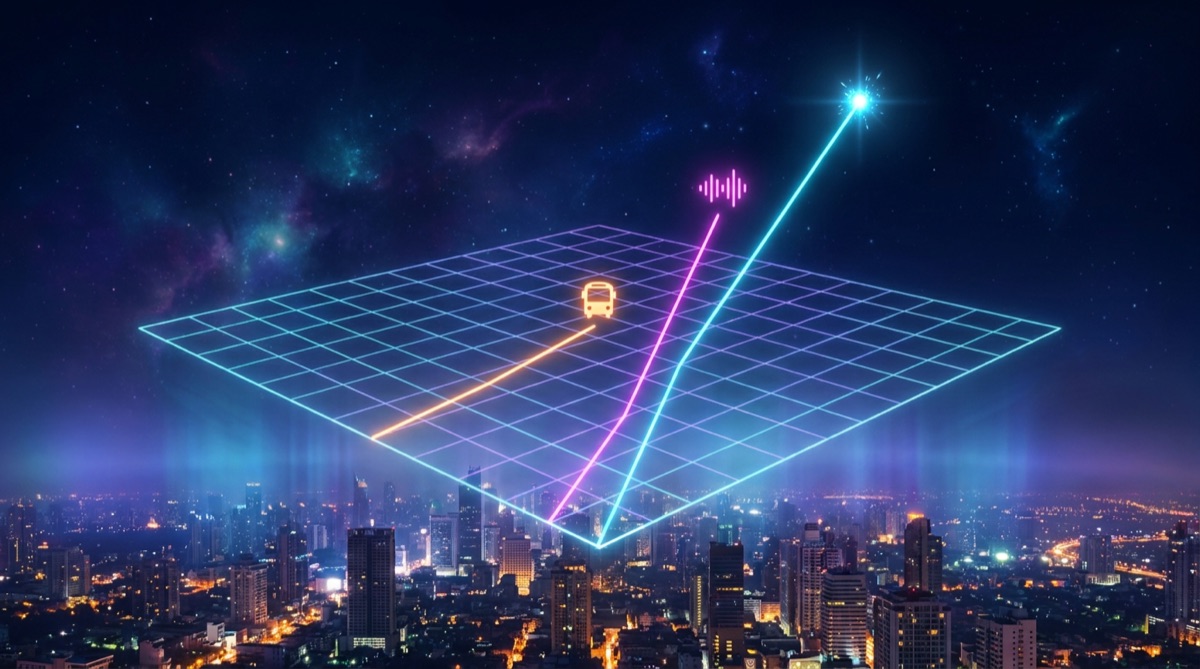
The function is a linear function. Its graph in the Cartesian plane (time on the horizontal axis, distance on the vertical) is a straight line through the origin.
The slope of a line through the points and is
On a distance–time graph, the slope is a speed: how many kilometers are covered per second. For light, .
Worked example 2: reading the slope
A line passes through and :
Comparison. If you draw on the same axes sound in air ( m/s at C), a bus at km/h and light, all three are lines through the origin, but the one for light is almost vertical: its slope is about times that of sound. That is why you first see the lightning and then hear the thunder.
Affine function: when you do not start from zero
If at the signal was already at a distance from the reference point, the relation is
an affine function: same slope (parallel lines), but it crosses the vertical axis at . If the signal approaches the reference point, the distance decreases and the slope is negative: .
3. The light-year
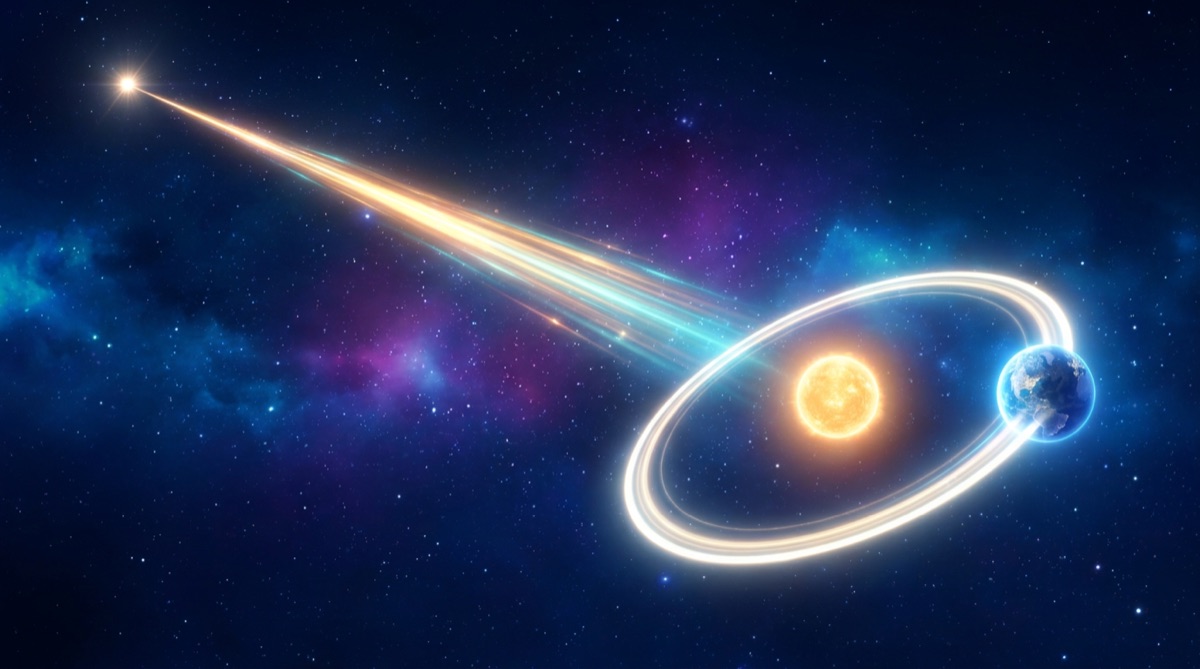
A light-year (ly) is the distance light travels in one year. To make it exact, the Julian year of days is used:
(The exact value is km.) The light-year is a unit of distance, not of time. The light-second ( km), the light-minute ( km) and the light-day ( km) are defined in the same way.
Advantage: saying that Proxima Centauri is ly away means that the light we see today left it 4.25 years ago. Looking far away is looking into the past.
Worked example 3: the light of the Sun
If the Sun went out, we would keep seeing it shine for more than 8 minutes.
4. Talking to distant spacecraft
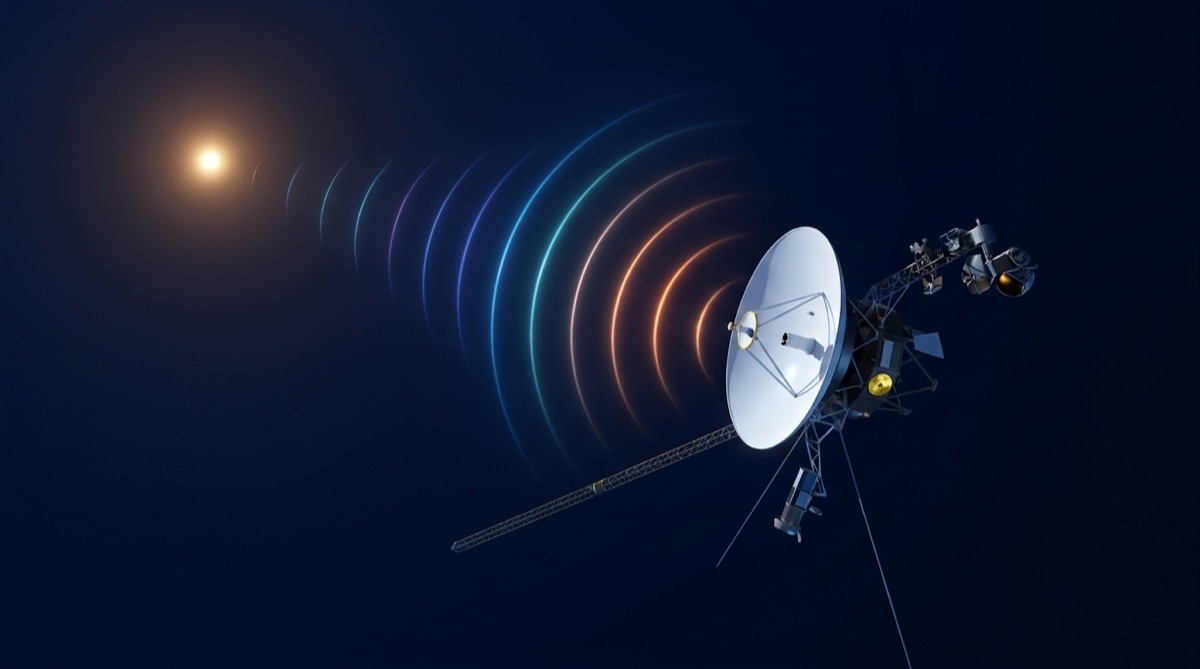
Commands to space probes travel as radio waves, which are light (electromagnetic radiation) and move at the speed .
| Destination | Approximate distance | One-way signal time |
|---|---|---|
| Moon | km | s |
| Mars (nearest and farthest) | to au | to min |
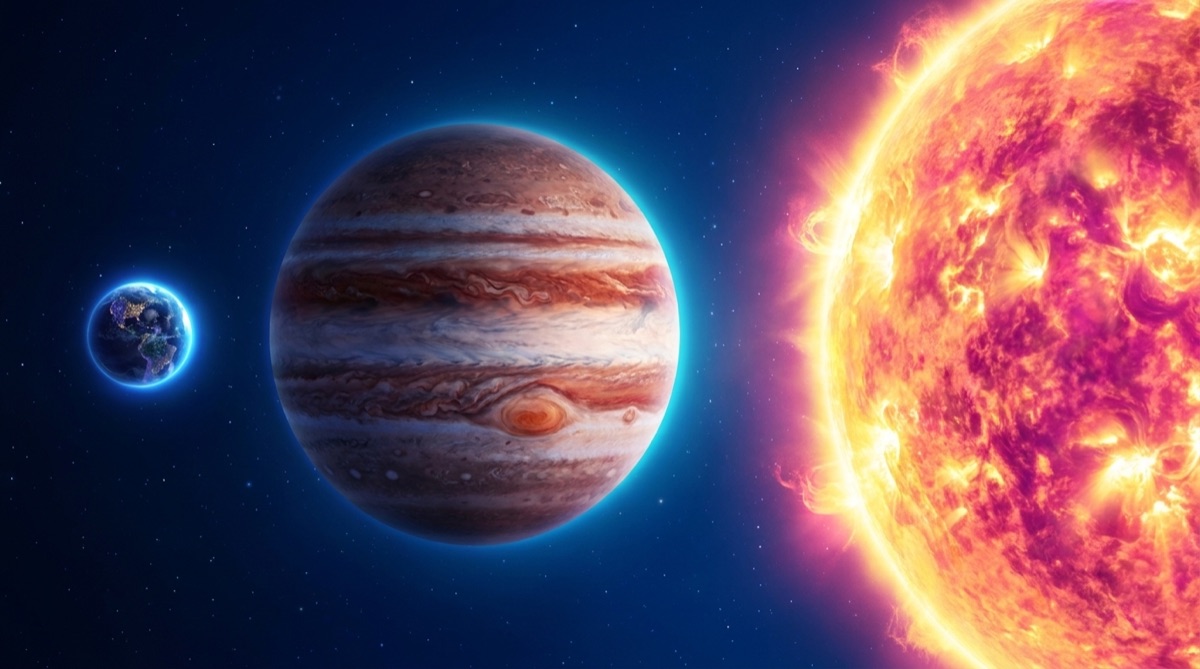
| Jupiter (from the Sun, au) | km | min |
| Voyager 1 (2026) | au | day |
That is why the rovers on Mars are not driven with a remote control in real time: between the command and the confirmation at least about 6 minutes go by (round trip), and sometimes more than 40.
Voyager 1, launched in 1977, is the most distant human-made object. In 2026 it is about 170 au away, almost one light-day: a message takes around one day to arrive and the reply another day. The exact figure changes every day (the spacecraft recedes about au per year); check it on the mission status page.
5. History: Rømer and the moons of Jupiter
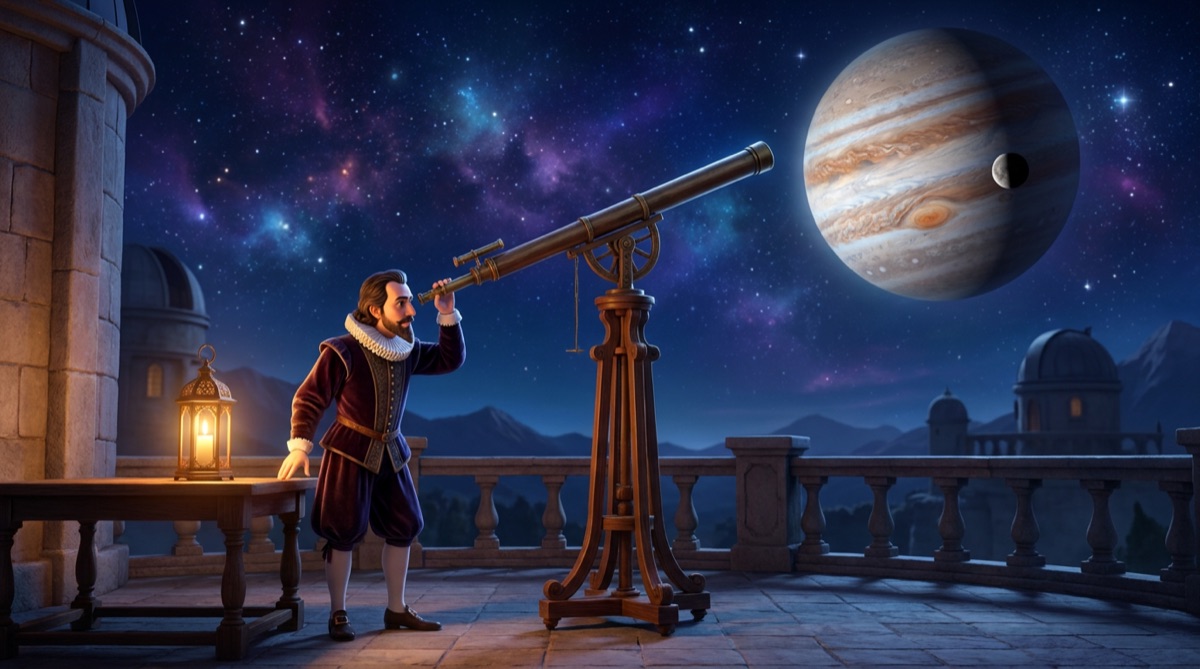
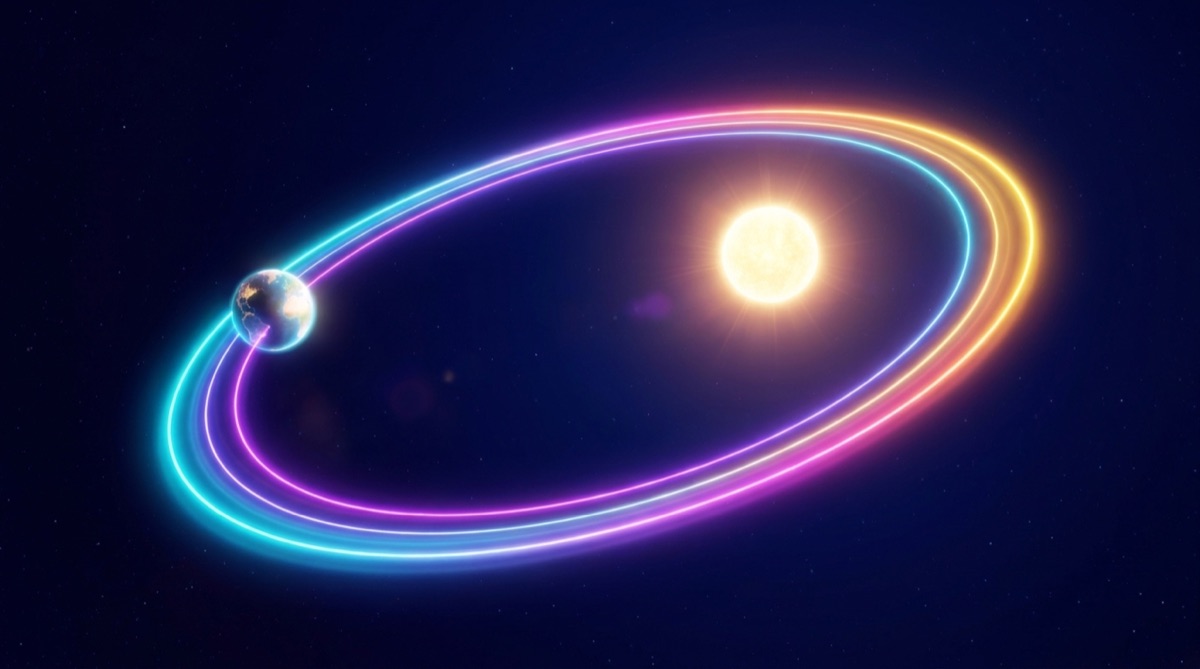
Until the 17th century many people thought that light was instantaneous. At the Paris Observatory, the Danish astronomer Ole Rømer was studying Io, a moon of Jupiter that enters the planet’s shadow (is eclipsed) once per orbit, every days hours. The eclipses of Io are like a clock in the sky: if they were perfectly regular, each one could be predicted years in advance.
But Rømer noticed that the eclipses came early when the Earth was approaching Jupiter and late when it was moving away. His explanation: the light from Io needs time to cross the extra distance. When the Earth is on the far side of its orbit, the light has to travel up to one diameter of the Earth’s orbit ( au) farther.
The historical data (verified):
- From his observations of 1671 to 1676, Rømer predicted in September 1676 that an eclipse of Io in November would arrive about 10 minutes later than the tables said, and so it did.
- On August 22, 1676, Cassini informed the Paris Academy of Sciences that light took “ten to eleven minutes” to cross the semi-diameter of the Earth’s orbit; Rømer explained the method on November 21 and published it in the Journal des Sçavans on December 7, 1676.
- Rømer estimated the total delay for the diameter of the orbit ( au) at about 22 minutes.
- Rømer did not publish a value for the speed. It was Christiaan Huygens who, in his Treatise on Light (1690), combined that delay with the size of the orbit known at the time and obtained about 16⅔ Earth diameters per second: about km/s.
Worked example 4: what speed do the 22 minutes give?
With the current au, au km and min s:
The real value of the delay is min; with it you get km/s. Rømer overshot the time by 32 % (and therefore fell 24 % short in the speed), but it was the first proof that light has a finite speed, and of the correct order of magnitude.
6. Explore with the simulator
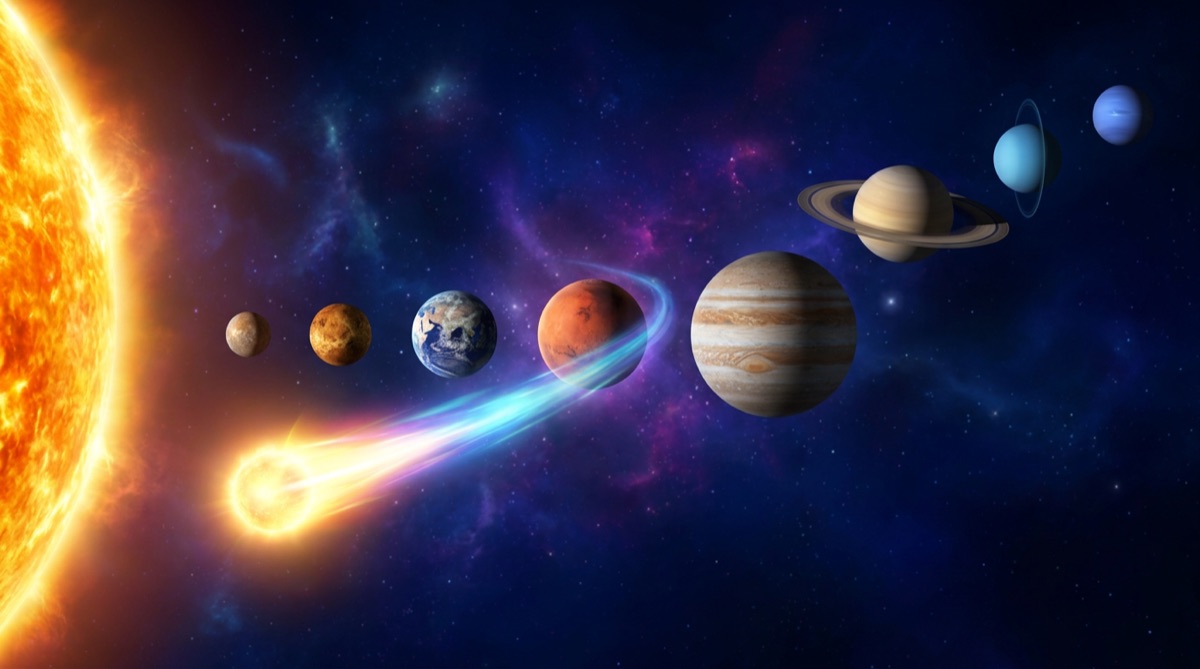
Use the light journey mode: a “light rocket” leaves the Sun and the simulator marks when it reaches each planet.
- Write down the arrival time at Earth, Mars, Jupiter and Neptune. Make a distance (au)–time (min) table.
- Plot the four points on a Cartesian graph. Are they aligned? Calculate the slope in au/min and compare it with au/min.
- How long would light take to reach a planet at 50 au? Use the line, not the simulator, and then check.
Activity: the light-time map
You need: graph paper or grid paper, ruler, calculator.
- Copy this table and complete it with (use km/s and km). Express in minutes.
| Destination | (au) | (km) | (min) |
|---|---|---|---|
| Moon | ? | ||
| Venus (at its nearest) | ? | ? | |
| Sun | ? | ||
| Mars (typical opposition) | ? | ? | |
| Jupiter (typical opposition) | ? | ? | |
| Saturn (typical opposition) | ? | ? |
- Draw the graph of (au) on the vertical axis against (min) on the horizontal, with the six points.
- Draw the line through the origin that best passes through them and calculate its slope with two distant points. How many au per minute? How much is that in km/s?
- Write the equation of your line in the form and use it to predict the light time to Neptune (30 au) and to Voyager 1 (170 au).
Final question: if one day we receive a radio signal from a spacecraft at 100 au, when was it sent? What date and time would you put on the reply so that the spacecraft receives it “today at noon” from its point of view?
Exercises
Level 1 — practice
- What distance does light travel in s? And in minute? Use km/s.
Show solution
km; km.
- A distance–time line passes through and . Calculate its slope. Could it be the graph of light?
Show solution
km/s. Yes: it is the speed of light.
- How long does sunlight take to reach Jupiter ( au)? Use the fact that to reach the Earth ( au) it takes s.
Show solution
s min.
Level 2 — apply
- Check with your own calculations that ly km.
Show solution
km.
- You see a lightning flash and hear the thunder s later. How far away did it strike? (Sound: m/s.) How long did the light of the flash take? Was it reasonable to neglect it?
Show solution
m km. The light takes s, about seven millionths of a second: yes, it is negligible compared with 6 s.
- A signal from a rover on Mars takes min to reach the Earth. How far away is Mars, in km and in au? How much time passes between sending a command and receiving the confirmation?
Show solution
km au. Round trip: min (not counting the time to process the command).
- How many km and how many au are there in a light-day? Compare it with the distance of Voyager 1.
Show solution
km au. It is approximately the distance of Voyager 1 in 2026.
Level 3 — challenges
- Rømer. With his delay of min for au, calculate in km/s and the percentage error relative to the current value. Repeat with min.
Show solution
km/s, error . With min s: km/s.
- Draw on the same axes (with suitable scales) the graphs for sound and for light. How many times larger is the slope for light? Why can’t they be seen well on the same scale?
Show solution
. If the vertical axis lets you see the line for sound (meters), the one for light is practically vertical; if it lets you see the one for light, the one for sound merges with the horizontal axis.
- Round trip. At 12:00 a message is sent to a probe located light-hours away; the probe replies immediately. Write the distance of the message from the Earth as a function of the time (in hours, from 12:00), on the way out and on the way back. What is the slope of each segment? At what time does the reply arrive?
Show solution
Outbound (): ; in light-hours, , slope light-hour per hour . Return (): (light-hours), slope . The reply arrives at 16:00.
- Io as a clock. Io is eclipsed every h. If the Earth is moving away from Jupiter at km/s (typical orbital speed), how many more km does the light have to travel from one eclipse to the next? How many seconds of delay does each eclipse accumulate? How many eclipses are needed to accumulate 10 minutes?
Show solution
In s the Earth moves away km. The light takes s longer at each eclipse. For 10 min s: eclipses, about 70 days. So, by comparing eclipses over months, Rømer could detect a delay that in a single eclipse was imperceptible.
✦ Mini-quiz
Key takeaways
- m/s, exact. is a linear function: the graph is a line through the origin and its slope is .
- Affine function : same slope, different starting point; negative sign if the signal is approaching.
- km: a distance.
- Sunlight takes 8 min 19 s; a command to Mars, between 3 and 22 min; to Voyager 1, close to one day.
- Rømer (1676) saw that the eclipses of Io ran up to 22 min late: the first proof that light is not instantaneous.
🍎 Teacher guide
- Time
- 2 sessions of 55 min
- Colombian national standard (MEN)
- Mathematics, Grades 8 to 9: “I identify relations between properties of graphs and properties of algebraic equations”; “I identify and use different ways of defining and measuring the slope of a curve that represents situations of variation in the Cartesian plane”; “I model situations of variation with polynomial functions”; “I use scientific notation to represent measurements of quantities of different magnitudes”. Natural Sciences, Grades 8 to 9: “I recognize and differentiate models to explain the nature and behavior of light”; “I use mathematics as a tool to model, analyze and present data”; “I inquire about technological advances in communications and explain their implications for society”.
- Evidence of learning
- Builds the distance–time graph of light, calculates its slope and identifies it with c; solves d = c·t for t or d in space communication problems; explains Rømer's reasoning and reproduces his estimate with the historical data.
Materials
- Graph paper or grid paper and rulers
- Scientific calculators
- Computer or tablet with the simulator
- Access to the Voyager status page (NASA/JPL) for the value of the day
Suggested sequence
Session 1. The linear function of light (55 min). Opener: “do you see the Sun as it is now?”; the table of light times in the Solar System. Development: , proportionality and the graph (sections 1 and 2); examples 1 and 2; exercises 1 to 3. Closing: “light-time map” activity (steps 1 and 2); finish the graph at home.
Session 2. Light-year, spacecraft and Rømer (55 min). Opener: sharing the graphs: everyone gets the same slope. Development: light-year (section 3), delays to the probes (section 4), exercises 5 to 7; Rømer’s story with example 4 and exercise 11 (how the delay accumulates). Closing: simulator challenges and mini-quiz. As a home challenge, exercise 10 (affine function with negative slope).
A figure that expires. The distance of Voyager 1 changes continuously; the figure “about 170 au in 2026” is rounded. Ask students to look up the current value on the mission status page (NASA/JPL) and recalculate.
Common mistakes
- Taking the light-year as a unit of time. Always ask for the unit and rephrase as “light takes that many years to get here”.
- Confusing slope with “visual steepness” and believing it changes when the scale of the axes changes. Always calculate it with two points.
- Believing that radio waves are slower than light. They are electromagnetic radiation and travel at c.
- Thinking that Rømer measured c directly. Make clear that he measured eclipse delays; the speed was calculated by Huygens later.