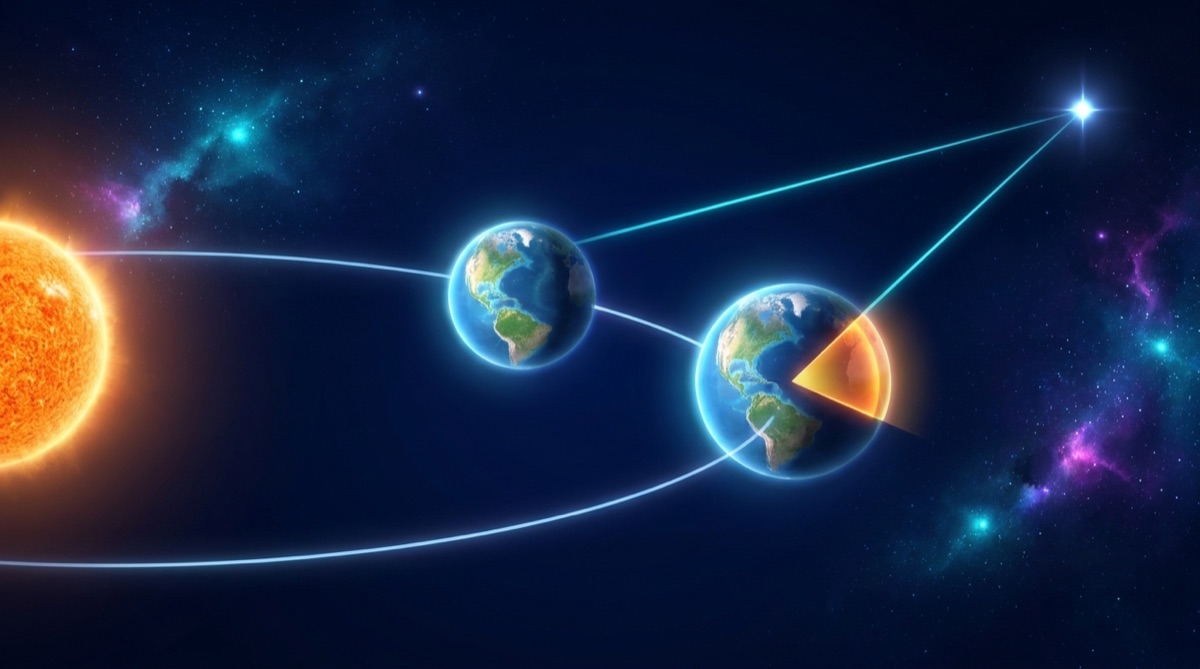
If tonight you see a bright star rise above the hill at exactly 8:00 p.m., tomorrow you will see it rise at 7:56, the day after at 7:52, and a month from now at 6:00. The stars gain 4 minutes a day on the clock. It is not that they run fast: it is that our clock does not measure the Earth’s turns but the passages of the Sun. This lesson is about the two clocks the Earth carries and the arithmetic that connects them.
1. Two ways of counting a day
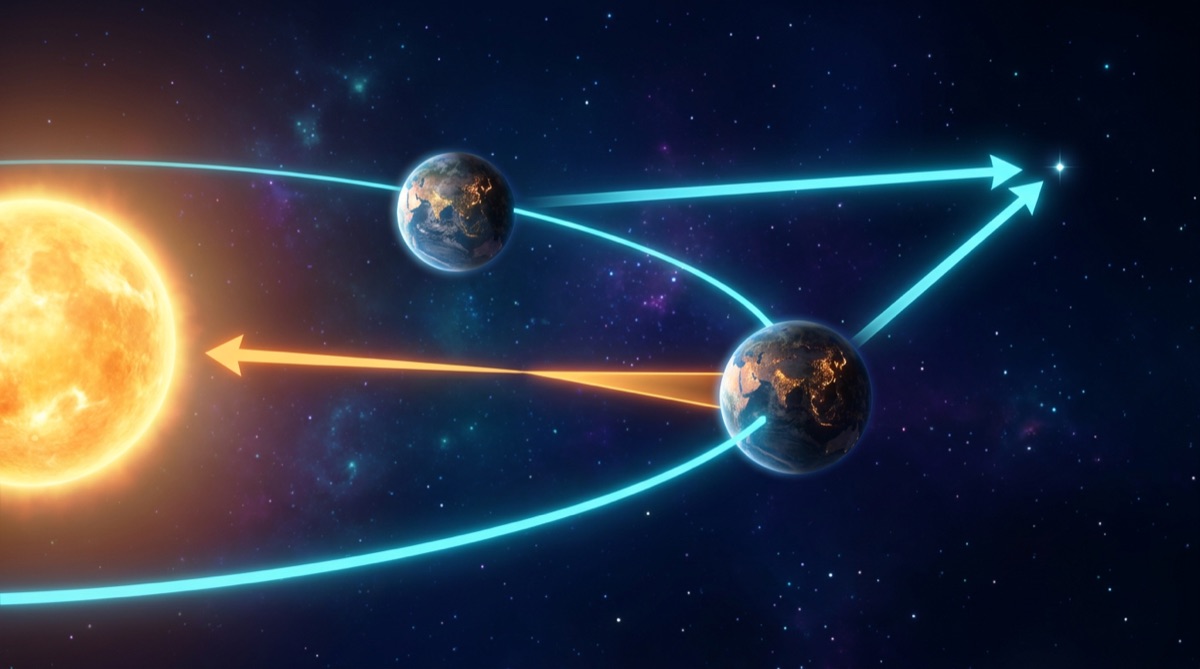
- Solar day: the time between two consecutive passages of the Sun across the meridian (from noon to noon). On average, exactly 24 h: it is the day of our clocks.
- Sidereal day: the time between two consecutive passages of a star across the meridian. It is the true turn of the Earth on its axis: 23 h 56 min 4.09 s (86 164.09 s, IERS).
Why do they not match? Because while the Earth turns, it also moves along its orbit. In one day it travels around the Sun. Seen from the Earth, that is the amount the Sun shifts eastward among the stars each day. After a full turn (one sidereal day) the star is back on the meridian, but the Sun has moved almost one degree: the Earth has to turn a little more to catch up with it.
How much time is that “little more”? The Earth turns 360° in 24 h, that is, 15° per hour or 1° every 4 minutes:
That is why the sidereal day is . A star that crosses the meridian today at a certain time will do so tomorrow 3 min 56 s earlier.
366.25 turns in a year
A year has 365.25 solar days (hence the leap year every four years). How many turns does the Earth make on its axis in that time?
One more turn than solar days. The “extra” turn is the one the Earth makes around the Sun: in a year, the Sun steals exactly one meridian passage from the stars. Said with the daily 3 min 56 s: . After a year the stars have gained a full day and the sky of a given date repeats at the same time: that is why there are “December constellations” and “June constellations.”
2. Clock arithmetic: modulo 24

The hours on a clock repeat: after 23 comes 0. We say that hours are counted modulo 24: two times that differ by a multiple of 24 h show the same hour. It is written
The same happens with angles, modulo 360°: and . The two arithmetics are linked by the Earth’s rotation: , hence and .
Worked example 1: at what time does it culminate 61 days from now?
A star crosses the meridian today at 22:00. In days it will do so min h earlier: at (18:00, modulo 24). One day later, at 17:56; three months later (91 d, 359 min h), at 16:00, in daylight, invisible.
Worked example 2: backwards, with modulo
At what time did the same star culminate 200 days ago? It must have done so min h 8 min later: (of the next day). At 11 in the morning, in sunlight: it could not be seen.
Rule of thumb: 2 hours per month ( min). What is over your head today at 22:00 will be over your head at 20:00 next month.
3. Sidereal time: the clock of the stars

Astronomers use a clock that keeps sidereal time : it advances 24 “sidereal hours” for each sidereal day, and it is defined so that at every instant equals the right ascension of the stars that are crossing the meridian. Remember that is measured in hours (0 h to 24 h) eastward from the vernal point; the hour angle of an object, how long ago it crossed the meridian, is
If the star culminates; if h it is 90° toward the west; if h h, 90° toward the east, climbing.
A formula to compute it
The sidereal time at the Greenwich meridian, , in hours, is obtained with a linear formula (USNO, equivalent to Meeus, eq. 12.4):
where is the number of days (it may be negative) from January 1, 2000 at 12:00 UT to 0:00 UT of the day in question, and is the universal time in decimal hours. The three numbers have a meaning: 6.6974 h was the Greenwich sidereal time at 0 h UT on January 1, 2000; 0.065710 h = 3.94 min is the daily gain, and 1.002738 is the solar day/sidereal day ratio ().
The local sidereal time of a place at longitude (positive to the east, negative to the west) is
Worked example 3: Bogotá, October 29, 2026, 20:00
Colombia’s legal time is UTC , so 20:00 on the 29th is 01:00 UT on October 30.
- Days from January 1, 2000 at 0:00 to October 30, 2026 at 0:00: 26 years with 7 leap years (2000, 2004, …, 2024) give ; from January 1 to October 30, 2026 there are 302 days. Total 9799; since the reference is at 12:00, .
- h. Modulo 24: h h 33 min.
- Bogotá: , h. h 22 h 37 min.
At 8 p.m. on October 29, the stars on the meridian of Bogotá are those with right ascension h 37 min (the constellation Aquarius and, a little farther south, Fomalhaut, h 58 min). The planisphere shows the local sidereal time in its footer: check it.
4. Legal time, solar time and the equation of time

The meridian of Colombian time
By Decree 2707 of 1982, Colombia’s legal time (its official standard time) is “that of Coordinated Universal Time, UTC, reduced by 5 hours.” Since , the Colombian clock shows the mean solar time of the 75° W meridian, which passes near Medellín (75.56° W). At any other longitude the Sun reaches the meridian at a different time, 4 minutes for every degree:
| City | Longitude W | Mean solar noon | |
|---|---|---|---|
| Leticia | 69.94° | −5.06° | 11:40 |
| Cúcuta | 72.51° | −2.49° | 11:50 |
| Bogotá | 74.07° | −0.93° | 11:56 |
| Barranquilla | 74.80° | −0.20° | 11:59 |
| Medellín | 75.56° | +0.56° | 12:02 |
| Cali | 76.52° | +1.52° | 12:06 |
Leticia, the easternmost, sees the Sun at its highest 26 minutes before Cali.
The equation of time
But the real Sun is not punctual even on the 75° meridian. The true solar day does not always last 24 h: it varies by a few seconds over the year for two reasons: the Earth’s orbit is an ellipse (it moves faster in January), and the Sun moves along the ecliptic, tilted 23.4° to the equator, so its “eastward” progress is not uniform. The seconds add up and the true Sun runs ahead of or behind the mean Sun by up to a quarter of an hour. The difference is called the equation of time:
| Approximate date | The real Sun… | |
|---|---|---|
| February 11 | −14 min 15 s | runs behind (later solar noon) |
| April 15 | 0 | on time |
| May 14 | +3 min 41 s | runs ahead |
| June 13 | 0 | on time |
| July 26 | −6 min 30 s | runs behind |
| September 1 | 0 | on time |
| November 3 | +16 min 25 s | runs ahead |
| December 25 | 0 | on time |
is the sum of two waves: one with a period of half a year (due to the axial tilt, amplitude 9.87 min) and another with a period of one year (due to the ellipse, amplitude 7.66 min). If you photograph the Sun every day at the same legal time, its positions trace an elongated figure 8, the analemma: the long axis is the declination (the seasons) and the width, .
Worked example 4: at what time is solar noon in Bogotá?
True solar noon mean solar noon . In Bogotá (11:56):
- November 3: 11:40 (the Sun crosses the meridian 20 min before 12).
- February 11: 12:10.
A sundial in Bogotá runs between 20 min fast and 10 min slow depending on the time of year; to read the legal time you have to subtract and add the 3.7 min of longitude.
Simulator: two clocks on the planisphere
The planisphere shows the local sidereal time and the altitude of the Sun in its footer.
- Choose Bogotá and set the local date and time to 2026-10-29 20:00. Read the local sidereal time: it should read ≈ 22 h 37 min, as in example 3. Identify which stars lie on the north–south line through the center (the meridian).
- Advance the date by one day (October 30), same time. The sidereal time has gone up by 3 min 56 s and the stars have shifted a little toward the west (the right).
- Now set October 30 at 19:56. The sky is identical to that of step 1: exactly one sidereal day has passed.
- Set November 29 at 18:00: the sidereal time is almost the same as in step 1 (one month = 2 h). What difference remains? (Hint: a 31-day month is 31 × 3.94 min = 122 min, not 120.)
- Set 2027-10-29 20:00, one year later: same sky, same sidereal time (with 1 min of difference due to the quarter day of the year).
- Change the place to Leticia without changing the time: the sidereal time increases by h min, because Leticia is farther east and “runs ahead” in the rotation.
Activity: timing the Earth’s turn with a star
You need: a phone with a clock showing seconds (synchronized with legal time), a fixed observation spot (a window, a corner) and a fixed landmark (the edge of a building, a pole), a notebook, and at least five clear nights in a row.
- Choose a bright star that, from your fixed spot, is about to disappear behind the landmark (or to appear from behind it). Always rest your head in the same place: precision depends on not moving.
- Write down the exact time (with seconds) at which the star disappears behind the edge. That is your homemade “culmination.”
- Repeat on the following nights, starting about 10 min before the previous time. Write down the date and time each time.
- Make a table with the night number (0, 1, 2, …) and the time in decimal minutes. Calculate the difference between consecutive nights and its average.
- Plot time against : it should come out as a straight line. Its slope is the daily gain; compare it with −3.94 min/day and calculate the percentage error. With the slope, predict the time on night 30 and check it if you can.
Final question: if your average gives −4.3 min/day instead of −3.94, what sources of error can you think of (head moved, clock, judging the instant)? How many nights would you need so that an error of ±20 s per reading does not affect the result by more than 1%?
Exercises
Basic
- Convert: (a) 5 h 20 min to degrees; (b) 200° to hours and minutes; (c) 3 min 56 s to degrees.
Show solution
(a) . (b) h h 20 min. (c) min .
- Sirius culminates today at 23:30. At what time will it culminate in 15 days? And in 45 days?
Show solution
min: 22:31. min h 57 min: 20:33.
- Calculate , , .
Show solution
(a) 6. (b) 17. (c) 5°.
Intermediate
- The local sidereal time is 4 h 30 min. Calculate the hour angle of Aldebaran ( h 36 min) and of Vega ( h 37 min). Which one has just risen and which one is about to culminate?
Show solution
Aldebaran: min: it culminates in 6 minutes. Vega: h 7 min h 53 min: it crossed the meridian almost 10 h ago; it is in the west, close to setting (from Bogotá, where Vega spends about 13 h above the horizon, it will already have set).
- Calculate the local sidereal time of Cali ( W) on January 1, 2027 at 0:00 legal time (05:00 UT). Hint: for January 1, 2027 is .
Show solution
h. Cali: h h 37 min. At midnight on New Year’s, Orion ( h) has just passed the meridian and Sirius ( h 45 min) is about to culminate.
- A sundial is installed in Cúcuta ( W). What legal time does it show at solar noon on November 3? And on February 11? And on September 1?
Show solution
Mean noon: min . Nov 3: . Feb 11: . Sep 1: , 11:50.
Challenge
- Mars. Its sidereal rotation lasts 24.6229 h and its year 686.980 Earth days. Calculate the length of the Martian solar day (the sol) with the same reasoning as in section 1 and compare it with NASA’s value, 24.6597 h.
Show solution
Sidereal turns per Martian year: . Solar days . Solar day h h 39 min 36 s. NASA: 24.6597 h. ✓ (General equation: , the same one that relates the Moon’s synodic and sidereal months.)
- Venus spins backwards: sidereal rotation h (243 days) and year 224.701 d h. Use with the negative sign and calculate how long a solar day lasts on Venus. Compare with NASA (2802 h) and explain why the Sun rises in the west there.
Show solution
h⁻¹, hence h Earth days (NASA: 2802.0 h). The negative sign indicates that the Sun crosses the sky backwards: it rises in the west. Since the rotation and the orbital motion go in opposite directions, their effects add and the solar day (117 d) is shorter than the rotation (243 d).
- Prove with algebra that if a planet makes sidereal turns in a year, it has exactly solar days, provided it spins in the same direction in which it orbits.
Show solution
Let be the year, the rotation and the solar day. In one year the planet turns times with respect to the stars, but the direction of the Sun has also made one full turn in the same direction; with respect to the Sun, the planet has turned times, and each of those is a solar day: . Dividing by : .
✦ Mini-quiz
Key takeaways
- Solar day 24 h; sidereal day 23 h 56 min 4 s. The difference, 3 min 56 s, is the degree the Earth advances along its orbit each day ( min).
- 365.25 solar days 366.25 sidereal days: one more turn, the orbital one.
- Hours modulo 24, angles modulo 360: . The stars gain 4 min/day, 2 h/month, 24 h/year.
- Local sidereal time = right ascension of whatever is culminating; . Formula: , and .
- Colombia: UTC−5 (Decree 2707 of 1982), meridian 75° W. Mean solar noon , minus the equation of time (between −14 and +16 min).
🍎 Teacher guide
- Time
- 2 sessions of 55 min
- Colombian national standard (MEN)
- Mathematics, Grades 8 to 9, numerical thinking: “I use real numbers in their different representations and in various contexts” and “I solve problems and simplify calculations using properties and relations of the real numbers and of the relations and operations among them”; spatial thinking: “I use geometric representations to solve and formulate problems in mathematics and in other disciplines”; variational thinking: “I identify relations between properties of graphs and properties of algebraic equations”. Natural Sciences, Grades 8 to 9: “I use mathematics as a tool to model, analyze and present data”; “I take measurements with instruments suited to the characteristics and magnitudes of the objects under study and express them in the corresponding units”; “I record my observations and results using diagrams, graphs and tables”.
- Evidence of learning
- Explains with a drawing of the orbit why the sidereal day is 3 min 56 s shorter than the solar day, proves the 366.25 yearly turns, predicts with modulo-24 arithmetic the culmination time of a star weeks later, computes the local sidereal time of a Colombian city with the formula and verifies it on the planisphere, corrects the reading of a sundial with the longitude and the equation of time, and obtains the daily gain of the stars from their own series of observations.
Materials
- Calculator
- Computer or tablet with the planisphere
- Globe or ball and lamp for the rotation + orbit model
- Phone with a seconds clock and notebook for the nighttime activity
- Printed table of the equation of time
Suggested sequence
Session 1. The two clocks (55 min). Opening: the hook question and the ball–lamp model with an “extra degree” (10 min). Development: section 1 (3 min 56 s and 366.25 turns, with the calculation on the board) and section 2 with examples 1 and 2 of modular arithmetic (25 min). Simulator, steps 1–5 (10 min). Closing: exercises 1–3 (10 min). Homework: start the nighttime activity.
Session 2. Sidereal time and Colombian time (55 min). Opening: at what time is noon in Leticia and in Cali? (5 min). Development: section 3 with example 3 step by step (the count is a good calendar exercise) and verification on the planisphere; section 4 with the table of cities and the equation of time (30 min). Exercises 4 and 6 in groups (10 min). Closing: mini-quiz (10 min). Challenges 7–9 link to the lesson on phases (synodic and sidereal months) and to Grade 9.
Common mistakes
- Believing that the Earth takes 24 h to make one turn. Do the model with the ball: one full turn and then the “extra degree” until it faces the lamp again.
- Adding the 3 min 56 s instead of subtracting them (the stars gain, they do not lose). Check with two real nights or with the simulator, steps 2 and 3.
- Operating with hours and minutes as if they were decimals (22:30 + 1.5 ≠ 23:80). Convert to minutes or decimal hours before operating and apply the modulo at the end.
- Thinking that clock noon is the Sun's noon. Use the table of cities and the equation of time; measure the shortest shadow in the schoolyard.
- Mixing up east/west longitude when adding λ/15. Fix the convention (east positive) and check with step 6 of the simulator: Leticia, farther east, runs ahead.