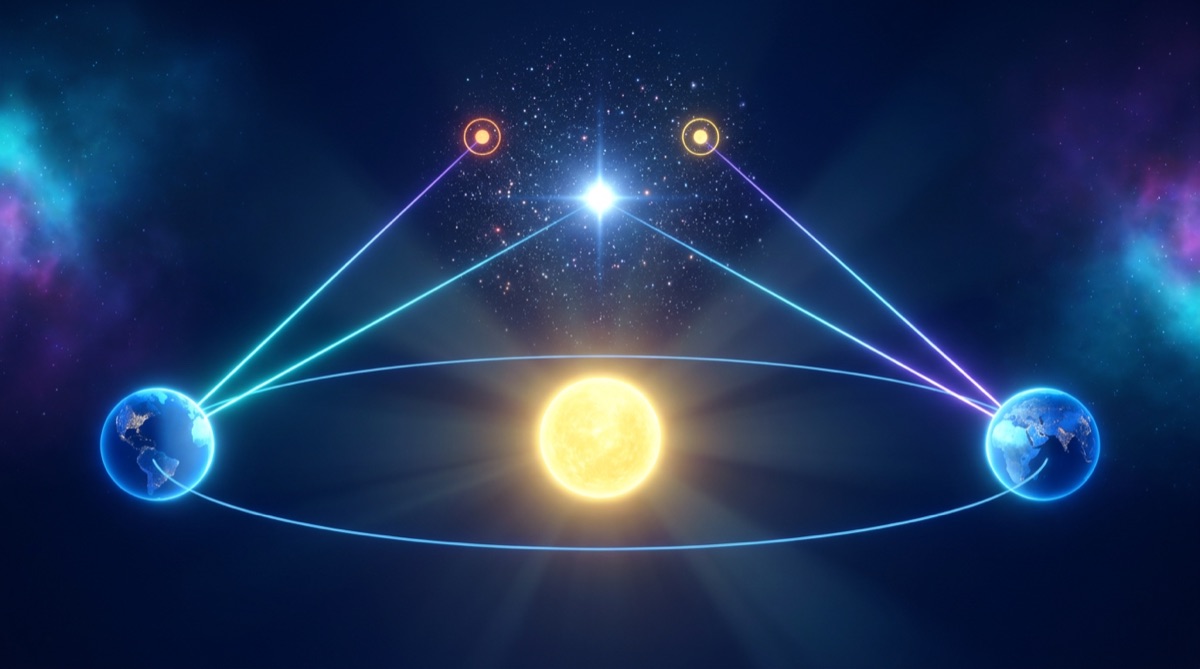
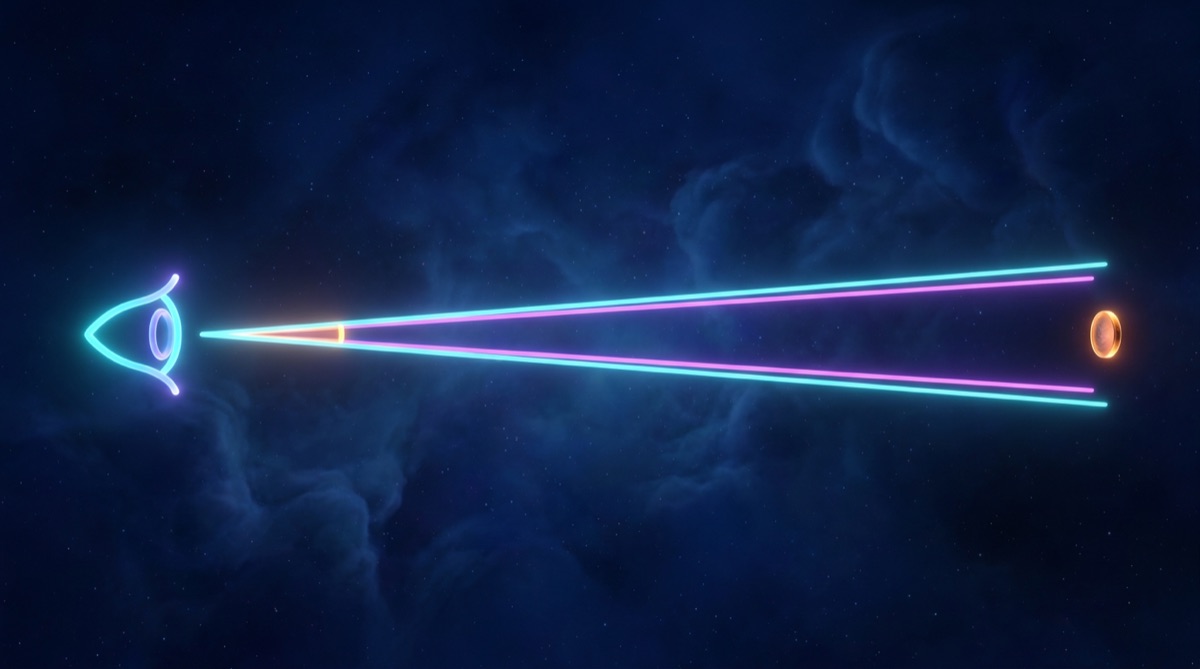
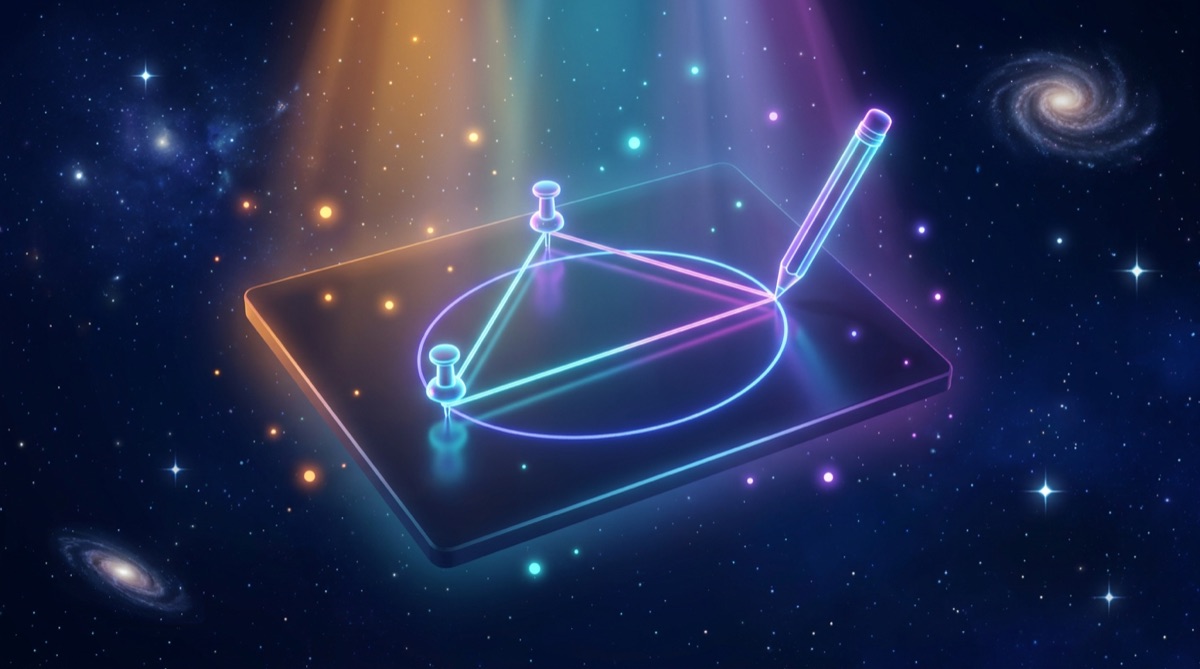
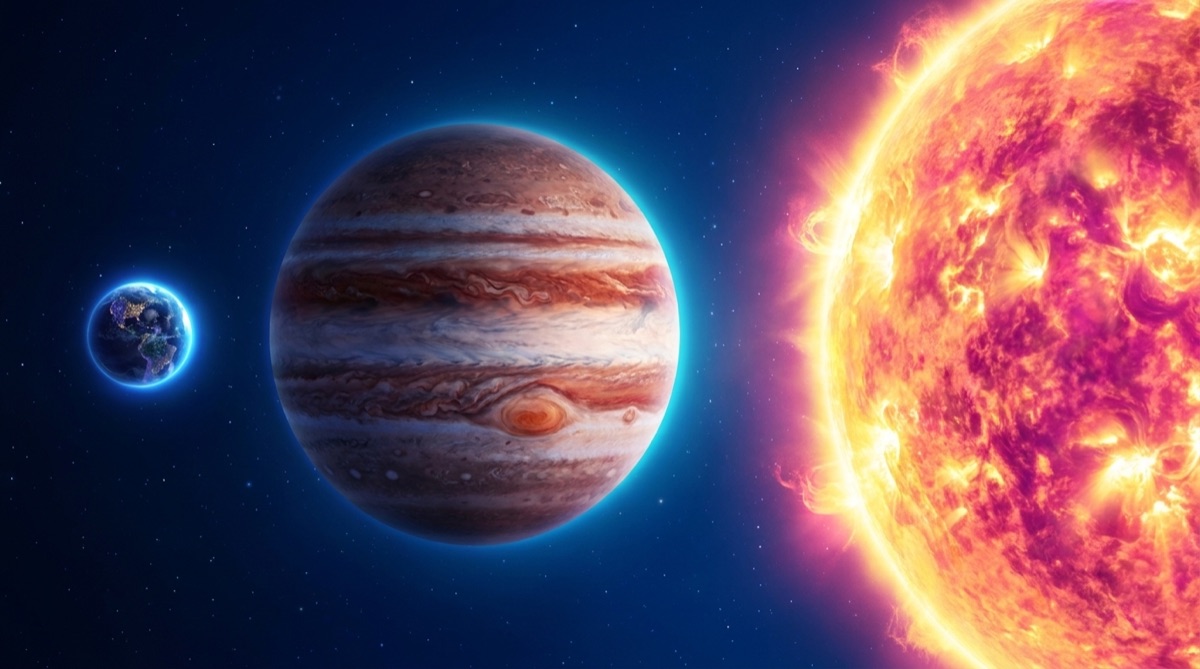
Hold a finger in front of your face, arm outstretched. Close your left eye, then your right. The finger “jumps” against the background. That jump is called parallax, and it is the most direct method there is for measuring the distance to a star: all it needs is a triangle and a little trigonometry. With it we are going to calculate, with real figures from the Gaia mission, how far away the nearest star to the Sun is.
1. Trigonometric ratios

In a right triangle with an acute angle , we call the side facing the opposite leg, the side that forms the angle together with the hypotenuse the adjacent leg, and the longest side the hypotenuse:
These ratios depend only on the angle, not on the size of the triangle (all right triangles with the same are similar). That is why a calculator can tabulate them. The tangent is the queen of distances: if we know one leg and one angle, we get the other leg.
Triangulation on Earth
Worked example 1: the height of a building. From away from the base you measure an elevation angle up to the roof, with your eyes above the ground:
Worked example 2: the distance to a hill. For something out of reach you use a baseline. From point you look at the hill; you walk perpendicular to that direction a distance to point and measure the angle between the direction to and the direction to the hill. Then . With and :
But if you are off by one degree and measure , you get : 33 % less! The farther away the object, the “narrower” the triangle and the more angular precision you need. This is exactly the problem with the stars.
2. The parallax triangle
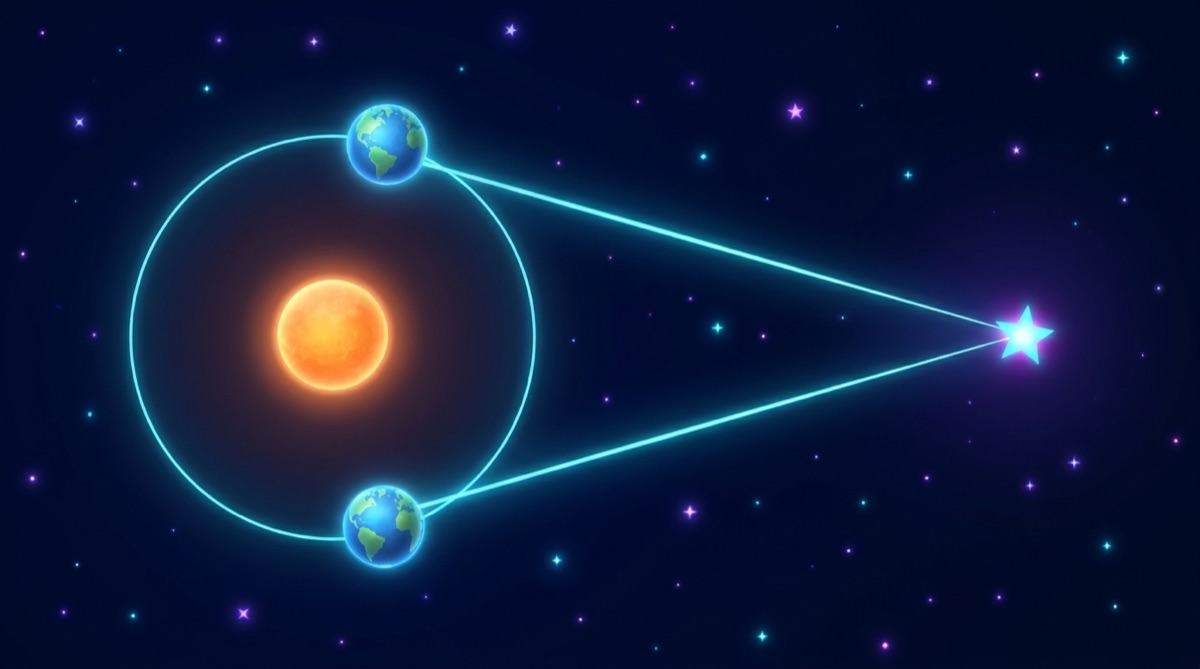
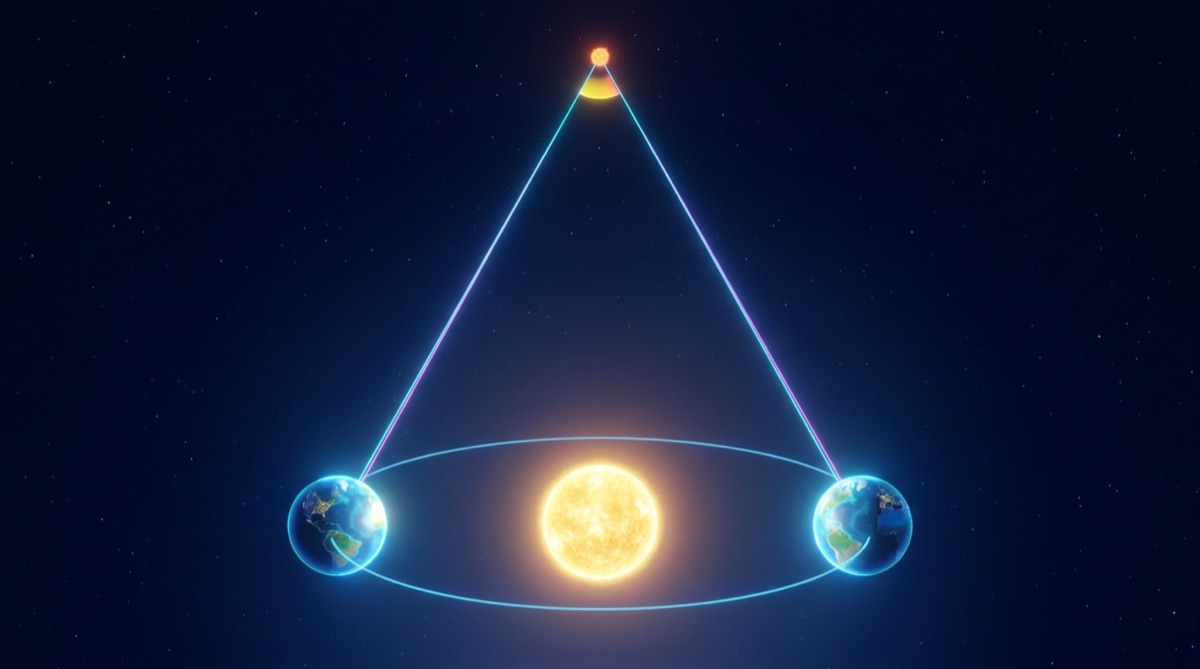
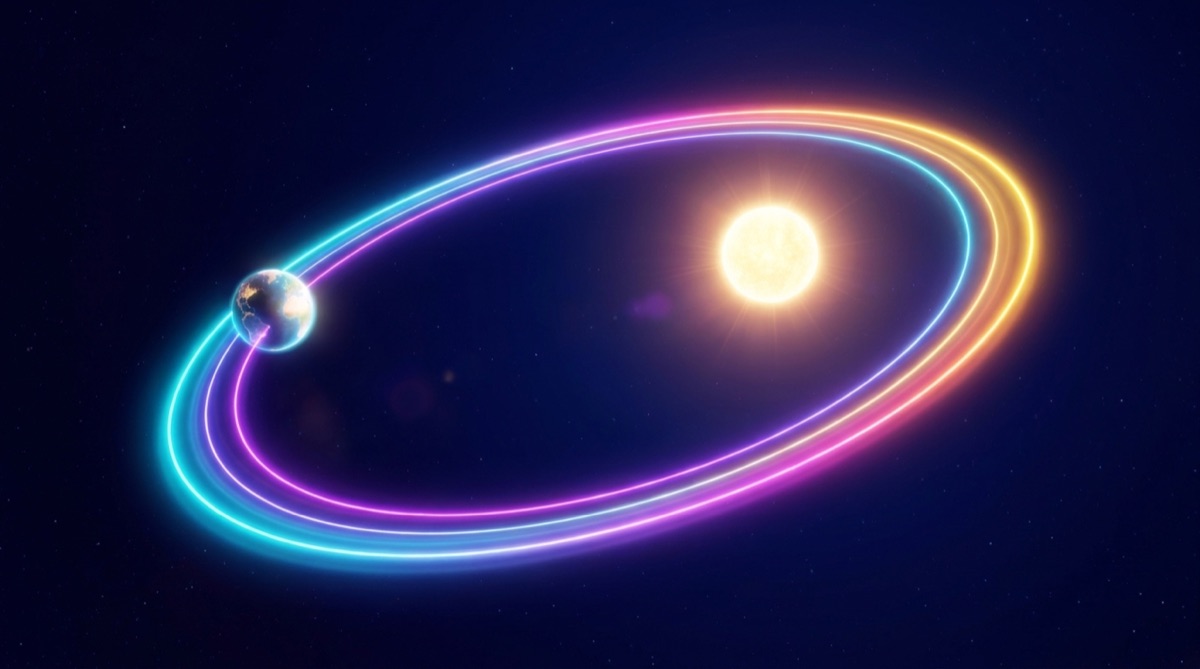
The Earth goes around the Sun at (astronomical unit, ). If we observe a nearby star in January and again in July, we see it from two points separated by 2 au: that is our baseline, the longest we can get without leaving the Solar System. The star appears to shift against the background of much more distant stars.
The annual parallax is defined as the angle under which the radius of the Earth’s orbit (1 au) would be seen from the star. In the right triangle Sun–Earth–star, with the right angle at the Sun:
where is the distance from the Sun to the star. The total shift between January and July (in the best case) is .
Simulator: the triangle seen from above and through the telescope
On the left, the geometry (not to scale); on the right, what you would see through the telescope: the nearby star traces a small ellipse against the fixed background.
- Choose Proxima Centauri and exaggeration 1: nothing can be seen. Raise the exaggeration until the ellipse appears and write down the factor you needed.
- Change the distance: how does the size of the ellipse change when you double ? (Prediction: it halves, because .)
- With (star on the plane of the Earth’s orbit) the ellipse flattens into a segment; with it is a circle. In general its semi-axes are and , where is the ecliptic latitude.
- Choose Betelgeuse and compare the instruments: could the eye measure it? Hipparcos? Gaia?
Measurable with error ≤ 20 %? naked eye (~1′): no · Hipparcos (~1 mas): yes · Gaia (~tens of µas): yes
Precisions as approximate orders of magnitude (naked eye 60″, Hipparcos 1 mas, Gaia 20 µas). Preset distances are rounded. 1″ = 4.85×10^-6 rad.
3. Small angles: why and how much error we make
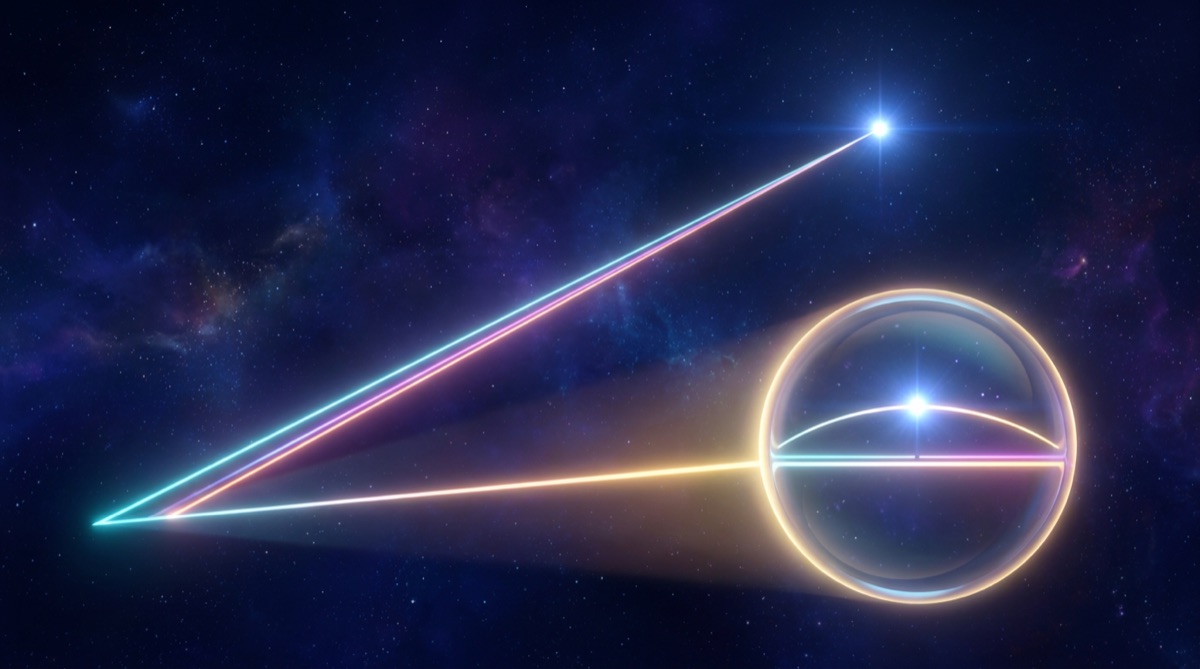
Stellar parallaxes are tiny: all of them are smaller than 1″ (one arcsecond, of a degree). For angles like these there is a shortcut: measured in radians, . Remember that , so and .
| Angle | In radians | Relative error | ||
|---|---|---|---|---|
| 10° | 0.174533 | 0.176327 | (1 %) | |
| 5° | 0.087266 | 0.087489 | ||
| 1° | 0.017453 | 0.017455 | ||
| 1′ | ||||
| 1″ |
The last column shows the rule: for small , , so the relative error of the approximation is . It shrinks 100 times every time the angle gets 10 times smaller. For a stellar parallax, the error is one part in one hundred billion, vastly smaller than any measurement error. That is why we write
Worked example 3. Up to what angle can you use if you accept an error of 0.1 %? We require , that is, .
4. The parsec
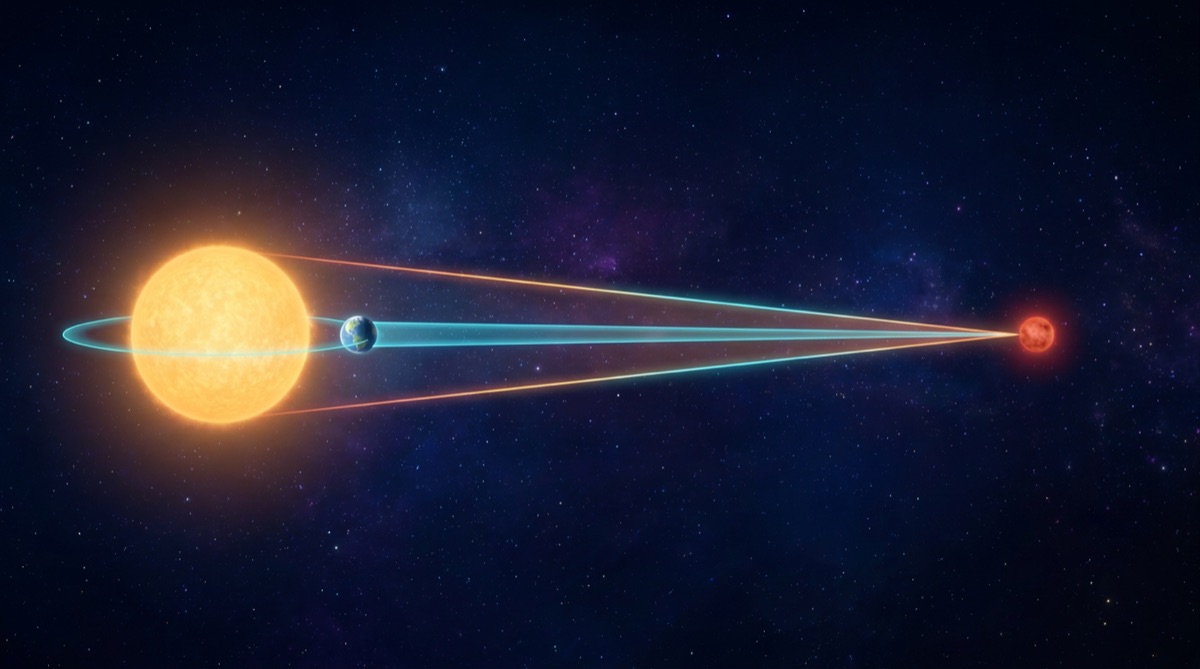
If is measured in arcseconds, and
Astronomers define a unit that makes this calculation trivial: the parsec (from “parallax of one second”), the distance at which 1 au subtends exactly 1″:
And then the formula takes its most famous form:
Worked example 4: Proxima Centauri. The Gaia DR3 catalog gives, for the nearest star to the Sun, milliarcseconds (mas), that is, . Then
Not even the nearest star reaches a parallax of 1″: that is why no parsec “fits” inside the solar neighborhood.
Propagating the error
If has an uncertainty , how much does have? Since , a 1 % increase in reduces by (almost) 1 %: the relative error is preserved,
For Proxima, , so : the distance to the nearest star is known to four reliable figures. For a star with and the same , the relative error would be 5 %; with , 50 %, and the distance hardly means anything anymore. The parallax method only works for relatively nearby stars; beyond them, other “rungs” of the distance ladder are needed.
5. A bit of history: Bessel and 61 Cygni
Since Aristotle, the lack of observable parallax had been used as an argument against the motion of the Earth. Astronomers searched for it for centuries without success: the angle was too small for their instruments. In 1838, Friedrich Wilhelm Bessel published the first reliable stellar parallax, for the star 61 Cygni: , that is, . At almost the same time, Thomas Henderson measured α Centauri and Friedrich Georg Wilhelm Struve measured Vega.
Bessel chose 61 Cygni because it had a large proper motion (it moves more than 4″ per year across the sky), a clue that it had to be close. Today, Gaia DR3 measures for 61 Cyg A (): Bessel was off by 10 %, an extraordinary achievement with the instruments of 1838. The Hipparcos satellite (the ’90s, precision of the order of 1 mas) measured about one hundred thousand stars, and Gaia (precision of tens of microarcseconds for bright stars) more than one billion; both figures are orders of magnitude.
Activity: the homemade quadrant
Materials: a protractor, a drinking straw, string, a nut, adhesive tape, a tape measure.
- Tape the straw along the straight edge of the protractor and hang the string with the nut from the center. You now have a quadrant: when you look through the straw, the string marks the angle.
- Calibrate it by aiming at something horizontal: the reading should correspond to of elevation (depending on how you taped the straw, the elevation angle is the reading or minus the reading).
- Choose a tall object at school (a pole, the building). Measure with the tape the horizontal distance from where you stand to its base and the height of your eyes .
- Aim at the top and read the angle . Calculate .
- Repeat from another distance (twice as far, for example) and compare the two results.
Final question: how much do your two heights differ? If your quadrant has an error of , how much does change in each case? From which distance is the measurement better, near or far? Relate it to what happens with the stars.
Exercises
Basic
- From 20 m away from a tree you measure an elevation angle of 40°, with your eyes at 1.6 m. How tall is the tree?
Show solution
.
- Convert to radians: 1°, 0.5° and 1″.
Show solution
rad; rad; rad.
- A star has . How many parsecs and light-years away is it?
Show solution
light-years.
Intermediate
- Sirius is about 2.64 pc away. What is its parallax in arcseconds and in milliarcseconds?
Show solution
.
- Show that starting from rad.
Show solution
. The approximation introduces an error of , negligible.
- Use the rule: up to what angle (in degrees) can you use if you accept an error of 1 %?
Show solution
: up to about 10°, as the table shows.
Challenge
- If an instrument measures parallaxes with an uncertainty of 1 mas, out to what distance can it measure with a relative error of 10 %? And Gaia, with 0.05 mas?
Show solution
We need , that is, : . With mas, mas and , twenty times farther.
- In the hill example, explain why an error of 1° changes the distance so much. Relate it to what happens with distant stars.
Show solution
The angle that really matters is the parallax angle of the hill, : 2° or 3°. An error of 1° is 33–50 % of that angle, and the distance inherits that relative error. For the stars, the parallaxes are so small that milliarcsecond precision is needed for to be acceptable.
- A student says: “If I observe a star in January and in July and see no change, the Earth does not move.” Write an argument with numbers for why that conclusion is wrong if they use only their eyes (resolution ≈ 1′).
Show solution
The nearest star has , a total shift of , about 40 times smaller than the resolution of the eye (). Not seeing the change with the naked eye proves nothing: instruments are needed (Bessel needed a heliometer and months of measurements for 0.31″).
✦ Mini-quiz
Key takeaways
- : with one leg and one angle you get the other leg.
- Parallax: ; for small angles (radians) with relative error .
- light-years, and .
- Proxima Centauri: mas (Gaia DR3) pc light-years.
- The relative error of is that of : parallax only works for nearby stars.
🍎 Teacher guide
- Time
- 3 sessions of 55 min
- Colombian national standard (MEN)
- Mathematics, Grades 10 to 11, spatial thinking: “I use geometric arguments to solve and formulate problems in mathematical contexts and in other sciences”; metric thinking: “I design strategies to approach measurement situations that require specific degrees of precision” and “I justify results obtained through processes of successive approximation, ranges of variation and limits in measurement situations”; numerical thinking: “I establish relations and differences between different notations of real numbers in order to decide on their use in a given situation”. Natural Sciences, Grades 10 to 11, I approach knowledge as a natural scientist: “I take measurements with appropriate instruments and equipment” and “I interpret the results taking into account the order of magnitude of the experimental error”.
- Evidence of learning
- Measures a height with the quadrant and estimates its error, derives d = 1 au / tan p, justifies tan p ≈ p with the table and the x²/3 rule, converts between pc, au and light-years, and calculates the distance to Proxima Centauri with its uncertainty from the Gaia DR3 parallax.
Materials
- Protractor, drinking straw, string, nut and adhesive tape per group
- Tape measure of 20 m or more
- Scientific calculator (radian and degree modes)
- Computer or tablet with the simulator
Suggested sequence
Session 1. Trigonometry and triangulation (55 min). Opener with the finger in front of the face (5 min). Review of trigonometric ratios and examples 1 and 2, with emphasis on the effect of a 1° error (20 min). Quadrant activity in the schoolyard in groups (30 min); each group measures from two distances.
Session 2. The parallax triangle and small angles (55 min). Sharing the quadrant results (10 min). Sun–Earth–star triangle and guided simulator challenge (20 min). Small-angle table: students calculate two rows on the calculator and verify the rule (15 min). Exercises 2 and 6 (10 min).
Session 3. The parsec and Proxima Centauri (55 min). Definition of the parsec and example 4 with the Gaia value; error propagation and the limit of the method (25 min). Bessel’s story (5 min). Exercises 3, 4 and 7 (15 min) and mini-quiz (10 min). Challenges 8 and 9 as homework.
Common mistakes
- Using the calculator in degrees when applying tan x ≈ x. The approximation only holds in radians: review the conversion with the table.
- Confusing p with the total shift 2p between January and July.
- Believing that the parallax ellipse is the orbit of the star. It is a perspective effect caused by the motion of the Earth.
- Thinking that “not seeing parallax with the naked eye” refutes the motion of the Earth (exercise 9).
- Forgetting to add the height of the eyes when using the quadrant.