Glossary / O / Measuring the universe
Order of magnitude
Also: orders of magnitude
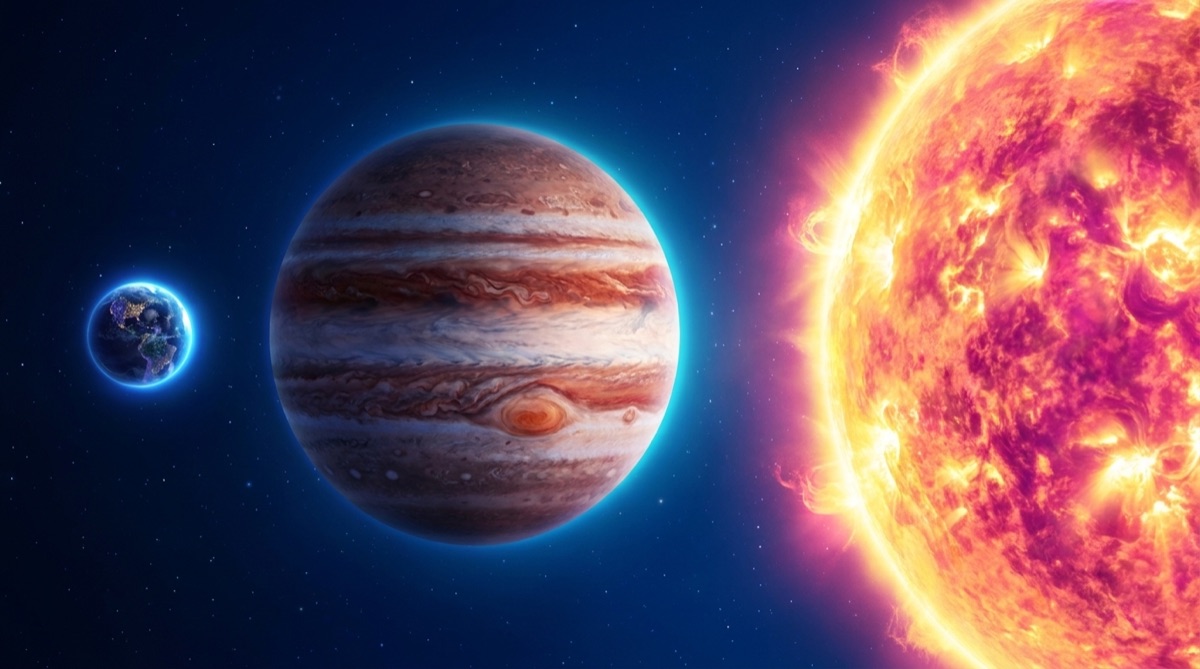
The power of ten closest to a number: saying "the Sun is a million times bigger than Earth" is talking in orders of magnitude. It is used to compare very different things without being exact.
Going further
Two quantities differ by orders of magnitude if their ratio is approximately ; that is, rounded.
Where it is explained: Scientific notation and distances in the universe Secondary Education
Related terms
Used in these lessons
- Scientific notation and distances in the universe Secondary Education 8 mentions
- The Milky Way and other galaxies Secondary Education 6 mentions
- The H–R diagram Secondary Education 3 mentions
- The equations of stellar structure Higher Education 3 mentions
- Radiative and convective transport Higher Education 3 mentions
- Gravitational waves: from the quadrupole to GW150914 Higher Education 3 mentions
- Stellar nucleosynthesis and solar neutrinos Higher Education 2 mentions
- Precession, nutation, aberration and refraction Higher Education 2 mentions
- The lives of stars Secondary Education 1 mention
- The blackbody and the color of the stars Secondary Education 1 mention
- Parallax and trigonometry Secondary Education 1 mention
- The speed of light and the light-year Secondary Education 1 mention
- Eratosthenes measures the Earth Secondary Education 1 mention
- Polytropes and the Lane–Emden equation Higher Education 1 mention
- The Chandrasekhar limit Higher Education 1 mention
- Galactic potentials: Poisson, Plummer, Hernquist, isothermal and NFW Higher Education 1 mention
- Collisionless Boltzmann equation, Jeans equations and the virial theorem Higher Education 1 mention
- Bayesian inference and MCMC Higher Education 1 mention
- Symplectic integrators and chaos in the N-body problem Higher Education 1 mention
- Runge–Kutta and adaptive step size Higher Education 1 mention
- The precession of Mercury's perihelion Higher Education 1 mention