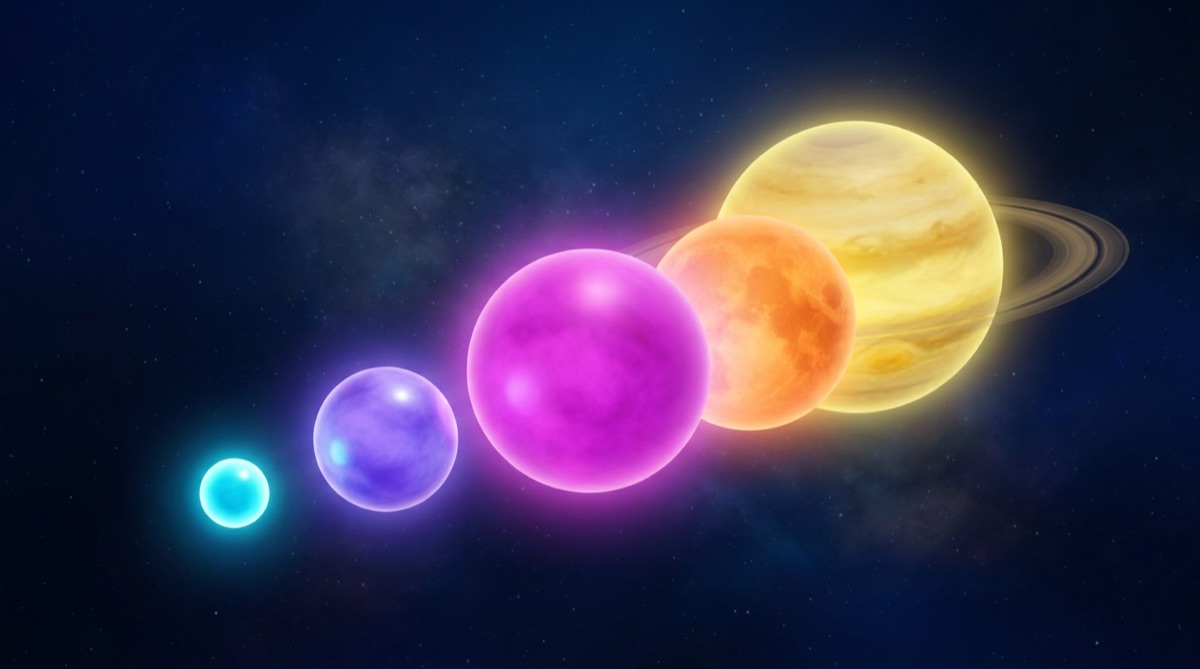
Nobody measures the distance from Bogotá to Cali in millimeters, or the thickness of a hair in kilometers. Every size has its convenient unit. The same happens in the universe: the kilometer works for the Moon, but for Neptune you already need billions, and for the nearest star, tens of trillions.
Astronomers use three bigger “rulers”: the astronomical unit for the Solar System, and the light-year and the parsec for stars and galaxies. All three have exact definitions, agreed on by the International Astronomical Union (IAU). We are going to get to know them and, above all, to convert between them.
1. Review: conversion factors

To go from one unit to another we multiply by a fraction that equals 1 because top and bottom are the same quantity, written in different units:
The unit we want to get rid of (h) appears once on top and once on the bottom, and it cancels. With astronomical distances we will do exactly the same, only the numbers go in scientific notation.
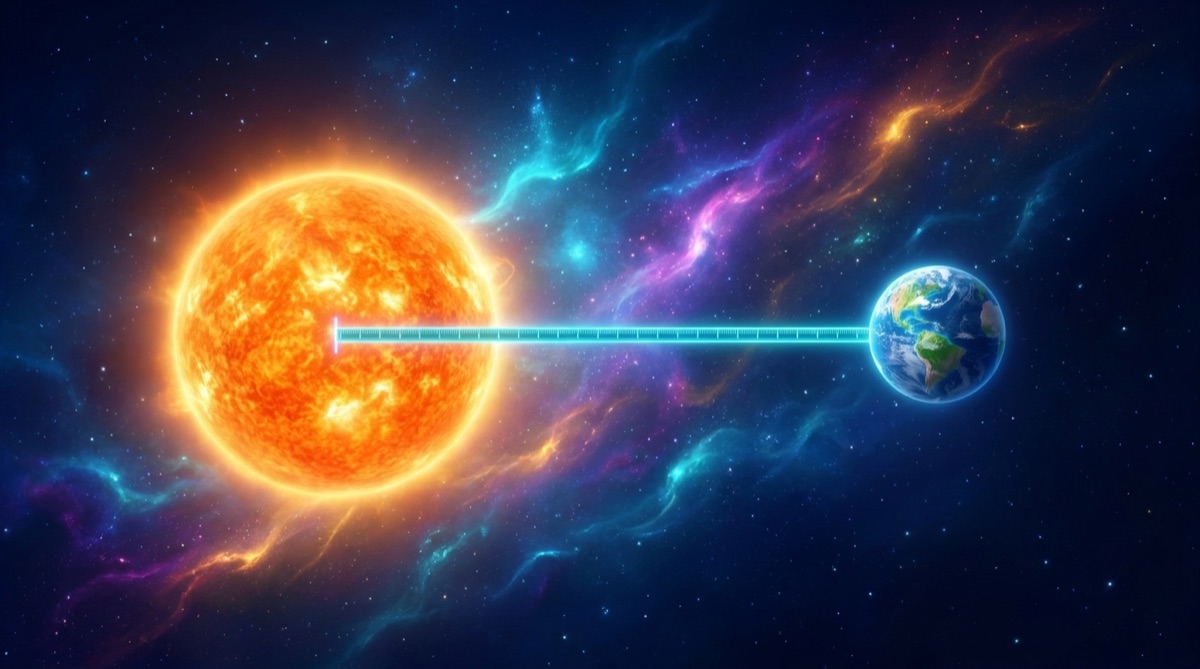
2. The astronomical unit (au)
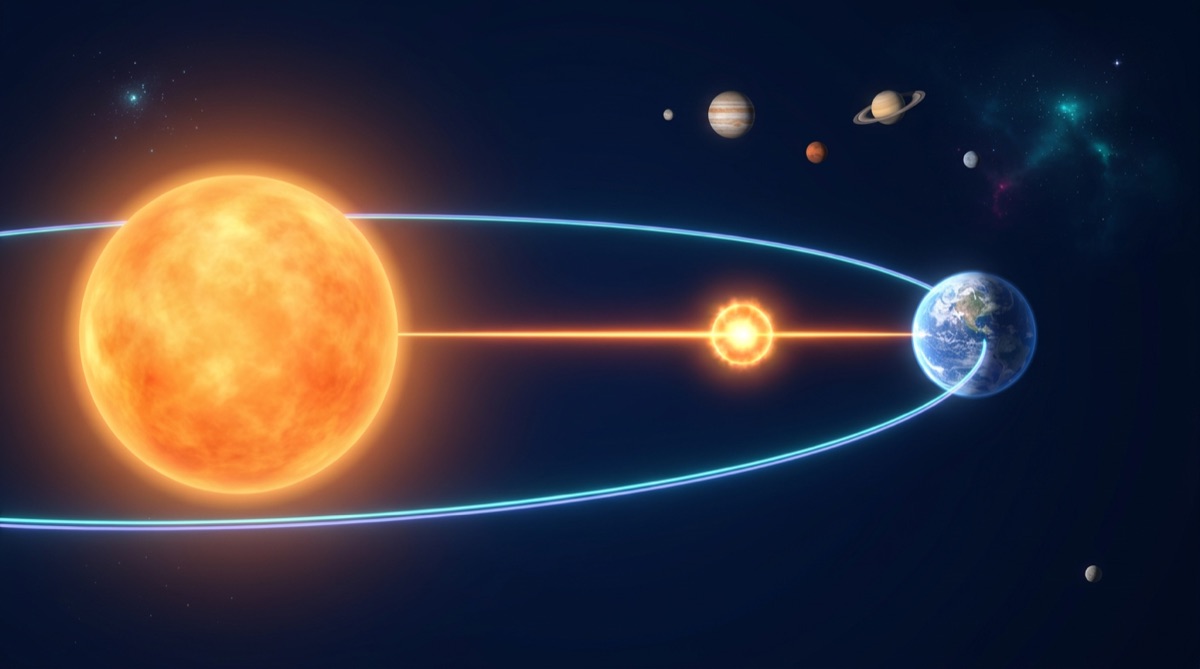
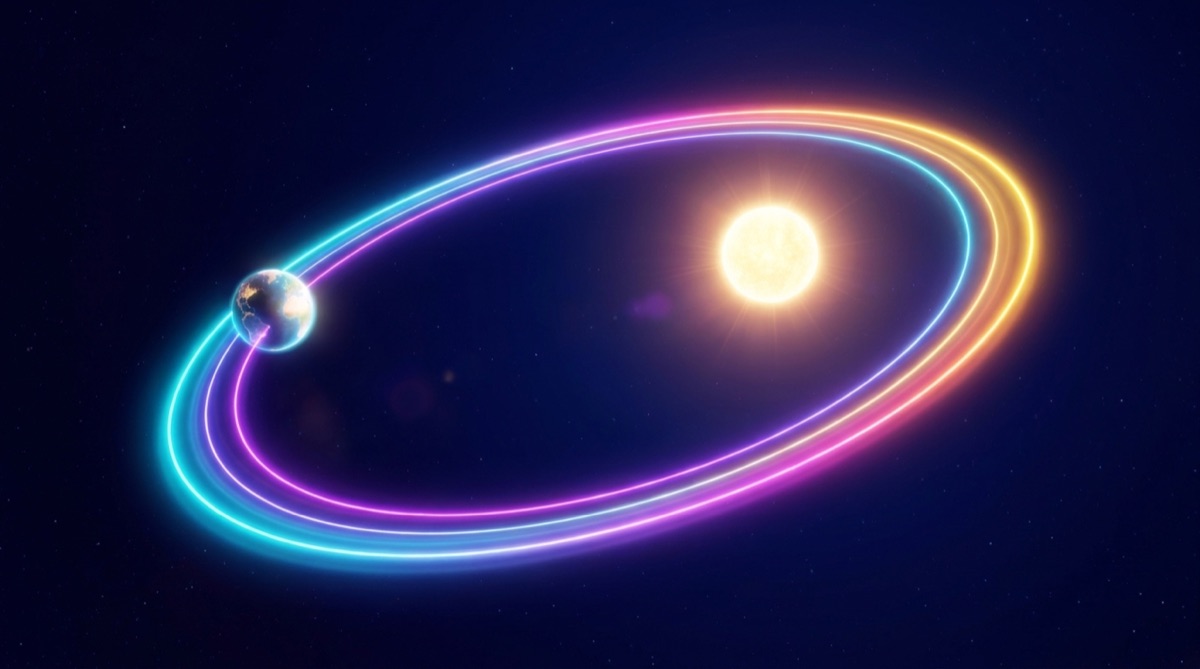
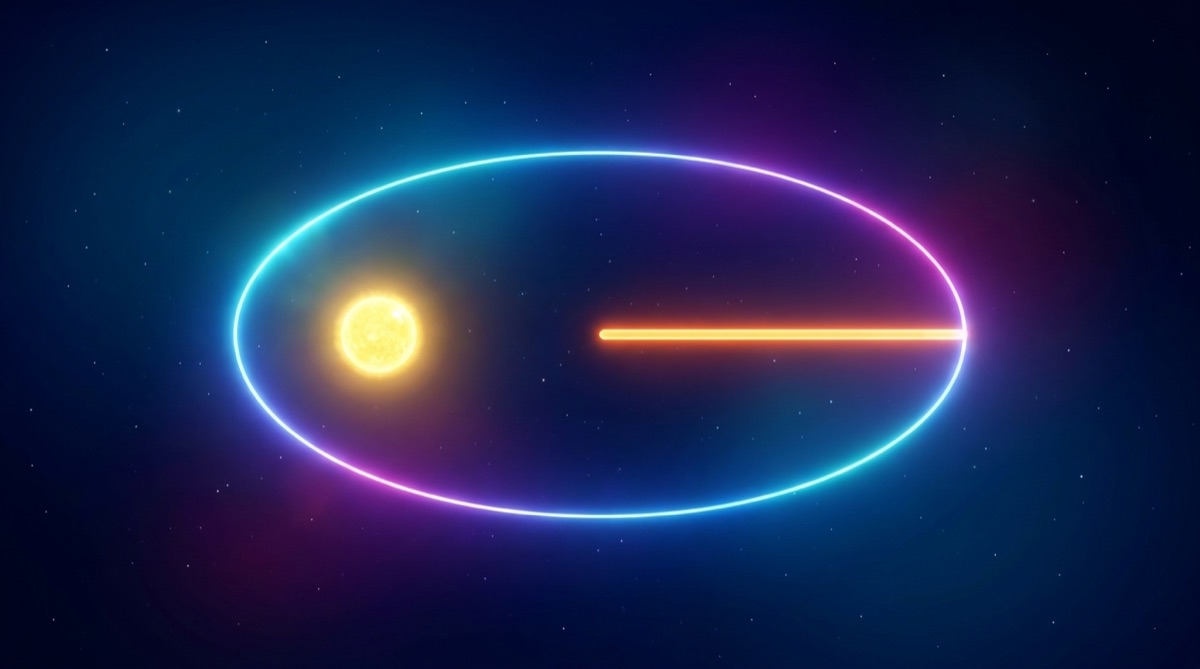
For centuries the astronomical unit was “the mean distance from the Earth to the Sun.” Since that distance is measured better and better and changes a little because of the shape of the orbit, in 2012 the IAU decided to fix it by definition:
It is the average Earth–Sun distance, rounded and declared exact. (In Spanish texts it is usually written “UA”; the IAU symbol is “au”.)
Light takes this long to cover 1 au:
The au is the ruler of the Solar System. Mean distances to the Sun (semi-major axis of each orbit):
| Planet | Mercury | Venus | Earth | Mars | Jupiter | Saturn | Uranus | Neptune |
|---|---|---|---|---|---|---|---|---|
| Distance (au) |
Worked example 1: Neptune in kilometers and in light time
Sunlight takes hours to reach Neptune.
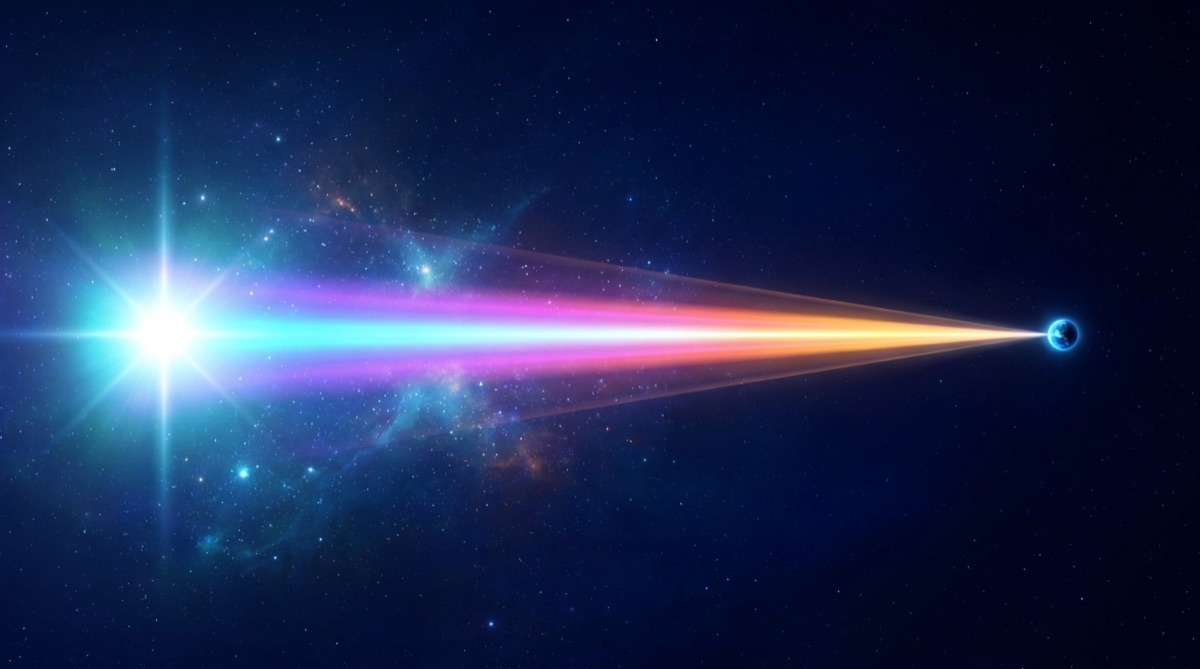
3. The light-year (ly)
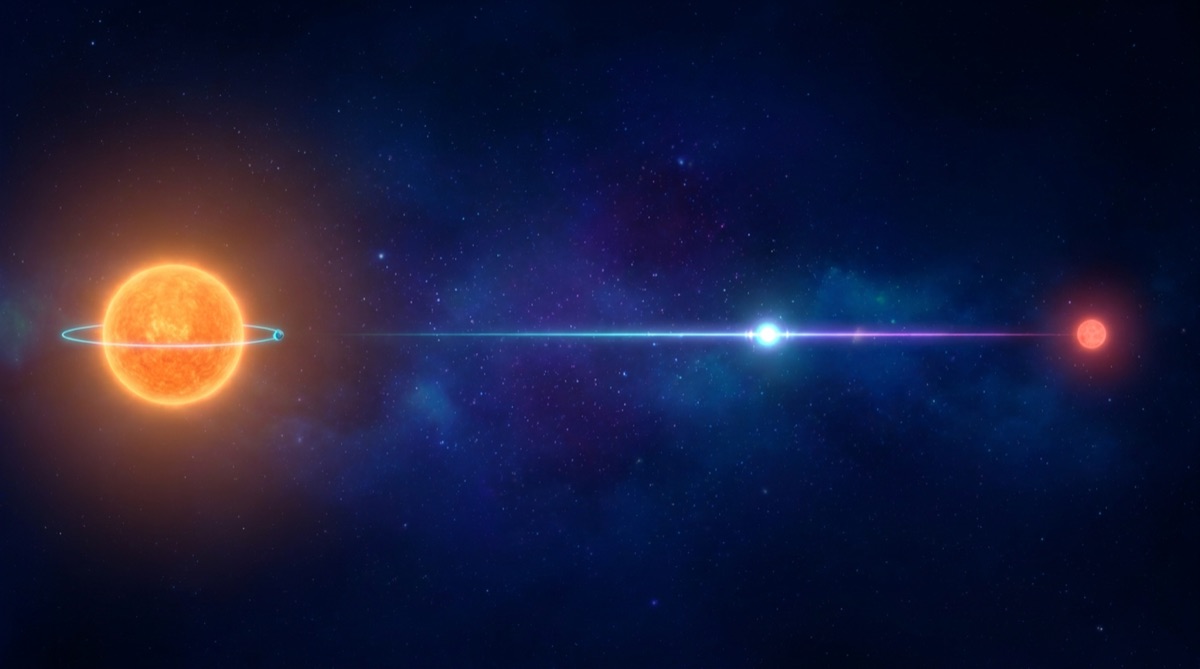
A light-year is the distance light travels in a vacuum during one year. To make it exact you have to say which year: astronomers use the Julian year, of exactly days of s:
Since m/s is exact, so is the light-year:
Almost nine and a half trillion kilometers. In astronomical units:
Careful: although it contains the word “year,” the light-year measures distance. Saying “the star is 4 light-years away” means “light takes 4 years to get here from there.” In the same way there are the light-second ( km), the light-minute ( km) and the light-hour ( au).
Worked example 2: the nearest star
Proxima Centauri is ly away. In kilometers and in au:
More than 268 000 times the Earth–Sun distance! That is why the au falls short outside the Solar System.
4. The parsec (pc)
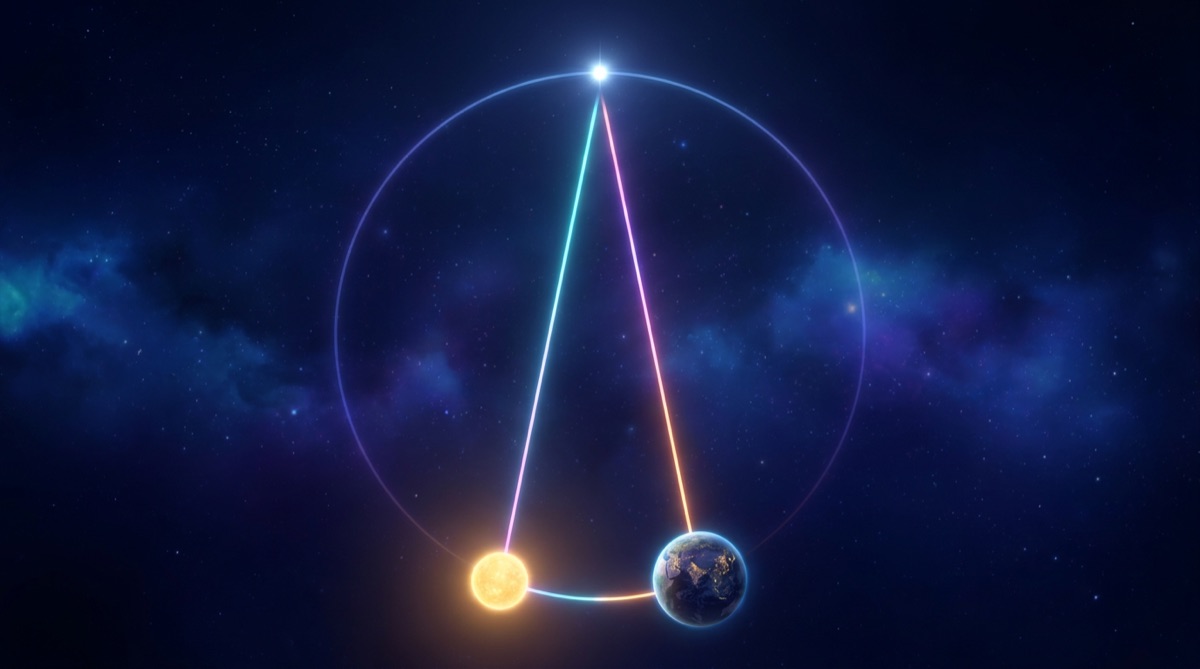
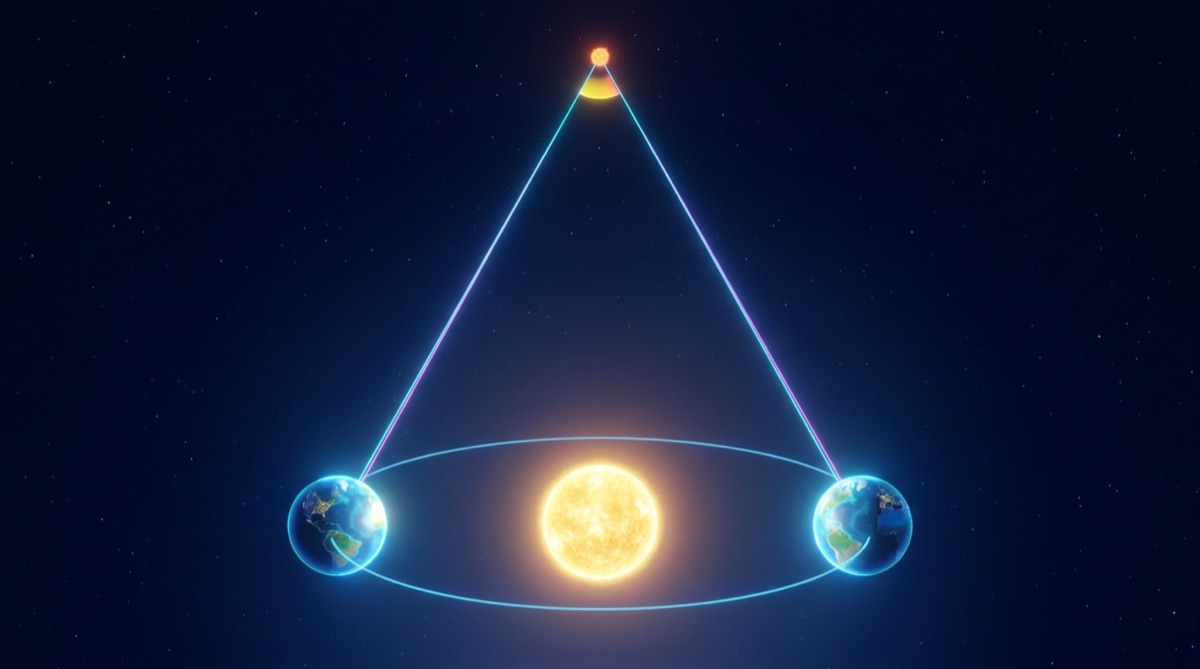
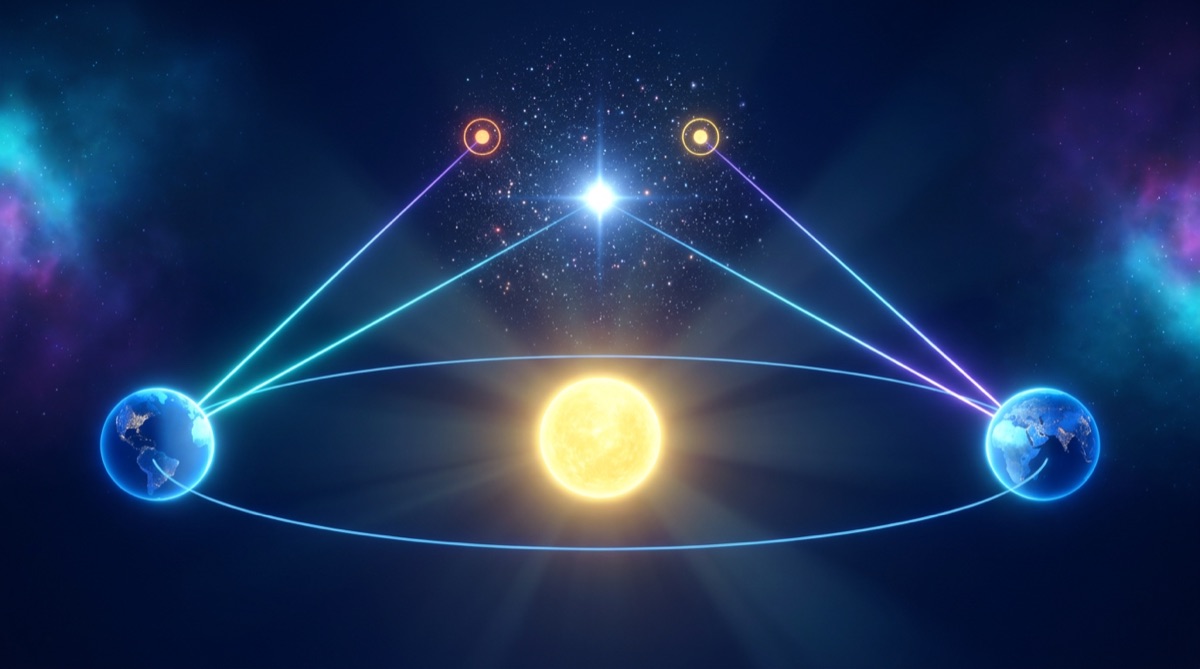
The parsec comes from how distances to the stars are measured: by parallax, the small change in direction with which we see a star when the Earth moves from one side of its orbit to the other (lesson 1 of this module).
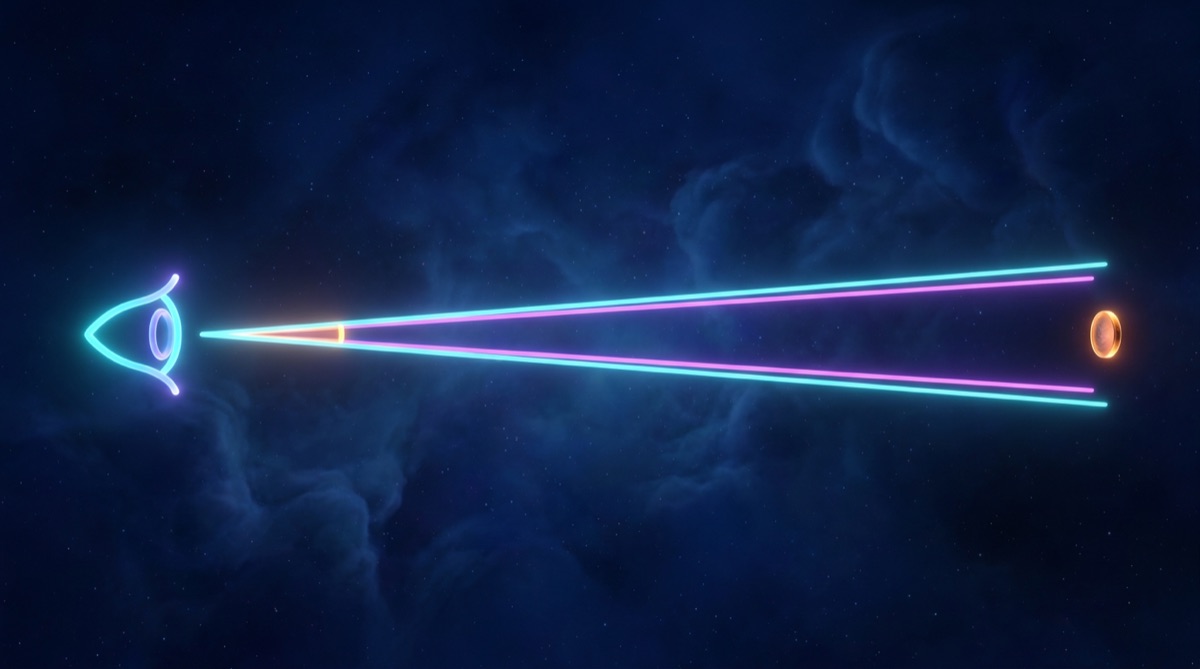
First, a very small angle. A degree is divided into 60 arcminutes () and each minute into 60 arcseconds ():
Definition. A parsec is the distance from which 1 au is seen under an angle of 1 arcsecond.
Why 648 000/π?
Imagine an enormous circle of radius with the observer at the center. An arc of that circle that spans 1 au and is seen under an angle of is of the full turn, whose length is . By proportionality between angle and arc:
(For such a small angle, the arc and the straight-line distance are practically the same.) In 2015 the IAU adopted this expression as the exact definition:
A parsec is a little more than three light-years. For larger distances the kiloparsec ( pc) and the megaparsec ( pc) are used.
Worked example 3: Proxima Centauri in parsecs
And the other way around: its parallax measured by the Gaia satellite is , and pc. (That rule, , is what makes the parsec so convenient; you will study it in Grade 10.)
5. Table of equivalences
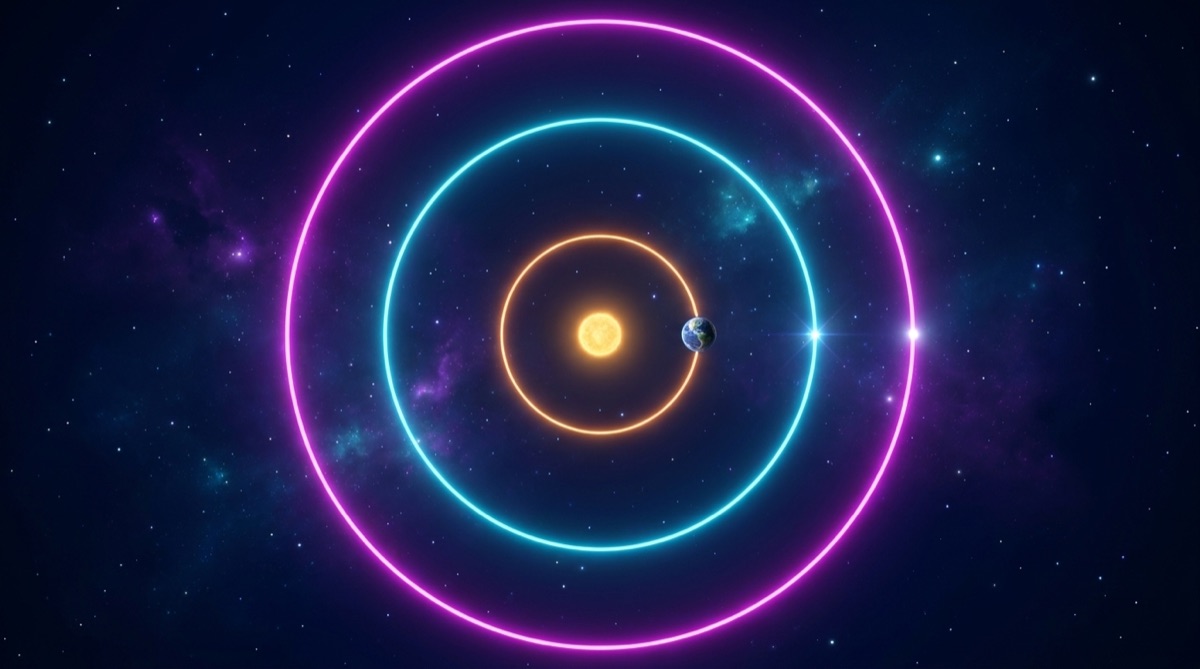
| km | au | ly | pc | |
|---|---|---|---|---|
| 1 au | 1 | |||
| 1 ly | 1 | |||
| 1 pc | 1 |
Which one do I use? Solar System: au. Stars in the neighborhood: ly or pc. Milky Way: kpc. Other galaxies: Mpc. If the result has more than six figures or a very large exponent, you probably chose a unit that is too small.
Worked example 4: Andromeda
The Andromeda Galaxy is about ly away. In parsecs:
6. Explore with the simulator

- Choose a Sun the size of a soccer ball. How many meters away is the Earth (1 au)? And Neptune (30 au)? Check that Neptune’s distance is 30 times the Earth’s.
- With the same scale, calculate how many kilometers from the ball Proxima Centauri would be ( au). Does it fit in your city? In your country?
- In the light journey mode, launch the “light rocket” and write down how long it takes to pass Mars, Jupiter and Neptune. Compare with s, s and s.
Activity: a tape measure for the universe
You need: a 10 m ribbon or rope marked every meter, cards, adhesive tape, a calculator.
- Decide that 1 m = 1 au. Tape one card per planet onto the rope, using the table from section 2 (Mercury at 39 cm, Mars at 1.52 m, Jupiter at 5.2 m, Saturn at 9.6 m; Uranus and Neptune fall off the rope: calculate where they would go).
- Calculate how many meters away, at that scale, 1 light-year would be (hint: 1 ly = 63 241 au). Is there a town or city at that distance from the school?
- Calculate where 1 parsec and Proxima Centauri would be.
- Change the scale: now 1 m = 1 pc. How many millimeters away is the whole Solar System (Neptune)? Could it be drawn?
Final question: why don’t astronomers use a single unit for everything?
Exercises
Basic level
- Convert to kilometers: (a) au (Mercury); (b) au (Jupiter).
Show solution
(a) km. (b) km.
- Sirius is ly away. How many parsecs is that? How many kilometers?
Show solution
pc. km.
- How long does light from the Moon take to reach the Earth? The Moon is km away.
Show solution
s. The Moon is “1.3 light-seconds” away.
Intermediate level
- How many au are there in a light-day? What human-made object is approximately at that distance?
Show solution
au. The Voyager 1 probe (launched in 1977) is, in 2026, about 170 au away: almost one light-day.
- A star cluster is kpc away. Express it in light-years and in scientific notation in kilometers.
Show solution
ly. In km: km.
- Check that au by dividing the values in meters, and then that ly by dividing au by au.
Show solution
au (rounding). ly. ✓
Challenge level
- Work out how many au the parsec would have if the arcsecond were defined as of a degree (instead of ). Would it be larger or smaller than the current one?
Show solution
The angle would be of a turn, so au. Much smaller: a larger angle is seen from closer up.
- How long does a radio signal sent from the Earth to a probe km away (near Neptune) take to arrive? Give the result in hours. If the probe replies immediately, how long do we wait for the reply?
Show solution
s h. The reply arrives h after sending the command.
- The observable universe has a radius of about m. Express it in light-years and in megaparsecs. Which unit gives the most manageable number?
Show solution
ly (46 500 million light-years). In pc: pc Mpc. Megaparsecs give the shortest number: about 14 000 Mpc.
✦ Mini-quiz
Key takeaways
- m exactly km: the ruler of the Solar System. Light covers it in 8 min 19 s.
- km au. It is distance, not time.
- au ly: the distance from which 1 au is seen under .
- To convert, multiply by a fraction that equals 1 and cancel the unit.
- Choose the unit according to the scale: au, ly/pc, kpc, Mpc.
🍎 Teacher guide
- Time
- 2 sessions of 55 min
- Colombian national standard (MEN)
- Mathematics, Grades 6 to 7: “I identify relations between different units used to measure quantities of the same magnitude”; “I solve and formulate problems whose solution requires exponentiation or roots”; “I justify the use of representations and procedures in situations of direct and inverse proportionality”; “I solve and formulate problems that involve scale factors (design of models, maps)”. Natural Sciences, Grades 6 to 7: “I take measurements with instruments and equipment suited to the characteristics and magnitudes of the objects and express them in the corresponding units”; “I identify and properly use the language of the sciences”.
- Evidence of learning
- States the three definitions, converts a given distance between km, au, ly and pc with conversion factors and scientific notation, and justifies the choice of unit for an object in the Solar System, a star and a galaxy.
Materials
- Scientific calculators
- 10 m rope or ribbon marked every meter, cards and adhesive tape
- Printed table of equivalences
- Computer or tablet with the simulator
Suggested sequence
Session 1. au and light-year (55 min). Opener: ask in which unit they would measure the thickness of a hair, the distance to Cali and the distance to the Moon; arrive at the idea of a “convenient unit.” Development: conversion factors (section 1), definition of the au and table of planets, example 1; Julian year and light-year, example 2; exercises 1, 3 and 4. Closing: “tape measure” activity, steps 1 and 2, in the hallway.
Session 2. The parsec and the conversions (55 min). Opener: review of degrees, arcminutes and arcseconds with a protractor and the idea of 1/1 296 000 of a turn. Development: derivation of 648 000/π with the arc/circumference proportion (section 4), table of equivalences, examples 3 and 4, simulator challenges; exercises 2, 5 and 6. Closing: steps 3 and 4 of the activity, mini-quiz and, as a home challenge, exercises 7 to 9.
Connection. Lesson 1 of this module (parallax, Grade 10) explains why the parsec is so practical (); lesson 3 (Grade 8) develops the light-year from the linear function .
Common mistakes
- Taking the light-year as a unit of time (“the star is 4 years away”). Always rephrase as “light takes 4 years to get here from there” and write the unit: 4 ly.
- Multiplying when you should divide when converting. Insist on writing the conversion fraction with the unit to be canceled in the right place.
- Believing that the parsec is defined by the size of the Earth or by light. Go back to the drawing: 1 au seen under 1 arcsecond.
- Forgetting to readjust the scientific notation (45.2 × 10⁸ instead of 4.52 × 10⁹). Check that the mantissa is between 1 and 10.