Glossary / G / Galaxies and cosmology
Galaxy
Also: galaxies
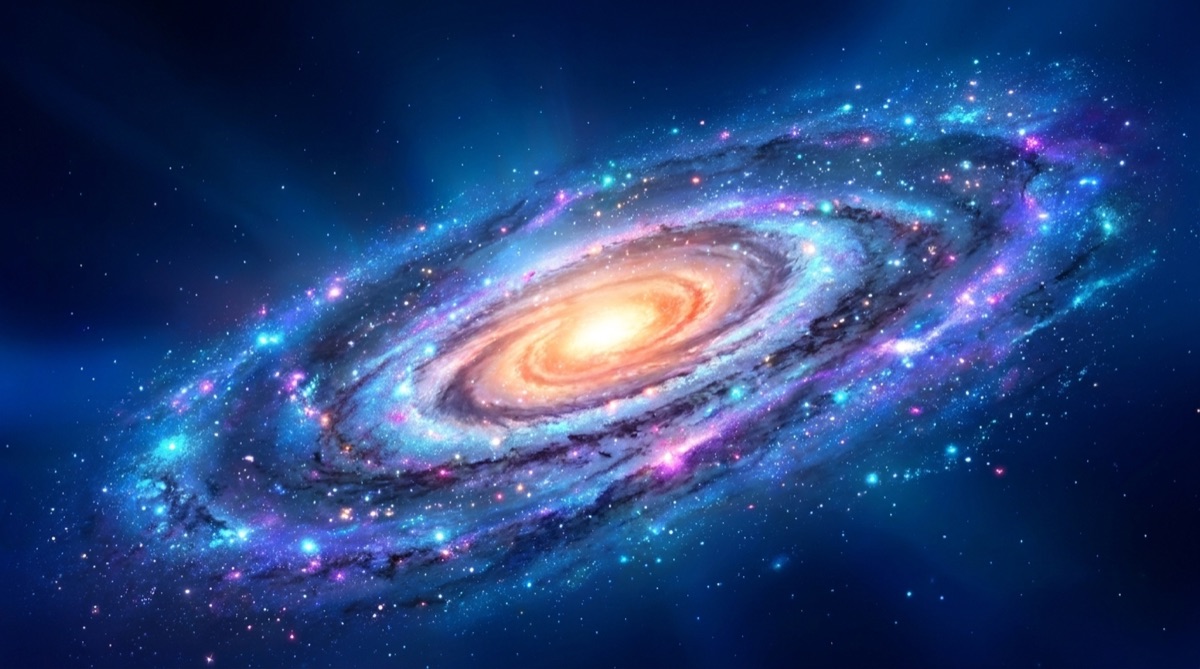
A city of stars: hundreds of billions of them, with gas, dust and dark matter, bound together by gravity. Ours is the Milky Way; the largest neighbor, Andromeda.
Going further
Hubble types: ellipticals, spirals (barred or not) and irregulars. Masses of –; 85 % of that mass is dark matter, inferred from rotation curves and the virial theorem.
Where it is explained: The universe is expanding Secondary Education
Related terms
Used in these lessons
- The Milky Way and other galaxies Secondary Education 27 mentions
- The universe is expanding Secondary Education 26 mentions
- Collisionless Boltzmann equation, Jeans equations and the virial theorem Higher Education 19 mentions
- Rotation curves and dark matter Higher Education 11 mentions
- Spectra and the Doppler effect Secondary Education 8 mentions
- Deflection of light and gravitational lenses Higher Education 8 mentions
- Cosmological distances Higher Education 5 mentions
- Astronomical unit, light-year and parsec Secondary Education 4 mentions
- Galactic potentials: Poisson, Plummer, Hernquist, isothermal and NFW Higher Education 3 mentions
- The Friedmann equations Higher Education 2 mentions
- Hunting exoplanets with transits Secondary Education 1 mention
- Weighing the Sun and the planets Secondary Education 1 mention
- Scientific notation and distances in the universe Secondary Education 1 mention
- Cosmic inflation Higher Education 1 mention
- Gravitational waves: from the quadrupole to GW150914 Higher Education 1 mention