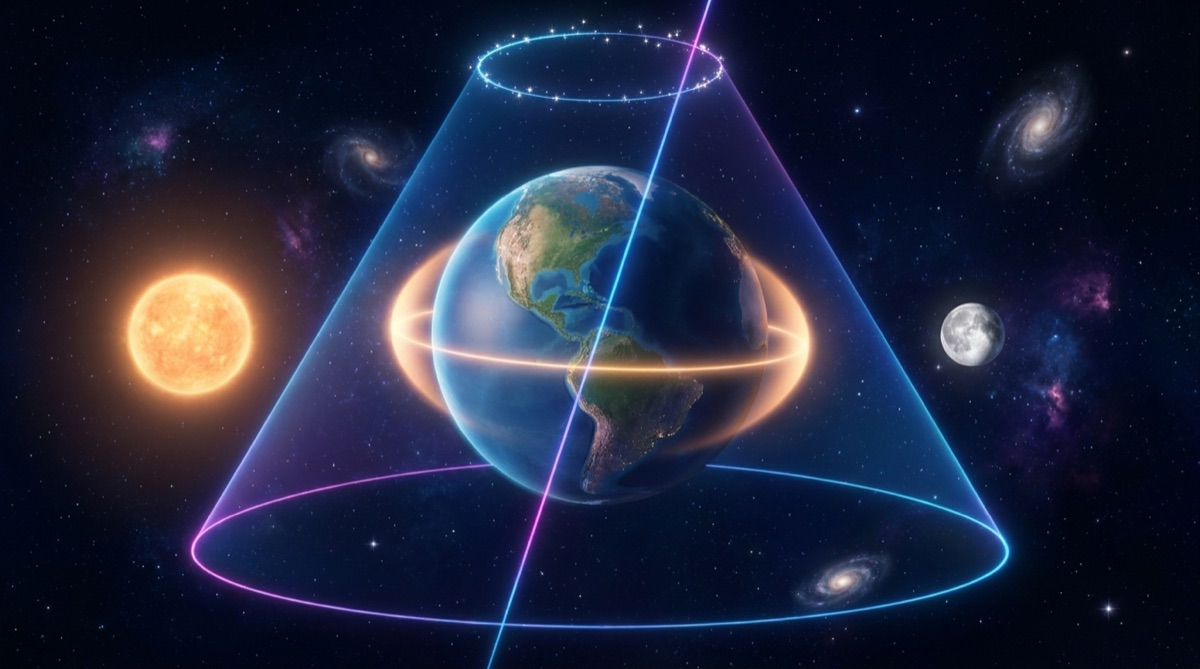
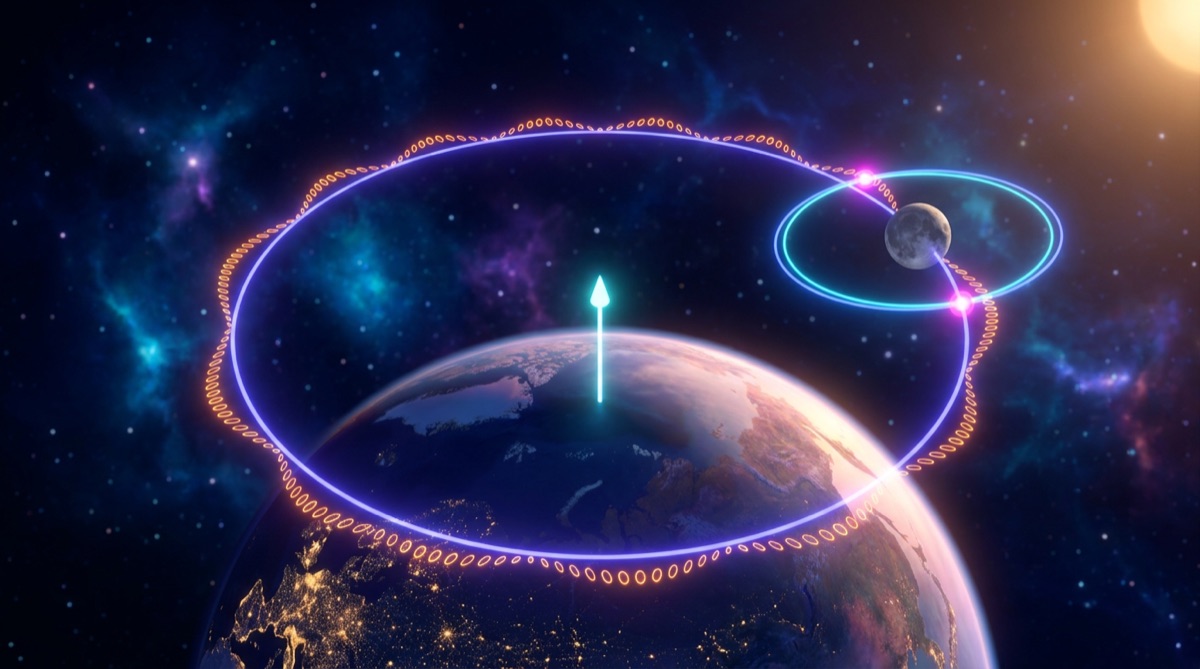
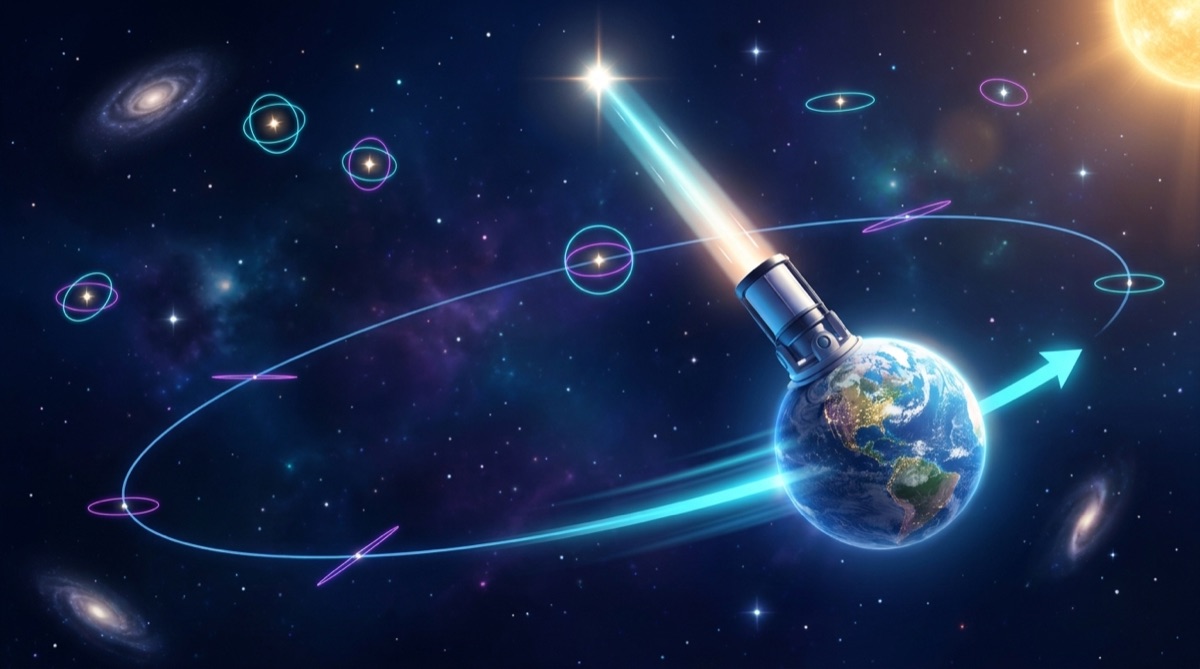
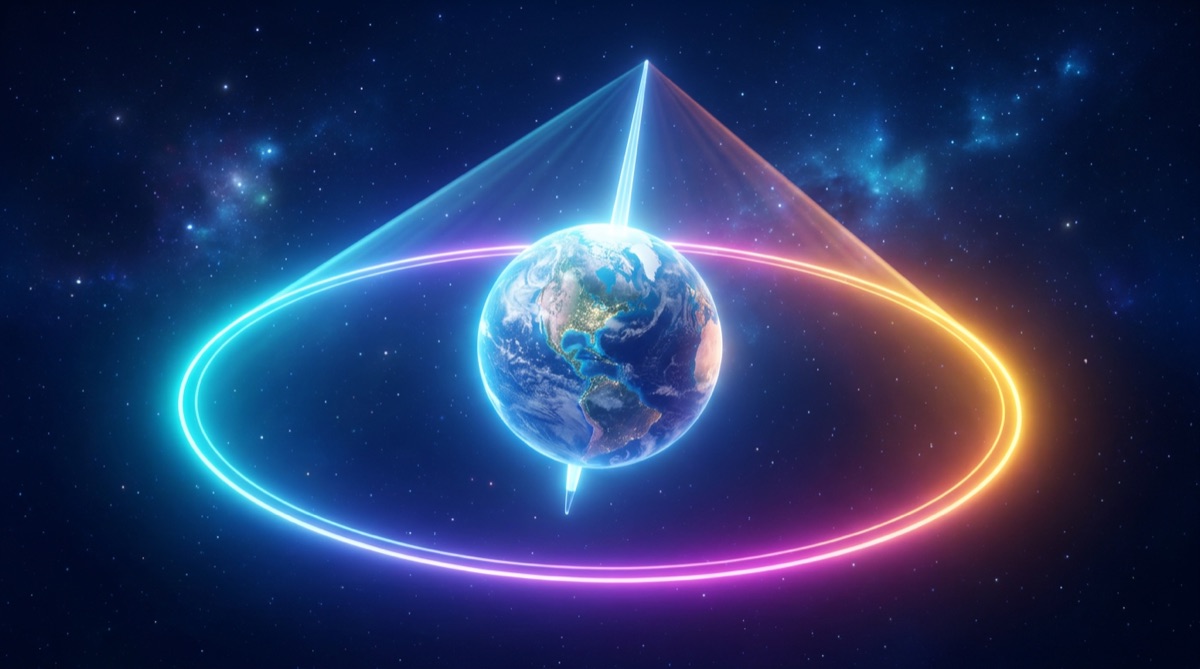
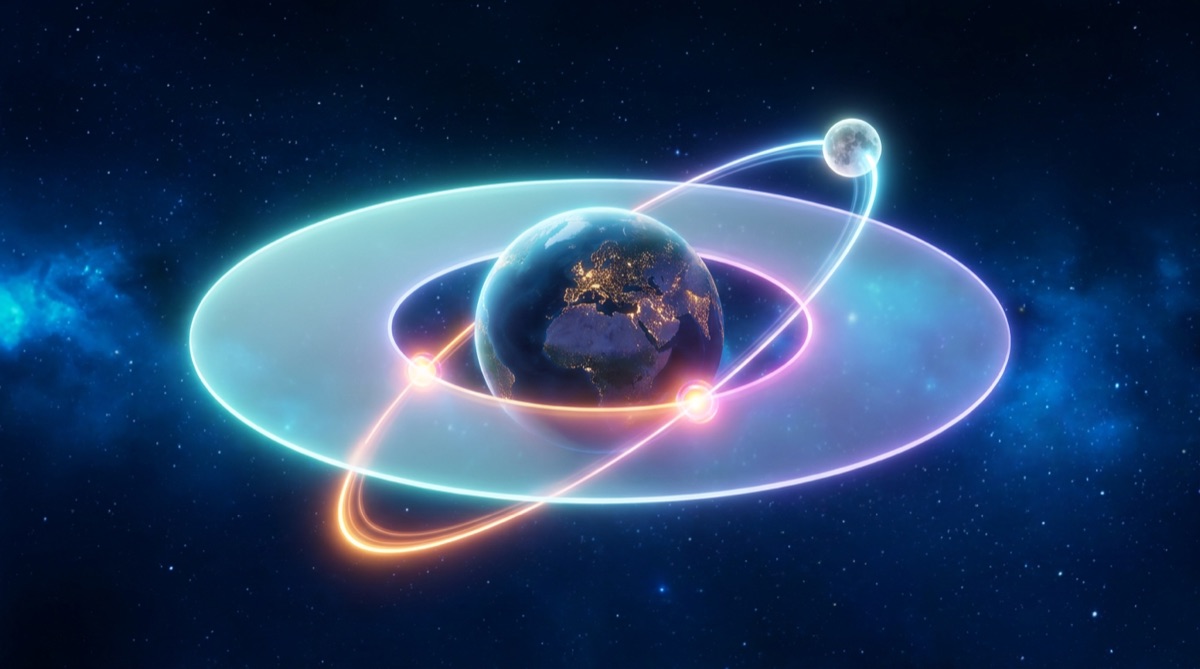
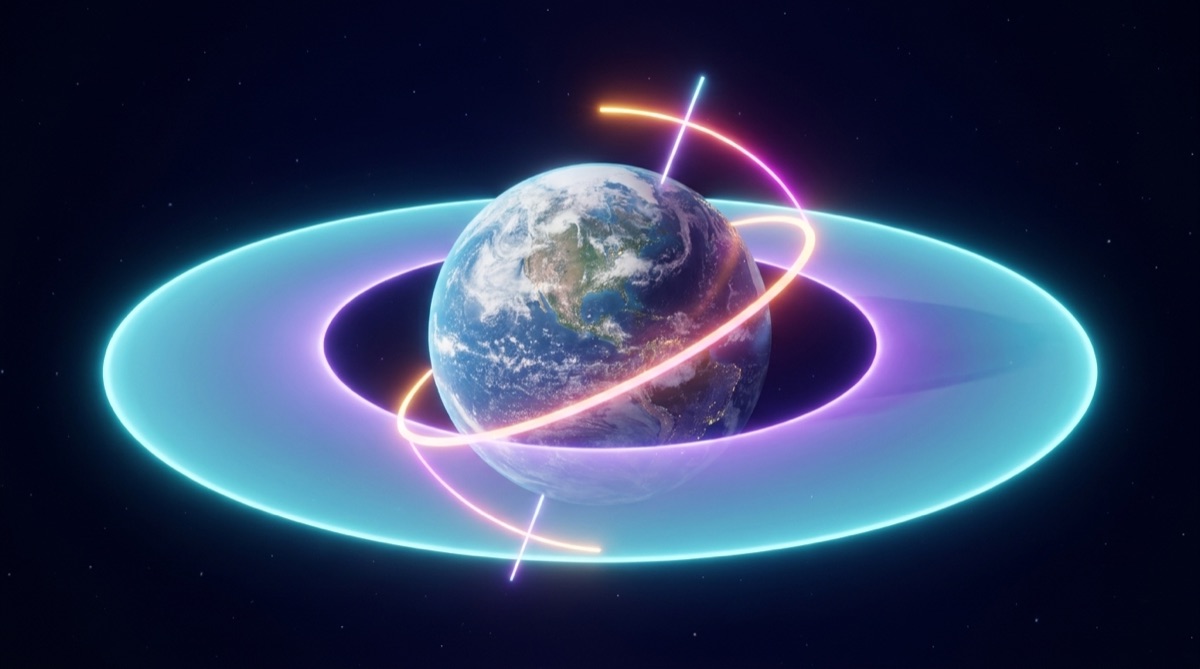
The four corrections that separate catalog coordinates from the direction in which to point: general precession (IAU 2006), nutation (18.6-year term), annual aberration (κ = 20.49552″) and atmospheric refraction (Bennett and Saemundsson), with the complete reduction of a star as an example.
⏱ 180 minrotation matricesperturbation seriesLorentz transformationsSnell's law and stratified atmosphereerror propagationrevision
By the end you will be able to:
Explain the physical origin of lunisolar precession and deduce the order of magnitude of its period from the gravitational torque on the equatorial bulge.
Apply the IAU 2006 precession rotation (angles ζ_A, z_A, θ_A) to equatorial coordinates and verify it with a reference example.
Derive the effect of nutation in right ascension and declination from Δψ and Δε, and relate the leading term to the regression of the lunar node.
Deduce annual aberration from the relativistic composition of velocities, obtain the constant κ and apply the formulas in equatorial coordinates.
Derive the refraction in a plane atmosphere, R = (n − 1) tan z, and use the Bennett and Saemundsson formulas with pressure and temperature correction; quantify the error of each approximation.
1. Motivation: from the catalog to the telescope
A catalog gives the mean position of a star at epoch J2000.0: the direction with respect to a fixed equator and equinox. To point a telescope today one must (1) precess to the mean equator of date, (2) add nutation to obtain the true equator, (3) correct for the aberration of light due to the Earth’s velocity (and for parallax, if the star is nearby), which yields the apparent position; and, after converting to horizontal coordinates with the sidereal time, (4) add atmospheric refraction. The sizes: precession 50′′ per year (cumulative), nutation up to 17′′, aberration up to 20.5′′, refraction from 0 at the zenith to 34′ at the horizon. None is negligible for a telescope with a field of arcminutes. In this lesson we derive each effect, give the current formulas and reduce a star from beginning to end.
Conventions: angles in radians in the code (src/lib/math/reduccion.ts), in arcseconds (′′) in the precession and nutation formulas; t is the time in Julian centuries of TT since J2000.0.
2. Precession
2.1 Physics: the torque on the equatorial bulge
The Earth is an oblate ellipsoid (J2=1.0826×10⁻³) spinning with angular velocity ω about an axis tilted by ε=23.44° with respect to the plane of its orbit. The Sun and the Moon exert on the bulge a mean torque perpendicular to the axis, of magnitude (averaging over the orbit)
Nˉ=23a3GM⊙(C−A)sinεcosε,
with C and A the polar and equatorial moments of inertia. A gyroscope subject to a perpendicular torque precesses with angular velocity Ωp=Nˉ/(Cωsinε):
Ωp=23a3ωGM⊙CC−Acosε.
With GM⊙/a3=n2 (n=2π/yr), (C−A)/C=H=3.27×10−3 (dynamical ellipticity) and ω=366.25n (rotations per year): Ωp⊙=23nHcosε/366.25=1.23×10−5n, that is, one cycle every 81000 years, ≈16′′ per year. The Moon, though far less massive, is so close that its contribution is ≈2.2 times the solar one (ML/dL3 versus M⊙/a3): in total ≈50′′ per year and a cycle of about 25 800 years. The axis describes a cone of half-angle ε around the pole of the ecliptic; the equinox regresses along the ecliptic toward the west. To this is added planetary precession: the planets slowly rotate the plane of the ecliptic, which moves the equinox by ≈0.1′′ per year in the opposite sense.
2.2 The IAU 2006 model (P03)
In 2006 the IAU adopted the P03 model of Capitaine, Wallace & Chapront (2003). The quantities, in arcseconds with t in Julian centuries of TT since J2000.0 (SOFA routine p06e), are:
pAψAεA=5028.796195t+1.1054348t2+0.00007964t3−0.000023857t4−0.0000000383t5=5038.481507t−1.0790069t2−0.00114045t3+0.000132851t4−0.0000000951t5=84381.406−46.836769t−0.0001831t2+0.00200340t3−0.000000576t4−0.0000000434t5(general precession in longitude)(lunisolar precession)(mean obliquity)
The general precession at J2000.0 is therefore p=50.28796′′ per year (a cycle of 360×3600/50.288=25772 years), and the mean obliquity decreases by 46.84′′ per century (0.47′′ per year). To precess equatorial coordinates from J2000.0 to the date one uses the three equatorial angles
The precession matrix is the composition of three rotations, P=Rz(−zA)Ry(θA)Rz(−ζA): rotate by ζA about the J2000 pole until the x axis reaches the node between the two equators, tilt by θA (the angle between the two equators) and rotate by zA about the new pole. In coordinates (Meeus eq. 21.4):
For small θA this reduces to the first-order formulas Δα=(m+nsinαtanδ)Δt, Δδ=ncosαΔt with m=3.075 s/yr and n=20.04′′/yr (problem 1). The pole precesses: the declination of a star near the pole changes a great deal, and the right ascension of a star very close to the pole changes enormously (the tanδ term). The constants ζA,zA,θA differ from the IAU 1976 ones by ≈0.13′′ per century: imperceptible except in precision astrometry.
3. Nutation
3.1 Origin and leading term
The lunisolar torque is not constant: it varies with the position of the Moon and the Sun and, above all, with the inclination of the lunar orbit (5.145°), whose node regresses with a period of 18.61 years. The result is a wobble of the axis superposed on the precession: nutation, described by two angles, Δψ (in longitude, along the ecliptic) and Δε (in obliquity). The IAU 2000A model has 1365 terms; the first, whose argument is the longitude of the lunar node Ω, dominates by an order of magnitude (SOFA nut00b):
The period of Ω is 1296000′′/6962890.5431′′ centuries =18.613 years. On the celestial sphere, the pole describes the nutation ellipse, with semi-axes 9.2′′ (in the direction of the pole of the ecliptic, from Δε) and 17.2′′sinε=6.8′′ (perpendicular, from Δψ), which Bradley observed in 1748 and d’Alembert explained dynamically in 1749.
3.2 Short series (Meeus) and precision
For 0.5′′ in Δψ and 0.1′′ in Δε four terms suffice (Meeus ch. 22):
with L=280.4665°+36000.7698°t (mean longitude of the Sun) and L′=218.3165°+481267.8813°t (of the Moon). The terms in 2L and 2L′ are the semiannual and fortnightly nutations. This is the series used by nutacionMeeus; the test compares it with the value of Meeus’s full series for April 10, 1987 (Δψ=−3.788′′, Δε=+9.443′′) and checks that the leading term alone (−3.36′′, +9.03′′) is within 0.4′′.
3.3 Effect on equatorial coordinates
With the equinox displaced by Δψ along the ecliptic and the obliquity changed by Δε, to first order (Meeus eq. 23.1; derived by differentiating the ecliptic → equatorial transformation, problem 2):
The term cosεΔψ, common to all stars, is the equation of the equinoxes of the previous lesson.
4. Annual aberration
4.1 Derivation
An observer moving with velocity v sees the light from a source in direction p^ (“natural” direction, toward the source) deflected toward the apex of its motion. With the Lorentz transformation of the velocity of a photon, if θ is the angle between p^ and v,
tanθ′=cosθ+βsinθ1−β2,β=v/c,
and for β≪1 the displacement is Δθ=θ−θ′=βsinθ+O(β2). With the mean orbital velocity of the Earth, v=29.785 km/s: β=9.936×10⁻⁵ rad =20.49′′. The constant of aberration
κ=20.49552′′(IAU 1976, epoch J2000.0)
is β in arcseconds for the mean velocity (more precisely, κ=na/(c1−e2) with n the mean motion and a the semi-major axis). Since the Earth’s velocity turns through 360° in a year, each star describes in the sky an aberration ellipse with semi-major axis κ and semi-minor axis κsinβecl (ecliptic latitude): a circle at the pole of the ecliptic, a segment of ±20.5′′ on the ecliptic. This effect, discovered by Bradley in 1728 while searching for the parallax of γ Draconis, was the first direct proof of the Earth’s motion and allowed c to be measured with a 1 % error.
The term of order β2 (∼10−8 rad =2 mas) matters in space astrometry; SOFA ab uses the full relativistic formula. For a star one must add the diurnal aberration due to the Earth’s rotation, ≤0.32′′cosφ.
4.2 Formulas in equatorial coordinates
With ⊙ the true longitude of the Sun, e the eccentricity and π the longitude of perihelion of the Earth’s orbit (Meeus eq. 23.3):
The terms in eκ (0.34′′) are the elliptic aberration, constant for each star throughout the year (the Earth’s velocity does not have constant magnitude); old catalogs included it in the mean positions. aberracionAnual implements these formulas and the test reproduces Meeus’s example 23.a.
5. Atmospheric refraction
5.1 Plane-parallel atmosphere
Consider an atmosphere stratified in plane layers with refractive index n(h), n=1 outside and n0 at the observer. By Snell’s law applied layer by layer, nsinz is invariant along the ray: sinztrue=n0sinz0, where z0 is the apparent (observed) zenith distance. The refraction R=z−z0 satisfies sin(z0+R)=n0sinz0; for small R, sinz0+Rcosz0=n0sinz0, hence
R=(n0−1)tanz0.
With n0−1=2.82×10⁻⁴ (air at 1010 hPa and 10 °C, yellow light): R=58.2′′tanz0, that is, 0.97′ at 45° altitude, which agrees with Bennett’s formula to better than 1′′ up to z0≈60° and to 2 % up to 80°. The result does not depend on the profile n(h) (only on n0): this is the plane-atmosphere theorem. Near the horizon it fails (the tangent diverges) because the curvature of the Earth matters; the next correction is R=Atanz0−Btan3z0 with B≈0.067′′ (SOFA refco), and for z0>80° one must trace rays numerically or use empirical formulas.
5.2 The Bennett and Saemundsson formulas
With h0 the apparent altitude in degrees, Bennett (1982) fitted, with error <0.07′ from horizon to zenith (Meeus eq. 16.3):
R=cot(h0+h0+4.47.31)arcminutes.
To go from the true altitude h to the apparent one, Saemundsson (1986) gave the approximate inverse (Meeus eq. 16.4):
R=1.02cot(h+h+5.1110.3)arcminutes,
consistent with Bennett to <4′′ for h≥5° (test reduccion.test.ts). Both refer to P=1010 hPa and T=10 °C and are multiplied by
1010hPaP⋅273+T/∘C283,
which is the dependence n0−1∝ρ∝P/T of an ideal gas. Values (Bennett, standard conditions): 34.5′ at the horizon, 28.75′ at 0.5° (Meeus’s example 16.a), 9.9′ at 5°, 5.4′ at 10°, 1.7′ at 30°, 1.0′ at 45°, 0.58′ at 60°, 0 at the zenith (−0.08′′ in reality: a residual of the fit). In Bogotá (2640 m, P≈750 hPa, T≈14 °C) the factor is 0.732: horizontal refraction 25.2′. This is why the Sun “rises” in Bogotá about 40 s later than standard refraction would give: the horizontal refraction of 34′ is equivalent to 34/15≈2.3 minutes of time at the equator, and 26% less is ≈36 s.
Refraction also depends on wavelength (n is larger in the blue): a low body is seen as a small vertical spectrum, of 1–2′′ between blue and red at 30°–45° altitude and of more than 30′′ at the horizon, the origin of the “green flash” at sunset.
6. Worked example: θ Persei in 2028
We reproduce Meeus’s examples 21.b and 23.a with our code (reduccion.ts). Data: θ Persei, J2000.0: α0=2h44m11.986s, δ0=+49°13′42.48′′; proper motion μα=+0.03425 s/yr, μδ=−0.0895′′/yr. Date: 2028 November 13.19 TT, JD=2462088.69, t=0.288670500.
Precession.ζA=668.374′′, zA=663.137′′, θA=578.514′′ (IAU 2006; Meeus with IAU 1976 obtains 668.414′′, 663.177′′, 578.479′′). Applying the rotation: α=2h46m11.324s, δ=+49°20′54.50′′ (Meeus: 11.331s and 54.54′′; the 0.1′′ difference is that of the precession model). In 28.9 years the star has moved 2 minutes of time in α and 7′ in δ.
Nutation. For that date the full series gives Δψ=+14.861′′, Δε=+2.705′′ (our short series: 15.04′′ and 2.67′′; the leading term alone: 16.48′′ and 2.65′′). With ε=23.436° (true obliquity): Δα1=+15.843′′, Δδ1=+6.217′′.
Aberration. With ⊙=231.328°, e=0.0166965, π=103.434°: Δα2=+30.045′′, Δδ2=+6.697′′.
Refraction. If the star is observed at apparent altitude h0=30° from Bogotá (750 hPa, 14 °C): R=1.717′×0.732=1.257′; its true altitude is 29°58′44.6′′. If instead the true altitude is computed from the apparent coordinates and the sidereal time, and comes out as 30°, the apparent altitude will be 30°+1.746′×0.732=30°01′16.7′′.
Error budget: precession 0.1′′ (model), nutation 0.5′′ (short series) or 0.001′′ (IAU 2000A), aberration 0.01′′ (terms of order β2 and approximate Earth velocity), refraction 0.07′ (formula) plus whatever the real atmosphere differs from the model (typically ±10% of R below 10° altitude: at the horizon, several arcminutes).
Bogotá (4.71° N, 74.07° W) · local sidereal time 1 h 46 min · Sun at -15.7° (astronomical twilight) · Moon at 47.6° · 66 of 150 stars above the horizon
What to observe. The simulator works with J2000 coordinates without precession, without nutation or aberration, and without refraction: that is why a star “rises” exactly when its computed altitude crosses zero. Compare the sunrise time it gives with that of an almanac: the difference (≈2–3 min at low latitudes) is the horizontal refraction plus the solar semidiameter.
Problems
1. (First-order formulas). From the precession rotation prove that, for a short interval Δt (years), Δα=(m+nsinαtanδ)Δt and Δδ=ncosαΔt, with m=(ζ˙A+z˙A) and n=θ˙A. Compute m and n with the IAU 2006 coefficients and apply them to θ Persei for 28.87 years; compare with the exact result.
Show solution
With ζA,zA,θA small and to first order: A≈cosδ0(sinα0+ζcosα0), B≈cosδ0(cosα0−ζsinα0)−θsinδ0, C≈sinδ0+θcosδ0cosα0. From C: δ−δ0=θcosα0. From tan(α−z)=A/B: expanding, α−z−α0=ζ+θsinα0tanδ0, hence α−α0=(ζ+z)+θsinα0tanδ0. Dividing by Δt: m=(2306.083227+2306.077181)′′/100yr=46.1216′′/yr =3.07477 s/yr and n=20.0419′′/yr =1.33613 s/yr. For θ Persei: Δα=(3.07477+1.33613sin41.054°tan49.228°)×28.867=(3.07477+1.01685)×28.867=118.1 s =1m58.1s (exact: 1m58.35s); Δδ=20.0419′′cos41.054°×28.867=436.2′′=7′16.2′′ (exact: 7′14.6′′). The first-order error is ≈0.3 s and 1.6′′ over 29 years, quadratic in Δt.
2. (Nutation in equatorial coordinates). Derive the formulas of §3.3 by differentiating the ecliptic → equatorial transformation sinδ=sinβcosε+cosβsinεsinλ, cosδcosα=cosβcosλ, with β fixed and λ→λ+Δψ, ε→ε+Δε.
Show solution
Differentiating the first: cosδΔδ=(−sinβsinε+cosβcosεsinλ)Δε+cosβsinεcosλΔψ. The identities of the inverse transformation give cosβcosλ=cosδcosα and −sinβsinε+cosβcosεsinλ=cosδsinα (it is the y component of the unit vector in equatorial coordinates), hence Δδ=sinεcosαΔψ+sinαΔε. For α one differentiates cosδcosα=cosβcosλ and uses the Δδ just obtained: −sinδcosαΔδ−cosδsinαΔα=−cosβsinλΔψ. With cosβsinλ=cosδsinαcosε+sinδsinε and substituting, after dividing by −cosδsinα and simplifying, Δα=(cosε+sinεsinαtanδ)Δψ−cosαtanδΔε. ■ The formulas fail near the pole (tanδ); there one works with vectors and the nutation matrix N=Rx(−ε−Δε)Rz(−Δψ)Rx(ε).
3. (Constant of aberration). Prove that κ=cP1−e22πa (with P the sidereal year) and compute its value with a=1.495978707×10¹¹ m, P=365.256363 d, e=0.0167086, c=299792458 m/s. Explain the difference from 20.49552′′.
Show solution
By conservation of angular momentum h=r2ν˙=μa(1−e2), and the transverse component of the velocity is v⊥=h/r=μ/h(1+ecosν); the radial component is vr=(μ/h)esinν. The velocity vector is the sum of a vector of constant magnitudeμ/h that rotates with ν and a constant vector eμ/h perpendicular to the major axis; the first produces the aberration ellipse of size κ=μ/(hc) and the second, the elliptic aberration eκ. With μ=4π2a3/P2: κ=cμa(1−e2)μ=cP1−e22πa. Numerically: 2π×1.495978707×1011/(2.99792458×108×31558149.8×0.99986)=9.9365×10−5 rad =20.4955′′, which agrees with the IAU value 20.49552′′ to the fifth decimal place: the constant is not an empirical fit but v/c with the constants of the Solar System.
4. (Plane-parallel refraction). Prove that for a plane stratified atmosphere R=(n0−1)tanz0 exactly to first order in n0−1, independently of the profile n(h), and estimate the error of that formula at z0=60° and 80° by comparing with Bennett.
Show solution
At each interface between plane layers, Snell gives nisinzi=ni+1sinzi+1: the product nsinz is constant along the ray, and connects the outside (n=1, true direction z) with the observer (n0, apparent direction z0): sinz=n0sinz0. Since the intermediate geometry does not appear, the result depends only on n0. With z=z0+R and R small: sinz0cosR+cosz0sinR=n0sinz0⇒Rcosz0≈(n0−1)sinz0. ■ With n0−1=2.82×10⁻⁴: R(60°)=58.2′′×1.732=100.8′′=1.68′ versus 1.717′ from Bennett (2 % less). R(80°)=58.2′′×5.671=330′′=5.50′ versus 5.39′ (2 % more: the curvature is already noticeable, shortening the path in the atmosphere relative to the plane model). At z0=89.5° the plane formula gives 111′ and the reality is 28.75′: near the horizon the plane model is useless. The term −Btan3z0 with B≈0.067′′ corrects the first effect of the curvature.
5. (Error of the horizontal refraction). Near the horizon the refraction varies by ≈10% with the thermal gradient of the low layers, which is not known. Estimate the error in the instant of sunrise in Bogotá and in Oslo (φ=59.9°) for an error of 3′ in R.
Show solution
The altitude of the Sun changes at the rate h˙=15°/h×cosφcosδsinH0≈15°/h×cosφ at the equinoxes. An error δh=3′ in the apparent altitude of the horizon is equivalent to a time error δt=δh/h˙. Bogotá: cos4.7°=0.997, h˙=14.95°/h=0.249′/s, δt=12 s. Oslo: cos59.9°=0.50, h˙=7.5°/h=0.125′/s, δt=24 s; at the winter solstice in Oslo (sinH0 small) it rises to ≈50 s. Almanacs do not give sunrise to better than the minute for this reason, not for lack of precision in the ephemerides.
6. (Computational: complete reduction). Write a program that, given the J2000 coordinates and the proper motion of a star, a TT date and the position of the Sun (you may take it from the lesson on the Sun: posicionSol), computes the apparent position applying IAU 2006 precession, nutation (short series) and aberration, and then, given the latitude, longitude, pressure and temperature, the observed altitude and azimuth (with Saemundsson refraction) at a UTC time. Verify with θ Persei (§6) and then apply it to Sirius from Bogotá today.
Show solution
Skeleton (Python; the coefficients are copied from reduccion.ts):
To these functions one adds correccion_nutacion, aberracion (formulas of §3.3 and §4.2) and the transformation to horizontal coordinates of lesson 1 with the sidereal time of lesson 2. Verification: θ Persei must give 2h46m14.38s, +49°21′07.4′′. For Sirius (α=6h45m08.917s, δ=−16°42′58.02′′, μα=−0.03847 s/yr, μδ=−1.2233′′/yr; SIMBAD/Hipparcos) the corrections in 2026 are: accumulated precession since 2000 of ≈1.2 minutes of time in α and ≈1.7′ in δ (first-order formulas of problem 1), up to 20′′ of aberration and ≈32′′ of accumulated proper motion, which for Sirius is not negligible.
✦ Self-assessment
Answer all the questions to check.
Further reading
Explanatory Supplement to the Astronomical Almanac, 3rd ed. (2013), ch. 6 (precession, nutation, rotation: the complete IAU 2006/2000A framework, with the CIO) and ch. 7 (reduction of positions: aberration, parallax, gravitational deflection).
Capitaine, Wallace & Chapront (2003), A&A 412, 567: the P03 model, with the tables we have used.
Mathews, Herring & Buffett (2002), JGR 107, 2068: the non-rigid Earth nutation theory behind IAU 2000A.
Meeus (1998), chs. 16, 21, 22, 23: practical formulas and the numerical examples reproduced by the test.
Green (1985), Spherical Astronomy, ch. 9 (precession and nutation with dynamical derivations); the chapters on refraction and aberration develop the full relativistic treatment.
Bennett (1982), J. Navigation 35, 255 and Saemundsson (1986), Sky & Telescope 72, 70: the refraction formulas.
Bradley (1729), Phil. Trans. 35, 637: the paper that discovered aberration (and, along the way, nutation, published in 1748).
🍎 Teacher guide
Time
2 classes of 90 min plus a 2 h workshop
Learning outcome
On completion, the student explains the physical origin of precession, nutation, aberration and refraction, applies the current models (IAU 2006, IAU 2000 leading term, κ = 20.49552″, Bennett/Saemundsson) to reduce a catalog position to apparent and observed, and quantifies the error of each step.
Evidence of learning
Submission of problem 6: reduction program verified with θ Persei (Meeus 21.b and 23.a) and applied to a star visible from the student's city, with an error budget.
Materials
Python 3 with NumPy
Reference code: src/lib/math/reduccion.ts and its test
Access to SIMBAD for coordinates and proper motions
A barometer and a thermometer (for the meteorological factor of the refraction)
The portal's interactive Planisphere simulator
Suggested sequence
Class 1 (90 min). Opening (15 min): the spinning top and the gravitational torque; estimate of the precession period on the board (§2.1). Development (60 min): IAU 2006 model and precession rotation; nutation and the lunar node; first-order formulas (problem 1) and derivation of the nutation formulas (problem 2). Closing (15 min): apply precession by hand to a star from the class list.
Class 2 (90 min). Opening (10 min): the story of Bradley and γ Draconis. Development (60 min): aberration by composition of velocities, aberration ellipse, elliptic aberration (problem 3); plane-parallel refraction (problem 4), Bennett and Saemundsson, meteorological factor, reading the table of values. Closing (20 min): problem 5; mini-quiz.
Workshop (2 h). Problem 6: complete reduction of θ Persei with verification against Meeus, and application to a bright star from each student’s city with the pressure and temperature measured in class.
Common mistakes
Confusing precession (secular, 50″/yr, changes the reference system) with nutation (periodic, 17″, same physics). Show the nutation ellipse superposed on the precession circle.
Applying nutation with the J2000 coordinates instead of the precessed ones. The example of §6 shows it: the formulas are first order in the position of date.
Believing that aberration depends on the distance to the star (that is parallax). Assign problem 3: κ depends only on v/c.
Forgetting that Bennett takes the apparent altitude and Saemundsson the true one. Have the program check that they are inverses to < 4″.
Using standard refraction in a high-altitude city. The factor P/1010 in Bogotá is 0.74: ignoring it means 9′ of error at the horizon.
Key terms in this lesson (12)
Glossary terms that appear in the text. Each one links to its full entry.
PrecessionEarth's axis wobbles very slowly, like a spinning top, and takes about 26 000 years to complete one turn. That is why the star marking north changes over the millennia.
Orbital nodesThe two points where the Moon's orbit crosses the plane of Earth's orbit. There are eclipses only when the new or full moon happens near a node; that is why there are not eclipses every month.
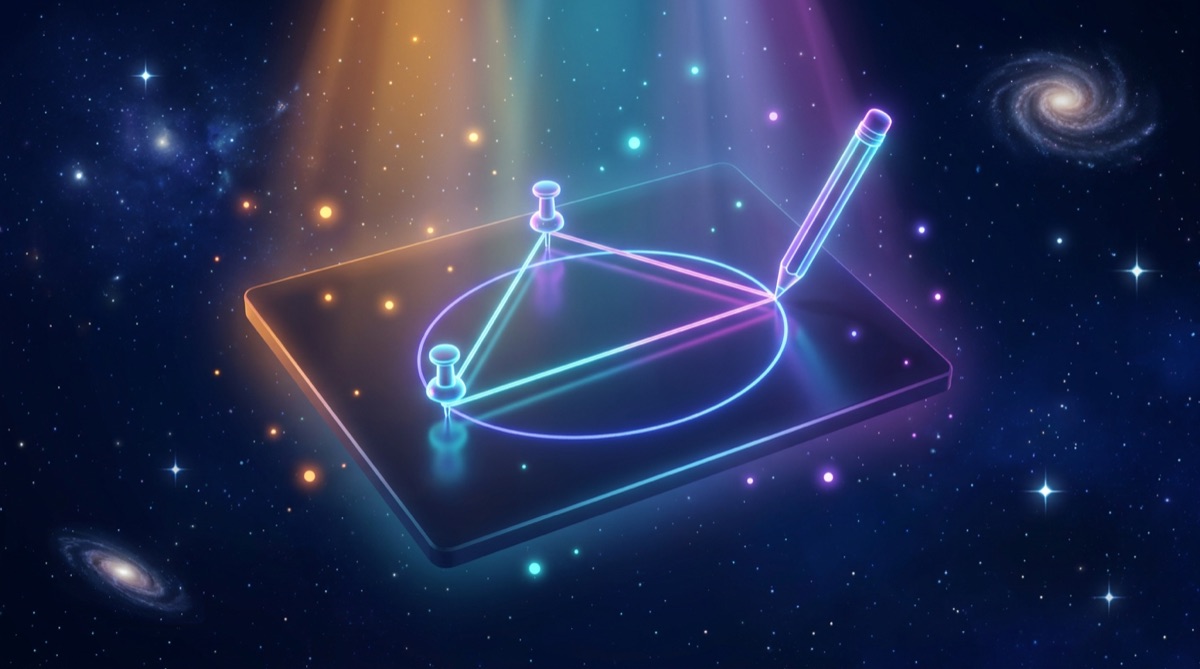
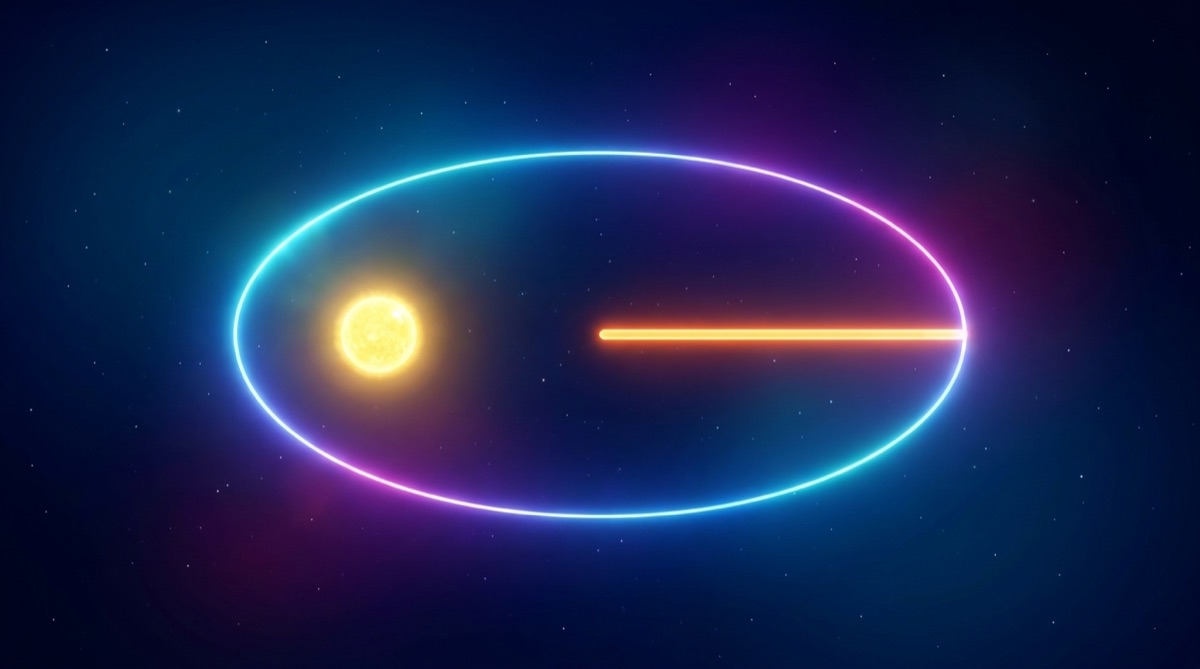
EllipseA "stretched" circle. You can draw one with a string tied to two nails (the foci): the sum of the distances to the two nails is always the same. The planets travel along ellipses with the Sun at one focus.
Apparent magnitudeA number that says how bright a star looks from Earth. The smaller it is, the brighter the star: Sirius has −1.5, and the faintest stars you can see with the naked eye, 6.
EclipticThe path the Sun seems to follow among the stars over the course of the year. The planets and the Moon always travel near that line; eclipses happen along it, which is where its name comes from.
HorizonThe line where the sky seems to touch the land or the sea. A celestial object "rises" when it crosses the horizon going up and "sets" when it crosses it going down.
EquinoxThe two days of the year (around March 20 and September 22) when day and night last the same everywhere in the world. On those days the Sun rises exactly in the east.
Semi-major axisHalf the length of the ellipse: the planet's "average" distance from the Sun. It is the number that rules Kepler's third law: the larger it is, the slower the planet.
ZenithThe point in the sky directly above your head. The opposite point, beneath your feet, is called the nadir.
DeclinationThe "latitude" of a star in the sky: how many degrees it is north (+) or south (−) of the celestial equator. Polaris has almost +90°.
Obliquity of the eclipticEarth's axis is tilted about 23.5° with respect to its orbit. That tilt causes the seasons: for some months the northern hemisphere leans toward the Sun, and for others, the southern one.
OrbitThe path one body follows around another because of gravity: the Moon around Earth, Earth around the Sun. Almost all are ellipses, slightly flattened ovals.
Capitaine, N., Wallace, P. T. & Chapront, J. (2003). Expressions for IAU 2000 precession quantities. Astronomy & Astrophysics 412, 567–586 (P03 model, adopted as IAU 2006). doi:10.1051/0004-6361:20031539
Mathews, P. M., Herring, T. A. & Buffett, B. A. (2002). Modeling of nutation and precession. Journal of Geophysical Research 107(B4), 2068 (IAU 2000A nutation model).
Urban, S. E. & Seidelmann, P. K. (eds.) (2013). Explanatory Supplement to the Astronomical Almanac, 3rd ed. University Science Books. Ch. 6 (Precession, Nutation, and Earth Rotation) and ch. 7 (reduction of positions).
Petit, G. & Luzum, B. (eds.) (2010). IERS Conventions (2010). IERS Technical Note 36. Ch. 5 (IAU 2006/2000A precession-nutation).
Meeus, J. (1998). Astronomical Algorithms, 2nd ed. Willmann-Bell. Ch. 16 (refraction), 21 (precession), 22 (nutation and obliquity), 23 (apparent places of stars).
Green, R. M. (1985). Spherical Astronomy. Cambridge University Press. Ch. 9 (precession and nutation); chapters on refraction and aberration.
Bennett, G. G. (1982). The calculation of astronomical refraction in marine navigation. Journal of Navigation 35, 255–259.
Saemundsson, T. (1986). Astronomical refraction. Sky & Telescope 72, 70.
Bradley, J. (1729). A letter … giving an account of a new discovered motion of the fix'd stars. Philosophical Transactions 35, 637–661 (discovery of aberration).
IAU (1976). System of Astronomical Constants (constant of aberration κ = 20.49552″). IAU SOFA, routines p06e, nut00b, ab, refco.