Glossary / P / The sky and coordinates
Precession
Also: precession of the equinoxes · axial precession · precession of the axis
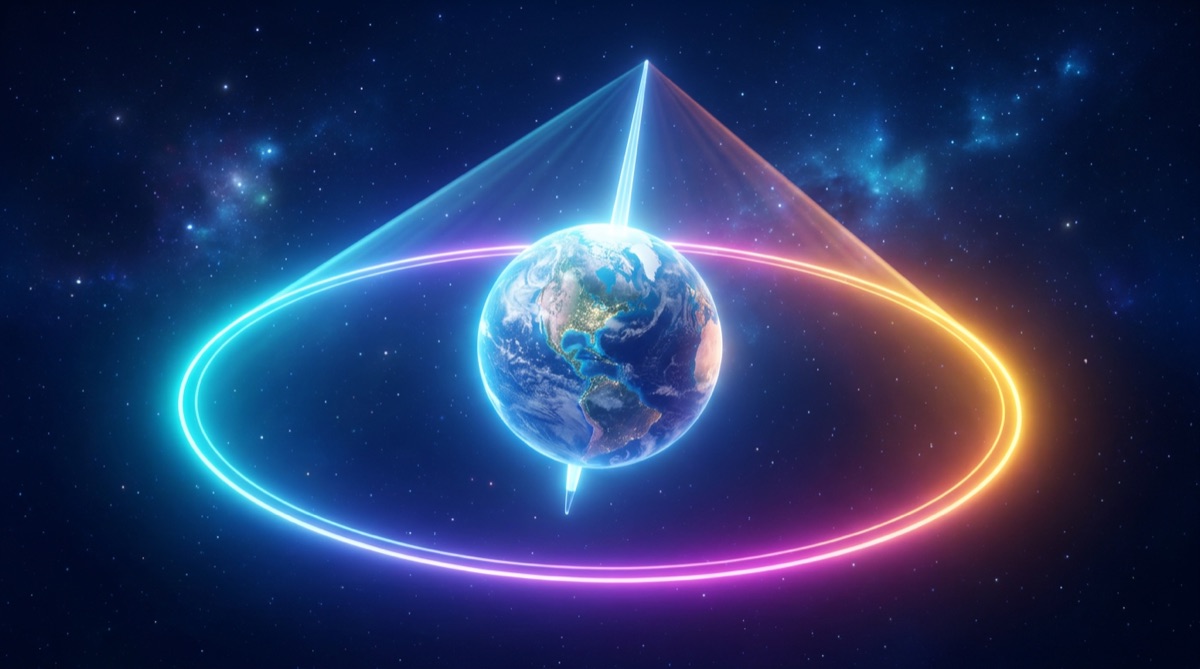
Earth's axis wobbles very slowly, like a spinning top, and takes about 26 000 years to complete one turn. That is why the star marking north changes over the millennia.
Going further
The turning of Earth's axis around the pole of the ecliptic, caused by the tidal torque of the Sun and the Moon on the equatorial bulge. The vernal point moves backward by /yr; equatorial coordinates depend on the epoch.
Reference value: 50.29″/yr → period ≈ 25 772 years Source: IAU 2006 (P03 model)
Where it is explained: Precession, nutation, aberration and refraction Higher Education
Used in these lessons
- Precession, nutation, aberration and refraction Higher Education 23 mentions
- The precession of Mercury's perihelion Higher Education 15 mentions
- Schwarzschild geodesics: orbits and light around a black hole Higher Education 10 mentions
- Time scales Higher Education 5 mentions
- Perturbation theory and the oblateness of the Earth Higher Education 5 mentions
- The two-body problem Higher Education 4 mentions
- Celestial coordinates Secondary Education 1 mention
- Phases of the Moon and eclipses Secondary Education 1 mention
- Spherical trigonometry and celestial coordinates Higher Education 1 mention