Cosmic microwave background and primordial nucleosynthesis
Thermodynamics of the CMB (T₀ = 2.72548 K), recombination with the Saha equation and decoupling at z ≈ 1090, power spectrum and acoustic peaks, and primordial nucleosynthesis: Y_p, D/H and the baryon-to-photon ratio η confronted with PDG 2025 and Planck 2018.
Compute the number and energy density of CMB photons and prove that T ∝ 1/a.
Derive the Saha equation, solve it for primordial hydrogen and explain why recombination happens at kT ≈ Q/40.
Distinguish recombination, decoupling and the last-scattering surface and estimate z ≈ 1090 with the Thomson rate.
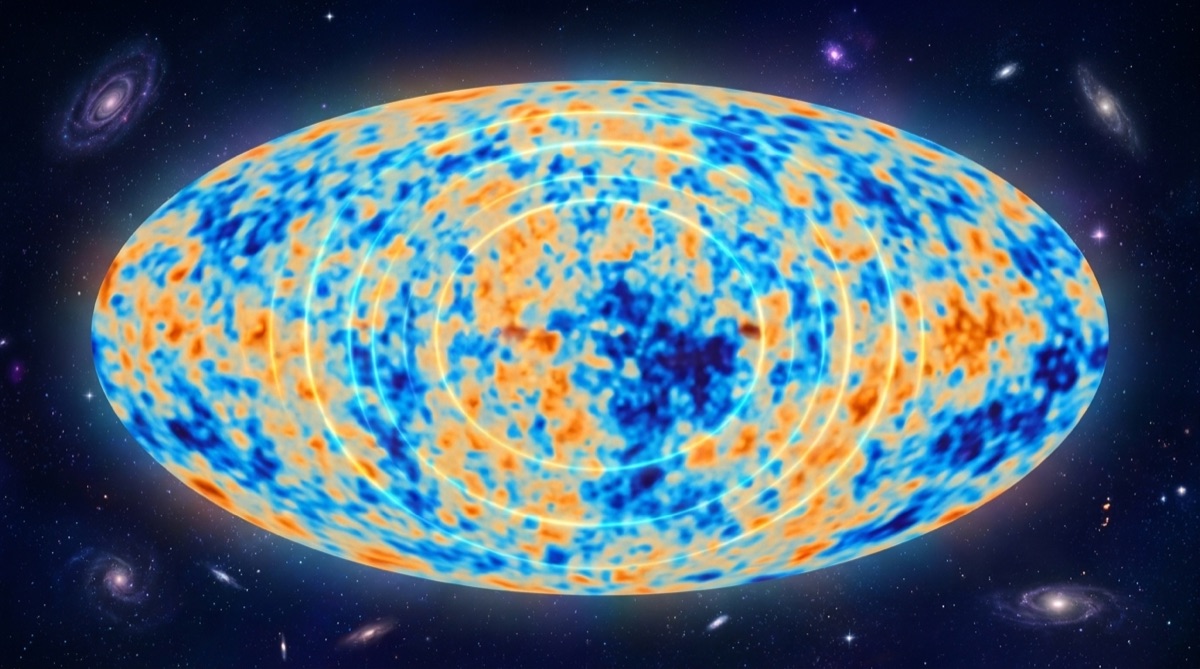
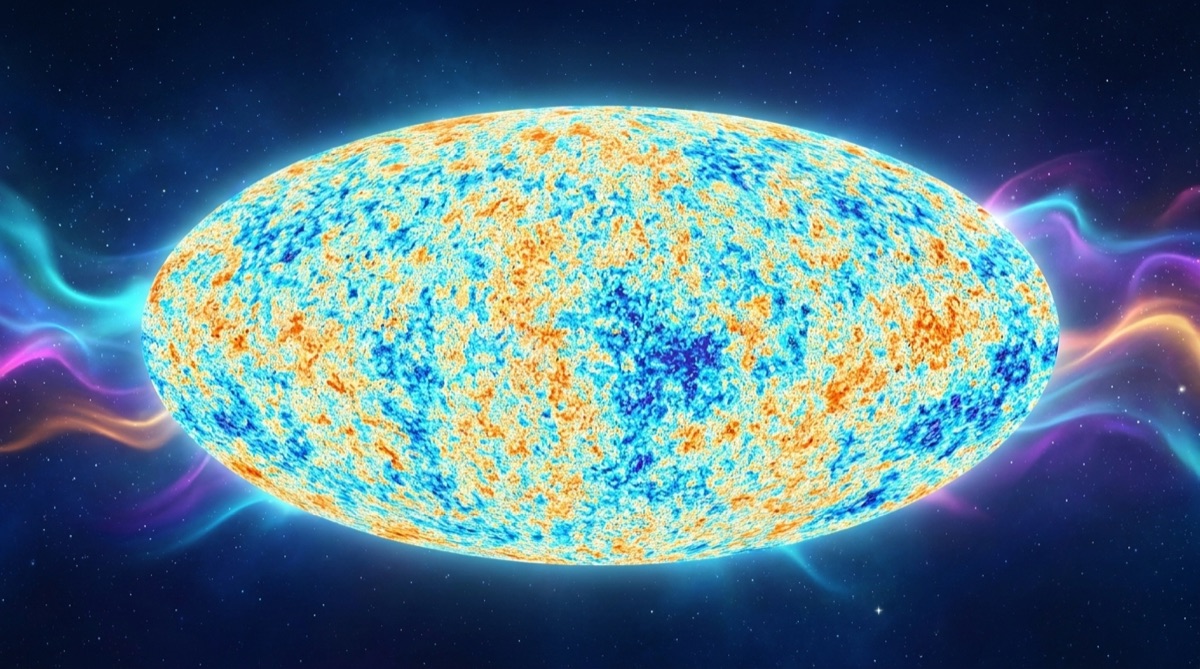
Interpret the CMB power spectrum: cosmic variance, Sachs–Wolfe plateau, sound horizon and position of the acoustic peaks.
Reproduce the n/p → Y_p chain of nucleosynthesis and confront Y_p, D/H and η with the PDG 2025 and Planck 2018 data.
1. Motivation: the most perfect blackbody
In 1965 Penzias and Wilson measured an excess antenna temperature of about 3.5 K at 4080 MHz, isotropic and without
seasonal variation. Today we know it is the thermal radiation of the early universe, with a Planck spectrum of
temperature
T0=2.72548±0.00057K
(Fixsen 2009, combining recalibrated FIRAS/COBE with WMAP and the literature). No laboratory blackbody
fits Planck’s law so well. That spectrum, its temperature and the minute anisotropies of
ΔT/T∼10−5 encode the composition of the universe. And three minutes after the Big Bang, the same
physics of thermal equilibrium fixed the abundances of the light elements. This lesson ties both together through the
same parameter: the baryon-to-photon ratio, η.
2. Thermodynamics of the cosmic photons
Densities
For a photon gas in equilibrium at temperature T (two polarizations, Bose–Einstein statistics with
zero chemical potential), the number and energy densities are
where ρc=3H02/8πG is the critical density and h=H0/(100kms−1Mpc−1). Adding
the three neutrinos (relativistic at decoupling, with temperature Tν=(4/11)1/3Tγ after
e± annihilation), Ωrh2=Ωγh2[1+87(114)4/3Neff]=4.18×10−5 with
Neff=3.044, that is Ωr=9.1×10⁻⁵ for h=0.6766: the value the library uses.
T ∝ 1/a
In a comoving volume V∝a3 the number of photons is conserved (after e± annihilation there are no
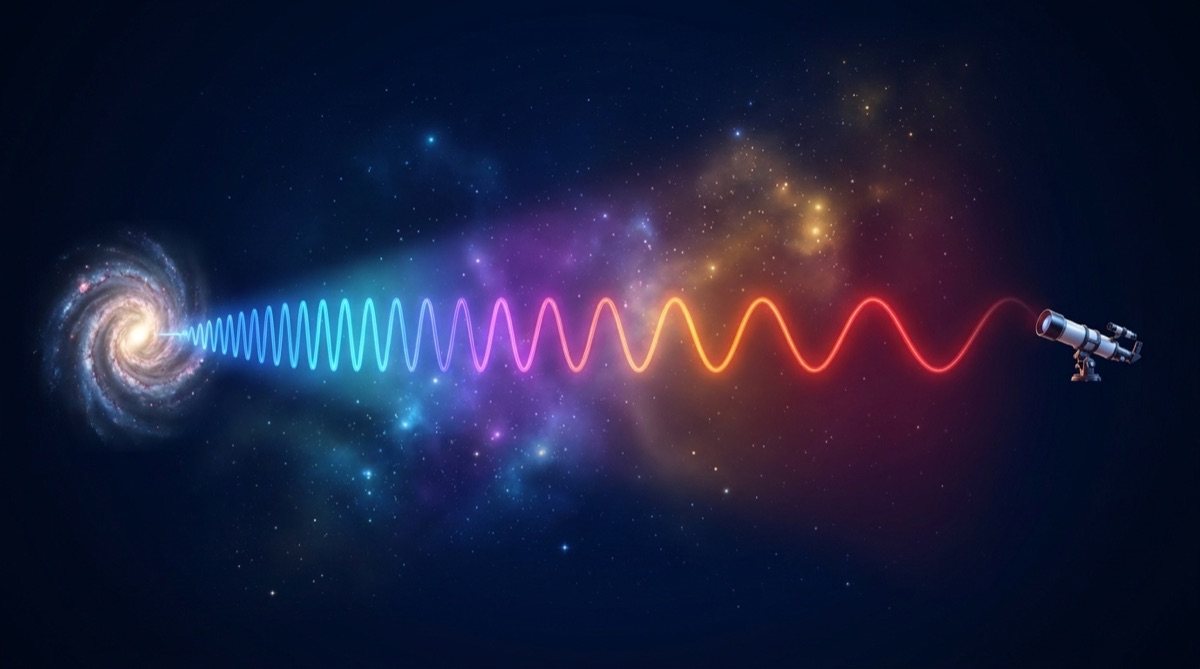
further sources) and each one redshifts as ν∝1/a. A Planck spectrum with T transforms into another
Planck spectrum with T′=Ta/a′ (problem 1), so that
T(z)=T0(1+z),εγ∝a−4,nγ∝a−3.
Matter–radiation equality, Ωm(1+z)3=Ωr(1+z)4, occurs at 1+zeq=Ωm/Ωr: with
Ωmh2=0.143, zeq=3418 (Planck 2018: 3402±26; the 0.5 % difference comes from the treatment
of the neutrino masses).
Baryons per photon
If each baryon has mass ≈mp, nb=Ωbρc/mp and
η≡nγnb=2.74×10⁻⁸Ωbh2⟹η10≡1010η=6.12±0.04
for Ωbh2=0.02237±0.00015 (Planck 2018 TT,TE,EE+lowE+lensing; PDG 2025, eqs. 24.7–24.8). There are some
1.6 billion photons for every baryon. This number governs both recombination and nucleosynthesis.
3. Recombination: the Saha equation
Consider hydrogen only (helium, with its higher ionization energy, is already neutral at this epoch) with
nH=np+nH0 the total density of hydrogen nuclei, ne=np and the ionization fractionxe≡ne/nH. In chemical equilibrium of p+e−↔H0+γ the chemical potentials satisfy
μp+μe=μH (μγ=0). For non-relativistic particles, ni=gi(mikBT/2πℏ2)3/2exp[(μi−mic2)/kBT];
forming the ratio npne/nH the potentials cancel and, with gpge/gH=1 and mp−mH≈−Q/c2
(Q=13.598 eV),
1−xexe2=nH1(2πℏ2mekBT)3/2e−Q/kBT≡S(T)
(Ryden 2017, eq. 8.26; Weinberg 2008, §2.3). Since nH=(1−Yp)ηnγ(T)∝T3, the right-hand side depends
only on T and η, and the positive root of the quadratic is xe=2S/(S+S2+4S).
Why does it recombine at kBT≪Q? Substituting nH=(1−Yp)ηnγ and writing nγ as a function of T,
The factor η−1∼109 and (mec2/kBT)3/2∼108 are only compensated when e−Q/kBT∼10−17, that is
kBT≈Q/40: there are so many photons per baryon that the Wien tail suffices to ionize down to temperatures
40 times lower than Q/kB (problem 3). Results of fraccionIonizacionSaha with η10=6.12, Yp=0.245:
xe
z
T (K)
kBT/Q
0.99
1573
4291
0.0272
0.9
1470
4008
0.0254
0.5
1369
3734
0.0237
0.1
1252
3416
0.0216
0.01
1133
3091
0.0196
The module test reproduces z=1370, T=3740 K for xe=1/2 (Ryden 2017, §8.3). Recombination is fast:
from 90 % to 10 % ionization in Δz≈220, about 70 000 years.
Limits of Saha. Equilibrium fails when the recombination rate drops below H: each direct recombination
to the ground level emits a photon that reionizes another atom, so that effective recombination proceeds
through the n=2 level and is bottlenecked by the escape of Ly α photons and by the two-photon decay
2s→1s (Peebles 1968). The result is a recombination slower than Saha and a residual fraction
xe∼10−3 that “freezes out” (Dodelson & Schmidt 2020, §4.6). Modern codes (RECFAST, HyRec,
CosmoRec) solve the kinetics with hundreds of levels.
4. Decoupling and the last-scattering surface
Photons decouple when the Thomson scattering rate Γ=neσTc drops below H.
At z=1090: nH=(1−Yp)ηnγ,0(1+z)3=2.5×10⁸ m⁻³, σT=6.65×10⁻²⁹ m², and
H=H0E(z)=2.19×10−18×2.31×104=5.1×10⁻¹⁴ s⁻¹, hence
HΓ=HxenHσTc≈970xe:
decoupling (Γ=H) occurs when xe≈10−3, well into the tail of recombination. The
last-scattering surface is defined by unit optical depth, τ(z∗)=∫neσTcdt=1;
Planck 2018 gives
z∗=1089.92±0.25,T∗=2973K,kBT∗=0.256eV,
with a width Δz≈80–100. The baryons, for their part, are released from the photon drag somewhat
later, at zdrag=1059.94±0.30, which is the epoch that sets the scale of the baryon acoustic
oscillations (BAO) with rdrag=147.09±0.26 Mpc.
5. Anisotropies and power spectrum
Dipole and multipoles
The dominant anisotropy is the dipole due to our motion relative to the CMB, of amplitude ≈3.36 mK
(370 km s⁻¹). Once subtracted, the map ΔT(n^)/T is expanded in spherical harmonics,
and one plots Dℓ=ℓ(ℓ+1)CℓT02/2π (in μK²). The multipole ℓ corresponds to an angular
scale θ≈180∘/ℓ.
Cosmic variance
We only have one sky: Cℓ is estimated from 2ℓ+1 independent (Gaussian) numbers aℓm,
so
CℓΔCℓ=2ℓ+12,
63 % for the quadrupole and 7 % at ℓ=200. It is an irreducible statistical limit, not an instrumental one.
Large scales: Sachs–Wolfe
On scales larger than the horizon at z∗ (ℓ≲50) the plasma has not had time to evolve and the
anisotropy directly reflects the primordial gravitational potential: ΔT/T=Φ/3c2 (Sachs–Wolfe effect;
the 1/3 results from combining the gravitational redshift Φ/c2 with the time delay −32Φ/c2 in a
matter-dominated universe). A scale-invariant primordial spectrum (ns=1) gives a flat Dℓ:
the “plateau”.
Acoustic peaks
Before decoupling, photons and baryons form a single fluid with sound speed
cs=3(1+R)c,R≡4ργ3ρb=4Ωγ3Ωba;
at z∗, R=0.62 and cs=0.45c. The initial overdensities oscillate through the competition between gravity and
radiation pressure; a mode of wavenumber k is left, at z∗, at phase krs, with the sound horizon
The modes with krs=nπ are at maximum compression (n odd) or rarefaction (n even) and produce the peaks.
Their angular scale is θ∗=rs/DM(z∗)=1.0411×10−2 rad (0.5965∘), measured to 0.03 %, and
ℓA≡π/θ∗=301.7; the peaks appear at ℓn≈ℓA(n−ϕn) with phase shifts ϕn≈0.27
(Hu & Dodelson 2002), hence the first peak at ℓ≈220. The physics of each feature:
Position of the first peak → θ∗ → geometry (curvature) and H0 given rs.
Relative height of odd/even peaks → R, that is Ωbh2: the baryons load the oscillator and
enhance the compressions.
Third peak and envelope → Ωmh2 through zeq (driving by potential decay in the radiation
era).
Silk damping (ℓ≳1000): photon diffusion during recombination erases the
fluctuations on scales smaller than the diffusion length.
The CMB spectrum with the simulator
T
5,772 K
λmax
502 nm
B−V
0.65
σT⁴
6.29 × 10⁷ W/m²
L/L☉
1.00
Mbol
4.74
Planck’s law Bλ(T) = (2hc²/λ⁵)/(ehc/λkT − 1). Wien’s law λmax = b/T with b = 2.898 × 10⁻³ m·K. Luminosity L = 4πR²σT⁴. The color of the circle is that of an ideal blackbody seen on an sRGB screen (normalized to maximum brightness); real stars deviate somewhat from a blackbody. Example-star values are approximate.
Set T=2.725 K: the maximum of Bλ falls at λmax=b/T=1.063 mm and that of Bν at
νmax=2.821kBT/h=160.2 GHz (the 143–217 GHz channel of Planck). Raise it to 3000 K (last scattering) and
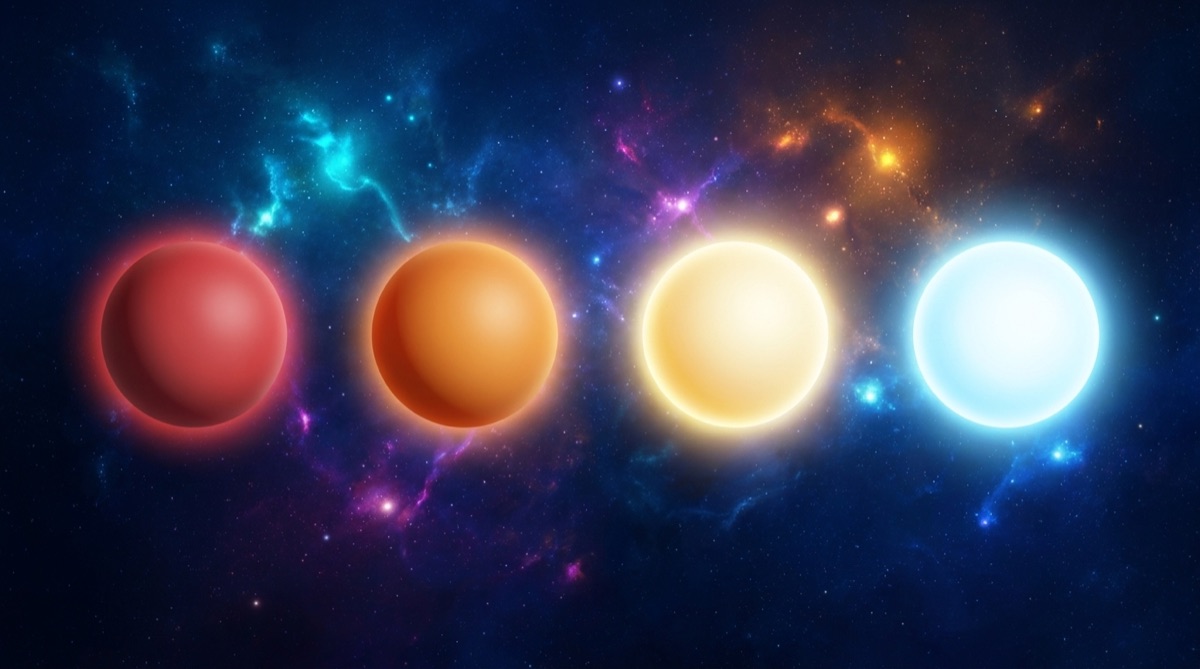
compare with the spectrum of a red dwarf: the CMB was reddish visible light.
6. Primordial nucleosynthesis (BBN)
Freeze-out of the n/p ratio
At kBT≫1 MeV the weak reactions n+νe↔p+e−, n+e+↔p+νˉe maintain
the equilibrium n/p=e−Qn/kBT with Qn=(mn−mp)c2=1.293 MeV. Their rate Γw∝GF2T5 falls
faster than H∝g∗T2/mPl, and they become equal at
kBTfr∼(GF4g∗G)1/6≃1MeV,t≈0.7s
(g∗=10.75: photons, e± and 3 neutrinos), with n/p≃1/6 (PDG 2025, §24.1). From then on the
free neutrons decay with τn=878.4±0.5 s.
The deuterium bottleneck
The nuclear chain starts with p(n,γ)D, but deuterium has binding energy BD=2.22 MeV and the
η−1∼109 photons per baryon photodissociate it until e−BD/kBT∼η, that is
kBT≈BD/ln(η−1)≈0.07–0.08 MeV, about t≈200–270 s (with g∗=3.36 after
e± annihilation). In that interval n/p falls from 1/6 to ≈(1/6)e−250/878=0.125; with the more precise value of the
freeze-out the result is n/p≃1/7 (PDG). Then almost all the neutrons end up in 4He:
Yp≡ρbρ(4He)=1+n/p2(n/p)≈8/72/7=0.25.
The traces of D, 3He and 7Li that survive depend strongly on η: the denser the plasma, the more
complete the burning and the less deuterium remains (D/H∝η−1.6 approximately), which is why deuterium
is the baryometer of BBN.
Data (PDG 2025, §24)
Quantity
Value
Source
Yp (metal-poor H II regions)
0.245±0.003
PDG 2025 eq. 24.3; Aver et al. 2021: 0.2453±0.0034
(D/H)p (absorption in quasars)
(2.508±0.029)×10−5
PDG 2025 eq. 24.2 (mean of 12 systems); Cooke et al. 2018: (2.527±0.030)×10−5
η10 (BBN, D + 4He)
6.040±0.118
PDG 2025 eq. 24.5
Ωbh2 (BBN)
0.02205±0.00043
PDG 2025 eq. 24.6
Ωbh2 (CMB, Planck 2018)
0.02237±0.00015
PDG 2025 eq. 24.7
η10 (CMB)
6.12±0.04
PDG 2025 eq. 24.8
Yp predicted with ηCMB
0.2454
Planck 2018 VI (PArthENoPE)
Nν (BBN)
2.898±0.141
PDG 2025 eq. 24.9
Two epochs separated by a factor 108 in temperature and ∼400000 years give the sameη to 1 %
precision. It is the strongest argument that the baryon density is Ωb≈0.049, far below
Ωm≈0.31: most of the matter is not baryonic. The only discrepancy is the lithium
problem: the 7Li observed in old stars is about three times lower than predicted, probably because of
stellar destruction.
Sensitivity to new physics: ΔYp≃0.013ΔNν (more relativistic species → larger H →
earlier freeze-out → more neutrons).
7. Error analysis
Recombination. Saha gives z(xe=0.5)=1369; the Peebles kinetics delays recombination and Planck places
τ=1 at z∗=1089.92±0.25. The error of Saha is not numerical (the bisection converges to 10−9) but one of
model: assuming equilibrium.
η from D/H. With D/H∝η−1.6, δη/η=δ(D/H)/(1.6D/H)=1.16%/1.6=0.7%,
that is ±0.04 in η10 from the measurement alone; the PDG ±0.118 is dominated by the nuclear
cross sections (d(p,γ)3He, d(d,n)3He, d(d,p)t).
Cosmic variance. The Planck spectrum at ℓ≲30 is limited by 2/(2ℓ+1), not by the
instrument; hence the low-quadrupole “anomaly” has little significance.
Problems
1. (Proof) A blackbody stays a blackbody. Prove that if at t1 the radiation has a Planck spectrum
with temperature T1, free expansion up to t2 produces a Planck spectrum with T2=T1a1/a2.
Proof
The number of photons in a comoving volume V∝a3 with frequencies in [ν,ν+dν] is
dN=Vc38πν2ehν/kBT1−1dν. Upon expansion, each photon goes to ν′=νa1/a2 and the
volume to V′=V(a2/a1)3; the number is conserved: dN′=dN. Expressing dN in terms of ν′,
ν2dν=(a2/a1)3ν′2dν′ and Vν2dν=V′ν′2dν′, hence
dN′=V′c38πν′2ehν′a2/(a1kBT1)−1dν′: a Planck spectrum with T2=T1a1/a2.
■
2. Photons and baryons. Compute nγ, εγ and Ωγ for T0=2.72548 K and H0=67.36 km s⁻¹ Mpc⁻¹, and the
number of photons per baryon for Ωbh2=0.02237. Propagate the uncertainty of T0 to nγ.
Show solution
nγ=4.107×10⁸ m⁻³; εγ=4.17×10⁻¹⁴ J m⁻³; ρc=8.53×10⁻²⁷ kg m⁻³ ⇒
Ωγ=5.45×10⁻⁵. nb=0.02237×1.878×10−26/1.6726×10−27=0.251 m⁻³ ⇒ nγ/nb=1.64×109.
Since nγ∝T3, δnγ/nγ=3δT/T=3×0.00057/2.72548=0.063%.
3. (Proof) kT ≈ Q/40. Write S(T) as S=Aη−1(kBT/mec2)−3/2e−Q/kBT with A a numerical constant
that you must obtain, and prove that xe=1/2 (that is, S=1/2) is reached at kBT≈Q/42 for
η=6.1×10⁻¹⁰, ignoring helium.
Proof
With nH=ηnγ=ηπ22ζ(3)(kBT/ℏc)3 and (mekBT/2πℏ2)3/2=(kBT/ℏc)3(mec2/2πkBT)3/2,
S=2ζ(3)(2π)3/2π2η1(kBTmec2)3/2e−Q/kBT, hence A=π2/[2ζ(3)(2π)3/2]=0.2606.
Let y=Q/kBT; mec2/Q=37580. The condition S=1/2 is 0.2606×1.64×109×(37580y)3/2e−y=0.5, i.e.
e−yy3/2=1.61×10−16, which by iteration (y=ln(y3/2/1.61×10−16)) gives y=42.2: kBT=Q/42.2=0.322 eV,
T=3740 K. ■
4. (Proof) Y_p and N_ν. (a) Prove Yp=2(n/p)/(1+n/p) assuming that all the neutrons end up in
4He. (b) If the freeze-out ratio is n/p=e−Qn/kBTfr and Tfr∝g∗1/6, estimate the change in Yp
when going from Nν=3 to 4 and compare it with ΔYp≃0.013ΔNν (PDG).
Proof
(a) For every neutron there are p/n protons; a 4He nucleus consumes 2 n and 2 p. With n neutrons, n/2
nuclei of mass 4m form: Yp=4(n/2)/(n+p)=2n/(n+p)=2(n/p)/(1+n/p). (b) g∗=5.5+47Nν: 10.75 → 12.5,
Tfr grows by a factor (12.5/10.75)1/6=1.0254. With Qn/kBTfr=ln6=1.79 (to reproduce n/p=1/6), the new
exponent is 1.79/1.0254=1.747, n/p=0.174; after the same decay factor 6/7: 0.149, Yp=0.260 versus
0.250: ΔYp≈0.010, of the order of the 0.013 of the full calculations. ■
5. (Computational) Saha versus the library. Solve xe(z) by bisection for η10=6.12 and Yp=0.245,
plot xe between z=1800 and 1000 and locate z(xe=0.5) and z(xe=0.01). Repeat with η10=3 and 12: how does
recombination shift?
Outline in Python
import numpy as npkB, hbar, c, me, eV = 1.380649e-23, 1.054571817e-34, 2.99792458e8, 9.1093837e-31, 1.602176634e-19Q, T0, z3 = 13.598 * eV, 2.72548, 1.2020569def x_e(z, eta10=6.12, Yp=0.245): T = T0 * (1 + z) ng = 2 * z3 / np.pi**2 * (kB * T / (hbar * c))**3 nH = (1 - Yp) * eta10 * 1e-10 * ng S = (me * kB * T / (2 * np.pi * hbar**2))**1.5 * np.exp(-Q / (kB * T)) / nH return 2 * S / (S + np.sqrt(S * S + 4 * S))z = np.linspace(1800, 1000, 801)for eta10 in (3, 6.12, 12): x = x_e(z, eta10) print(eta10, z[np.argmin(abs(x - 0.5))], z[np.argmin(abs(x - 0.01))])
With η10=6.12: 1369 and 1133. More baryons per photon (larger η) ⇒ smaller S ⇒ somewhat earlier
recombination (larger z), but only logarithmically: doubling η moves z(1/2) by about 20 units.
6. Cosmic variance and sound horizon. (a) With what relative precision can Cℓ be measured at ℓ=2, 10 and 1000
with a noiseless full-sky map? (b) Estimate rs as csη∗, where η∗=281 Mpc is the comoving particle horizon
at z∗ (lesson 4) and cs=0.45c, and compare it with 144.43 Mpc. Why does it come out smaller?
Show solution
(a) 2/5=63%, 2/21=31%, 2/2001=3.2%. (b) 0.45×281=126 Mpc, 13 % less than the true
value because cs was larger in the past (R∝a: cs→c/3=0.577c as a→0); the integral of cs weights
the early epochs more than the estimate with the final value does.
7. Decoupling. Repeat the calculation of §4 at z=1300 with xe(1300) from Saha and at z=1000 with xe=10−3. In which of
the two are the photons coupled?
Show solution
At z=1300, Saha gives xe≈0.2, nH∝(1+z)3=4.2×10⁸ m⁻³, Γ=0.2×4.2×108×6.65×10−29×3×108=1.7×10⁻¹² s⁻¹;
H(1300)=H0Ωr(1301)4+Ωm(1301)3=6.7×10⁻¹⁴ s⁻¹: Γ/H=25, coupled. At z=1000 with xe=10−3,
since Γ∝xe(1+z)3 and H∝(1+z)3/2 in the matter era, Γ/H≈970xe(1001/1091)3/2≈0.85: already decoupled.
✦ Self-assessment
Answer all the questions to check.
Further reading
Ryden, B. (2017). Introduction to Cosmology, 2nd ed., ch. 8 (CMB: Saha, decoupling, anisotropies) and ch. 9 (BBN: n/p, deuterium bottleneck).
Dodelson, S. & Schmidt, F. (2020). Modern Cosmology, 2nd ed., §4.6 (recombination with Peebles) and ch. 9 (anisotropies, acoustic peaks).
Weinberg, S. (2008). Cosmology, ch. 2 (thermal history: §2.3 recombination, §2.4 nucleosynthesis) and ch. 7 (anisotropies).
Hu, W. & Dodelson, S. (2002). ARA&A 40, 171: the standard reference on the physics of the acoustic peaks.
By the end, the student computes the thermal properties of the CMB, solves the Saha equation and explains quantitatively the position of the acoustic peaks and the agreement between the η of BBN and that of the CMB.
Evidence of learning
Submission of problem 5 (numerical Saha with three values of η) and of problem 4 (Y_p and N_ν) with derivation.
Materials
Python 3 with NumPy or src/lib/math/recombinacion.ts
Printed Planck 2018 power spectrum (figure 1 of Planck 2018 VI)
Simulator cuerpo-negro
PDG 2025 §24, table 24.1
Suggested sequence
Class 1. Thermodynamics (§2) with a live calculation of nγ and η; derivation of Saha (§3) and numerical solution
in class (problem 5); decoupling with the ratio Γ/H (§4).
Class 2. Guided reading of the Planck spectrum: point out the plateau, peaks 1–3 and the damping, and associate each feature
with a parameter (§5). Nucleosynthesis (§6) as a chain of four numbers: Qn, Tfr, τn, BD. Close with the PDG
table and the agreement ηBBN=ηCMB.
Common mistakes
Thinking that recombination happens at kT = 13.6 eV: problem 3 dismantles this with the factor 1/η.
Confusing recombination (x_e = ½, z ≈ 1370), decoupling (Γ = H, x_e ~ 10⁻³) and last scattering (τ = 1, z ≈ 1090).
Believing that the first peak is at exactly ℓ = π/θ*: there are projection phase shifts (ℓ ≈ 220 versus ℓ_A ≈ 302).
Attributing Y_p ≈ 0.25 to a coincidence: it follows from n/p ≈ 1/7, fixed by Q_n, T_fr and τ_n.
Key terms in this lesson (11)
Glossary terms that appear in the text. Each one links to its full entry.
Cosmic microwave backgroundThe oldest light in the universe: it set out when the universe was 380 000 years old and today arrives from every direction, cooled to 2.7 degrees above absolute zero. It is the "baby picture" of the cosmos.
SpectrumThe light of a star separated into all its colors, as a prism or a rainbow does. In it there are "fingerprints" that tell what the star is made of and how hot it is.
Stellar nucleosynthesisThe manufacture of chemical elements inside stars: hydrogen makes helium; helium makes carbon and oxygen; and so on up to iron. The calcium in your bones was made in a star.
BlackbodyAn ideal object that absorbs all the light it receives and glows only because of its temperature. A red-hot iron or a star behaves almost like one: its color tells how hot it is.
HorizonThe line where the sky seems to touch the land or the sea. A celestial object "rises" when it crosses the horizon going up and "sets" when it crosses it going down.
Planck's lawThe formula that says how much light of each color a hot object emits. It explains why cool stars are reddish and hot stars are bluish.
RedshiftThe light from distant galaxies arrives "stretched" toward the red because the universe expands while it travels. The farther the galaxy, the larger the redshift.
Big BangThe beginning of the expansion of the universe, 13.8 billion years ago, when everything was unimaginably hot and dense. It was not an explosion "in" space: it was space itself starting to stretch.
GravityThe force with which a planet pulls everything toward its center. On Earth it makes things fall 9.8 m/s faster every second; on Mars, with less mass and a smaller size, it is only 38 % of Earth's.
Light-yearThe distance light travels in one year. It does not measure time, it measures distance: about 9.5 trillion kilometers.
Mass and weightMass is how much "stuff" you are made of, and it is the same anywhere. Weight is the force with which a planet pulls on you: on the Moon you would weigh six times less, but your mass would be the same.
Fields, B. D., Molaro, P. & Sarkar, S. (2025). Big-Bang nucleosynthesis, in Particle Data Group, Review of Particle Physics, §24 (rev. December 2025).
Cooke, R. J., Pettini, M. & Steidel, C. C. (2018). One percent determination of the primordial deuterium abundance. ApJ 855, 102. doi:10.3847/1538-4357/aaab53.
Aver, E. et al. (2021). Improving helium abundance determinations with Leo P as a case study. JCAP 03, 027. arXiv:2010.04180.
Ryden, B. (2017). Introduction to Cosmology, 2nd ed., chs. 8 (CMB) and 9 (nucleosynthesis).
Dodelson, S. & Schmidt, F. (2020). Modern Cosmology, 2nd ed., Academic Press, chs. 4 and 9.
Weinberg, S. (2008). Cosmology, chs. 2 and 3.
Hu, W. & Dodelson, S. (2002). Cosmic microwave background anisotropies. ARA&A 40, 171. doi:10.1146/annurev.astro.40.060401.093926.
Peebles, P. J. E. (1968). Recombination of the primeval plasma. ApJ 153, 1. doi:10.1086/149628.
Penzias, A. A. & Wilson, R. W. (1965). A measurement of excess antenna temperature at 4080 Mc/s. ApJ 142, 419.