Mass and weight
Also: weight · weigh
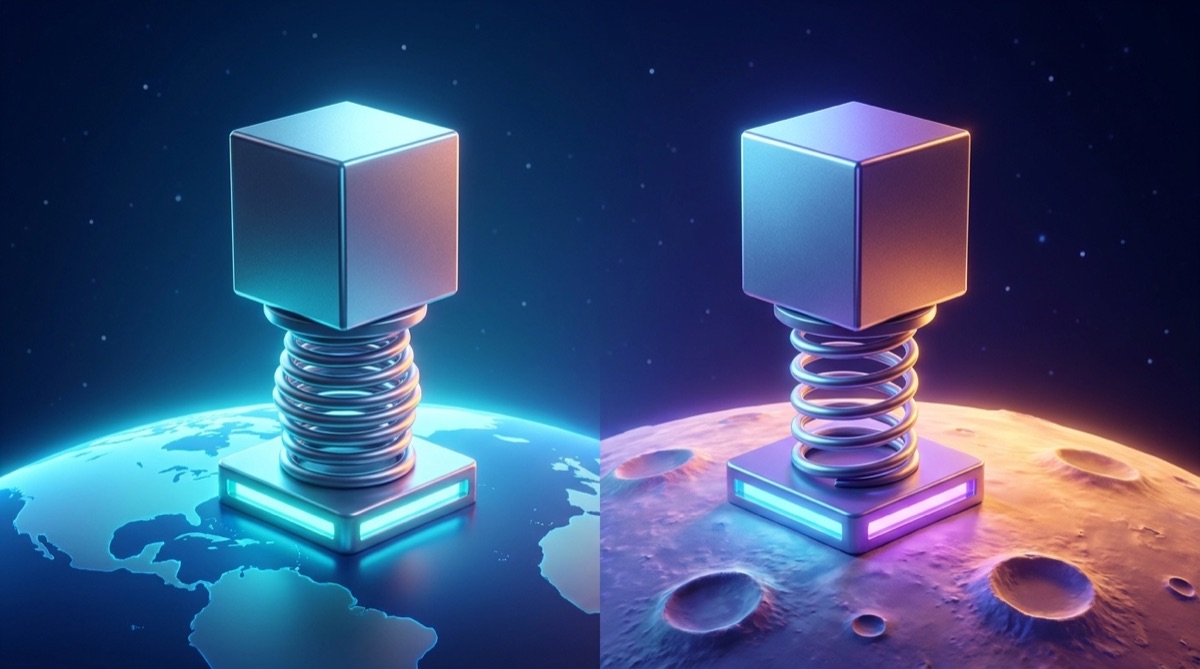
Mass is how much "stuff" you are made of, and it is the same anywhere. Weight is the force with which a planet pulls on you: on the Moon you would weigh six times less, but your mass would be the same.
Going further
, where is the local gravity. Mass (kg) is invariant; weight (N) depends on the body you are on. A balance scale compares masses; a spring scale measures weight.
Where it is explained: How much would you weigh on Mars? Elementary Education
Related terms
Used in these lessons
- How much would you weigh on Mars? Elementary Education 24 mentions
- Universal gravitation and satellites Secondary Education 7 mentions
- Weighing the Sun and the planets Secondary Education 5 mentions
- Radiative and convective transport Higher Education 5 mentions
- The equations of stellar structure Higher Education 3 mentions
- Lomb–Scargle periodograms Higher Education 3 mentions
- The universe is expanding Secondary Education 2 mentions
- Tides Secondary Education 2 mentions
- Eratosthenes measures the Earth Secondary Education 2 mentions
- Deflection of light and gravitational lenses Higher Education 2 mentions
- The lives of stars Secondary Education 1 mention
- The Milky Way and other galaxies Secondary Education 1 mention
- The Chandrasekhar limit Higher Education 1 mention
- Time scales Higher Education 1 mention
- Transits and light curves Higher Education 1 mention
- Cosmic microwave background and primordial nucleosynthesis Higher Education 1 mention
- Runge–Kutta and adaptive step size Higher Education 1 mention