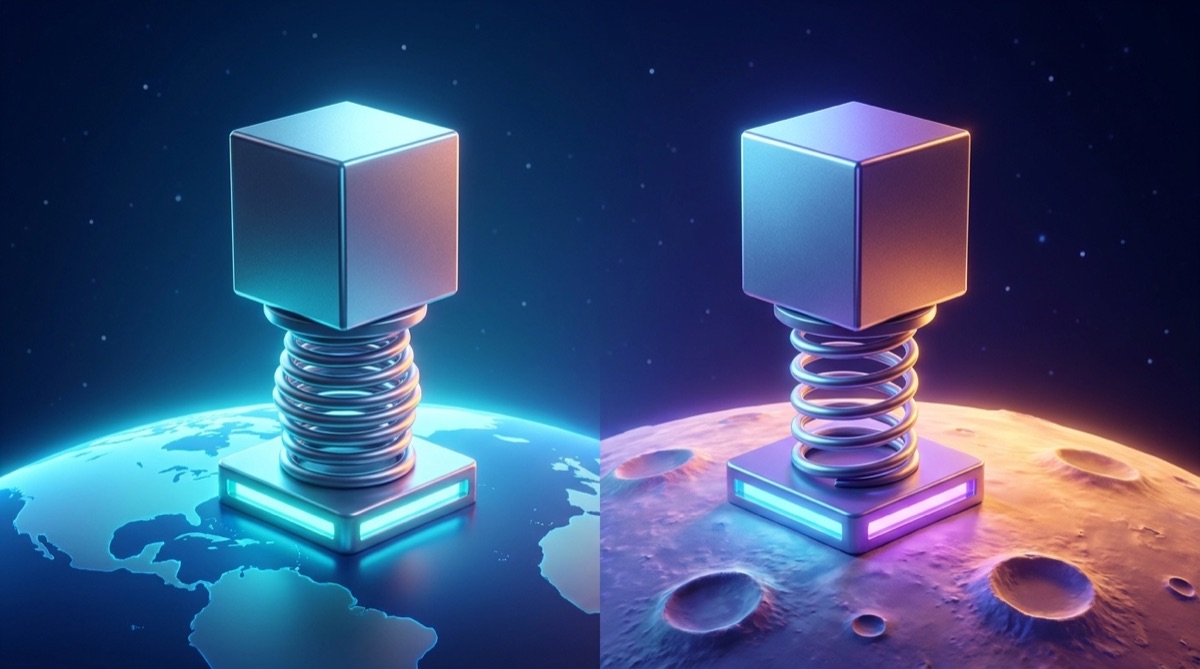
A bathroom scale on Mars
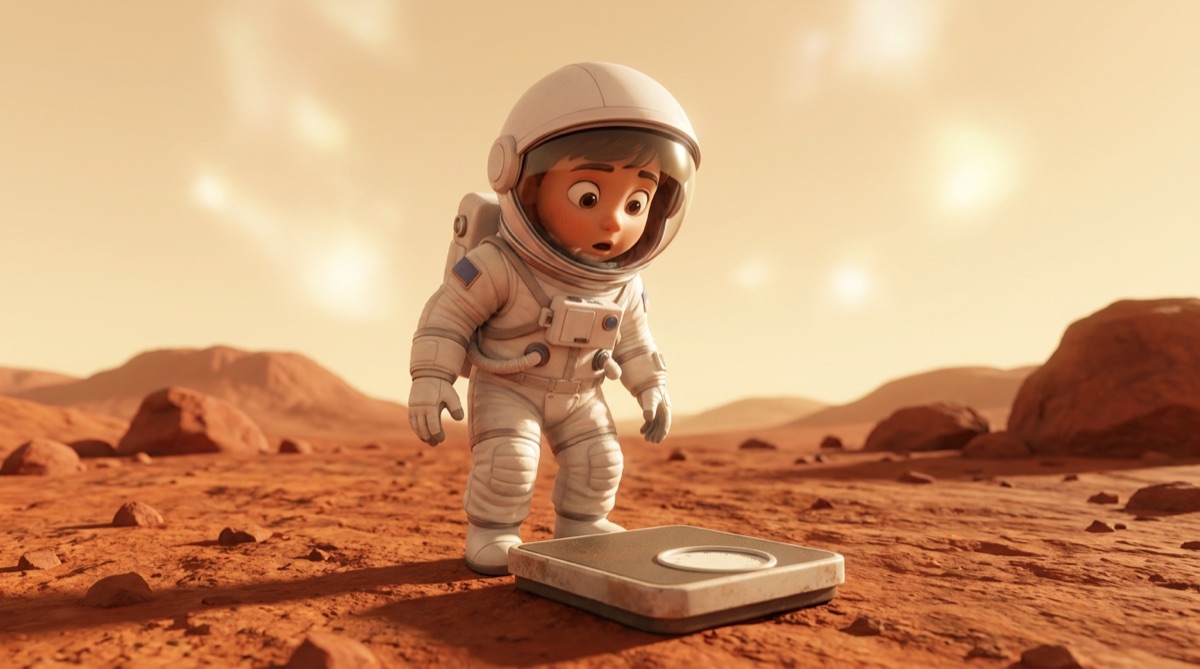
Imagine you travel to Mars and take the bathroom scale with you. You step on it and… it reads less than half!
Did you lose weight on the trip? No. You are still the same. What changed is the force with which the planet pulls on you.
Mass and weight are not the same

Mass is how much matter you have. It is measured in kilograms (kg). Your mass is the same at home, on the Moon or on Mars.
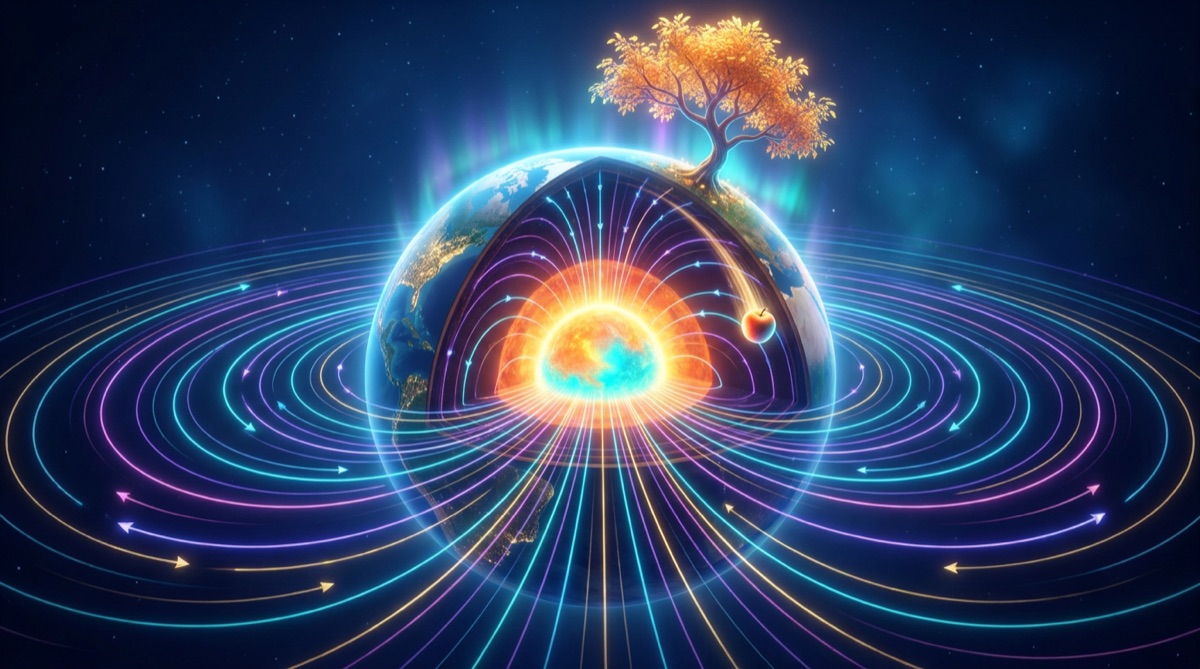
Weight is the force with which a planet pulls you toward it. A planet with more gravity pulls you harder. One with less gravity pulls you more gently.
When you step on a scale, the scale measures how hard you press on it. Then it turns that into “kilos”, assuming you are on Earth. That is why, on Mars, the same scale would read less.
Each planet’s factor
Each place has a factor: a number that tells us how many times harder (or more gently) it pulls compared with Earth.
| Place | Factor (compared with Earth) | If on Earth the scale reads 30 kg… |
|---|---|---|
| Mercury | 0.38 | 11.4 kg |
| Venus | 0.91 | 27.3 kg |
| Earth | 1 | 30 kg |
| Moon | 0.16 | 4.8 kg |
| Mars | 0.38 | 11.4 kg |
| Jupiter* | 2.36 | 70.8 kg |
| Saturn* | 0.92 | 27.6 kg |
| Uranus* | 0.89 | 26.7 kg |
| Neptune* | 1.12 | 33.6 kg |
| Pluto | 0.07 | 2.1 kg |
* The giants have no ground: this is what the scale would read while floating at the height of their clouds.
To calculate, we multiply:
A factor less than 1 makes the number smaller. A factor greater than 1 (Jupiter, Neptune) makes it bigger.
Multiplying by a decimal, step by step

Let’s calculate .
- Forget the decimal point for a moment: .
- The number 0.38 has two digits after the decimal point: they are hundredths.
- So the result also has two decimal digits: .
On Mars, the scale would read 11.4 kg.
A trick for estimating: 0.38 is almost 0.4, and multiplying by 0.4 is like taking 4 tenths. . Our result (11.4) is close: good!
On the Moon the factor is 0.16, almost one sixth. If on Earth the scale reads 30 kg, on the Moon it would read about kg. (Exactly: 30 × 0.16 = 4.8 kg.)
Weight on each planet: a table for you
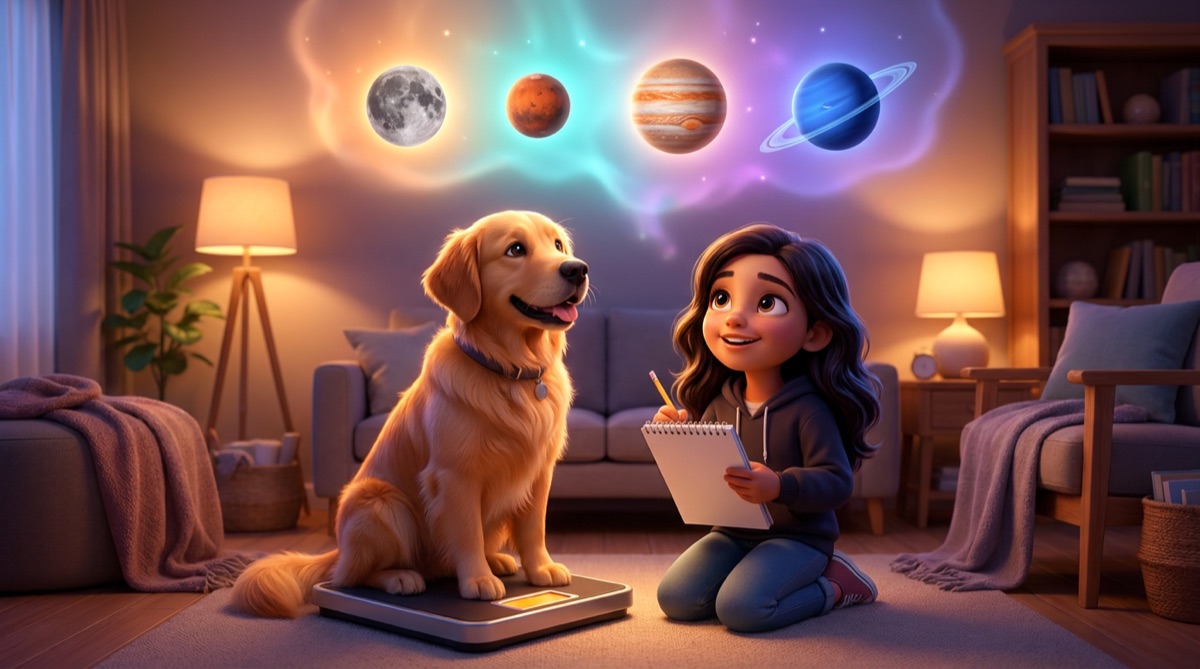
Take what your scale reads (or the mass of your backpack, or of a 20 kg dog) and complete:
| Place | Factor | Estimate | Exact calculation |
|---|---|---|---|
| Earth | 1 | — | ? |
| Moon | 0.16 | ÷ 6 | ? |
| Mars | 0.38 | × 0.4 | ? |
| Jupiter | 2.36 | × 2 and a bit more | ? |
| Neptune | 1.12 | a bit more than on Earth | ? |
Order the places from lowest to highest weight. Does it match the order of the factors?
Jumping on the Moon
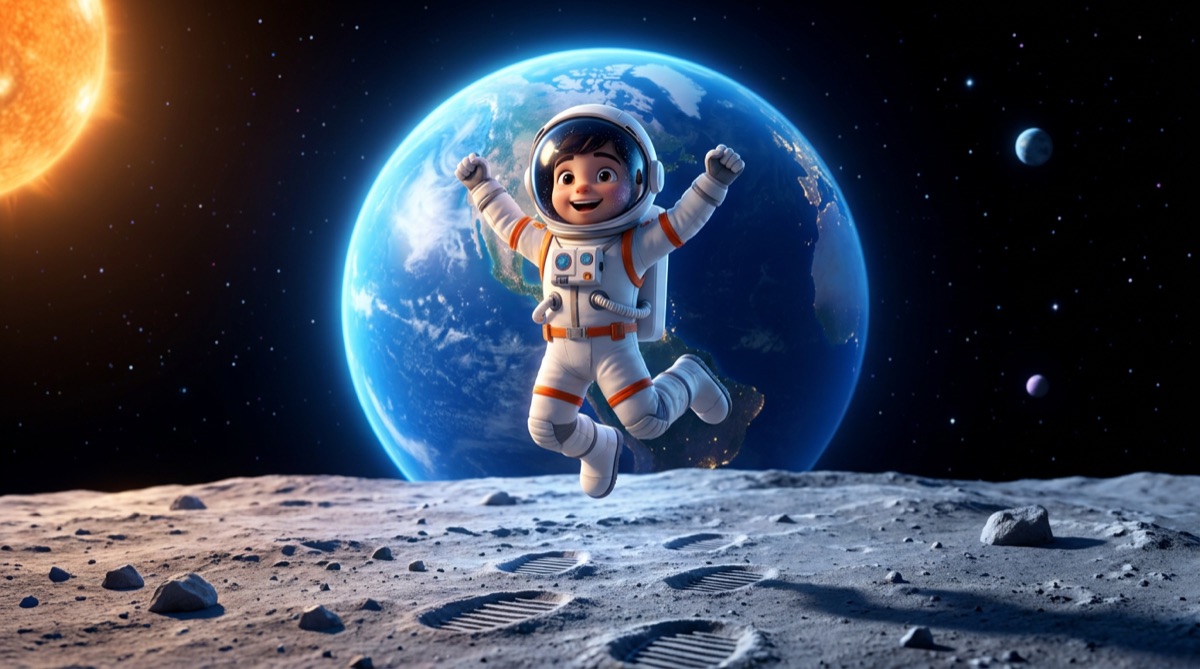
If a planet pulls you more gently, you jump higher. With the same push, the height of the jump is as many times greater as gravity is smaller.
- On the Moon gravity is 0.16 of Earth’s, almost . You jump about 6 times higher.
- On Mars it is 0.38. : you jump about 2 and a half times higher.
If on Earth you jump 40 cm straight up:
| Place | Jump height |
|---|---|
| Earth | 40 cm |
| Mars | 40 × 2.6 ≈ 104 cm, more than a meter! |
| Moon | 40 × 6 = 240 cm, higher than a door! |
The astronauts of the Apollo program did not jump that high on the Moon: their suits were heavy and stiff. But they did walk in hops, because each step lifted them more than they expected.
For Grade 5: weight in newtons

Scientists measure weight in newtons (N). It is calculated like this:
where is the weight (in newtons), is the mass (in kilograms) and is the gravity of the place (on Earth, ).
A 30 kg child weighs N on Earth. On Mars () the child weighs N.
Notice: . The factor in the table comes from dividing the two gravities!
Play with the simulator

Open the How much would you weigh? tab and type in what your scale reads.
- Where would you weigh the most? And the least?
- Why does Saturn, being so big, pull on you almost the same as Earth? (Hint: it is enormous but not very dense, and its “surface” is very far from the center.)
- Look at the age column: how many “Mars years” old are you?
Activity: feel a kilo of Mars
Materials: plastic bags, rice or sand, a kitchen scale (or a homemade spring scale), a two-pan balance (it can be a clothes hanger with two cups), marker, tape measure.
Homemade spring scale: hang a rubber band (or a spring) from a pencil. At the bottom, hook on a plastic cup with a paper clip. Tape a ruler next to it and mark how far the cup drops with different loads.
- Fill a bag with 1 kg of rice. Call it the “Earth bag”.
- What would that bag read on Mars? kg = 380 g. Fill another bag with 380 g. Call it the “Mars bag”.
- Lift one bag in each hand. That is how 1 kg of rice on Mars would feel.
- Do the same for the Moon (160 g) and Jupiter (2 360 g, heavy!).
- Hang the bags on the spring scale and write down how much the band stretches. Make a table: place, grams, centimeters of stretch.
- Jump: measure with the tape measure how high you jump (mark on the wall with chalk the tip of your fingers standing and jumping). Calculate how high you would jump on Mars and on the Moon.
Final question: a two-pan balance compares two masses. If you took it to Mars with 1 kg on each pan, would it still be balanced? Why? (Yes: both sides become lighter by the same amount. The balance measures mass; the bathroom scale, weight.)
Exercises
- A girl’s scale reads 40 kg on Earth. What would it read on Mars? Estimate first.
Show solution
Estimate: 40 × 0.4 = 16. Calculation: 40 × 38 = 1 520; two decimals: 15.2 kg.
- For the same girl, what would it read on the Moon? And on Jupiter?
Show solution
Moon: 40 × 0.16 = 6.4 kg (estimate: 40 ÷ 6 ≈ 6.7). Jupiter: 40 × 2.36 = 94.4 kg (estimate: 40 × 2 = 80 and a bit more).
- A 5 000 kg elephant travels to the Moon. What is its mass there? And what would a scale read?
Show solution
Its mass is still 5 000 kg: mass does not change. The scale would read 5 000 × 0.16 = 800 kg.
- On Earth you jump 50 cm. How high would you jump on Mars? And on the Moon?
Show solution
Mars: 50 × 2.6 = 130 cm. Moon: 50 × 6 = 300 cm, that is, 3 meters.
- (For Grade 5) Calculate the weight in newtons of the 40 kg girl on Earth and on the Moon (g = 1.6).
Show solution
Earth: 40 × 9.8 = 392 N. Moon: 40 × 1.6 = 64 N. Check: 64 ÷ 392 ≈ 0.16, the Moon’s factor.
✦ Mini-quiz
Remember
- Mass does not change from one place to another; weight does, because it depends on gravity.
- To find out what the scale would read on another world, we multiply by a factor.
- When multiplying by a decimal, we count the digits after the decimal point to place it in the result.
- Estimating first (0.38 ≈ 0.4; 0.16 ≈ 1/6) tells us whether the result is reasonable.
- On the Moon you would jump about 6 times higher; on Mars, about 2 and a half times.
🍎 Teacher guide
- Time
- 2 sessions of 55 min
- Colombian national standard (MEN)
- Natural Sciences, Grades 4 to 5: 'I compare the weight and the mass of an object at different points in the solar system'; 'I relate the state of rest or motion of an object to the forces applied to it'; 'I take measurements with conventional instruments (balance, scale, stopwatch, thermometer...) and non-conventional ones (pace, hand span, foot, fathom, cup...)'. Mathematics, Grades 4 to 5: 'I use decimal notation to express fractions in different contexts and relate these two notations to that of percentages'; 'I solve and pose problems in situations of direct and inverse proportionality and product of measures'; 'I use various calculation and estimation strategies to solve problems in additive and multiplicative situations'; 'I recognize the use of some magnitudes (length, area, volume, capacity, weight and mass, duration, speed, temperature) and of some of the units used to measure quantities of the respective magnitude in additive and multiplicative situations'.
- Evidence of learning
- Explains in their own words the difference between mass and weight and illustrates it with the two-pan balance; completes the table of weights in four places, estimating before calculating; builds and uses a homemade spring scale; calculates their jump on the Moon and on Mars. In Grade 5, calculates weights in newtons and obtains the factor by dividing gravities.
Materials
- Plastic bags and rice or sand (about 4 kg per group)
- Kitchen scale
- Rubber bands, plastic cups, paper clips, pencils and rulers for the spring scale
- Clothes hanger and two cups for the two-pan balance
- Tape measure and chalk to measure the jump
- Computer or tablet with the simulator (How much would you weigh? tab)
Suggested sequence
Session 1. Mass, weight and factors (55 min). Opening (10 min): “If you take the bathroom scale to Mars, does it read the same? And if you take a two-pan balance?” (vote). Development (35 min): mass versus weight; table of factors; multiplying by decimals step by step with estimation; activity “feel a kilo of Mars”, steps 1 to 5. Closing (10 min): exercises 1 to 3.
Session 2. Jumping on the Moon (55 min). Opening (10 min): short video of Apollo astronauts walking in hops. Development (30 min): section “Jumping on the Moon”, measuring the jump on the wall and calculating for Mars and the Moon; simulator in How much would you weigh?; for Grade 5, weight in newtons and where the factor comes from. Closing (15 min): exercises 4 and 5 and mini-quiz.
Note on the data. The factors come from dividing the gravity of each place (NASA’s Planetary Fact Sheet) by 9.8 m/s² and rounding to hundredths. The jump height is calculated assuming the same take-off speed; real space suits reduce the jump a lot, as the Apollo videos show.
Common mistakes
- Saying “on the Moon I have less mass”. Mass does not change; weight does. Use the two-pan balance to show it.
- Placing the decimal point “by eye” when multiplying by decimals. Require counting the decimal digits of the factor and checking with the estimate.
- Believing that big planets always pull harder. Saturn (0.92) pulls less than Earth despite its size: gravity depends on mass and on the distance to the center.
- Thinking that on the Moon you float. Gravity is smaller, not zero: an object falls, just more slowly.
- In Colombia the decimal separator is a comma (0.38 is written with a comma); the simulator shows a point (0.38). Accept both notations.
- If a student is sensitive about their weight, suggest using the mass of an object (a backpack, a dog, a 5 000 kg elephant).