November is a good month for early risers. From Colombia, with the Sun rising shortly before six, the last hours of the night bring a parade of four planets, a very close conjunction of Mars and Jupiter, and the Leonid meteor shower with the Moon out of the way. And for those who prefer the early evening, Saturn rules the sky after dinner. All times in this article are Colombia time (UTC−5).
The phases of the Moon
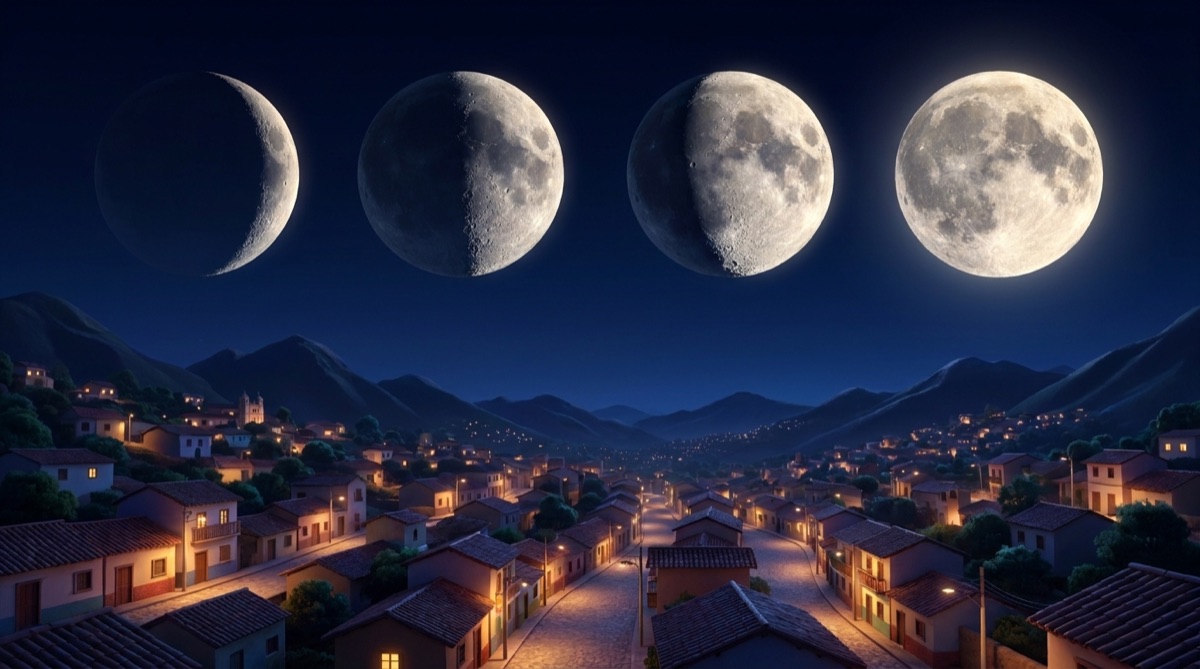
| Phase | Date and time (Colombia) |
|---|---|
| Last quarter | Sunday, November 1, 15:28 |
| New moon | Monday, November 9, 02:02 |
| First quarter | Tuesday, November 17, 06:48 |
| Full moon | Tuesday, November 24, 09:53 |
The new moon on the 9th opens the best week of the month for deep-sky objects and meteors: from the 6th to the 13th the Moon barely gets in the way. Around first quarter, the Moon sets near midnight and leaves the early-morning hours dark, which is just what the Leonids need. The full moon on the 24th rises at dusk and stays up all night; that is the night for looking at craters with binoculars, not for hunting galaxies.
With the simulator you can see the Sun–Earth–Moon geometry for any date and check why the first-quarter Moon can be seen in the afternoon sky.
The planets
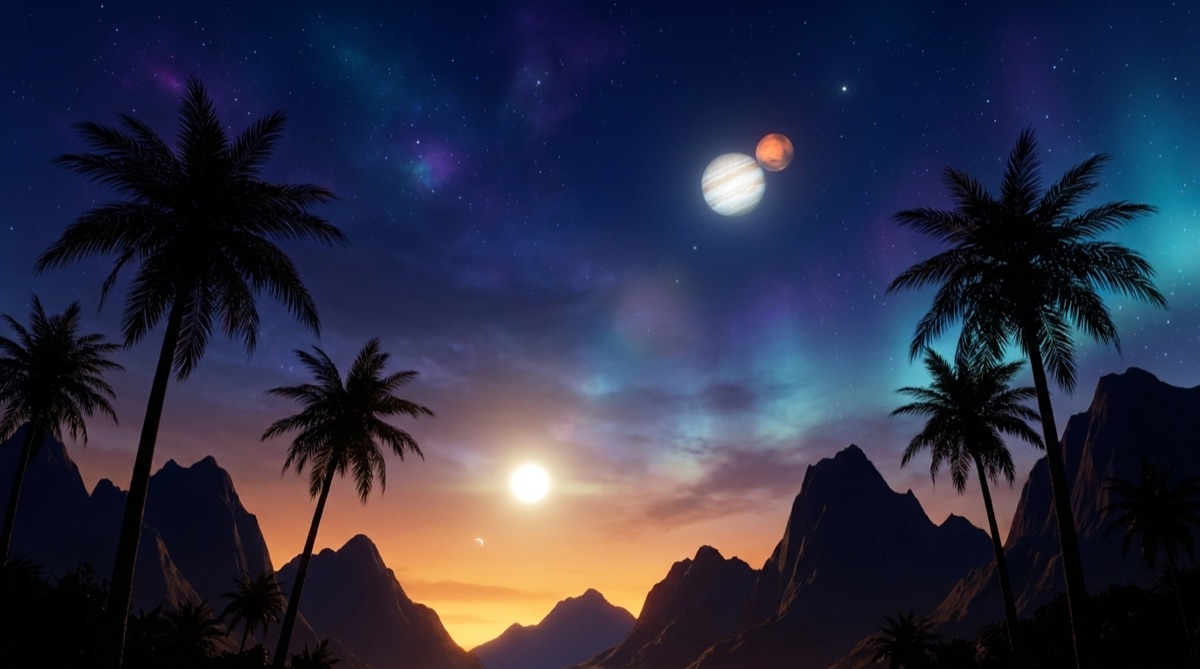
Saturn, in the evening. It passed opposition on October 4, so in November it is already high in the sky by nightfall and sets in the small hours. It lies in the Cetus–Pisces region, an area with no bright stars, which makes it easy to pick out: a steady, yellowish point that does not twinkle. A small telescope shows the rings, which this year appear almost edge-on. On November 20 the gibbous Moon passes just above it. Neptune is in the same area, but it takes binoculars or a telescope and a chart to see it.
Uranus, at midnight. It reaches opposition on November 25, between the Pleiades and the Hyades, in Taurus. It is visible in binoculars as a tiny greenish point; to the naked eye, only from a very dark sky and knowing where to look.
Mars and Jupiter, before dawn. Both are in Leo and rise around midnight; by 4 or 5 a.m. they are high in the east. Jupiter is the brighter one; Mars, reddish, closes in on it day by day until the conjunction of November 15–16, when they are just over a degree apart: two full-Moon diameters, the width of a little finger at arm’s length. They will look like a double star of two different colors. Afterwards Mars moves on, and on the 26th it passes Regulus, the brightest star of Leo. The waning Moon passes near both on the 2nd and 3rd, and a thin waning crescent visits them again on the 30th.
Venus, before sunrise. Venus passed between Earth and the Sun at the end of October, and in November it emerges into the morning sky: early in the month it barely pulls away from the Sun, but by month’s end it rises almost three hours ahead of it, in Virgo, near Spica. It reaches its greatest morning brilliancy on November 29. It is by far the brightest object in the sky after the Sun and the Moon.
Mercury, low and tricky. It passes inferior conjunction (between Earth and the Sun) early in the month and reappears very low above the eastern horizon, below Venus, in the second half of the month. From Colombia’s latitude, where the ecliptic rises almost vertically, its apparitions are better than from Europe: look for it about 40 minutes before sunrise, around November 20.
Putting it all together, in the last week of the month, looking east an hour before dawn, you will see, from bottom to top: Mercury, Venus, and much higher up Jupiter and Mars. This is the “alignment” the news will talk about: physically there is nothing special about it (the planets are hundreds of millions of kilometers from one another), but it is pretty.
The Leonids
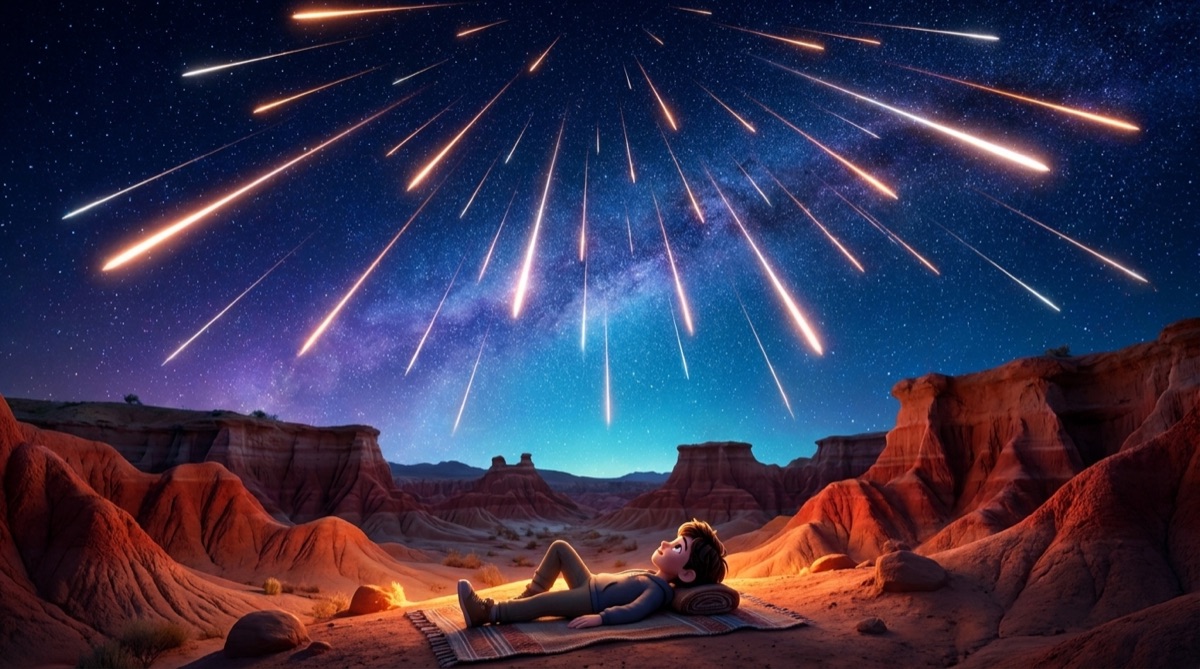
The Leonids are debris from comet 55P/Tempel-Tuttle, and they hit the atmosphere at 71 km/s, the highest speed of any major shower: they leave fast meteors, often with persistent trains. According to the 2026 calendar of the International Meteor Organization (IMO), they are active from November 6 to 30 and their traditional peak falls on November 17 at 6:45 p.m. Colombia time. Since the radiant (in the “Sickle” of Leo) does not rise until after midnight, the best hours for observing are the early mornings of the 17th and the 18th, between 2 and 5 a.m.
The expected rate under ideal conditions (ZHR) is about 15 meteors per hour. In practice, with the radiant halfway up the sky and an ordinary sky, count on seeing five to ten per hour. The IMO warns that this is not a storm year: the models of Vaubaillon and Sato predict crossings of very faint dust filaments on the 17th, 18th and 19th, with no significant activity. Leonid storms, like those of 1966 and 1999–2002, happen near the comet’s perihelion passage, and the next one is in 2031.
The good news is the Moon: at first quarter, it sets before 1 a.m. and leaves the sky dark in the hours that matter. A place like the Tatacoa Desert, in Huila, or anywhere far from city lights, multiplies what you will see. No equipment is needed: lie down, look up (you do not need to look at the radiant) and give your eyes twenty minutes to adapt to the dark.
Two minor showers round out the month: the Northern Taurids, peaking on November 12 with barely 5 meteors per hour, but slow and sometimes with bright fireballs, and the alpha Monocerotids on the 22nd, usually sparse but with a history of brief outbursts.
Key takeaways
- New moon on the 9th and full moon on the 24th; the week of the 6th to the 13th is the darkest.
- Saturn in the evening; Uranus at opposition on the 25th.
- Mars and Jupiter one degree apart on November 16, before dawn, in Leo.
- Venus returns to the morning sky and shines brightest on the 29th.
- Leonids: early mornings of the 17th and 18th, about 15 meteors per hour at most, with no Moon.
To get your bearings: Cardinal points and The phases of the Moon. To learn why the planets appear where they do: Celestial coordinates, and the interactive planisphere to draw the sky over your city at any hour.