In 1600, in a castle near Prague, two men who could not have been more different met. One was Tycho Brahe, a Danish nobleman of 53, wealthy, proud, owner of the best astronomical data ever gathered. The other was Johannes Kepler, a mathematician of 28, poor, sickly and convinced that the universe had a hidden mathematical harmony. They got along badly almost from the start. And yet, from that meeting came the first correct description of how the planets move.
The man who measured the sky
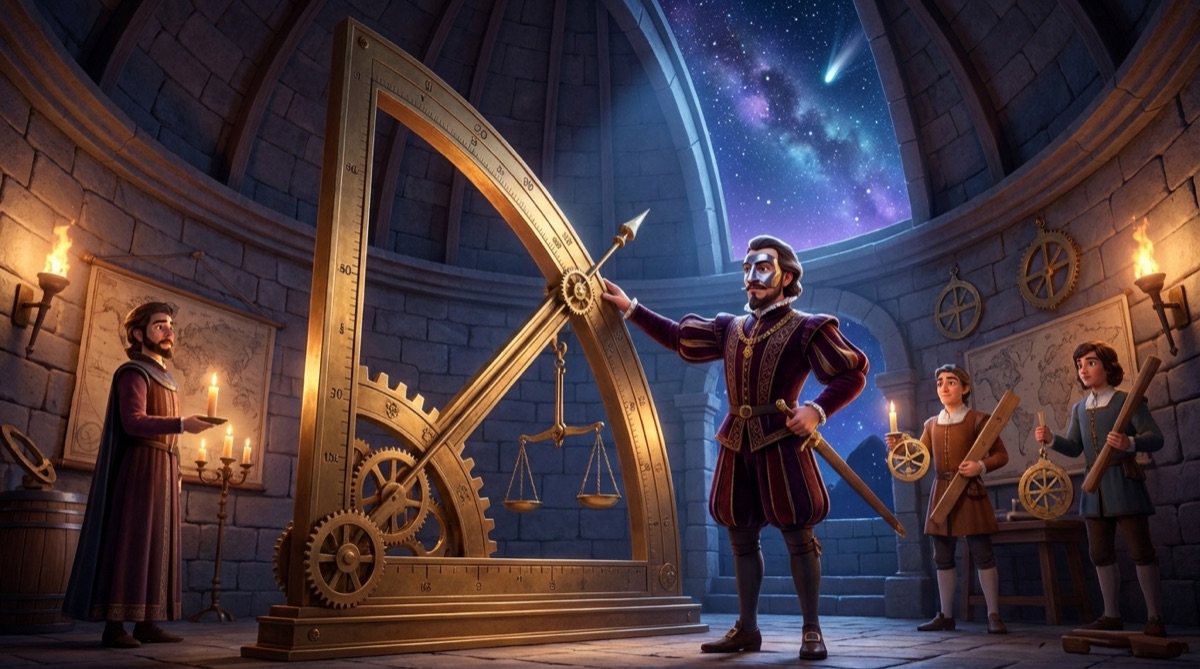
Tycho Brahe (1546–1601) had no telescope: the instrument would be invented eight years after his death. What he had was an obsession with precision. At his observatory of Uraniborg, on the island of Hven, he built huge quadrants and sextants, several meters across, with finely divided scales, and calibrated them again and again. A modern analysis of his instruments and his notebooks concludes that his positions of stars and planets had errors of about one minute of arc, one sixtieth of a degree. The best earlier catalogs were off by ten minutes or more.
But Tycho did something even more valuable than measuring well: he measured continuously. For more than twenty years he recorded the positions of Mars, Jupiter and Saturn night after night, not just at the “interesting” moments. That continuous archive is what would let Kepler discover the real shape of an orbit.
Tycho believed in a universe of his own: the Earth still at the center, the Sun going around it, and the other planets going around the Sun. He wanted Kepler to use his data to confirm that model. Kepler, a Copernican, wanted the opposite. Tycho died in October 1601, barely a year and a half after Kepler arrived, and his data ended up in the mathematician’s hands. (For centuries a rumor of poisoning surrounded that death; analyses of his remains published in 2012 found no lethal amounts of mercury.)
The war with Mars

Kepler set to work on Mars, the planet whose orbit resisted circle-based models the most. For years he fitted one model after another. He got to one that reproduced Tycho’s positions with a maximum error of eight minutes of arc: a quarter of the diameter of the full Moon. Any earlier astronomer would have declared victory.
Not Kepler. He knew Tycho did not err by eight minutes. If the model missed by that much, the model was wrong. In the Astronomia nova (1609) he writes it clearly: those eight minutes “point the way to the reform of all of astronomy”. He abandoned circles (which astronomy had used for two thousand years) and tried an oval, and then an ellipse with the Sun at one of its foci. It worked. He also found that the planet moves faster near the Sun and slower far from it, in such a way that the Sun–planet line sweeps out equal areas in equal times. These are Kepler’s first and second laws.
You can see them in action here: change the eccentricity and watch how the planet’s speed changes along the orbit while the swept sectors keep the same area.
The key equation
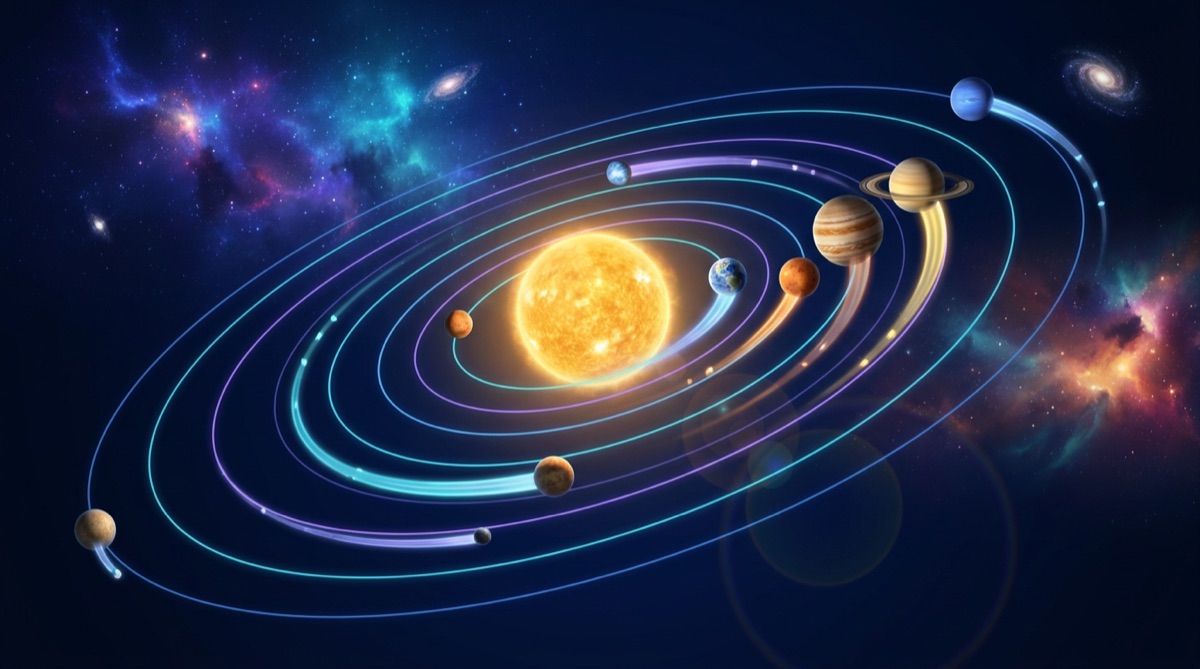
The third law was still missing, and it took nine more years. Kepler was looking for a relation between the size of the orbits and the time each planet takes to travel them. He found it, as he himself notes, on May 15, 1618, and published it in Harmonices mundi (1619):
In words: the square of a planet’s period is proportional to the cube of the size of its orbit. If a planet is four times farther from the Sun than the Earth, it takes eight times longer to go around (). The relation holds for all the planets with the same constant, and today we know it also holds for the moons of Jupiter, artificial satellites and the stars orbiting black holes. It is the tool with which celestial bodies are weighed.
How do we know?
This story is extraordinarily well documented. We have Tycho’s observing notebooks, Kepler’s manuscripts with his calculations (including his arithmetic mistakes) and his letters. The Astronomia nova is a unique book because Kepler does not just give the result: he recounts every failed attempt, every dead end. That is why historians have been able to reconstruct step by step how he arrived at the ellipse.
And the laws have been checked millions of times. Newton showed in 1687 that all three follow from his law of gravitation, and today every probe traveling to Mars or Jupiter follows a trajectory computed with the physics born of those eight minutes of arc.
Key takeaways
- Tycho Brahe measured planetary positions to a precision of one minute of arc, without a telescope, for more than twenty years.
- Kepler refused to accept an error of eight minutes in his model of Mars and discovered that orbits are ellipses, not circles.
- The third law () relates the size of an orbit to its period and makes it possible to weigh planets, stars and galaxies.
- The deeper lesson: a good measurement is worth more than a pretty theory, and a small disagreement between the two can be the door to a discovery.
The three laws, with worked examples, are in the secondary lesson Kepler’s laws; the derivation from gravitation, in Gravitation and satellites; and the equation Kepler used to compute positions, in the higher-education lesson Kepler’s equation.