Johannes Kepler spent years trying to fit the orbit of Mars into circles, using the best observations of his time, those of Tycho Brahe. The best fit he achieved was off by 8 arcminutes, a quarter of the Moon’s diameter. Anyone else would have blamed the observations; Kepler trusted Tycho and abandoned the circle. The result was three laws that describe how the planets move and that, a century later, Newton would explain with a single force.
1. Conic sections: the ellipse

If you cut a cone with a plane you get a conic section: a circle if the cut is horizontal, an ellipse if it is slightly tilted, a parabola if it is parallel to the generating line and a hyperbola if it is tilted even more. Closed orbits are ellipses.
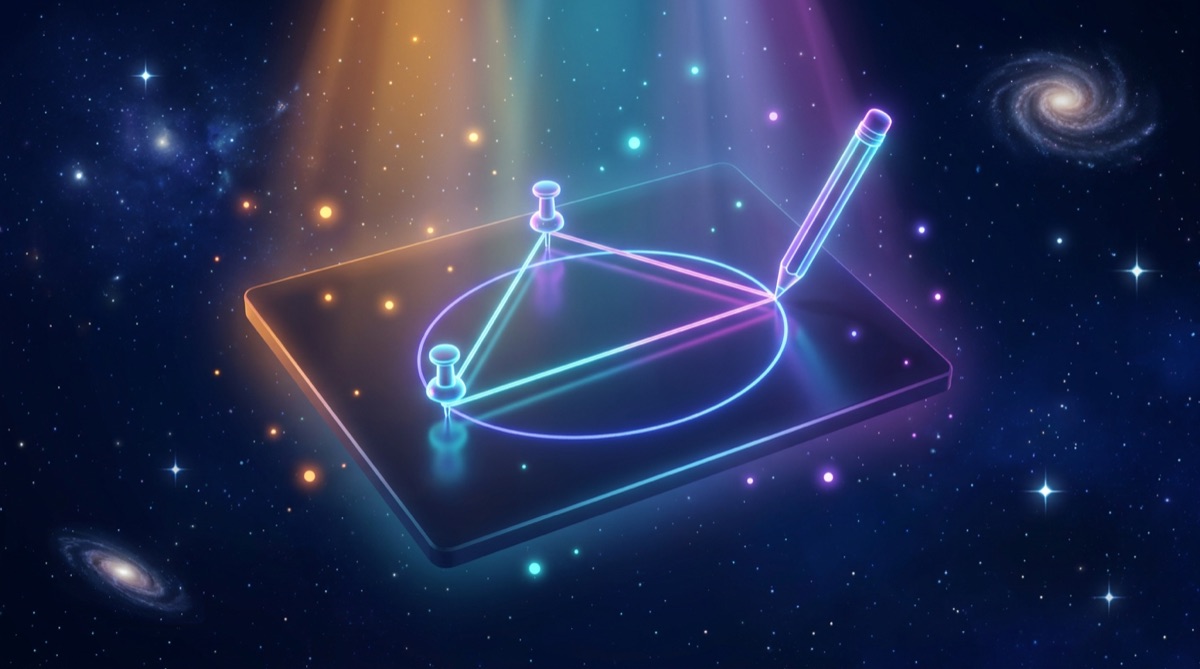
Definition as a locus. An ellipse is the set of points whose sum of distances to two fixed points, the foci and , is constant and equal to . If a gardener’s string is long and its ends are pinned at the foci, the pencil that keeps it taut draws an ellipse.
The elements of the ellipse:
- : semi-major axis, half of the longest diameter;
- : semi-minor axis, half of the shortest diameter;
- : focal distance, from the center to each focus;
- : eccentricity, between 0 (circle, both foci together at the center) and 1 (infinitely elongated ellipse).
By the Pythagorean theorem applied to the endpoint of the minor axis (its two distances to the foci both equal ):
With the center at the origin and the foci on the axis, the Cartesian equation is
The ellipse of an orbit
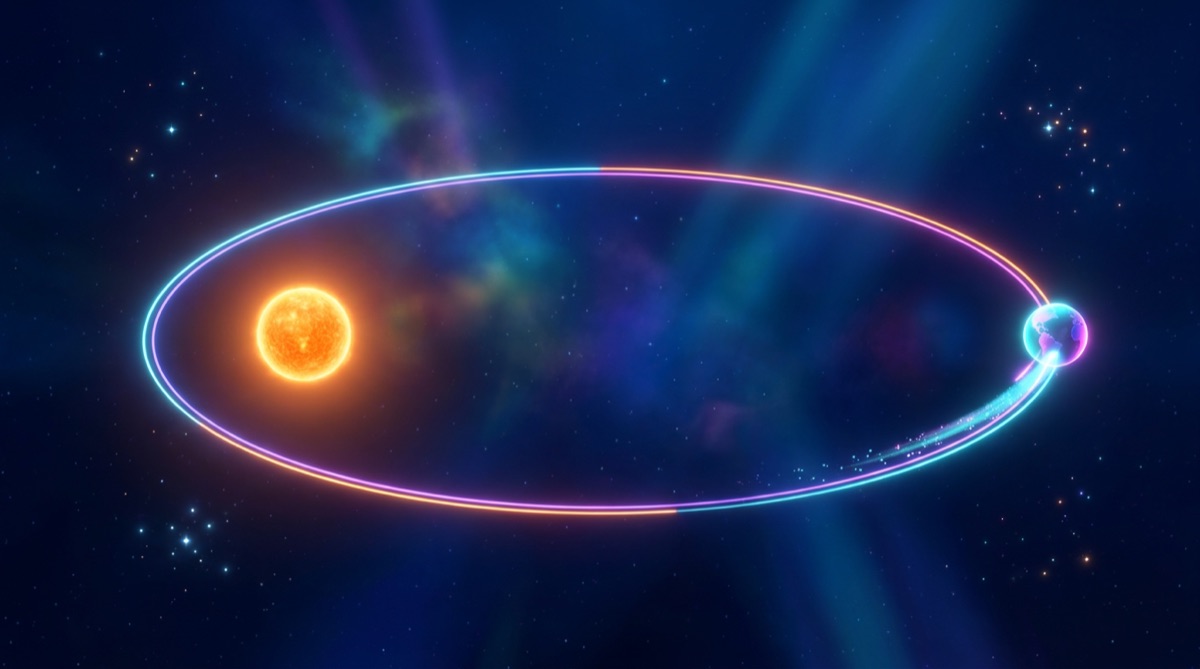
Kepler’s 1st law: each planet travels along an ellipse with the Sun at one of its foci (the other focus is empty). The extreme points have names: the perihelion, at distance from the Sun, and the aphelion, at distance :
Measured from the Sun, with the angle (the true anomaly) counted from perihelion, the distance is
which equals at and at , as it should.
Worked example 1: the orbit of Mars. NASA gives a perihelion of km and an aphelion of km. Adding and subtracting the two equations:
Worked example 2: Halley’s comet. According to JPL, au and . Then au (closer to the Sun than Venus), au (beyond Neptune) and au: an ellipse four times longer than it is wide.
Worked example 3: what about Earth? With , : drawn on a sheet of paper, Earth’s orbit is indistinguishable from a circle. What you do notice is that the Sun is not at the center: million km. That is why in January (perihelion) the Sun’s disk looks 3.4 % larger in diameter than in July (6.9 % in area).
2. Second law: equal areas in equal times
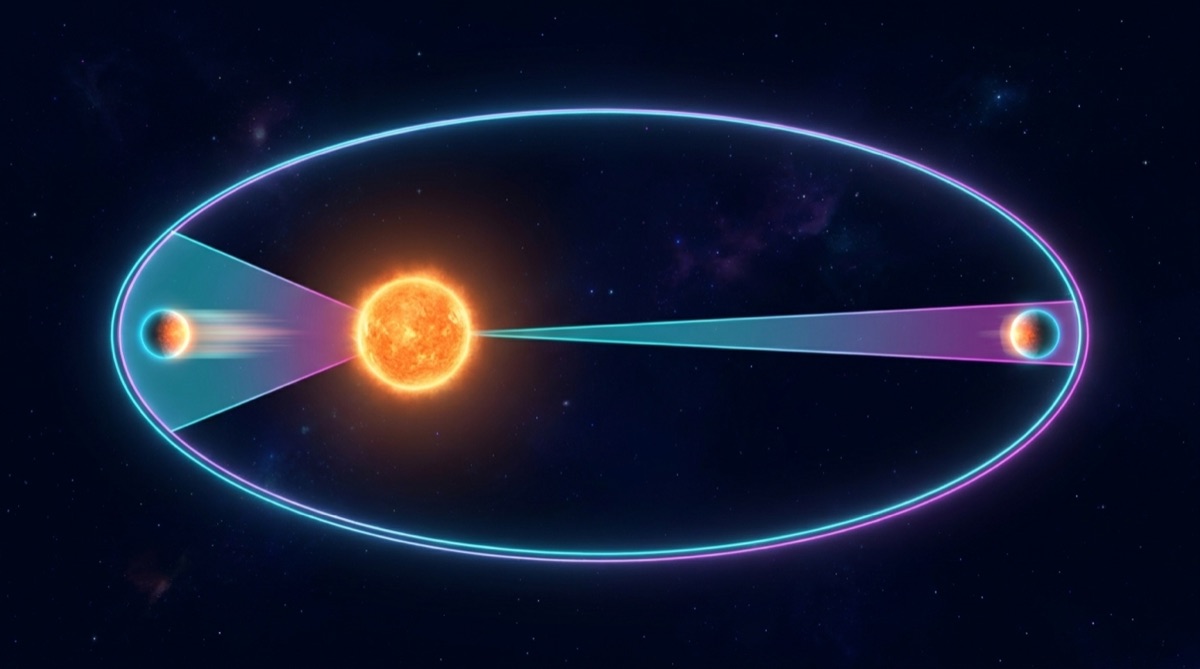
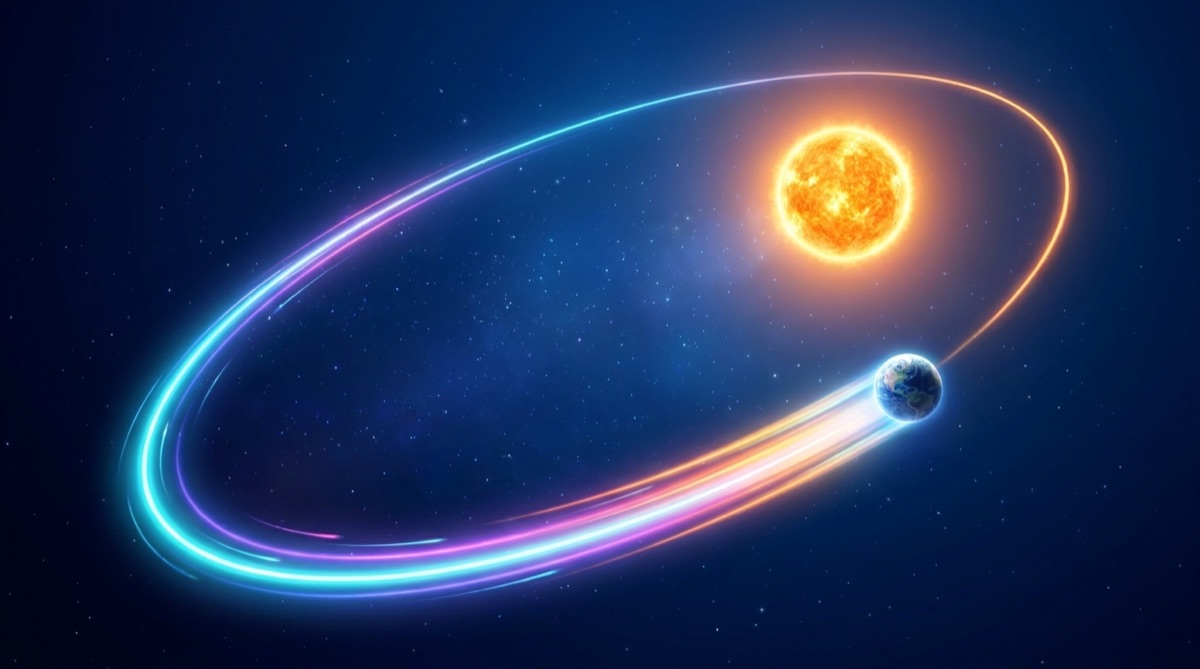
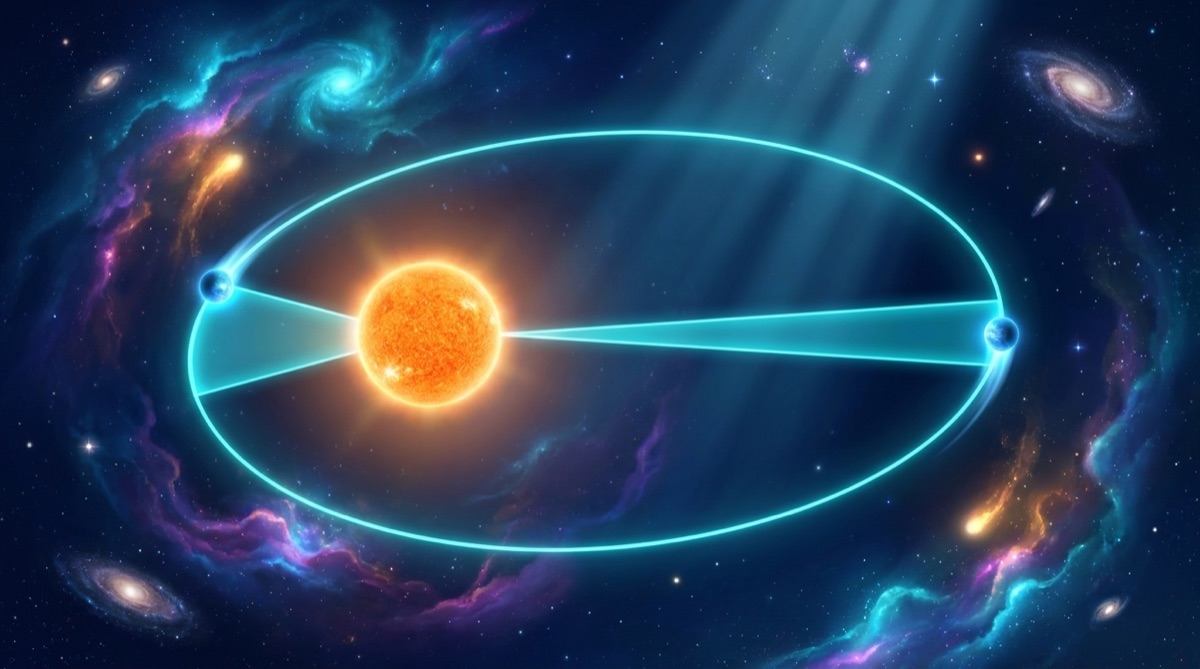
2nd law: the Sun–planet segment sweeps out equal areas in equal times. Near the Sun, the segment is short and the planet has to move farther to sweep the same area: it goes faster at perihelion and slower at aphelion.
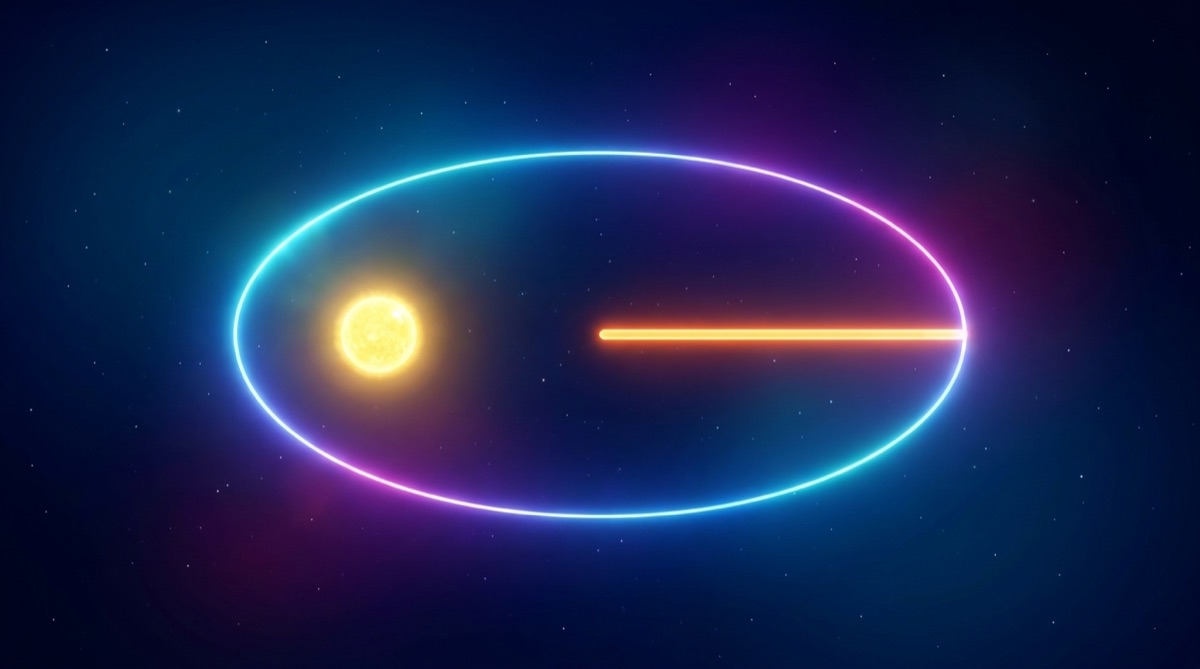
We can put numbers on it. At perihelion and aphelion the velocity is perpendicular to the radius, and the area swept in a short time is a thin triangle of base and height : . Setting the areas at both points equal,
Worked example 4. For Earth, : NASA measures 30.29 km/s at perihelion and 29.29 at aphelion, a ratio of 1.034. For Halley’s comet, : it passes through perihelion 61 times faster than through aphelion, where it crawls along for decades.
3. Third law: periods, distances and powers
3rd law (1619): the square of the period is proportional to the cube of the semi-major axis,
If we measure in years and in au, the constant equals 1 (because Earth has and ), and the law is solved with fractional exponents:
Remember what they mean: and . On the calculator:
a ^ 1.5 and T ^ (2 ÷ 3).
Worked example 5. Jupiter: au, so years (observed: 11.86).
Worked example 6. A comet with a period of 76 years has au. It is Halley.
Checking with the eight planets
With the mean distance and the period from the NASA table, converted to au (÷149.6) and years (÷365.25):
| Planet | (au) | (years) | |||
|---|---|---|---|---|---|
| Mercury | 0.387 | 0.241 | 0.058 | 0.058 | 1.00 |
| Venus | 0.723 | 0.615 | 0.378 | 0.378 | 1.00 |
| Earth | 1.000 | 1.000 | 1.000 | 1.000 | 1.00 |
| Mars | 1.524 | 1.881 | 3.54 | 3.54 | 1.00 |
| Jupiter | 5.204 | 11.86 | 140.6 | 140.9 | 1.00 |
| Saturn | 9.572 | 29.42 | 865.8 | 877.1 | 0.99 |
| Uranus | 19.16 | 83.75 | 7014 | 7039 | 1.00 |
| Neptune | 30.18 | 163.7 | 26 805 | 27 490 | 0.98 |
The ratios equal 1 to within 1–2 %. The small deviations of Saturn and Neptune come from the rounding of the table and from the fact that the giant planets perturb one another: the exact law is for two bodies, and in the next lesson we will see that the “constant” is .
Simulator: the three laws in action
The simulator solves the exact orbit. The shaded region is the area swept out in the same time interval.
- Set and look at the shaded area at perihelion and at aphelion: its shape changes (short and wide, long and thin), but not its size.
- Read at perihelion and at aphelion and check that .
- Set and move : with au, should be years; with au, years. Write down three pairs and check that .
- Set and . In which part of the orbit does the planet spend most of its time? Time with a clock how long it takes to cover the half near the Sun and the far half.
Activity: ellipses with a string and two thumbtacks
Materials: cardboard, white sheet of paper, two thumbtacks (or pins), 30 cm of non-stretch thread, pencil, ruler.
- Pin the two thumbtacks cm apart. Tie the thread into a loop of total length cm (so that the string going from one focus to the pencil and to the other focus measures cm).
- With the pencil keeping the loop taut, draw the complete curve.
- Measure with the ruler the semi-major axis and the semi-minor axis . Check that (it should give ) and compute .
- Repeat with the thumbtacks 2 cm apart (, similar to that of Mars) and almost touching (, Earth).
- Mark the Sun at one focus and label the perihelion and aphelion.
Final question: what distance between thumbtacks would you need to draw Halley’s comet () with cm? How wide would the ellipse be?
Exercises
Basic
- With au, how long is Jupiter’s year? And Saturn’s, with au?
Show solution
years; years (observed: 29.4).
- Mercury: perihelion km, aphelion km. Compute (in km and in au) and .
Show solution
km au; . It is the most eccentric planet.
- An orbit has au and . Compute , and .
Show solution
au, au, au.
Intermediate
- A comet has a period of 2 years. What is its semi-major axis? And if the period is 1000 years?
Show solution
au; au (the cube of 10 is 1000, and ).
- Set the simulator to . In which part of the orbit does the planet spend most of its time? Justify with the 2nd law and compute .
Show solution
Far from the Sun, near aphelion: there the radius is long and a small advance is enough to sweep the same area. .
- Write in three different ways (root of a cube, cube of a root, decimal power) and compute the result. Does it match Halley’s period (27 700 days)?
Show solution
years; years. ✓
Challenge
- For Halley, compute at (the point where the comet is “beside” the Sun) and compare it with . What fraction of the semi-major axis is it?
Show solution
au; and au, they agree (it is called the semi-latus rectum). It is only 6 % of : the Sun is very close to one end of the ellipse.
- Weighing Jupiter. Newton showed that for any central body . The moon Io orbits Jupiter with km and days. Compute in m³/s² and compare it with the nominal value .
Show solution
, within 0.1 % of the nominal value. With we get kg, 318 times Earth.
- Derive from the law of areas (section 2) and use it to explain why summer in the northern hemisphere (Earth near aphelion) lasts a few days longer than summer in the southern hemisphere.
Show solution
At perihelion and aphelion the velocity is perpendicular to the radius, and the area swept in is ; setting them equal, , so . Near aphelion (July) Earth moves more slowly and takes longer to cover that half of the orbit: from the March equinox to the September one about 186 days go by, compared with about 179 from September to March.
✦ Mini-quiz
Key takeaways
- Ellipse: sum of distances to the foci ; , ; .
- 1st law: the Sun at one focus; , .
- 2nd law: equal areas in equal times; .
- 3rd law: = constant; in years and au, and .
- Kepler describes how; Newton will explain why with .
🍎 Teacher guide
- Time
- 3 sessions of 55 min
- Colombian national standard (MEN)
- Mathematics, Grades 10 to 11, spatial thinking: “I identify visually, graphically and algebraically some properties of the curves observed at the edges obtained by longitudinal, diagonal and transverse cuts of a cylinder and a cone”, “I solve problems that use the geometric properties of conic figures by means of transformations of the algebraic representations of those figures” and “I recognize and describe curves and/or loci”; numerical thinking: “I compare and contrast the properties of numbers (natural, integer, rational and real) and those of their relations and operations in order to build, handle and use the different number systems appropriately”. Natural Sciences, Grades 10 to 11: “I establish differences between models, theories, laws and hypotheses” and “I use mathematics to model, analyze and present data and models in the form of equations, functions and conversions”; builds on Grades 8 to 9: “I explain the planetary model from gravitational forces”.
- Evidence of learning
- Draws an ellipse of a given eccentricity and verifies a² = b² + c², computes a and e for Mars from its perihelion and aphelion, obtains periods and semi-major axes with the exponents 3/2 and 2/3, and checks T²/a³ ≈ 1 with the NASA table.
Materials
- Cardboard, thumbtacks, thread, pencil and ruler per group
- Scientific calculator with fractional-exponent powers
- Printout of the planetary data table (NASA)
- Computer or tablet with the simulator
Suggested sequence
Session 1. The ellipse (55 min). Opening with the story of the 8 arcminutes (5 min). Thumbtack activity in groups with measurement of , , and verification of Pythagoras (25 min). Formal definition, equation and worked examples 1–3 (20 min). Closing: exercise 2 (5 min).
Session 2. Areas and speed (55 min). Second law with the simulator (guided challenge, steps 1, 2 and 4) and derivation of (30 min). Example 4 with the data for Earth and Halley (10 min). Exercises 3 and 5 (15 min).
Session 3. The third law and powers (55 min). Fractional exponents on the calculator (10 min); the groups complete the table of the eight planets by sharing out the planets (15 min); examples 5 and 6 and exercises 1, 4 and 6 (15 min); mini-quiz (10 min). Challenges 7–9 as homework; number 8 anticipates the gravitation lesson.
Common mistakes
- Placing the Sun at the center of the ellipse. The thumbtack activity corrects it: the Sun goes at a focus.
- Believing that the seasons are due to the distance to the Sun. Example 3: e = 0.0167, the Sun only changes by 3 % in size; the seasons come from the tilt of the axis.
- Computing a^(3/2) as a × 1.5 or as a³/2. Insist on √(a³) and do it with a = 4 (result 8).
- Thinking that the second law says the speed is constant. Contrast with the shaded region of the simulator.
- Confusing the period with the time between perihelion and aphelion.