Throw a stone. It falls. Throw it harder and it goes farther before falling. What if you threw it so hard that, while it fell, the Earth curved away beneath it and the ground receded at exactly the same rate? The stone would keep falling forever without ever touching the ground. That is a satellite. It is not that it does not fall: it falls around the Earth.
Newton’s cannonball
The thought experiment is Isaac Newton’s and appeared in a book published in 1728, after his death, De mundi systemate (“On the System of the World”), the version for non-mathematical readers of book III of his Principia. Newton asks us to imagine a cannon on top of a very high mountain, above the air. Fire a ball: it traces a curve and lands some distance away. Fire with more powder: the ball goes farther. With more still, farther yet. There will come a moment when the ball, as it falls, does so following exactly the curvature of the Earth: it will go all the way around and come back to the cannon from behind. And it will keep going around.
Try it: fire first at “Very slow”, then faster and faster. Near 8 km/s the ball no longer touches the ground. And above about 11 km/s it never comes back: it escapes the Earth.
Orbits: nearly circular orbit with period 84.7 min; perigee at 10 km and apogee at 13 km altitude. It falls around the Earth without touching it.
- Cannon altitude
- 10 km (r₀ = 6 388 km)
- Circular v at that altitude
- 7.90 km/s
- Escape v at that altitude
- 11.17 km/s (= √2 · v_c)
- Specific energy ε
- -31.19 MJ/kg (bound)
- Eccentricity e
- 0.000
- Simulated time
- 0 s
The revolutionary part of the idea is that the same force that makes the apple fall makes the Moon orbit. There are not two kinds of physics, one for the sky and one for the Earth. There is only one, and the difference between falling and orbiting is sideways speed.
The key equation
How much speed is needed? For a circular orbit at a distance from the center of the Earth,
where is the gravitational constant and the mass of the Earth. In words: the orbital speed is the square root of the Earth’s pull divided by the distance to the center. The closer you are, the faster you have to go. For the International Space Station, at an altitude of about 400 km (that is, about 6 780 km from the center), the calculation gives 7.7 km/s: about 27 600 km/h, a little more than what NASA quotes for the station’s actual speed (28 000 km/h, because the altitude varies). At that speed you go around the Earth in about 92 minutes: sixteen sunrises a day.
To orbit farther out takes less speed, but more energy to climb. “Geostationary” communications satellites, at 35 786 km, move at only 3.1 km/s and take exactly one day to go around, which is why they look still in the sky.
Try it
In the simulator you can change the size and shape of the orbit. Notice that the closer to the central body, the faster the satellite moves, and that if an orbit is elongated the satellite goes faster at the nearest point and slower at the farthest: that is what would happen to Newton’s ball if it left a little faster than circular speed.
So, do they never fall?
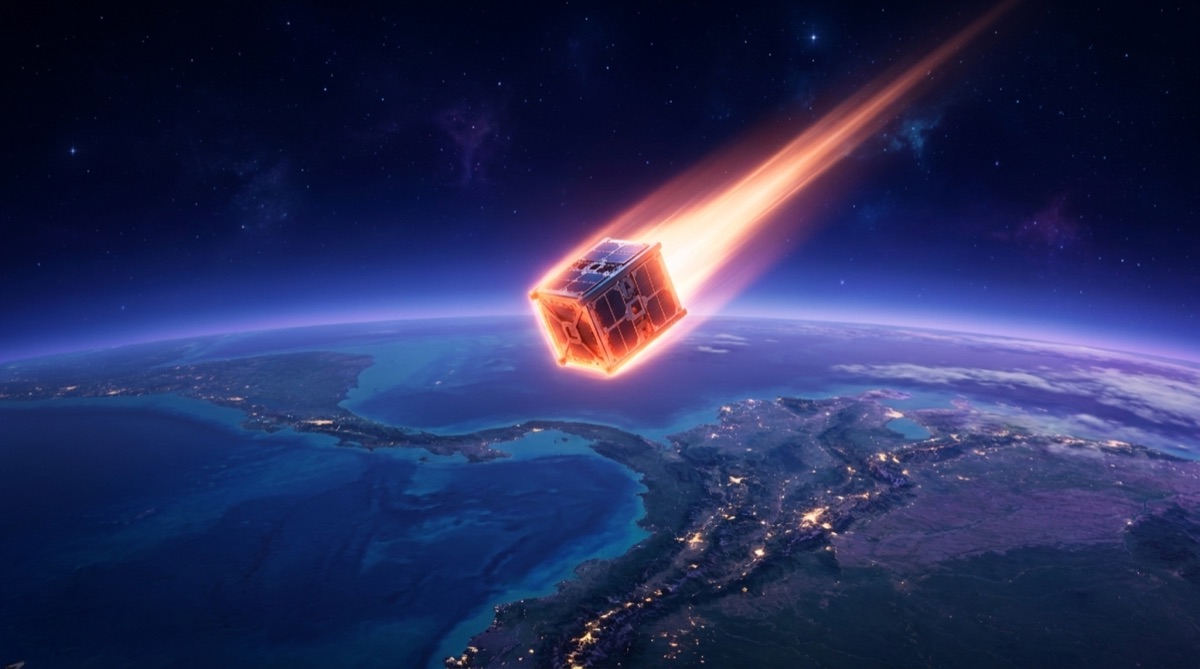
They fall, in two ways. The first we have already said: they are always falling; an orbit is a perpetual fall that never ends. The second is more literal. Below about 1 000 km there remains a trace of atmosphere, too thin to breathe but enough to slowly brake anything passing through at 7.7 km/s. As it loses speed, the satellite descends; as it descends, it meets more air; and the fall accelerates until it burns up from the heat.
Colombia has an example close to home. FACSAT-2 “Chiribiquete”, the Colombian Air Force’s Earth-observation satellite, was launched on April 15, 2023 on a Falcon 9 rocket from California and entered an orbit about 500 km high. With no propulsion to correct its orbit, drag kept lowering it for two and a half years, until it reentered the atmosphere in October 2025. The Space Station, at 400 km, would lose altitude the same way if it were not pushed back up periodically with the engines of the cargo ships.
How do we know?
Newton’s cannon was a thought experiment; in 1957 it became real with Sputnik 1, the first artificial satellite, which went around the Earth every 96 minutes exactly as the formula predicted. Since then more than 20 000 objects have been launched into orbit, and each of them is a check of the equation. The speed given to a rocket at launch is calculated with it; if the calculation were wrong, there would be no GPS, no satellite television, no pictures of hurricanes.
And there is a check you can do yourself: the International Space Station frequently passes over almost all of the inhabited world (between latitudes 51.6° N and 51.6° S) and can be seen with the naked eye as a bright star crossing the sky in about five minutes, shortly after dusk or before dawn. Its apparent speed, its altitude and the time of each pass are calculated with the same physics as the cannonball.
Key takeaways
- A satellite does fall: what keeps it in orbit is its enormous sideways speed, which makes the ground “slip away” from it through the curvature of the Earth.
- The speed needed to orbit near the Earth is about 7.7 km/s (28 000 km/h); the farther out, the slower.
- The force that keeps the Moon in orbit is the same one that makes a stone fall: Newton’s gravitation.
- Low orbits are braked by the residual atmosphere; that is why FACSAT-2 reentered in 2025 and the Space Station needs periodic boosts.
The full calculations (orbital speed, period, geostationary orbit) are in the secondary lesson Gravitation and satellites. And if you want to program Newton’s cannonball yourself step by step: Simulating an orbit with Euler. Related: “There is no gravity in space”.