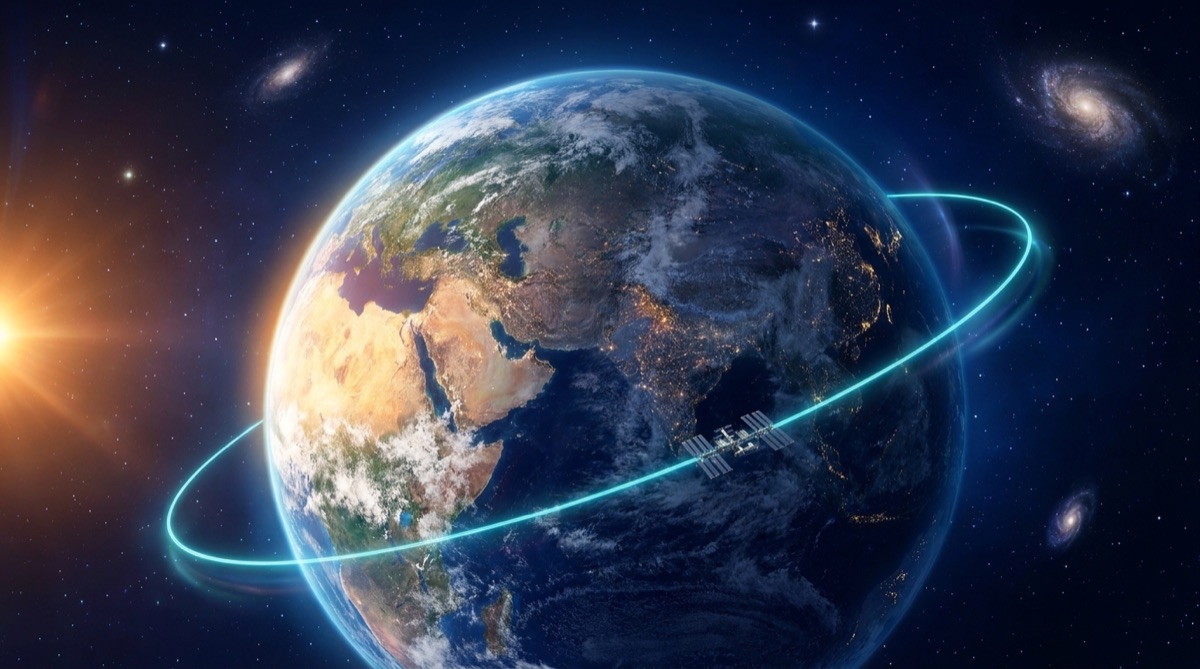
The images are unmistakable: astronauts doing somersaults, drops of water turned into quivering spheres, pens hanging still in midair. If everything floats, it seems obvious that there is no gravity up there. But let us do a quick calculation. The International Space Station orbits at an altitude of about 400 km. The Earth has a radius of 6 378 km. Four hundred kilometers, for the Earth, is like the peel on an orange. Does gravity really vanish in so little space?
The calculation
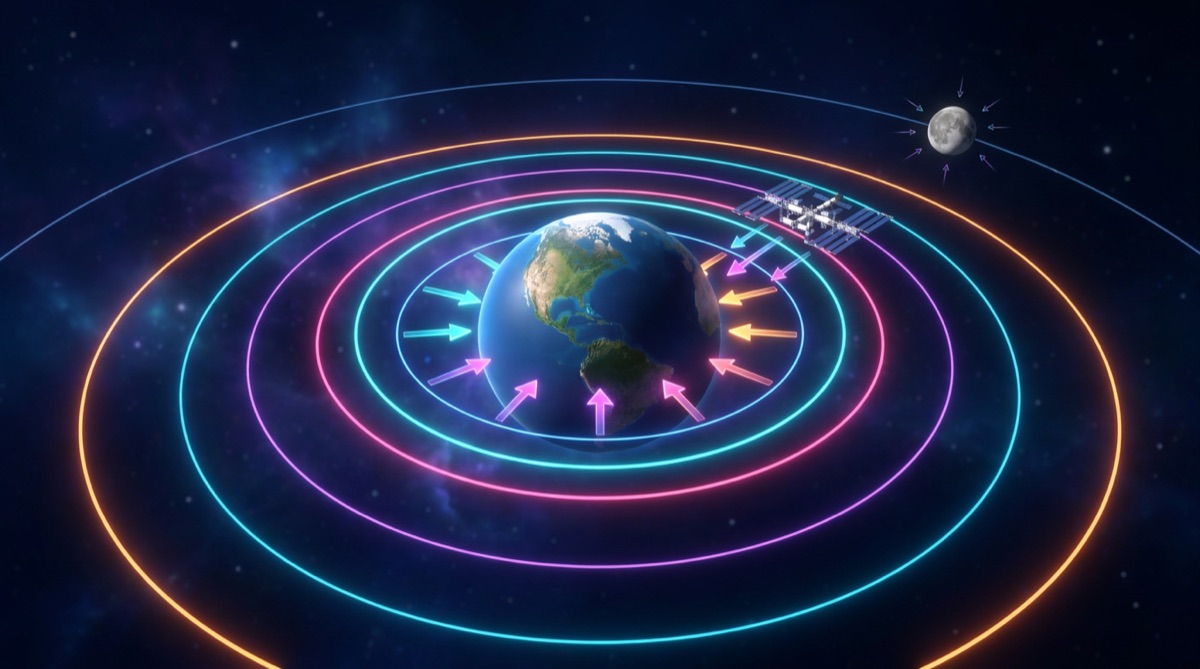
No. Newton’s gravity decreases with the square of the distance to the center of the Earth, not to its surface. On the ground you are 6 378 km from the center; on the Station, 6 778 km. The ratio of the two distances is 1.063, and its square, 1.13. So gravity on the Station is times that on the ground: 88.5 %. NASA gives the same figure (88.8 % at 250 miles). A 70 kg astronaut on the Station is still pulled toward the Earth with a force equivalent to about 62 kg on the ground. That is not “no gravity”. It is almost all of the gravity.
For Earth’s gravity to drop by half you would have to climb to 2 640 km; for it to fall to 1 %, to 57 000 km, beyond the geostationary satellites. And even at the Moon, 384 000 km away, Earth’s gravity is still acting: it is what keeps the Moon in orbit. If gravity “ran out” in space, the Moon would fly off in a straight line.
So why do they float?
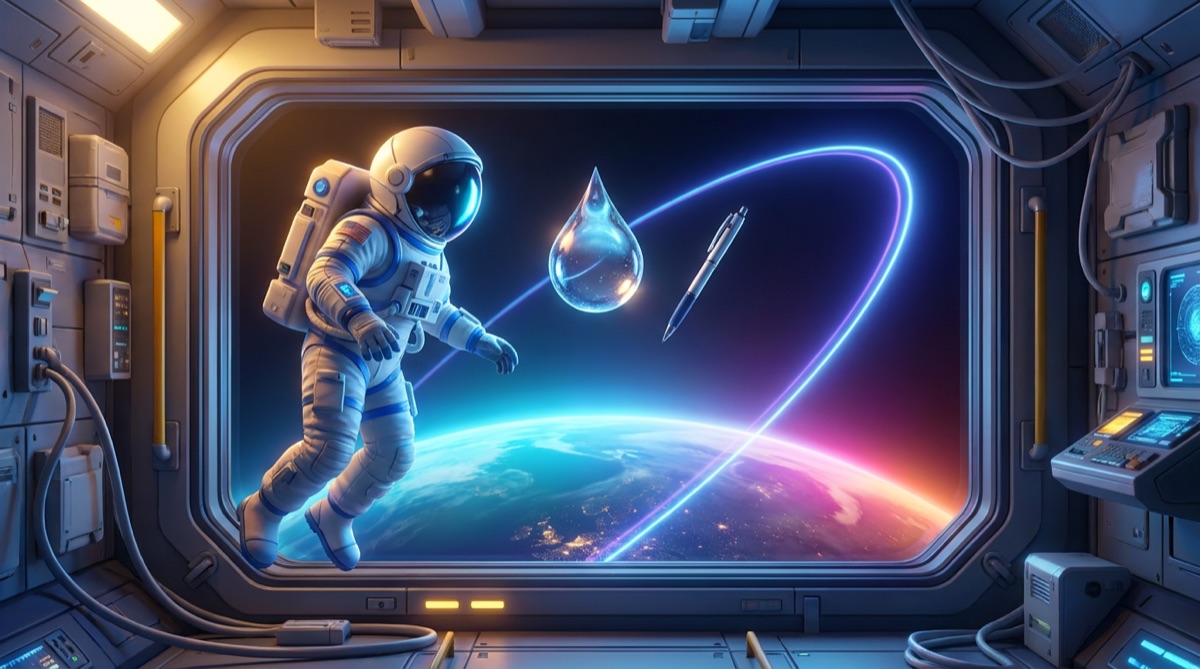
Because they are falling. And so is the Station. And everything inside it. They fall together, with the same acceleration, and when everything falls at once nothing presses against anything: feet do not press on the floor, the pen does not press on the hand. That feeling of “weighing nothing” is free fall.
You can experience it without leaving the planet. In an elevator that starts going down you feel your stomach rise: for a fraction of a second you weigh less. If the cable snapped (and there were no emergency brakes), you and the elevator would fall together and you would float inside it until the end. Space agencies train astronauts this way: in airplanes that fly free-fall arcs of about 25 seconds, and in drop towers where experiments fall for several seconds in a vacuum.
The Space Station takes this to the limit: it falls continuously, but it moves sideways so fast (28 000 km/h) that, as it falls, the Earth curves away beneath it and it never reaches the ground. It falls around the Earth. That is why the gravity the astronauts feel is not zero but almost zero: scientists call it microgravity, not “zero gravity”.
The key equation
Gravity at a distance from the center of the Earth, compared with that at the surface , is
with the radius of the Earth. In words: if you double the distance to the center, gravity falls to a quarter; if you triple it, to a ninth. On the Station, is only 6 % larger than , so gravity drops by barely 11 %. What floats is not a body without gravity: it is a body that no longer has anything holding it up.
Einstein’s happiest thought
In 1907, Albert Einstein, sitting in the patent office in Bern, had an idea he would later call “the happiest thought of my life”: a person falling from a roof does not feel their own weight. While falling, everything they carry falls with them, and in their immediate surroundings it is as if gravity did not exist. That seemingly trivial observation was the seed of general relativity: gravity and free fall are, locally, indistinguishable. The astronauts on the Station live inside that idea twenty-four hours a day.
How do we know?
That gravity does not vanish in orbit is not an interpretation: it is what keeps the Station there. If there were no gravity at 400 km, the Station would move away in a straight line at 28 000 km/h and we would lose it in minutes. That it passes over every place on its track, several times a day, at exactly the moment the ephemerides predict, is the proof that the Earth is pulling on it with almost its full force.
And microgravity is not perfect: the drag of the residual air, the slight change in gravity from one end of the Station to the other (it is 109 m long) and the crew’s own movements produce accelerations of around one millionth of . Hence the prefix “micro”. The crystallization, combustion or fluid experiments done there take advantage of precisely that absence of weight, not an absence of gravity.
Key takeaways
- On the Space Station, at 400 km, gravity is 88 % of that on the ground. It does not vanish: it decreases with the square of the distance to the center of the Earth.
- Astronauts float because they are in free fall: they and the Station fall together, around the Earth.
- The same gravity keeps the Moon in orbit, 384 000 km away.
- The correct term is microgravity, not “zero gravity”.
How to fall around the Earth without touching it: Why don’t satellites fall?. The calculations of gravity with altitude: Gravitation and satellites. For the youngest, how much you would weigh on other worlds: How much would you weigh on Mars?.