Glossary / K / Orbits and gravitation
Kepler's equation
Also: Kepler equation · mean anomaly · eccentric anomaly · true anomaly
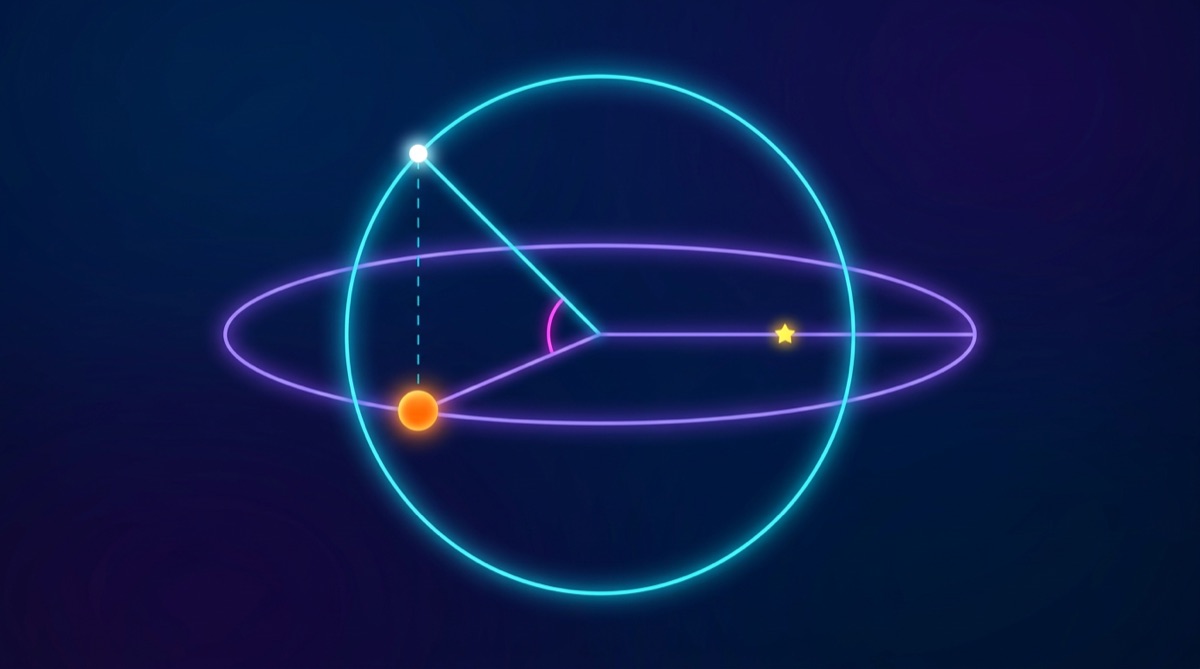
The equation that says where on its ellipse a planet is on a given date. It cannot be solved with algebra: it has to be solved by successive approximations, as astronomy programs do.
Going further
, where is the mean anomaly, the mean motion and the eccentric anomaly. It is solved by Newton–Raphson: .
Where it is explained: Kepler's equation and its numerical solution Higher Education
Related terms
Used in these lessons
- Kepler's equation and its numerical solution Higher Education 14 mentions
- The radial-velocity method Higher Education 6 mentions
- Orbital elements and state ↔ elements conversion Higher Education 5 mentions
- The two-body problem Higher Education 4 mentions
- Runge–Kutta and adaptive step size Higher Education 2 mentions
- Simulating an orbit with the Euler method Secondary Education 1 mention
- Kepler's three laws Secondary Education 1 mention
- Perturbation theory and the oblateness of the Earth Higher Education 1 mention