Glossary / K / Orbits and gravitation
Kepler's laws
Also: Kepler's law · Kepler's first law · Kepler's second law · Kepler's third law · Kepler's three laws · law of areas · harmonic law · Kepler laws · laws of Kepler · laws of planetary motion
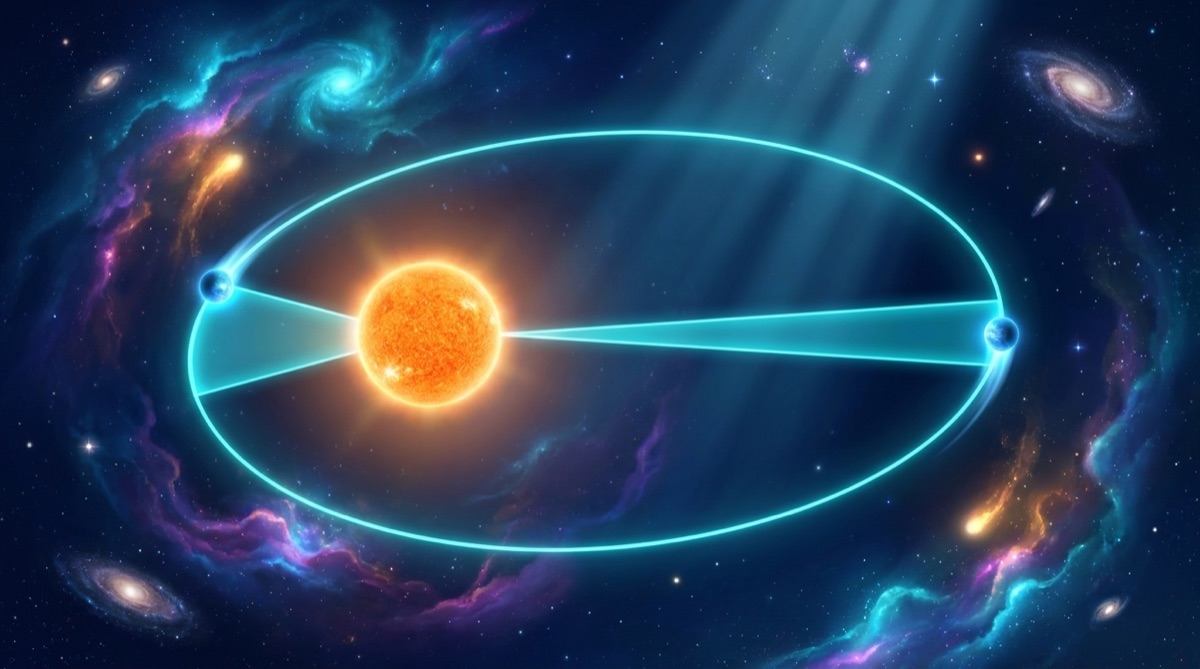
Three rules about how the planets move: (1) they follow ellipses with the Sun at one focus, (2) they move faster when they are closer to the Sun and (3) distant planets take much longer to go around.
Going further
(1) Conic orbits with the focus at the center of mass. (2) constant: the radius vector sweeps equal areas in equal times (conservation of angular momentum). (3) ; in au and years, for the Solar System.
Where it is explained: Kepler's three laws Secondary Education
Related terms
Used in these lessons
- Universal gravitation and satellites Secondary Education 6 mentions
- Kepler's three laws Secondary Education 4 mentions
- The two-body problem Higher Education 4 mentions
- Weighing the Sun and the planets Secondary Education 3 mentions
- Gravitational waves: from the quadrupole to GW150914 Higher Education 3 mentions
- Velocity, acceleration and derivatives Secondary Education 2 mentions
- Simulating an orbit with the Euler method Secondary Education 2 mentions
- Tides Secondary Education 2 mentions
- Transits and light curves Higher Education 2 mentions
- Schwarzschild geodesics: orbits and light around a black hole Higher Education 2 mentions
- The lives of stars Secondary Education 1 mention
- The Chandrasekhar limit Higher Education 1 mention
- Rotation curves and dark matter Higher Education 1 mention
- The radial-velocity method Higher Education 1 mention
- Kepler's equation and its numerical solution Higher Education 1 mention
- The restricted three-body problem and the Lagrange points Higher Education 1 mention
- Perturbation theory and the oblateness of the Earth Higher Education 1 mention
- Resonances and chaos Higher Education 1 mention
- The precession of Mercury's perihelion Higher Education 1 mention