Glossary / L / Orbits and gravitation
Law of universal gravitation
Also: universal gravitation · Newton's law of gravitation · law of gravitation · Newton's law of universal gravitation · universal law of gravitation
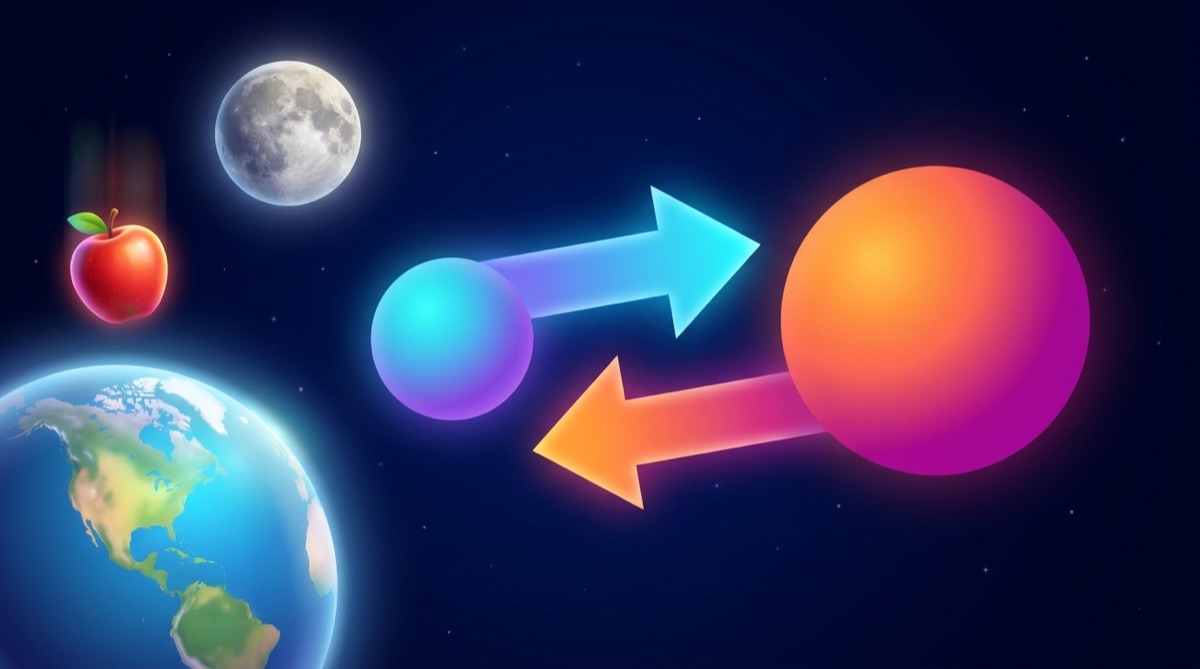
Newton's rule: all bodies attract one another with a force that grows with their masses and decreases with the square of the distance. The same force that makes an apple fall holds the Moon in place.
Going further
, with m³ kg⁻¹ s⁻². Combined with it reproduces Kepler's three laws and makes it possible to "weigh" the Sun using Earth's orbit.
Reference value: G = 6.674 30 × 10⁻¹¹ m³ kg⁻¹ s⁻² Source: src/lib/math/constants.ts (CODATA 2018 / IAU)
Where it is explained: Universal gravitation and satellites Secondary Education
Related terms
Used in these lessons
- Universal gravitation and satellites Secondary Education 5 mentions
- Symplectic integrators and chaos in the N-body problem Higher Education 2 mentions
- Velocity, acceleration and derivatives Secondary Education 1 mention
- The precession of Mercury's perihelion Higher Education 1 mention