Glossary / P / Orbits and gravitation
Perturbation
Also: perturbing force · perturbing acceleration · perturbation theory · Lyapunov exponent
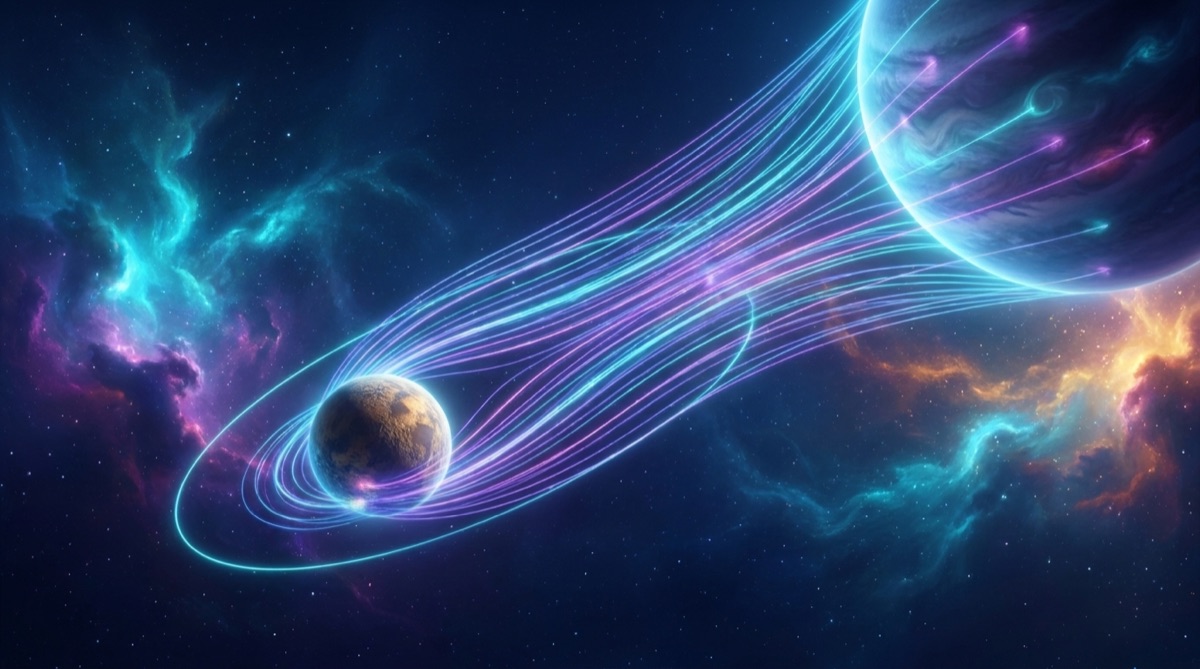
Any small "nudge" that pulls an orbit away from a perfect ellipse: the attraction of other planets, Earth's flattening, air drag. That is how Neptune was discovered, through the perturbations of Uranus.
Going further
A small acceleration added to . Gauss's or Lagrange's equations give the slow variation of the osculating elements; secular, short-period and long-period effects are distinguished.
Where it is explained: Perturbation theory and the oblateness of the Earth Higher Education
Related terms
Used in these lessons
- The precession of Mercury's perihelion Higher Education 9 mentions
- Symplectic integrators and chaos in the N-body problem Higher Education 8 mentions
- Perturbation theory and the oblateness of the Earth Higher Education 7 mentions
- Resonances and chaos Higher Education 5 mentions
- Schwarzschild geodesics: orbits and light around a black hole Higher Education 5 mentions
- The two-body problem Higher Education 4 mentions
- Weighing the Sun and the planets Secondary Education 3 mentions
- Cosmic inflation Higher Education 3 mentions
- Gravitational waves: from the quadrupole to GW150914 Higher Education 3 mentions
- Polytropes and the Lane–Emden equation Higher Education 2 mentions
- The equations of stellar structure Higher Education 1 mention
- The Chandrasekhar limit Higher Education 1 mention
- Runge–Kutta and adaptive step size Higher Education 1 mention
- Orbital elements and state ↔ elements conversion Higher Education 1 mention
- The restricted three-body problem and the Lagrange points Higher Education 1 mention