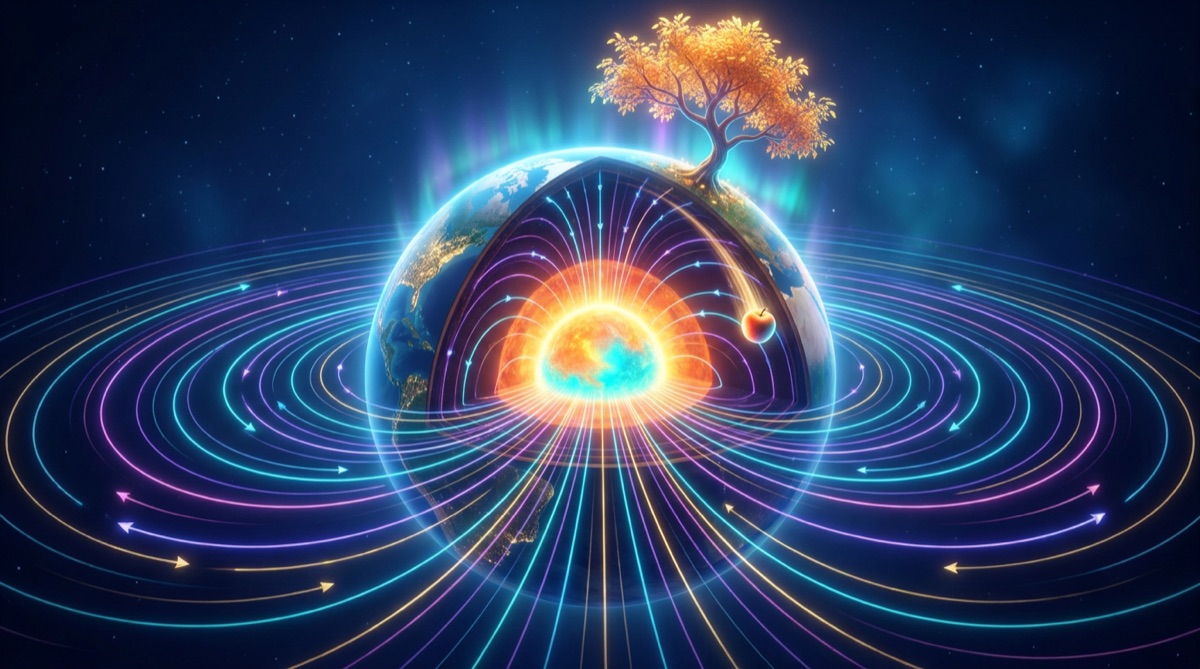
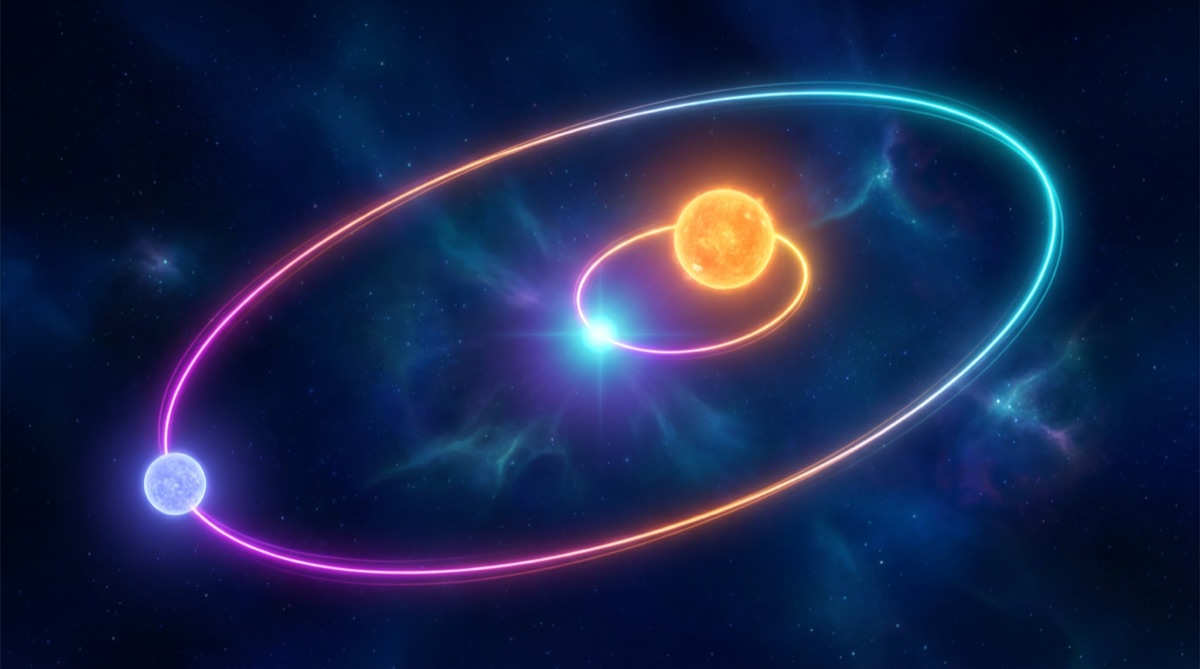
How much does the Sun weigh? Nobody can put it on a scale, and yet we know its mass to five significant figures. And that of a black hole 26 000 light-years away, which does not even emit light? That too. The trick is the same in both cases: watch something orbiting around it and time it. Kepler’s third law, once Newton supplied the constant, is the largest scale in the universe.
1. Newton’s scale
In the previous lesson we derived that, for a circular orbit of radius around a body of mass ,
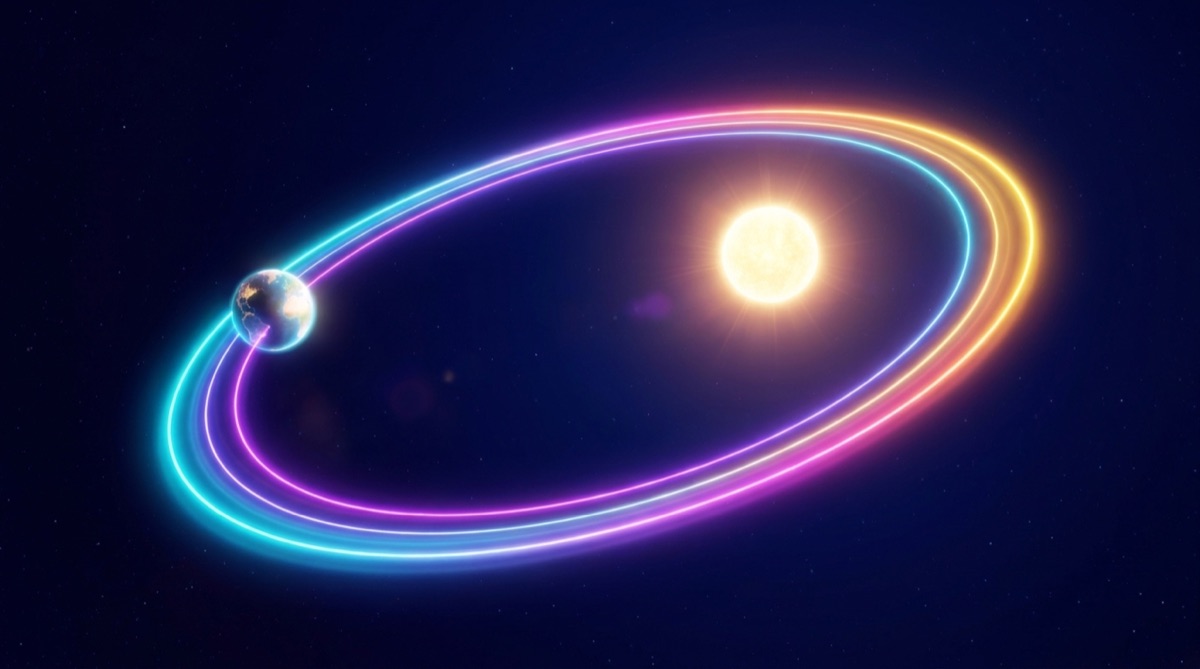
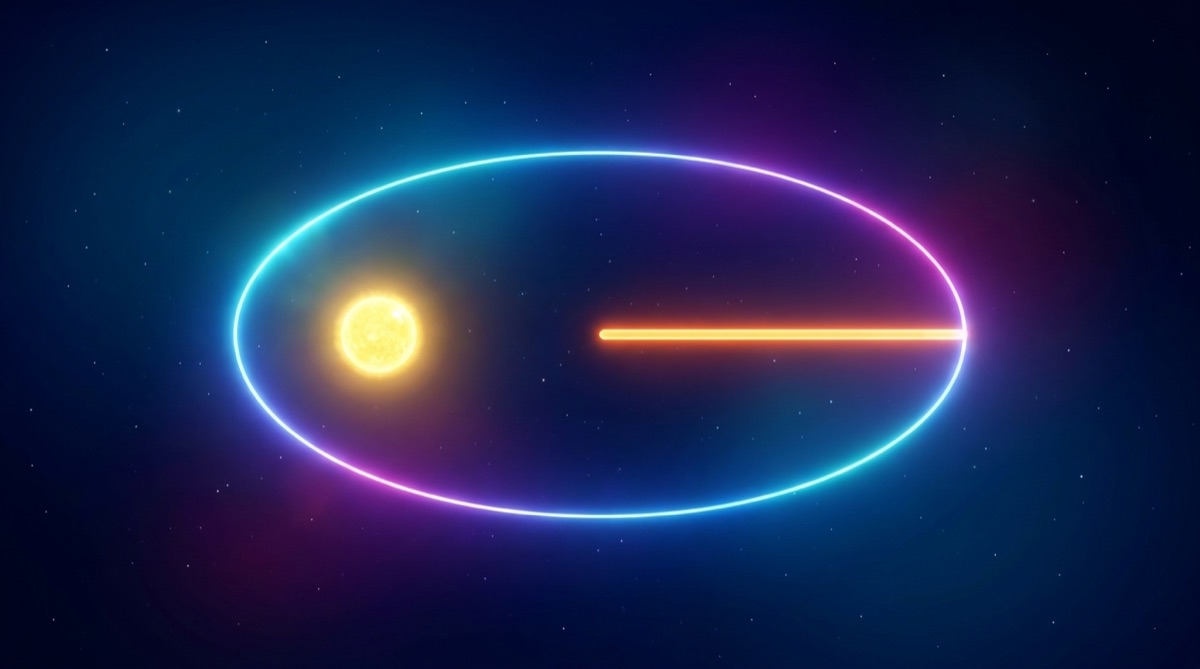
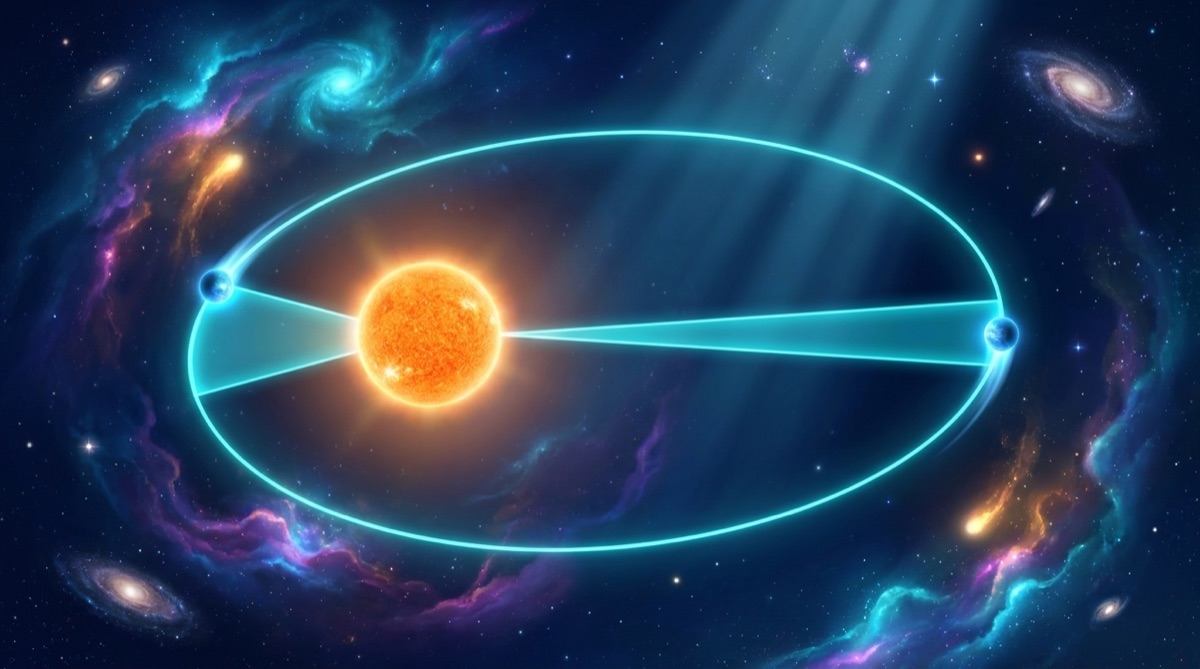
Newton showed that the formula also holds for elliptical orbits if the semi-major axis is used instead of . Solving for the mass:
where
- : mass of the central body (kg),
- : semi-major axis of the satellite’s orbit (m),
- : sidereal orbital period of the satellite (s),
- (CODATA 2018).
Two important observations:
- The mass of the satellite does not appear. A small body orbits the same way whether it is a stone or a spacecraft: that is why observing any satellite is enough to weigh the central body.
- What the orbit gives directly is the product , which is measured with enormous precision (ten significant figures for Earth). To separate you have to divide by , which is only known to five figures: the mass of the Sun in kilograms is less precise than . That is why astronomers almost always work with (the gravitational parameter).
Worked example 1: the mass of the Sun from Earth’s orbit
Semi-major axis m; sidereal period s.
The IAU nominal value is : agreement in the five figures we used. And
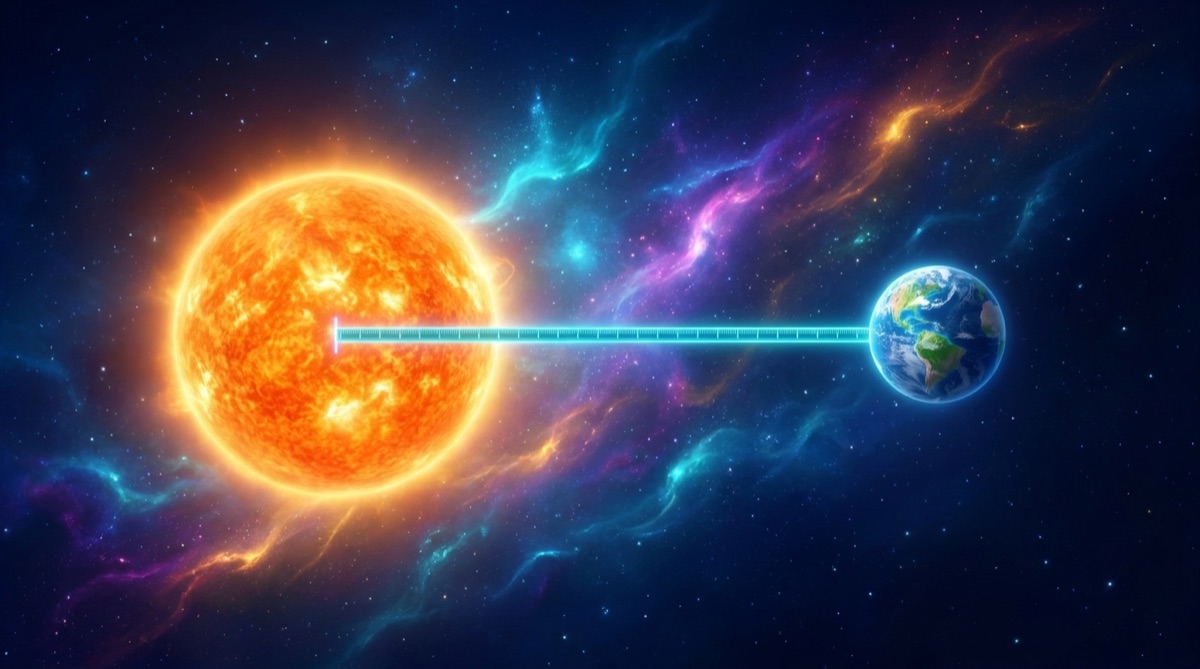
Two octillion metric tons, 333 000 times the mass of Earth, obtained with a calendar and a ruler (the Earth–Sun distance).
Worked example 2: the mass of Jupiter from Io
In 1610 Galileo discovered four moons orbiting Jupiter; the innermost, Io, takes d s to travel an orbit of semi-major axis km m.
versus the IAU nominal value (a 0.1 % difference, due to the rounding of ). The mass: kg, and the comparison with the Sun:
Jupiter has one thousandth of the Sun’s mass and 318 times that of Earth. Newton did exactly this calculation in the Principia (1687), with the data of his time, and obtained .
Worked example 3: the mass of Earth from the Moon (and a correction)
Moon: km m, d s.
But : we overshoot by 1 %. The reason is that the Moon is not “small”: it has 1/81 of Earth’s mass, and in reality Earth and the Moon both revolve around their common center of mass. Newton’s exact formula for two bodies is
with the distance between the two bodies. What we measure with the Moon is ; the difference is, approximately, ( according to NASA; the rest comes from using a rounded mean distance and from the pull of the Sun). For Earth and the Sun the correction is negligible: .
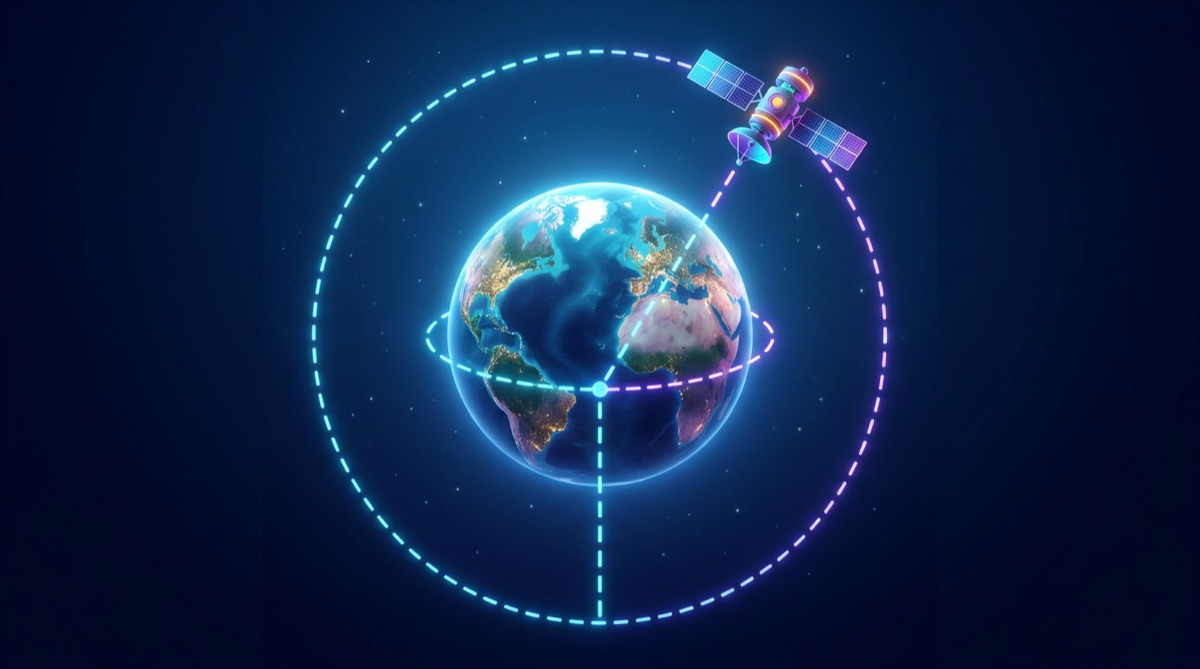
With an artificial satellite the correction disappears. A geostationary satellite ( km, s) gives : exact.
2. The astronomical form: solar masses, au and years
If we measure in au, in years and in solar masses, the constant equals exactly 1 (because Earth, with au and year, orbits a mass of ):
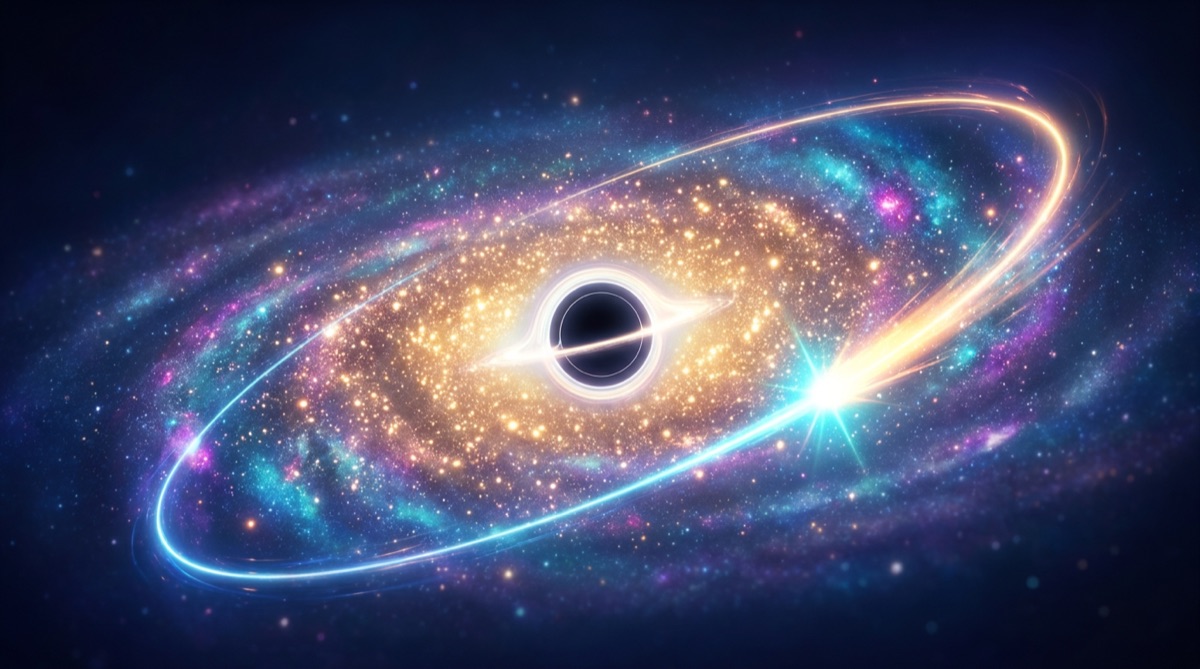
This is the form astronomers use for double stars (where is not negligible and one obtains the sum of the two masses) and for the center of the galaxy.
Worked example 4: weighing the black hole of the Milky Way
The star S2 orbits the object Sagittarius A*, at the center of the Milky Way. The GRAVITY instrument of the European Southern Observatory measured its orbit (2020): period years, angular semi-major axis milliarcseconds (mas), distance to the Galactic center pc.
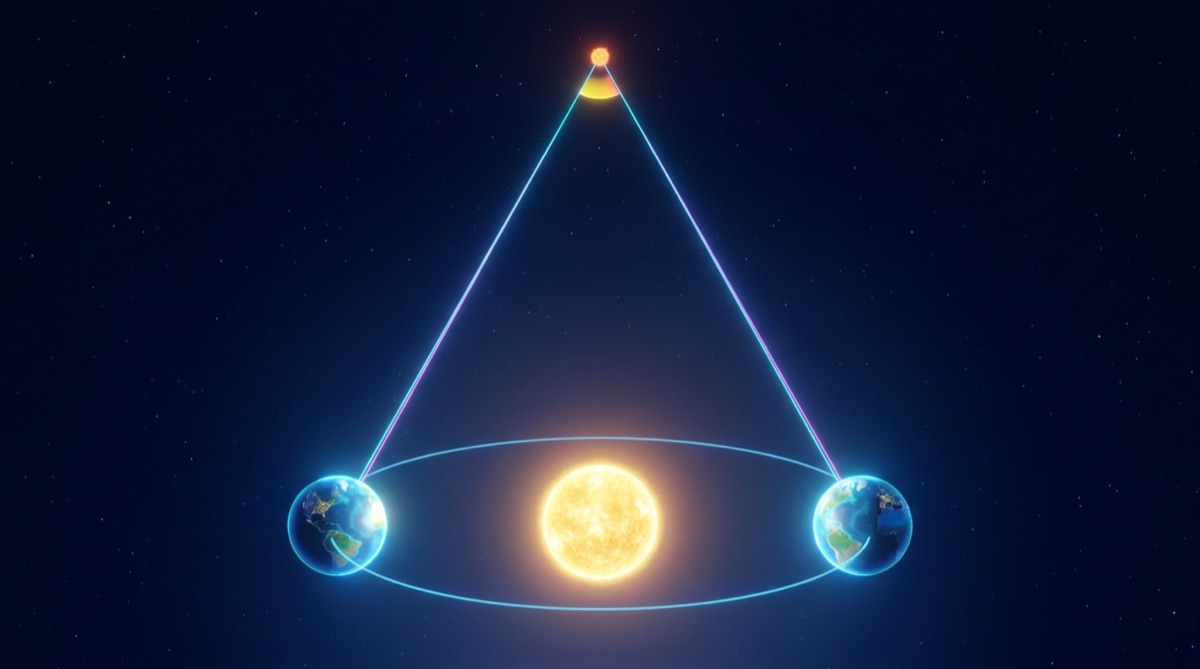
First the semi-major axis in au. By the definition of the parsec, an angle of at pc corresponds to au, so :
And the mass:
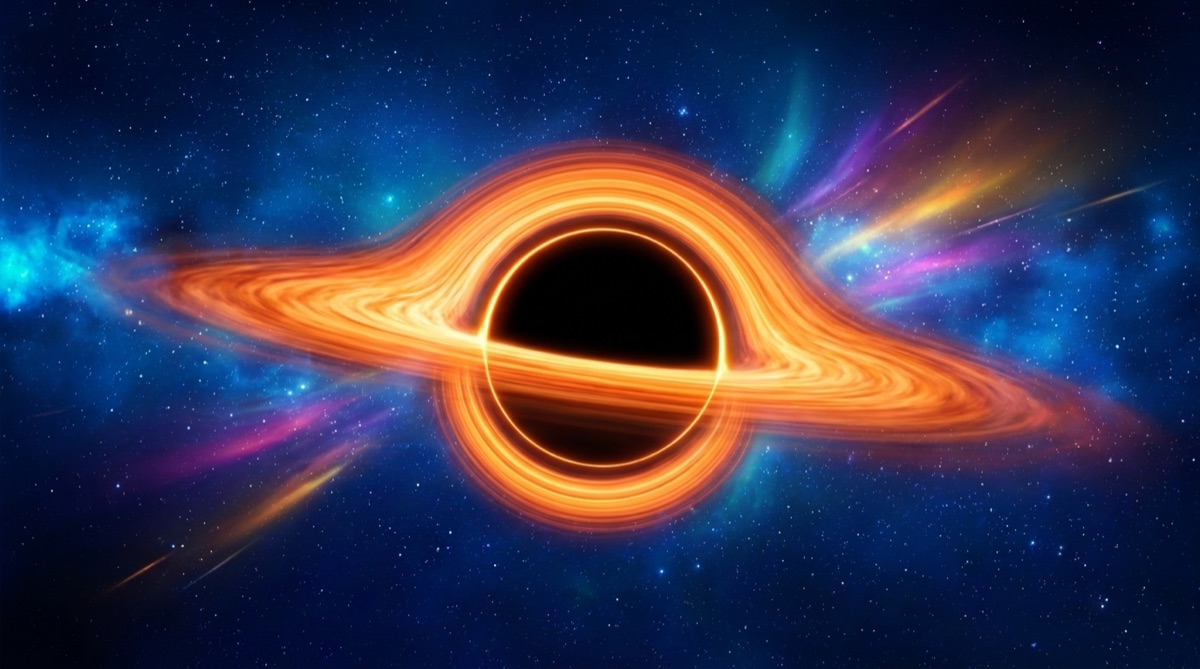
Four million suns in a region smaller than the orbit of Mercury… and one that emits no light. The mass of S2 (about 14 ) is negligible. The result published by GRAVITY is .
3. What about planets without moons?
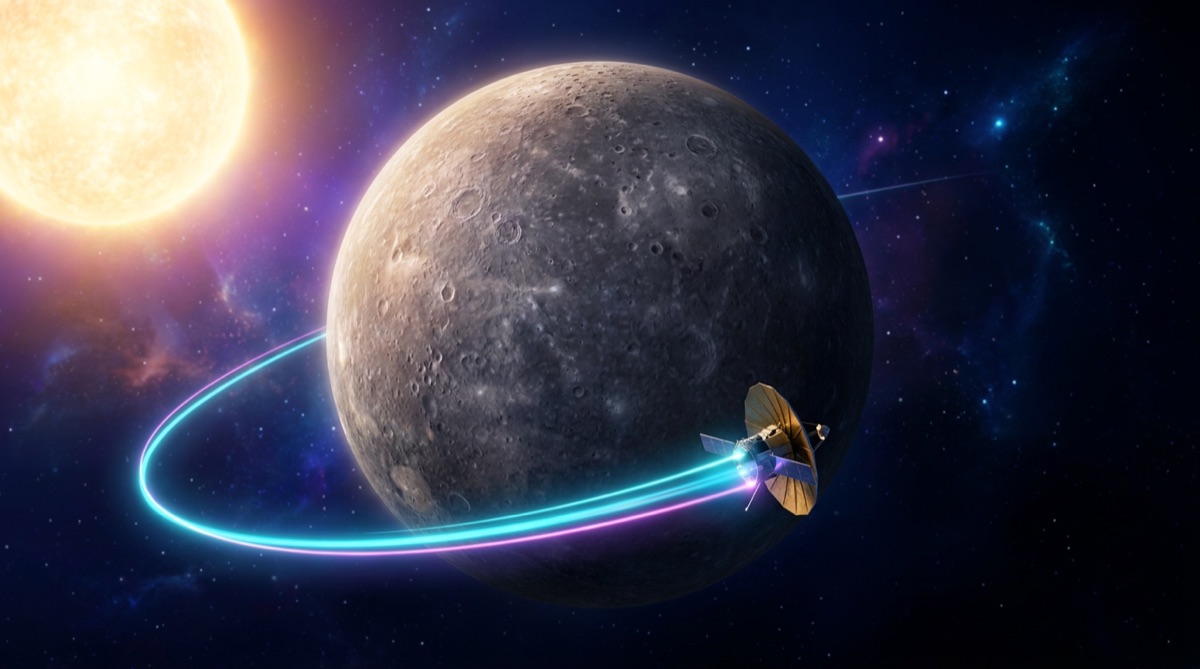
Mercury and Venus have no natural satellites, so for centuries their mass was the worst known in the Solar System (it could only be estimated from the perturbations they cause in neighboring orbits). Today they are weighed with probes: the trajectory of Mariner 10 and MESSENGER (Mercury) and of Magellan and Venus Express (Venus) is deflected by the gravity of the planet, and from that deflection one obtains . It is the same law: a body in free fall “measures” the mass that attracts it.
Simulator: a scale for the Sun
The simulator solves the exact orbit around the Sun with m³/s² and shows and in the lower panel.
- Set and au. Read (in years) and check that .
- Change to 5.20 au (Jupiter) and to 0.39 au (Mercury). Does still hold? That constancy is the proof that they all orbit the same mass.
- Set without changing : the period does not change. Only the semi-major axis determines , not the shape of the orbit. That is why the formula uses and not the instantaneous distance.
- Read in meters and in seconds for any orbit and compute on the calculator: it should give you .
Activity: Kepler’s constant with the eight planets
You need: a scientific calculator or spreadsheet, and this table (NASA Planetary Fact Sheet).
| Planet | (au) | (days) |
|---|---|---|
| Mercury | 0.38710 | 87.969 |
| Venus | 0.72333 | 224.701 |
| Earth | 1.00000 | 365.256 |
| Mars | 1.52371 | 686.980 |
| Jupiter | 5.20289 | 4332.59 |
| Saturn | 9.53668 | 10759.22 |
| Uranus | 19.18916 | 30685.4 |
| Neptune | 30.06992 | 60189 |
- Convert each period to years by dividing by 365.256 (sidereal year).
- Compute , and the ratio for each planet, to four decimal places.
- Compute the mean and the maximum deviation from 1.0000. Which planet deviates the most? Is it a measurement error or is there a physical reason? (Hint: the ratio gives in solar masses.)
- Convert Earth’s ratio to SI units: multiply by and divide by ; multiply by and obtain . Divide by and write to three figures.
- In the spreadsheet, plot against : the slope should be .
Final question: if Jupiter’s period were measured with a 1 % error, what error would its ratio have? And if the 1 % error were in ? Which of the two measurements is it more worthwhile to refine?
Exercises
Basic
- A satellite goes around Earth every 100 min at km. Compute and compare it with the nominal value.
Show solution
s. m³/s², 1 % above (the data in the statement are rounded).
- Mars: its moon Phobos orbits with km and d. Compute and the mass of Mars. NASA: m³/s².
Show solution
s. m³/s² (0.1 % error). kg, 10.7 % of Earth’s mass.
- Use the astronomical form to find the mass of a star around which a planet orbits at 2 au with a period of 2 years.
Show solution
.
Intermediate
- Europa ( km, d), Ganymede ( km, d) and Callisto ( km, d) orbit Jupiter. Compute with each one and comment on the spread.
Show solution
Europa: s, . Ganymede: s, . Callisto: s, . The four satellites (with Io, ) agree to three figures: four independent “scales” give the same weight, which confirms that they all orbit the same central mass under the same law.
- Saturn: Titan orbits with km and d. Compute the mass of Saturn and express it in Earth masses ( kg).
Show solution
s. m³/s². kg (NASA: kg).
- Solve the formula for and compute at what distance a satellite of Jupiter would have to orbit to take exactly one Earth day (86 400 s).
Show solution
m km, between Io (421 800 km) and the surface of Jupiter (71 500 km).
Challenge
- With the Moon’s orbit we obtained , but the exact value is . Compute what lunar period would be compatible with that value and km, and compare it with 27.3217 d. What do you attribute the difference of minutes to?
Show solution
s d, about 53 min less than 27.3217 d (0.13 %). The lunar orbit is not a pure Keplerian ellipse: the Sun perturbs it (its differential pull lengthens the period) and 384 400 km is a conventional mean. For the precision of a secondary-school textbook the agreement is excellent; for the precision of an astronomer, perturbation theory is needed.
- S2 has eccentricity . Compute its minimum and maximum distance to Sagittarius A* in au and in light-hours (1 au = 499 light-seconds). Would the Solar System (Neptune at 30 au) fit inside the orbit of S2?
Show solution
au light-hours; au light-hours light-days. The entire Solar System (30 au) fits four times inside the minimum distance from S2 to the black hole.
- Show that in the astronomical form the constant equals 1: start from in SI and substitute au, sidereal year s, and kg.
Show solution
kg . When is expressed in au, in years and in , all the conversion factors cancel and what remains is .
✦ Mini-quiz
Key takeaways
- : any satellite is a scale for the central body; the mass of the satellite plays no part (except in if it is not small).
- Orbits give with enormous precision; inherits the uncertainty of .
- Sun (with Earth): m³/s², kg. Jupiter (with Io): . Earth (with the Moon): , 1 % too high because of the lunar mass.
- In au, years and solar masses: . With S2: for the black hole of the Milky Way.
- Without moons (Mercury, Venus) a planet is weighed with the trajectory of probes.
🍎 Teacher guide
- Time
- 2 sessions of 55 min
- Colombian national standard (MEN)
- Natural Sciences, Grades 10 to 11, physical environment: “I relate mass, distance and the force of gravitational attraction between objects” and “I establish relations between the gravitational field model and the law of universal gravitation”; I approach knowledge as a natural scientist: “I use mathematics to model, analyze and present data and models in the form of equations, functions and conversions” and “I interpret results taking into account the order of magnitude of the experimental error”. Mathematics, Grades 10 to 11, numerical thinking: “I establish relations and differences between different notations of real numbers in order to decide on their use in a given situation”; metric thinking: “I solve and formulate problems involving quantities whose mean values are usually defined indirectly as ratios between values of other quantities, such as mean velocity, mean acceleration and mean density” and “I design strategies to tackle measurement situations that require specific degrees of precision”.
- Evidence of learning
- Solves the third law for M, computes GM and M of the Sun, Jupiter and Earth from real orbital data in SI units with scientific notation, explains the G(M + m) correction with the Moon, verifies a³/T² = 1 with the table of the eight planets and applies the astronomical form to weigh Sagittarius A* with the orbit of S2, propagating the errors of T and a.
Materials
- Scientific calculator (cube roots and scientific notation)
- Computer with a spreadsheet for the activity (one per group)
- Printed activity table
- Computer or tablet with the orbit simulator
Suggested sequence
Session 1. Newton’s scale (55 min). Opening: how do you weigh what you cannot touch? (5 min). Development: solving for , worked examples 1 and 2 on the board with a calculator, discussion of versus (25 min); simulator, steps 1–4 (10 min). Closing: exercises 1 and 2 (15 min).
Session 2. From the Moon to the black hole (55 min). Opening: example 3 and the correction (10 min). Development: astronomical form and example 4 (S2), with emphasis on the conversion of mas and pc to au (15 min); activity with the planet table in groups on a spreadsheet (20 min). Closing: mini-quiz (10 min). Challenges 7–9 can be left as homework for the group that finishes first.
Common mistakes
- Using the altitude of the satellite instead of the semi-major axis, or km instead of m. Require conversion to SI and check the order of magnitude against the nominal value.
- Believing that a more massive satellite orbits differently. Show the cancellation of m in v²/r = GM/r² and the constancy of a³/T² for the four moons of Jupiter.
- Confusing G with GM. Insist that the orbit measures the product and that G is measured in the laboratory.
- Forgetting that T must be the sidereal period (with respect to the stars) and not the synodic one. Refer back to the lesson on phases and eclipses.
- Adding relative errors without taking the exponents into account: the error of a³ is three times that of a and that of T² is twice that of T.