Glossary / T / Orbits and gravitation
Two-body problem
Also: two bodies · two-body · Kepler problem
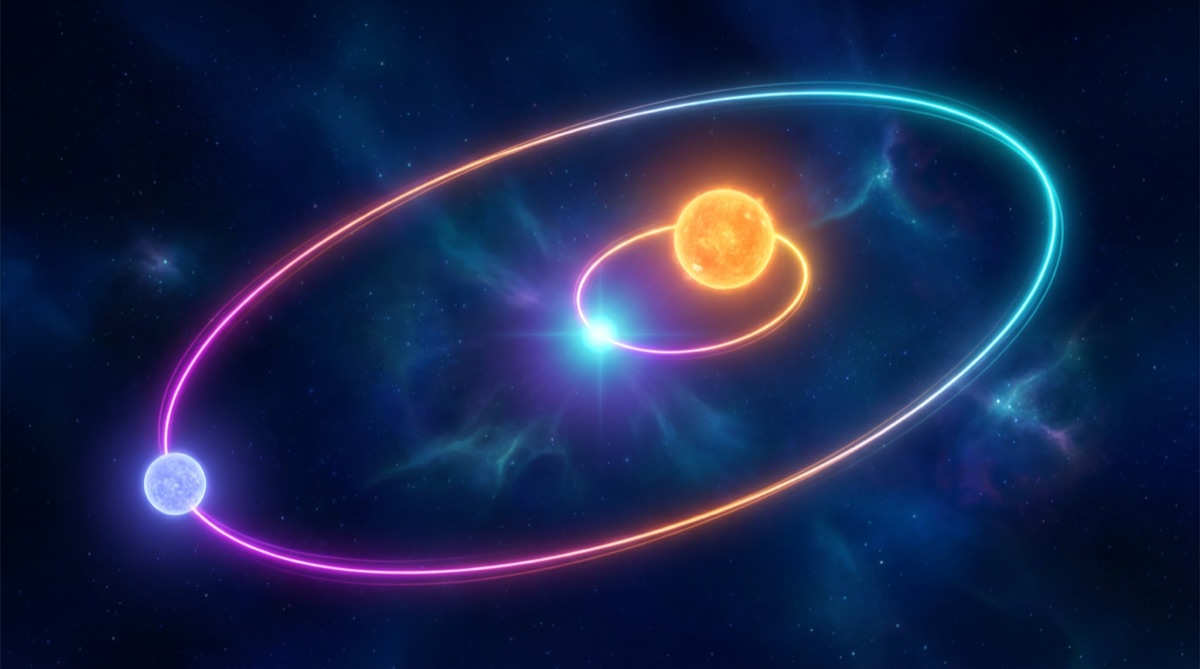
Working out how two bodies move when they attract only each other, like the Sun and a planet. It has an exact solution: Kepler's ellipses. With three bodies there is no longer a closed formula.
Going further
It reduces to a body of reduced mass in the potential , . Integrals: energy , angular momentum and the Laplace–Runge–Lenz vector (eccentricity).
Where it is explained: The two-body problem Higher Education
Related terms
Used in these lessons
- The two-body problem Higher Education 7 mentions
- Perturbation theory and the oblateness of the Earth Higher Education 6 mentions
- Symplectic integrators and chaos in the N-body problem Higher Education 5 mentions
- Orbital elements and state ↔ elements conversion Higher Education 5 mentions
- Collisionless Boltzmann equation, Jeans equations and the virial theorem Higher Education 4 mentions
- Kepler's equation and its numerical solution Higher Education 4 mentions
- Runge–Kutta and adaptive step size Higher Education 3 mentions
- Weighing the Sun and the planets Secondary Education 2 mentions
- The radial-velocity method Higher Education 2 mentions
- Large-scale N-body and the Barnes–Hut tree Higher Education 2 mentions
- Hohmann transfers and gravity assists Higher Education 2 mentions
- Simulating an orbit with the Euler method Secondary Education 1 mention
- Universal gravitation and satellites Secondary Education 1 mention
- Stellar nucleosynthesis and solar neutrinos Higher Education 1 mention
- Resonances and chaos Higher Education 1 mention
- The precession of Mercury's perihelion Higher Education 1 mention